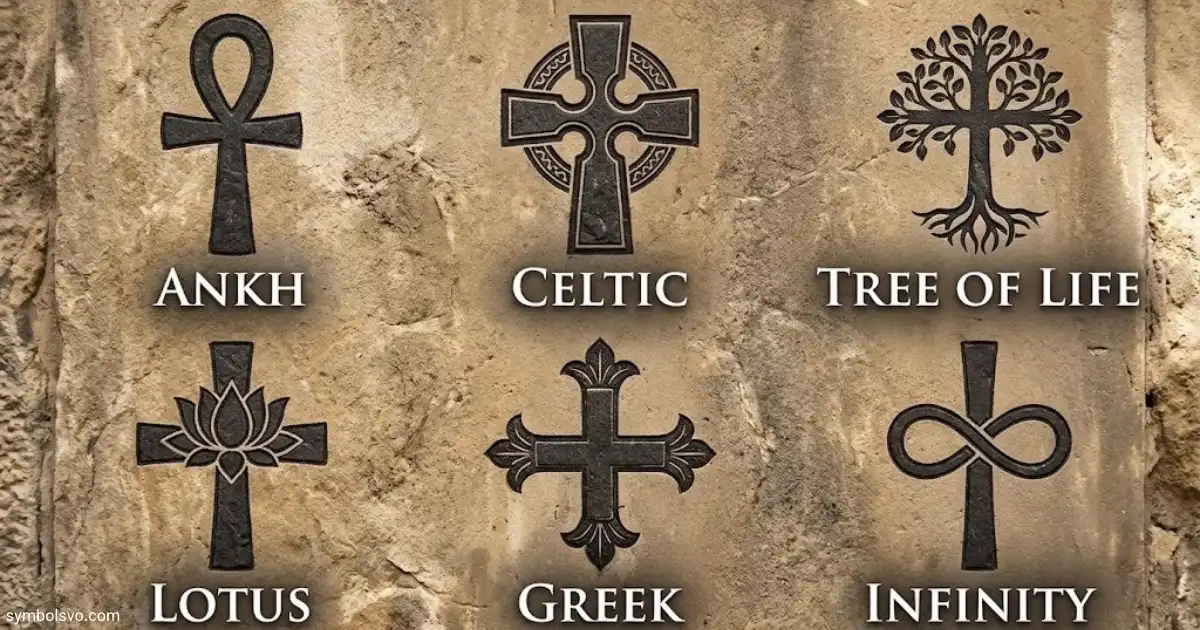
Cross symbols appear in churches, ancient monuments, national flags, jewelry, coats of arms, and religious artwork. Although many people associate the cross with Christianity, its history reaches across different cultures, artistic traditions, and belief systems.
Some crosses represent faith, sacrifice, salvation, and resurrection. Others identify a religious community, commemorate a historical event, or represent a country’s heritage. Their meanings depend on their shapes, origins, and cultural settings.
Understanding these differences helps you recognize familiar designs and interpret less common symbols accurately. A Latin cross, for example, differs from an Orthodox cross in its structure, while an Egyptian ankh has a distinct history connected with life.
This guide explores more than 60 cross symbols and meanings, including Christian crosses, early Christian monograms, saint-associated designs, heraldic crosses, regional variations, and non-Christian symbols. You’ll also learn how to identify different cross shapes and distinguish designs that look similar but carry different associations.
What Do Cross Symbols Mean?
The meaning of a cross depends on the tradition that uses it. The same basic geometry can represent different ideas in different historical and cultural settings.
In Christianity, the cross primarily recalls the crucifixion of Jesus Christ. Christians also associate it with redemption, salvation, sacrifice, hope, and the resurrection. Over centuries, different churches developed distinctive cross designs to express particular theological beliefs and cultural traditions.
Outside Christianity, cross-shaped symbols have other histories. The ancient Egyptian ankh, for instance, represents life in Egyptian religious imagery. The swastika has long-standing religious associations in Hinduism, Buddhism, and Jainism, although its later appropriation by Nazi Germany created a deeply harmful association in that context.
Common meanings associated with particular cross symbols include:
- Faith and devotion: The Latin cross and crucifix are prominent examples in Christian traditions.
- Hope and perseverance: Christian interpretations of the anchor symbol connect it with steadfast hope.
- Sacrifice and salvation: The cross recalls the crucifixion of Jesus and its theological significance.
- Resurrection and eternal life: Some Christian cross designs emphasize Christ’s victory over death.
- Religious authority: Papal, patriarchal, and other institutional crosses can identify particular offices or traditions.
- Cultural heritage: Celtic, Armenian, Ethiopian, and other regional designs reflect distinctive histories.
- Life and renewal: The Egyptian ankh is associated with life and divine vitality.
- Identity and allegiance: Crosses also appear in national flags, military insignia, heraldry, and organizational emblems.
These associations aren’t universal rules. A cross’s appearance alone rarely reveals its complete meaning. Its historical setting and the people who use it matter just as much.
How to Identify Different Types of Crosses
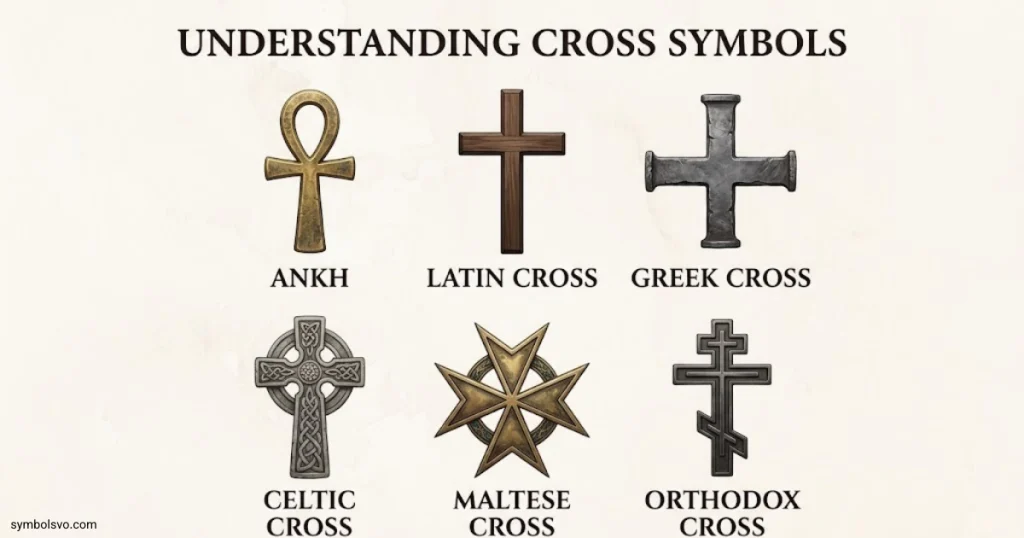
Before exploring individual designs, learn to recognize their basic shapes. This makes it easier to distinguish similar symbols and understand their origins.
Latin Cross
The Latin cross has a long vertical shaft with a shorter horizontal bar positioned above its midpoint. Its lower arm extends farther than its upper arm.
This familiar design represents Christianity and the crucifixion of Jesus. It appears in church architecture, religious jewelry, memorials, and Christian artwork.
Greek Cross
The Greek cross has four arms of approximately equal length. It appears in Byzantine art, Christian architecture, and several Eastern Christian traditions.
Its balanced proportions distinguish it from the Latin cross.
Tau Cross
The Tau cross resembles the capital letter T. Its horizontal bar sits at the top of the vertical shaft.
The design appears in Christian symbolism and is associated with St. Anthony in particular traditions.
Saltire
A saltire is an X-shaped cross. It appears in heraldry and national flags, including Scotland’s flag, where a white saltire crosses a blue field.
The term describes the shape rather than one universal religious meaning.
Orthodox Cross
The familiar Orthodox cross often has three horizontal bars. The upper bar represents the inscription associated with Jesus, while the lower bar represents the footrest in common interpretations.
The lower bar often slopes in Russian Orthodox representations. Specific designs and interpretations vary across Eastern Christian traditions.
Ankh
The ankh resembles a cross with a loop above its horizontal bar. It originated in ancient Egyptian religious imagery and is associated with life.
Although its shape resembles a cross, its historical origin and symbolism differ from those of the Christian cross.
Other Visual Features
Additional details can help identify more specialized designs:
- Flared arms: The ends widen toward their tips, as in some Pattée crosses.
- Rounded terminals: The arms end in rounded or ball-like shapes.
- Surrounding circle: A ring around the intersection is a distinctive feature of many Celtic crosses.
- Multiple bars: Two or three horizontal bars appear in several ecclesiastical designs.
- Stepped base: A cross standing on steps may represent Calvary.
- Smaller surrounding crosses: Four smaller crosses identify the familiar Jerusalem Cross.
- Looped or woven construction: The ankh and St. Brigid’s Cross have distinctive forms and materials.
When identifying an unfamiliar symbol, consider its proportions, decorative features, geographic setting, and documented use. A photograph of the object or its location can provide valuable clues.
Types of Christian Crosses and Their Meanings
Christianity uses many cross designs. Some emphasize the crucifixion, while others identify particular churches, historical traditions, saints, or religious institutions.
Latin Cross
The Latin Cross is one of the most widely recognized Christian cross symbols. Its longer lower arm distinguishes it from the equal-armed Greek cross.
Christians associate the design with Jesus’ crucifixion, redemption, and salvation. It appears on church buildings, gravestones, pendants, paintings, and memorials.
The Latin term crux immissa refers to this form of cross. Historical Christian art uses both Latin and Greek crosses, although their proportions differ.
Greek Cross
The Greek Cross has four arms of approximately equal length. It became important in Byzantine Christian art and appears in religious decoration, church plans, and various ecclesiastical designs.
The Greek cross is also associated with the broader history of Eastern Christianity. However, it isn’t exclusive to one denomination or region.
Its equal arms make it particularly easy to distinguish from the Latin cross.
Orthodox Cross
The Orthodox Cross is especially recognizable in its three-bar form. It appears in Russian Orthodox and other Eastern Christian settings, although designs vary between churches.
The upper bar represents the inscription placed above Jesus in traditional depictions. The middle bar represents the principal crossbeam, while the lower bar represents the footrest.
In many Russian Orthodox representations, the footrest slopes upward on one side and downward on the other. Traditional explanations connect this feature with the two criminals crucified alongside Jesus.
The details and interpretations can vary, so not every Orthodox cross should be read identically.
Crucifix
A crucifix is a cross bearing a representation of Jesus’ crucified body. This distinguishes it from an empty cross.
Crucifixes are especially prominent in Catholic worship and devotional art. They emphasize Christ’s suffering and sacrifice, while an empty cross can emphasize the crucifixion’s theological significance without depicting his body.
Different Christian communities use crucifixes in different ways. Some traditions favor them in worship, while others more commonly display an empty cross.
Tau Cross
The Tau Cross, also called St. Anthony’s Cross in certain Christian contexts, has a T-shaped design.
Its name comes from the Greek letter tau. The symbol appears in Christian devotional traditions and has associations with St. Anthony and the Franciscan tradition.
Because its upper arms meet at the top of the vertical shaft, it differs from the conventional Latin cross.
Patriarchal Cross
The Patriarchal Cross typically has two horizontal bars. The shorter upper bar sits above the main crossbeam.
The design appears in ecclesiastical insignia, heraldry, and historical religious emblems. Its exact significance depends on the institution and setting in which it appears.
Although it resembles the Cross of Lorraine, the two aren’t automatically interchangeable. Their historical uses and specific designs can differ.
Papal Cross
The Papal Cross traditionally features three horizontal bars on a vertical shaft. It is associated with representations of papal office and authority.
The three-bar arrangement distinguishes it from the two-bar Patriarchal Cross and the three-bar Orthodox Cross, whose designs and contexts differ.
A papal cross should also be distinguished from the crossed keys associated with St. Peter and the papacy. The two symbols can appear in related institutional settings, but they aren’t the same emblem.
Jerusalem Cross
The Jerusalem Cross consists of a central cross surrounded by four smaller crosses. It is associated with the medieval Kingdom of Jerusalem and later Christian heraldic traditions.
Some Christian interpretations connect the five crosses with Christ and the spread of the Gospel. Other explanations emphasize the relationship between the central cross and the four smaller ones.
The design appears in religious insignia, historical emblems, and Christian decorative objects. Its recognizable arrangement makes it one of the easiest specialized crosses to identify.
Calvary Cross
The Calvary Cross stands on a stepped base, often with three steps. The base represents Calvary, traditionally identified as the site of Jesus’ crucifixion.
The stepped structure distinguishes it from a simple Latin cross. It may appear in religious artwork, memorials, and heraldic designs.
The term also connects the symbol with Christian reflections on the crucifixion and salvation.
Anchor Cross
The Anchor Cross combines features of a cross and an anchor. In Christian symbolism, the anchor is associated with hope and steadfastness.
This connection makes the design a fitting expression of faith during uncertainty or hardship. Early Christians also used anchor imagery in symbolic and decorative contexts.
However, not every anchor-shaped cross has the same origin. Its interpretation depends on the specific design and the context in which it appears.
Resurrection Cross
A Resurrection Cross is a broad label for Christian cross designs that emphasize the resurrection of Jesus.
Some versions show a cross with a banner, while others incorporate imagery associated with Christ’s victory over death. There isn’t one universal design shared by every Christian tradition.
The central theme is the relationship between the crucifixion and the resurrection in Christian belief.
Passion Cross
The Passion Cross refers to designs associated with the Passion of Christ, including his suffering and crucifixion.
Some representations incorporate instruments of the Passion, such as nails, a spear, or a crown of thorns. These details refer to episodes in the Christian account of Jesus’ final hours.
The exact form varies across religious artwork and devotional traditions.
Marian Cross
A Marian Cross is associated with Mary, the mother of Jesus, and particular forms of Marian devotion.
The term can refer to specific religious emblems or cross designs used in Marian contexts. It doesn’t identify one universally standardized shape.
When interpreting a Marian cross, look for its documented institutional or devotional use rather than assuming that every version carries the same meaning.
Cross of Lorraine
The Cross of Lorraine has two horizontal bars, usually with a shorter upper bar. It has appeared in European heraldry and historical insignia.
The symbol became particularly prominent in twentieth-century French resistance imagery, where it was associated with opposition to Nazi Germany and the Free French movement.
Although it resembles the Patriarchal Cross, the Cross of Lorraine has its own historical associations.
Canterbury Cross
The Canterbury Cross is associated with Anglican Christian identity and ecclesiastical symbolism.
Its recognizable design includes a circular form and decorative intersecting arms. It appears in religious objects and organizational emblems connected with Anglican traditions.
The name identifies a particular Christian emblem rather than every cross used in Canterbury.
Cross of Camargue
The Cross of Camargue is associated with the Camargue region of southern France. Its design combines three elements: a cross, an anchor, and a heart.
These elements are commonly interpreted through the Christian virtues of faith, hope, and charity. The cross represents faith, the anchor represents hope, and the heart represents charity.
The regional context is important because the design functions as a cultural emblem as well as a religious symbol.
Sacred Heart Cross Imagery
The Sacred Heart is a Christian devotional image associated with Jesus’ love and sacrifice. It often appears with a heart surrounded by a crown of thorns or topped by a cross.
When combined with a cross, the imagery connects Christ’s crucifixion with divine love and redemption. The Sacred Heart itself isn’t a single standardized cross type.
Early Christian Cross Symbols and Monograms
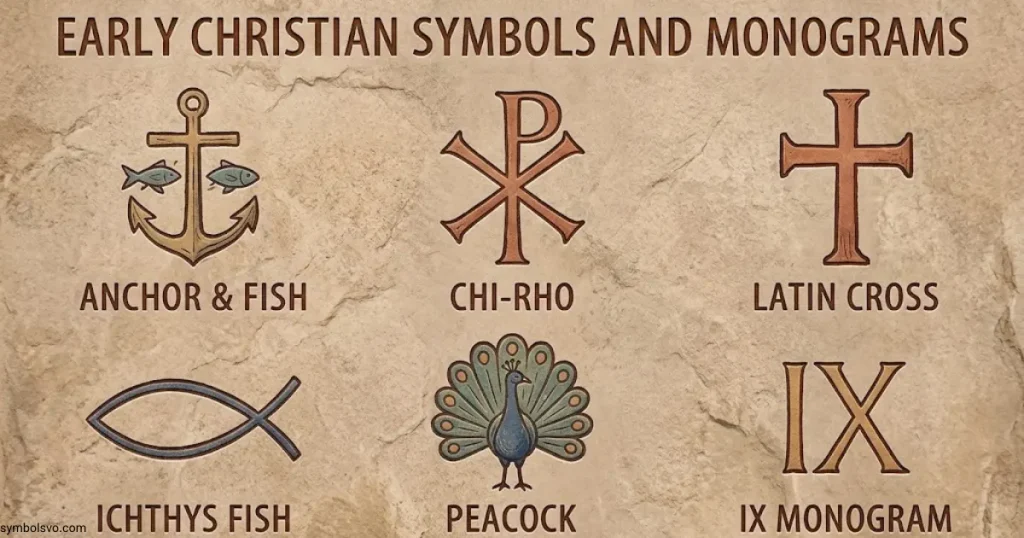
Some early Christian symbols combine cross-like forms with letters. These designs helped communicate Christian identity and beliefs through visual signs.
Chi-Rho
The Chi-Rho combines two Greek letters: chi (Χ) and rho (Ρ). Both appear in the Greek word Christos, meaning Christ.
The symbol became especially prominent during the reign of Constantine the Great. It appeared on imperial standards and later Christian artwork, including coins, inscriptions, and religious objects.
Constantine’s association with the Chi-Rho is an important part of its history. However, the symbol existed before his reign, so it shouldn’t be described as a design he invented.
The Chi-Rho differs from a conventional cross because its central feature is a monogram formed from Greek letters.
Staurogram
The Staurogram combines the Greek letters tau (Τ) and rho (Ρ). Early Christian manuscripts used the combination in words related to the cross and crucifixion.
Some scholars interpret the staurogram as an early visual reference to Jesus’ crucifixion. Its significance lies in the way written language and religious imagery came together in early Christian texts.
The design is especially relevant to research on the development of early Christian crucifixion imagery.
Iota-Chi Cross
The Iota-Chi Cross combines the Greek letters iota (Ι) and chi (Χ). These letters can refer to the name of Jesus in early Christian monograms.
Its letter-based structure distinguishes it from the Chi-Rho, which combines chi and rho. Historical examples and interpretations should be checked carefully because related monograms can look similar.
Cross of Constantine
The Cross of Constantine is commonly discussed alongside the Chi-Rho because of the symbol’s association with Constantine the Great.
Traditional accounts connect Constantine with a vision before the Battle of the Milvian Bridge in 312 CE. The historical details and later interpretations of this account require careful treatment.
The key point is that the Chi-Rho became strongly associated with Constantine and imperial Christianity. The symbol’s history began earlier than his reign.
Early Coptic Cross
The Coptic Cross represents Christian traditions associated with Egypt. Coptic art developed distinctive forms of crosses, combining Christian imagery with regional artistic practices.
Some Coptic designs use elaborate arms and geometric decoration. Others incorporate forms influenced by older Egyptian visual traditions.
The ankh also became part of Christian Egyptian imagery in certain contexts. This history illustrates how symbols can acquire new meanings when communities adopt and reinterpret familiar forms.
Byzantine Cross
The Byzantine Cross describes cross imagery associated with Byzantine Christian art and culture rather than one universally fixed design.
Crosses appeared in mosaics, manuscripts, church architecture, and ceremonial objects. Artists used different proportions, decorative details, and inscriptions according to the setting.
The term is therefore best understood as a historical and artistic category.
Crosses Associated With Christian Saints
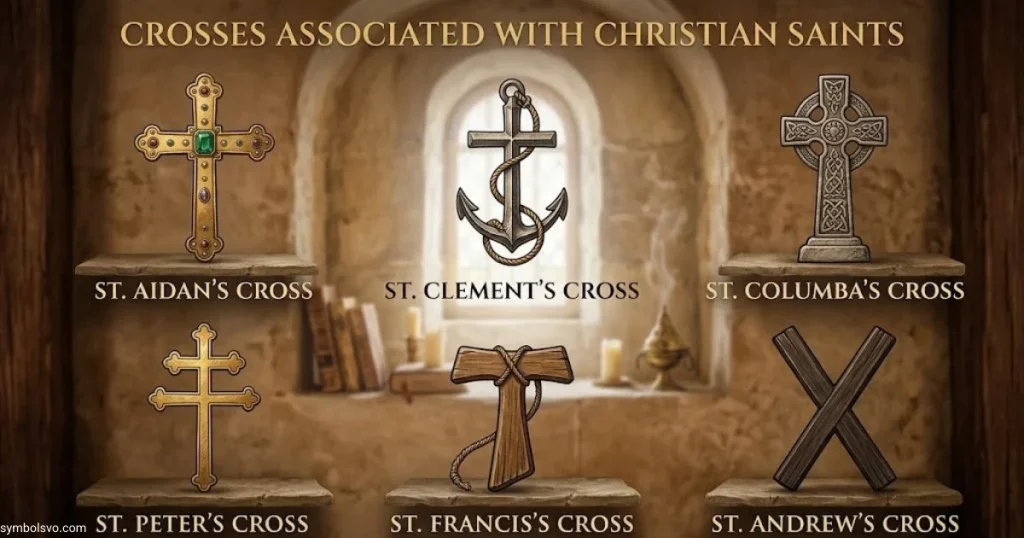
Several crosses take their names from saints or from traditions surrounding their lives and martyrdom. These associations are often rooted in religious tradition rather than independently verified details about every historical event.
St. Peter’s Cross
St. Peter’s Cross is an inverted Latin cross associated with the tradition that Peter requested a different form of crucifixion because he considered himself unworthy to die in the same manner as Jesus.
Within Christian tradition, the inverted cross can therefore represent humility and devotion. Its meaning changes in other contexts, where artists or popular culture may use it to communicate opposition to Christianity.
An inverted cross isn’t automatically an anti-Christian symbol. Its historical and visual context matters.
St. Andrew’s Cross
St. Andrew’s Cross is an X-shaped cross, also known as a saltire. Christian tradition associates it with the martyrdom of St. Andrew.
The design is especially familiar from Scotland’s national flag, which displays a white saltire on a blue field. It also appears in heraldry and other national or regional emblems.
St. George’s Cross
St. George’s Cross is commonly represented as a red cross on a white field. It is associated with St. George and English heraldic tradition.
The design appears in England’s flag and in numerous historical and civic contexts. Its modern uses can express national identity as well as religious or historical associations.
St. Brigid’s Cross
St. Brigid’s Cross is traditionally woven from rushes or similar plant materials. Its distinctive woven structure sets it apart from metal or stone crosses.
The symbol belongs to Irish Christian and cultural traditions and is associated with St. Brigid’s feast day. Families and communities have traditionally made and displayed these crosses as part of local customs.
St. Thomas Cross
The St. Thomas Cross is associated with St. Thomas Christian communities in India, particularly communities in Kerala.
These crosses reflect the long history of Christianity in the region. Some forms include inscriptions and decorative features that distinguish them from more familiar Western crosses.
Their significance is closely tied to the religious heritage and identity of the communities that use them.
St. James Cross
The St. James Cross is associated with St. James and the Order of Santiago, a historical religious and military order in Iberia.
Its design appears in Spanish and Portuguese heraldic traditions. The exact form should be identified from the specific emblem because cross designs associated with saints and orders can vary.
St. Anthony’s Cross
St. Anthony’s Cross commonly refers to the Tau cross. Its T-shaped form connects it with the Greek letter tau and with Christian traditions surrounding St. Anthony.
The design also appears in religious contexts connected with the Franciscan tradition. Its meaning depends on the specific devotional or institutional setting.
Other Saint-Associated Crosses
Other names include St. Philip’s Cross and St. Clement’s Cross. These labels can refer to traditions about saints’ martyrdoms or to particular devotional depictions.
For accurate identification, consult historical or ecclesiastical sources for the exact form. Avoid assuming that every saint-associated cross has a universally standardized design.
Heraldic Crosses and Medieval Cross Designs
Heraldic crosses use specific shapes and decorative features to distinguish coats of arms, institutional insignia, and historical emblems. Their terminology often describes the design rather than assigning it a universal spiritual meaning.
Cross Pattée
The Cross Pattée has arms that broaden toward their outer ends. It appears in heraldry and in several historical and institutional emblems.
The design is often associated with medieval imagery, although its later uses extend well beyond the Middle Ages. A flared cross isn’t automatically a Templar emblem; its actual context must be established.
Maltese Cross
The Maltese Cross has four arms that broaden outward and form eight points. It is closely associated with the Order of St. John and later organizations connected with that tradition.
The design also appears in civic, emergency-service, and institutional insignia. Its use in these settings doesn’t mean every Maltese cross has a direct connection to the historical order.
Cross Fleury
The Cross Fleury has arms ending in fleur-de-lis-like forms. The decorative ends distinguish it from a plain cross and other heraldic designs.
It appears in coats of arms and religious heraldry. Its interpretation depends on the particular emblem in which it appears.
Cross Bottony
The Cross Bottony has arms ending in trefoil-like shapes. These rounded, three-lobed terminals provide a useful visual clue.
It is a heraldic design rather than a symbol with one universally agreed religious meaning.
Cross Moline
The Cross Moline has arms resembling the ends of a millrind, a component associated with a millstone. Its forked terminals distinguish it from many other crosses.
The term describes its heraldic form. Any additional meaning depends on the specific coat of arms or institution.
Cross Potent
The Cross Potent has arms ending in T-shaped forms. It is recognized in heraldry and appears in historical designs associated with the broader tradition of the Jerusalem Cross.
Its name describes the shape of the arms rather than a universal symbolic message.
Cross Pommée
The Cross Pommée has rounded or ball-like terminals. The rounded ends distinguish it from designs with trefoil or fleur-de-lis terminals.
As with other heraldic crosses, its use and significance depend on the emblem’s historical context.
Cross Fitchy
The Cross Fitchy has one arm, often the lower arm, ending in a point. This pointed feature distinguishes it from a standard cross.
The term is used in heraldic descriptions. Its presence alone doesn’t establish an association with a particular religious order.
Cross Voided
A Voided Cross has an open interior, leaving an outline rather than a solid shape. The term describes how the design is constructed.
A voided cross may appear in heraldry, decorative art, or institutional emblems. Its symbolic meaning depends on the context rather than the open center alone.
Cross Raguly
The Cross Raguly has irregular, jagged edges resembling cut branches. The uneven arms distinguish it from smooth-sided heraldic crosses.
Its name describes its outline. It shouldn’t automatically be interpreted as a symbol of suffering or hardship without evidence from the specific context.
Cross Patonce
The Cross Patonce has arms that flare into decorative, often leaf-like ends. It resembles other flared crosses, so the details of its terminals matter.
Heraldic references help distinguish it from the Cross Fleury and other related forms.
Cross Crosslet
The Cross Crosslet features smaller crossbars near the ends of its arms. These additional bars make the design more complex than a plain cross.
It appears in heraldry and institutional emblems. Its exact interpretation depends on the coat of arms or historical object where it appears.
Gothic Cross
A Gothic Cross is a broad label for cross designs associated with Gothic art or modern Gothic aesthetics. Pointed shapes, elongated proportions, and ornate details may appear in these designs.
Unlike the Greek or Latin cross, the term doesn’t identify one universally standardized shape. Modern decorative use can differ considerably from historical religious examples.
Pisan Cross
The Pisan Cross is associated with Pisa and its civic and heraldic history. Recognized versions use a distinctive arrangement of smaller forms around a central cross.
Because related designs can vary, identify the particular historical emblem before assigning a precise meaning.
Order of Christ Cross
The Order of Christ Cross is associated with the Portuguese Order of Christ and its historical role in Portugal.
The cross appears in Portuguese heraldic and institutional settings. Its association with the order distinguishes it from other red cross designs that may have superficially similar forms.
Templar Cross
The Templar Cross refers to cross designs associated with the Knights Templar in historical and modern representations.
Several cross forms have been linked with the order, so color or shape alone isn’t enough to establish a Templar connection. Historical records and institutional context provide stronger evidence.
Regional and Cultural Christian Crosses
Cross designs also reflect the history of local churches, communities, and artistic traditions. Regional examples often carry cultural significance beyond their basic geometry.
Celtic Cross
The Celtic Cross typically combines a cross with a ring around its intersection. It is closely associated with medieval stone crosses and Christian art in Ireland and other Celtic-influenced regions.
Historic high crosses often include carved biblical scenes, geometric patterns, and interlaced decoration. Modern Celtic crosses may simplify these features or use them in jewelry and memorials.
The design has become a widely recognized symbol of Celtic heritage, although modern interpretations don’t always match the meanings of particular historical monuments.
Armenian Cross and Khachkar
Armenian Christian art includes distinctive crosses carved into stone, churches, and monuments. A khachkar is a carved Armenian cross-stone monument, often decorated with intricate patterns.
These monuments reflect Armenian Christian heritage and a long tradition of religious stone carving. Their ornamentation may include branching forms, leaves, rosettes, and geometric details.
A khachkar is more than a decorative cross. It belongs to a particular cultural and artistic tradition.
Ethiopian Cross
Ethiopian crosses are known for elaborate geometric patterns and intricate metalwork. They appear in Ethiopian Orthodox Christian traditions, including ceremonial and devotional objects.
Different designs vary by region, workshop, and intended use. Some are made for processions or worship, while others serve as personal devotional objects.
Their complex latticework distinguishes many Ethiopian examples from simpler Latin crosses.
Scandinavian or Nordic Cross
The Nordic Cross is an off-center cross used in the flags of Denmark, Sweden, Norway, Finland, and Iceland.
Its horizontal bar sits closer to the flagpole side than the outer edge. The design is strongly associated with Scandinavian and Nordic national identity.
Although these flags share a basic layout, their colors and historical backgrounds differ. The Nordic cross is primarily a flag design rather than one standardized church cross.
Lauburu or Basque Cross
The Lauburu is a traditional Basque emblem formed from four curved arms. Its name is commonly translated as “four heads.”
It appears in Basque cultural art, architecture, and decorative objects. Some modern interpretations connect it with movement, cycles, or regional identity, but those meanings shouldn’t be treated as universal historical facts.
Its curved arms distinguish it from crosses formed by straight intersecting bars.
Non-Christian Cross-Shaped Symbols and Their Meanings
Not every cross-shaped symbol originated in Christianity. Several important examples belong to religious traditions that developed independently, while some designs have been adopted and reinterpreted across cultures.
Ankh: The Ancient Egyptian Symbol of Life
The Ankh is an ancient Egyptian symbol shaped like a cross with a loop at the top. It appears in religious artwork, hieroglyphic contexts, and images of Egyptian deities.
The ankh is associated with life and divine vitality. In Egyptian art, gods are often depicted holding it or presenting it to rulers.
The symbol later appeared in some Coptic Christian contexts, where its shape could be understood through Christian ideas about eternal life. This history illustrates how a familiar form can acquire additional meanings when a new community adopts it.
Swastika: An Ancient Symbol Across Cultures
The Swastika is an ancient symbol with a long history in Hinduism, Buddhism, Jainism, and other cultural traditions. Its four bent arms can point in either direction, depending on the design.
In Hindu traditions, the swastika is associated with auspiciousness and well-being. Buddhist and Jain traditions also use related forms in religious and cultural settings.
However, Nazi Germany appropriated the symbol in the twentieth century, making it strongly associated with Nazism, antisemitism, persecution, and genocide in that context.
These histories must be distinguished carefully. The symbol’s older religious uses remain meaningful to many communities, while its Nazi use carries a separate and deeply harmful history.
Sun Cross
A Sun Cross generally refers to a cross enclosed within a circle or a related wheel-like design. Cross-and-circle motifs appear in different historical and archaeological settings.
Some examples are interpreted as solar symbols, but the meaning of an individual artifact depends on its date, location, and context. A similar geometric pattern doesn’t automatically prove that two cultures shared the same beliefs.
The term is therefore best used descriptively unless stronger historical evidence supports a particular interpretation.
Pagan Sun Cross
The Pagan Sun Cross is a label sometimes used for cross-and-circle designs in modern Pagan or related spiritual settings.
Some contemporary interpretations connect the symbol with solar cycles, the seasons, or the natural world. However, these modern associations shouldn’t automatically be projected onto every ancient circular cross.
When discussing a particular example, distinguish its documented historical use from later spiritual interpretations.
Vajra and Cross-Shaped Religious Motifs
The Vajra is a ritual object and religious symbol used in Buddhist and Hindu traditions. Its forms can be elaborate and symmetrical, sometimes creating a cross-like appearance.
In relevant traditions, the vajra is associated with spiritual power and indestructibility. Its symbolism and ritual role differ from those of a Christian cross.
Although the term Vajra Cross appears in some modern symbol lists, the vajra shouldn’t be classified as a conventional cross without explaining the specific design being discussed.
Troll Cross
The Troll Cross is associated with modern Scandinavian folklore and popular protective symbolism. It is commonly depicted as a looped or bent metal form.
Modern accounts often describe it as a protective charm, but claims about its ancient history require careful verification. A symbol’s popularity in modern folklore doesn’t prove that the same design was widely used in ancient Scandinavia.
Scientology Cross
The Scientology Cross is an emblem associated with the Church of Scientology. It uses a distinctive cross design in the organization’s visual identity.
Its meaning should be explained in relation to that institution rather than generalized to Christianity or other religions. The presence of a cross shape doesn’t establish that two religious traditions share the same theology or history.
Rose Cross
The Rose Cross combines a rose with a cross and appears in Rosicrucian and esoteric Christian traditions.
Different groups have interpreted the design in different ways. Some connect it with spiritual transformation, while others emphasize the relationship between Christian imagery and esoteric teachings.
The Rose Cross is therefore better understood through its particular historical and organizational context than through one universal definition.
Cross Symbols in Flags, Heraldry, and Institutions
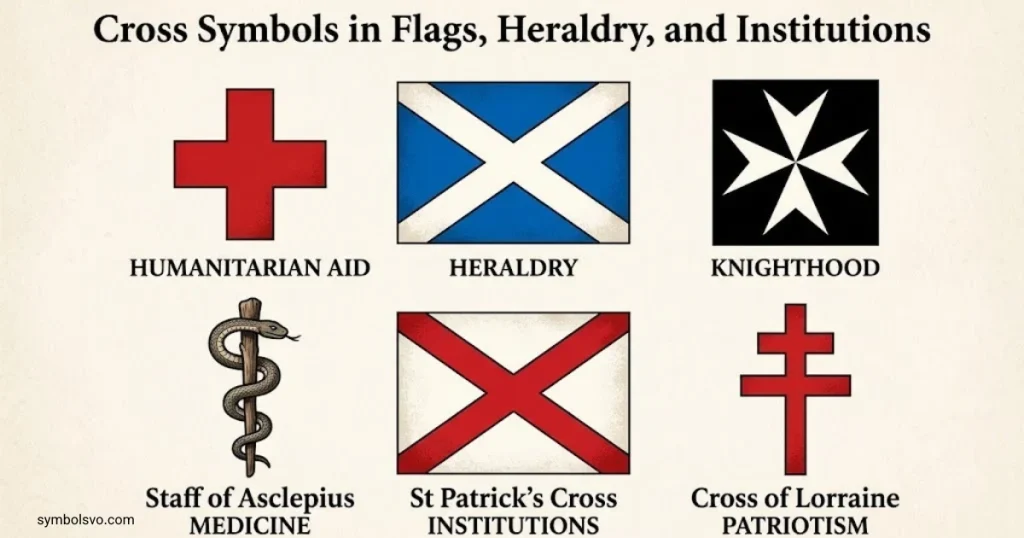
Crosses appear in public life as well as religious settings. Their use can reflect national identity, historical events, military traditions, or institutional affiliation.
Crosses in National Flags
Several familiar flags feature cross designs:
- Denmark: The Dannebrog uses a white Nordic cross on a red field.
- Sweden: Its flag uses a yellow Nordic cross on a blue field.
- Norway: Its flag features a blue cross outlined in white on a red field.
- Finland: Its flag uses a blue Nordic cross on a white field.
- Iceland: Its flag uses a red cross outlined in white on a blue field.
- Scotland: The Scottish flag features a white saltire on a blue field.
- England: The English flag features a red St. George’s Cross on a white field.
- Switzerland: The Swiss flag displays a white cross on a red field.
These designs carry distinct national histories. Their shared geometry doesn’t mean they all have identical religious meanings.
Crosses in Military and Historical Orders
Cross designs have appeared in military orders and historical institutions, including the Order of St. John, the Knights Templar, and the Portuguese Order of Christ.
The Maltese Cross, for example, is closely associated with the Order of St. John. The Iron Cross has a separate history in Prussian and German military traditions.
A cross used by a military organization may function as an insignia rather than a general religious statement. Its meaning depends on the organization, historical period, and circumstances of use.
Crosses in Churches and Religious Organizations
Churches use crosses in architecture, vestments, seals, ceremonial objects, and artwork. Papal, Patriarchal, Orthodox, Coptic, Armenian, and Ethiopian designs can identify particular traditions or institutions.
A cross’s placement can provide clues to its function. A cross carved above a church entrance may serve a different purpose from one displayed on a national flag or a medieval coat of arms.
Crosses in Jewelry, Tattoos, and Decorative Art
Crosses are common in pendants, rings, bracelets, tattoos, and decorative designs. Some people choose them for religious devotion, while others value their historical, cultural, or personal associations.
Before interpreting a design, identify its actual form. A Celtic cross, crucifix, Orthodox cross, and heraldic cross can have different histories even when they share a similar outline.
A person’s choice of jewelry or body art also doesn’t automatically reveal their beliefs. Personal symbolism can differ from established historical meaning.
Cross Symbols Compared: Shape, Origin, and Meaning
The following table summarizes several common designs and their best-established associations.
| Cross or symbol | Distinctive shape | Main association |
| Latin Cross | Longer lower arm | Christian faith and crucifixion |
| Greek Cross | Four equal-length arms | Byzantine and other Christian traditions |
| Orthodox Cross | Often three horizontal bars | Eastern Orthodox Christianity |
| Crucifix | Cross bearing Jesus’ figure | Christian devotion and crucifixion |
| Tau Cross | T-shaped | Christian symbolism and St. Anthony traditions |
| St. Andrew’s Cross | X-shaped | St. Andrew and Scottish heraldry |
| St. Peter’s Cross | Inverted Latin cross | Tradition surrounding St. Peter |
| Jerusalem Cross | Central cross with four smaller crosses | Medieval Christian history |
| Celtic Cross | Cross with a surrounding ring | Celtic-influenced Christian art and heritage |
| Maltese Cross | Four flared arms forming eight points | Order of St. John and related insignia |
| Cross Pattée | Arms widen toward their ends | Heraldry and institutional emblems |
| Cross Potent | Arms ending in T-shaped forms | Heraldry |
| Chi-Rho | Interlocking Greek letters Χ and Ρ | Early Christian monogram |
| Ankh | Loop above the crossbar | Ancient Egyptian symbol of life |
| Swastika | Four bent arms | Multiple cultural traditions and Nazi appropriation |
| Sun Cross | Cross enclosed in a circle | Historical motifs and varied solar interpretations |
| St. Brigid’s Cross | Woven plant material | Irish Christian and cultural traditions |
| Cross of Lorraine | Two horizontal bars | European heraldry and French resistance history |
| Cross of Camargue | Cross, anchor, and heart | Regional identity and faith, hope, and charity |
| Lauburu | Four curved arms | Basque cultural identity |
The table is a starting point, not a complete identification system. Some labels describe a specific emblem, while others refer to broad families of designs. For unfamiliar symbols, consult a reliable historical or heraldic reference.
What Is the Difference Between Common Cross Symbols?
Similar-looking designs often confuse readers. These comparisons highlight the most useful differences.
Latin Cross vs. Greek Cross
The Latin cross has a longer lower arm, while the Greek cross has four arms of approximately equal length. Both appear in Christian art, but their proportions make them easy to distinguish.
Cross vs. Crucifix
A cross is the general shape formed by intersecting bars or lines. A crucifix includes a representation of Jesus’ crucified body.
This distinction is especially useful when discussing Catholic devotional art and traditions that more commonly display an empty cross.
Orthodox Cross vs. Patriarchal Cross
The familiar Orthodox cross often has three horizontal bars, including a slanted lower footrest. The Patriarchal Cross usually has two horizontal bars.
Their historical and ecclesiastical associations also differ. A three-bar cross shouldn’t automatically be classified as the Patriarchal Cross.
Patriarchal Cross vs. Cross of Lorraine
Both designs have two horizontal bars. However, the Cross of Lorraine has a particular European heraldic history and became prominent in French resistance imagery.
The Patriarchal Cross appears in different ecclesiastical and heraldic contexts. Their similar shapes don’t make their histories interchangeable.
Celtic Cross vs. Latin Cross
The Celtic cross typically includes a ring around the intersection. The Latin cross doesn’t require this feature.
Celtic crosses are associated with regional Christian art and heritage, while the Latin cross is a more general Christian form.
Jerusalem Cross vs. Calvary Cross
The Jerusalem Cross has four smaller crosses around a central cross. The Calvary Cross stands on a stepped base.
These distinctive features make them relatively easy to tell apart.
Maltese Cross vs. Cross Pattée
The Maltese Cross has four arms forming eight points. A Cross Pattée has arms that broaden toward their ends, but it doesn’t necessarily share the Maltese Cross’s exact shape.
Both appear in heraldry and institutional emblems, so context remains important.
Christian Cross vs. Ankh
The Christian cross generally uses straight intersecting bars, while the ankh has a distinctive upper loop.
Their histories differ. The Christian cross is associated with the crucifixion of Jesus, whereas the ankh originated in ancient Egyptian religious imagery and represents life.
Sun Cross vs. Christian Cross
A Sun Cross typically features a cross within a circle or a related wheel-like design. A Christian cross may appear with or without a surrounding circle.
The geometric resemblance alone doesn’t prove a shared origin or identical religious meaning.
How to Choose or Identify a Cross Symbol
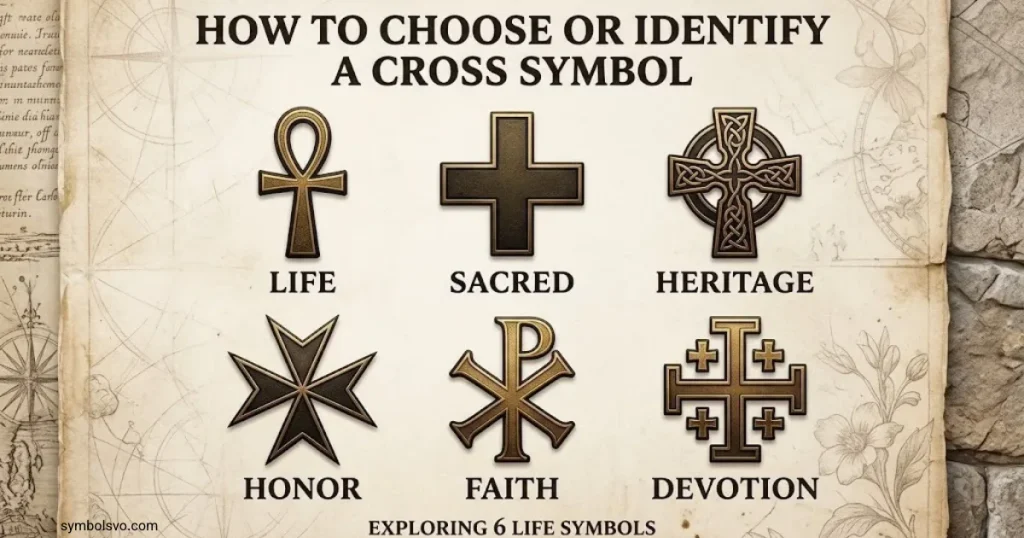
If you’re researching a cross for a historical project, jewelry, artwork, or another purpose, start with its shape and documented context.
Consider the Religious Tradition
A crucifix, Orthodox cross, and Celtic cross have different histories. If you want to understand a symbol’s religious significance, consult sources connected with the relevant tradition.
Examine the Design Details
Look for distinctive features, including:
- The length and arrangement of the arms.
- The presence of one, two, or three horizontal bars.
- A ring, loop, stepped base, or pointed terminals.
- Decorative elements such as a rose, heart, anchor, or smaller crosses.
- Inscriptions or associated symbols.
Small details can separate two designs that initially appear identical.
Research Its Historical Setting
A cross on a medieval coat of arms may have a different significance from a similar design in a modern church. Likewise, a cross on a national flag may represent a historical tradition rather than a statement of personal faith.
Use the object’s date, location, and institutional association to narrow the possibilities.
Avoid Assuming One Universal Meaning
The most reliable interpretation comes from the particular symbol and its documented use. A cross can carry religious, cultural, artistic, and personal significance at the same time.
When evidence is limited, describe what is known about the design and distinguish it from later interpretations.
Frequently Asked Questions About Cross Symbols
What are the most common types of crosses?
Common examples include the Latin Cross, Greek Cross, Orthodox Cross, crucifix, Celtic Cross, Jerusalem Cross, Tau Cross, and St. Andrew’s Cross. Each has distinctive visual features and historical associations.
What do different cross symbols mean?
Cross symbols can represent Christian faith, sacrifice, salvation, resurrection, religious authority, cultural heritage, or national identity. Other cross-shaped symbols, such as the ankh, have distinct meanings rooted in different religious traditions.
What does the Christian cross symbolize?
The Christian cross primarily recalls the crucifixion of Jesus Christ. Christians also associate it with redemption, salvation, hope, sacrifice, and the resurrection.
What is the difference between a cross and a crucifix?
A cross is a general geometric or symbolic form. A crucifix is a cross that includes a representation of Jesus’ crucified body.
What are the main types of Christian crosses?
Major examples include the Latin Cross, Greek Cross, Orthodox Cross, Tau Cross, Patriarchal Cross, Papal Cross, Jerusalem Cross, Calvary Cross, and Celtic Cross. Their meanings and uses vary by tradition.
What is the difference between a Latin Cross and a Greek Cross?
The Latin Cross has a longer lower arm. The Greek Cross has four arms of approximately equal length.
What does an Orthodox Cross mean?
The Orthodox Cross is associated with Eastern Christian traditions. Its familiar three-bar form includes an upper inscription bar and a lower footrest, which may appear slanted in Russian Orthodox representations.
Why does the Orthodox Cross have three bars?
The three bars commonly represent the inscription above Jesus, the main crossbeam, and the footrest. Traditional interpretations of the slanted footrest vary across Orthodox contexts.
What does an upside-down cross mean?
An inverted Latin cross is traditionally associated with St. Peter’s martyrdom in Christian tradition. In other contexts, it may be used to communicate anti-Christian or alternative meanings, so its significance depends on the setting.
What does the Celtic Cross represent?
The Celtic Cross is associated with Celtic-influenced Christian art, regional heritage, and historical stone monuments. Modern interpretations can differ from the documented contexts of medieval examples.
What does the Jerusalem Cross symbolize?
The Jerusalem Cross is associated with the medieval Kingdom of Jerusalem and Christian history. Some interpretations connect its central and four smaller crosses with Christ and the spread of Christianity.
What does the Chi-Rho symbol mean?
The Chi-Rho combines the Greek letters chi and rho from the word Christos, meaning Christ. It became especially prominent during Constantine the Great’s reign and appears in early Christian art and inscriptions.
What does an anchor cross represent?
The anchor cross combines cross and anchor imagery. In Christian symbolism, the anchor is associated with hope and steadfastness, although individual designs can have different histories.
What does the ankh symbolize?
The ancient Egyptian ankh is associated with life and divine vitality. It appears in religious art and hieroglyphic contexts and was later adopted in some Coptic Christian settings.
What is the original meaning of the swastika?
The swastika has a long history in several cultures, including Hinduism, Buddhism, and Jainism, where it can carry auspicious religious meanings. Nazi Germany later appropriated the symbol, creating a separate and deeply harmful association with Nazism and genocide.
What is the difference between the Patriarchal Cross and the Cross of Lorraine?
Both generally feature two horizontal bars. The Cross of Lorraine has a distinct European heraldic history and became prominent in French resistance imagery, while the Patriarchal Cross appears in various ecclesiastical and heraldic traditions.
Which crosses are associated with Christian saints?
Examples include St. Peter’s Cross, St. Andrew’s Cross, St. George’s Cross, St. Brigid’s Cross, St. James Cross, and St. Anthony’s Cross. Their shapes and historical associations vary.
What are heraldic crosses?
Heraldic crosses are designs used in coats of arms and related emblems. Terms such as Pattée, Fleury, Bottony, Moline, and Potent describe particular shapes or decorative features.
Are all cross-shaped symbols Christian?
No. The ankh originated in ancient Egyptian religion, and the swastika has longstanding associations with several Asian religious traditions. Other cross-like designs appear in cultural, artistic, and historical contexts unrelated to Christianity.
How can you identify an unfamiliar cross symbol?
Examine its shape, proportions, decorative details, and location. Then compare those features with reliable historical, religious, or heraldic references. An inscription, date, or geographic origin can help confirm the identification.
Conclusion: Understanding Cross Symbols and Their Meanings
Cross symbols have diverse histories that extend across Christianity, other religious traditions, heraldry, national identity, and cultural art. Their shapes may look similar, but their origins and meanings can differ considerably.
The Latin Cross, Greek Cross, Orthodox Cross, Celtic Cross, and Jerusalem Cross illustrate the diversity within Christian symbolism. Heraldic designs such as the Cross Pattée and Cross Fleury show how geometry helps distinguish institutional and historical emblems. Meanwhile, the ankh and swastika demonstrate why cross-shaped symbols must be interpreted within their own cultural settings.
The best way to understand a cross is to examine its form, historical origin, and documented use together. Doing so provides a more accurate picture than relying on a list of symbolic meanings alone.
Whether you’re identifying a symbol in a historical monument, researching religious art, or exploring cultural heritage, context is the key to understanding what a cross represents.

I’m Daniel Brooks, a content creator and symbol enthusiast dedicated to researching the fascinating world of signs and symbols. I enjoy discovering the hidden meanings behind famous icons, emojis, historical emblems, and cultural symbols. Through my writing, I aim to provide trustworthy, well-researched, and reader-friendly information that helps people learn something new with every visit.
Books:
- The Complete Guide to World Symbols
- The Power of Universal Signs
 Nathan Holloway
 Mason Ellington