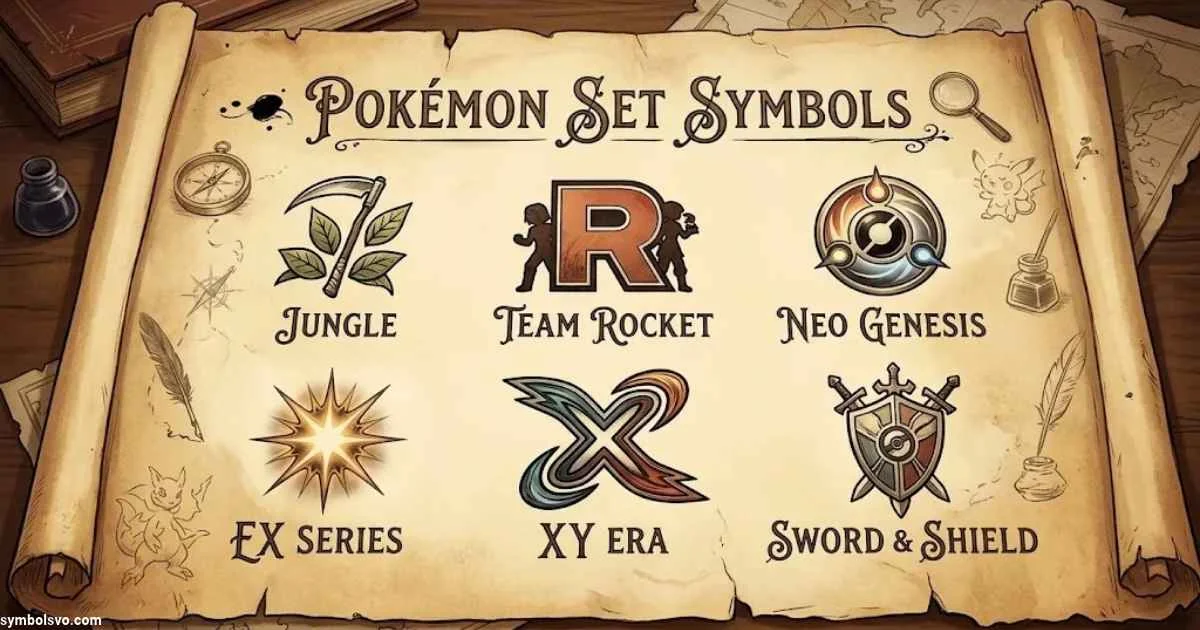
Pokémon cards contain more information than their artwork and attack descriptions reveal. Look closely at the bottom of a card and you’ll find small symbols, letters, and numbers that tell an important story. These markings help identify the expansion, distinguish different printings, and organize a collection.
For collectors, Pokémon set symbols make card identification much easier. A small graphic on an older card can reveal its original expansion. On newer cards, an alphanumeric code serves the same general purpose. However, these markings aren’t always easy to understand, especially when you’re comparing cards from different generations.
The Pokémon Trading Card Game (Pokémon TCG) has changed its card identification system several times. Vintage releases such as Base Set, Jungle, and Fossil use different markings from modern Scarlet & Violet and Mega Evolution cards. Rarity symbols and regulation marks add another layer of information.
This guide explains Pokémon set symbols and meanings, historical expansion symbols, modern expansion codes, card numbering, and other important card markings. You’ll also learn how to identify unfamiliar cards and organize your collection accurately.
What Are Pokémon Set Symbols?
Pokémon set symbols are small printed graphics that identify the expansion or special release associated with a Pokémon card. Collectors use these symbols to determine which set originally included a particular card.
For example, a vintage card from Jungle carries a small expansion symbol near its lower-right area. A card from Fossil has a different graphic. These markings make it easier to distinguish cards that might otherwise look similar.
Every Pokémon expansion has its own identifying information. Older English releases generally used graphic symbols while newer releases adopted alphanumeric expansion codes.
A set symbol answers a simple question: Which Pokémon card expansion does this card belong to?
Consider a Pikachu card that appears in multiple expansions. Its name and artwork might look familiar, but its set symbol and collector number can reveal a different release.
Why Does Every Pokémon Expansion Have Its Own Symbol?
Expansion symbols provide a quick visual reference for collectors. Instead of relying entirely on artwork or release dates, you can compare the printed mark against an expansion checklist.
These identifiers also help distinguish reprints.
A popular Pokémon card may appear in several expansions with different artwork, numbering, or card designs. Even when two cards feature the same Pokémon, their expansion information can differ.
Set symbols help collectors:
- Identify the original expansion of a card.
- Separate cards from different releases.
- Build accurate expansion checklists.
- Distinguish certain reprints and card versions.
- Organize collections by release.
- Research vintage Pokémon cards.
- Confirm information through card databases.
What Information Can You Learn From a Set Symbol?
A traditional expansion symbol identifies the set rather than providing a complete description of the card.
When you combine it with the collector number, you gain a more precise identification method.
For example, a card numbered 4/102 belongs to a different checklist from a card numbered 4/64. The number before the slash identifies the card’s position while the number after the slash represents the printed set total.
However, some cards use special numbering systems. Secret rares and promotional cards are important examples.
Are Pokémon Set Symbols Unique to Each Expansion?
Generally, each expansion has its own identifying symbol or code. This makes expansion identification straightforward when the markings remain intact and readable.
However, you shouldn’t assume every Pokémon card follows the same layout. Base Set is a notable exception because it doesn’t carry a traditional expansion symbol.
Promotional cards and special subsets also require additional attention. Their markings and numbering conventions can differ from regular expansion cards.
Where Are Pokémon Set Symbols Located on a Card?
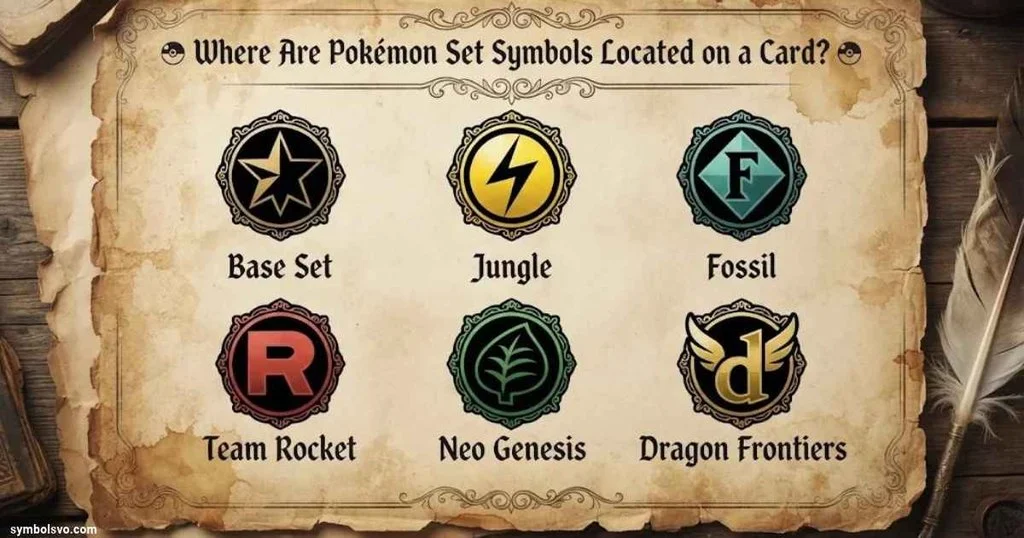
The location of a set symbol depends on the card’s age and design. Pokémon has changed its card layouts several times since the original English Trading Card Game releases.
Therefore, checking only one corner can lead to confusion.
The following locations describe common English Pokémon card layouts. Individual promotional cards and special releases may differ.
Set Symbol Location on Vintage Pokémon Cards
On many early Pokémon cards, the expansion symbol appears near the lower-right corner of the illustration box.
This placement is particularly familiar to collectors who own Jungle, Fossil, Team Rocket, and Neo series cards.
For example:
- Jungle cards display a jungle-themed expansion symbol.
- Fossil cards feature a fossil-inspired graphic.
- Team Rocket cards use a distinctive Rocket-themed mark.
- Neo expansions have individual identifying graphics.
The original Base Set doesn’t display a traditional expansion symbol. Its cards rely on other printed details for identification.
Set Symbol Location on EX, Diamond & Pearl, and XY Cards
As Pokémon introduced new card designs, the placement of expansion symbols changed.
Many EX, Diamond & Pearl, Platinum, Black & White, and XY cards display their expansion symbols near the bottom-right portion of the card.
The exact position can vary slightly between layouts.
When identifying these cards, examine the collector number and nearby graphic together. This combination is more reliable than relying on artwork alone.
Expansion Identifier Location on Modern Pokémon Cards
Modern English Pokémon cards use alphanumeric expansion identifiers instead of the familiar traditional graphic symbols.
On Sword & Shield and Scarlet & Violet cards, the identifying information generally appears along the bottom-left area.
Scarlet & Violet cards commonly display:
- A regulation mark.
- An expansion identifier.
- A language designation.
- A collector card number.
- A rarity symbol.
These markings provide several different types of information.
For example, the identifier SVI represents the Scarlet & Violet expansion. The letters are easier to type into a database than a small graphic symbol.
Where to Find the Card Number and Rarity Symbol
The collector number usually appears along the bottom edge of the card.
It commonly follows this format:
123/198
The first number identifies the card’s position within the set. The second indicates the set’s printed card total.
The rarity symbol appears nearby, although its exact placement depends on the card design.
Don’t confuse these markings. The collector number identifies a card within an expansion while the rarity symbol describes its rarity classification.
Where to Find the Regulation Mark
Modern Pokémon cards also display a small letter called the regulation mark.
You can generally find it in the lower-left identification area.
This letter helps determine whether a card is eligible for the Standard tournament format. It doesn’t identify the expansion and shouldn’t be confused with the expansion code.
Pokémon’s official competitive guidance explains that Standard format legality depends on regulation marks. Older versions of cards may remain legal when an eligible reprint exists.
Pokémon Set Symbols vs. Expansion Codes: What’s the Difference?
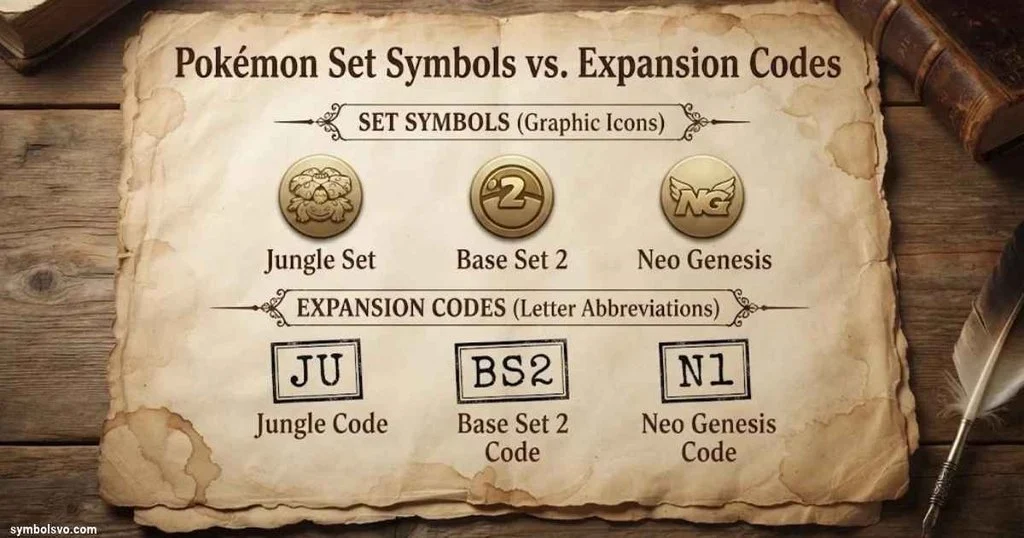
Although collectors sometimes use these terms interchangeably, set symbols and expansion codes describe different identification formats.
Traditional set symbols use graphics. Expansion codes use letters or other printed characters to identify a release.
Both help collectors determine which expansion a card belongs to.
| Identification marking | Main purpose | Example |
| Set symbol | Identifies an expansion through a graphic | Jungle symbol |
| Expansion code | Identifies an expansion through text | SVI |
| Collector number | Identifies a card within its checklist | 123/198 |
| Rarity symbol | Indicates rarity classification | Circle, diamond, or star |
| Regulation mark | Helps determine Standard format eligibility | G, H, I |
What Are Traditional Pokémon Set Symbols?
Traditional expansion symbols are small illustrations printed on Pokémon cards.
Their designs often relate to the expansion’s theme, name, or visual identity.
For example, Fossil uses a fossil-inspired design. Jungle has a recognizable botanical theme. Team Rocket uses imagery associated with the villainous organization.
These symbols became an important part of vintage Pokémon collecting.
Collectors often recognize older expansions through their graphics without needing to read the complete card information.
What Are Pokémon Expansion Codes?
An expansion code is a short printed identifier associated with a Pokémon TCG release.
Modern English cards use these codes to make expansion identification easier.
Examples include:
| Expansion | English expansion code |
| Scarlet & Violet | SVI |
| Paldea Evolved | PAL |
| Obsidian Flames | OBF |
| Pokémon 151 | MEW |
| Paradox Rift | PAR |
| Paldean Fates | PAF |
| Temporal Forces | TEF |
| Twilight Masquerade | TWM |
| Shrouded Fable | SFA |
| Stellar Crown | SCR |
| Surging Sparks | SSP |
| Prismatic Evolutions | PRE |
| Journey Together | JTG |
| Destined Rivals | DRI |
| Black Bolt | BBL |
| White Flare | WHT |
These are useful identifiers when searching online card databases or building digital collection lists.
Why Did Modern Pokémon Cards Move Away From Traditional Set Symbols?
Graphic symbols work well on physical cards, but they can be difficult to search electronically.
A collector might recognize a symbol visually but struggle to describe it accurately in a search box.
Alphanumeric identifiers solve this problem.
They offer several practical advantages:
- Easier database searches.
- More consistent digital cataloging.
- Simpler expansion identification.
- Convenient collection tracking.
- Better compatibility with spreadsheets and card-management tools.
This change also reflects how Pokémon collecting has grown. Digital databases and online marketplaces now play an important role in card research.
Are Set Symbols and Expansion Codes Interchangeable?
They serve similar identification purposes but aren’t the same printed element.
A vintage card may have a graphic symbol while a modern card displays an expansion code.
Both can identify an expansion, but you should use the correct terminology when discussing a particular card.
For example, calling SVI a traditional set symbol isn’t technically accurate. It’s an expansion code.
Pokémon Set Symbols by Era: Complete Historical Guide
The Pokémon Trading Card Game has developed through several major eras. Each period introduced new expansions, artwork styles, and identification conventions.
Understanding these eras helps collectors recognize unfamiliar cards and place them within the correct release period.
Original Pokémon TCG Era (1999–2002)
The original English Pokémon card releases introduced the expansion symbols that many vintage collectors recognize today.
The Wizards of the Coast era established the early English Pokémon TCG expansion system.
The first major releases included:
| Expansion | Release year |
| Base Set | 1999 |
| Jungle | 1999 |
| Fossil | 1999 |
| Base Set 2 | 2000 |
| Team Rocket | 2000 |
| Gym Heroes | 2000 |
| Gym Challenge | 2000 |
| Neo Genesis | 2000 |
| Neo Discovery | 2001 |
| Neo Revelation | 2001 |
| Neo Destiny | 2002 |
The Base Set deserves special attention. Unlike many later vintage expansions, it doesn’t have a traditional expansion symbol.
Collectors commonly identify Base Set cards through their numbering, artwork, and other printing characteristics.
Jungle and Fossil introduced recognizable expansion graphics. Later releases continued this visual identification system.
The Gym and Neo expansions also helped establish the importance of expansion-specific markings.
e-Reader Era (2002–2003)
The e-Reader era introduced a distinctive card design that collectors can recognize quickly.
Its three main English expansions were:
- Expedition Base Set
- Aquapolis
- Skyridge
These cards included dot-code features designed for compatibility with Nintendo’s e-Reader accessory.
The technology allowed supported cards to interact with the device and display additional content.
For collectors, this period matters because e-Reader cards have a distinctive appearance. Their borders, card layouts, and printed features differ from earlier releases.
Aquapolis and Skyridge also have important places in vintage collecting because of their artwork and unusual card presentation.
EX Series Era (2003–2007)
The EX series introduced Pokémon-ex cards and continued expanding the game’s visual identity.
Its English expansions included:
| Expansion | Release year |
| EX Ruby & Sapphire | 2003 |
| EX Sandstorm | 2003 |
| EX Dragon | 2003 |
| EX Team Magma vs Team Aqua | 2004 |
| EX Hidden Legends | 2004 |
| EX FireRed & LeafGreen | 2004 |
| EX Team Rocket Returns | 2004 |
| EX Deoxys | 2005 |
| EX Emerald | 2005 |
| EX Unseen Forces | 2005 |
| EX Delta Species | 2005 |
| EX Legend Maker | 2006 |
| EX Holon Phantoms | 2006 |
| EX Crystal Guardians | 2006 |
| EX Dragon Frontiers | 2006 |
| EX Power Keepers | 2007 |
The word EX in these expansion names shouldn’t be confused with the modern lowercase ex mechanic.
EX cards became a defining feature of this era. Their special layouts and artwork make them easy to distinguish from earlier cards.
When identifying an EX-era card, check its expansion symbol and collector number together.
Diamond & Pearl and Platinum Era (2007–2010)
This period introduced Pokémon LV.X cards and additional changes to card presentation.
Important expansions included:
- Diamond & Pearl
- Mysterious Treasures
- Secret Wonders
- Great Encounters
- Majestic Dawn
- Legends Awakened
- Stormfront
- Platinum
- Rising Rivals
- Supreme Victors
- Arceus
The Diamond & Pearl era is especially interesting for collectors because of its LV.X cards and distinctive artwork.
Platinum continued the series with new expansion identities and additional card mechanics.
When sorting cards from this period, don’t rely solely on the Pokémon name. Expansion symbols and numbering provide more dependable identification details.
HeartGold & SoulSilver Era (2010–2011)
The HeartGold & SoulSilver series brought Pokémon from the Johto region back into the spotlight.
Its major releases included:
- HeartGold & SoulSilver
- Unleashed
- Undaunted
- Triumphant
The Call of Legends set followed in 2011 and is closely associated with this collecting period.
These releases included Prime cards and Legend cards with distinctive visual layouts.
Collectors should pay particular attention to the special card designs and expansion identifiers when organizing this era.
Black & White Era (2011–2013)
The Black & White series introduced Pokémon from the fifth generation.
Its English expansions included:
- Black & White
- Emerging Powers
- Noble Victories
- Next Destinies
- Dark Explorers
- Dragons Exalted
- Boundaries Crossed
- Plasma Storm
- Plasma Freeze
- Plasma Blast
- Legendary Treasures
This period featured Pokémon-EX cards and several special card designs.
The Plasma expansions also introduced a recognizable visual theme across multiple releases.
The expansion symbol remains important when distinguishing cards from this era because several sets share similar card layouts.
XY Era (2014–2016)
The XY series introduced Mega Evolution cards into the Pokémon TCG.
Major expansions included:
- XY
- Flashfire
- Furious Fists
- Phantom Forces
- Primal Clash
- Roaring Skies
- Ancient Origins
- BREAKthrough
- BREAKpoint
- Fates Collide
- Steam Siege
- Evolutions
Mega Evolution became an important part of the game’s identity during this period.
BREAK cards also introduced an unusual horizontal artwork presentation.
For collectors, the XY era offers several different card styles. Checking the expansion identifier and collector number helps prevent confusion between visually similar releases.
Sun & Moon Era (2017–2019)
The Sun & Moon series introduced Pokémon-GX cards and expanded the game’s special rarity categories.
Its English expansions included:
- Sun & Moon
- Guardians Rising
- Burning Shadows
- Shining Legends
- Crimson Invasion
- Ultra Prism
- Forbidden Light
- Celestial Storm
- Lost Thunder
- Team Up
- Unbroken Bonds
- Unified Minds
- Hidden Fates
- Cosmic Eclipse
Special releases such as Hidden Fates and Shining Legends attracted collectors through their distinctive card selections.
This era also included alternative-art cards and several popular full-art designs.
Collectors should distinguish regular expansions from special sets when creating checklists.
Sword & Shield Era (2020–2023)
The Sword & Shield series introduced Pokémon V, VMAX, VSTAR, and related card mechanics.
Its major English expansions included:
| Expansion | Release year |
| Sword & Shield | 2020 |
| Rebel Clash | 2020 |
| Darkness Ablaze | 2020 |
| Champion’s Path | 2020 |
| Vivid Voltage | 2020 |
| Shining Fates | 2021 |
| Battle Styles | 2021 |
| Chilling Reign | 2021 |
| Evolving Skies | 2021 |
| Celebrations | 2021 |
| Fusion Strike | 2021 |
| Brilliant Stars | 2022 |
| Astral Radiance | 2022 |
| Pokémon GO | 2022 |
| Lost Origin | 2022 |
| Silver Tempest | 2022 |
| Crown Zenith | 2023 |
The Sword & Shield era marked an important transition in English card identification.
Traditional expansion graphics gave way to alphanumeric expansion identifiers on these cards.
Collectors should also recognize that regulation marks became part of modern card identification during this period.
Scarlet & Violet Era (2023–2025)
Scarlet & Violet introduced Pokémon ex cards and a refreshed rarity system.
Its major English expansions included:
- Scarlet & Violet
- Paldea Evolved
- Obsidian Flames
- Pokémon 151
- Paradox Rift
- Paldean Fates
- Temporal Forces
- Twilight Masquerade
- Shrouded Fable
- Stellar Crown
- Surging Sparks
- Prismatic Evolutions
- Journey Together
- Destined Rivals
- Black Bolt
- White Flare
The expansion codes make identification easier than relying on graphic symbols alone.
For example, a card displaying MEW belongs to the Pokémon 151 expansion. A card carrying PAL belongs to Paldea Evolved.
This era also features Illustration Rare, Special Illustration Rare, and Hyper Rare cards.
The expansion code and collector number remain essential when identifying these cards.
Mega Evolution Era (2025–2026)
The Mega Evolution series brought Mega Evolution Pokémon back into the Pokémon TCG.
The English releases listed by November 2026 include:
| Expansion | Release date |
| Mega Evolution | September 26, 2025 |
| Phantasmal Flames | November 14, 2025 |
| Ascended Heroes | January 30, 2026 |
| Perfect Order | March 27, 2026 |
| Chaos Rising | May 22, 2026 |
| Pitch Black | July 17, 2026 |
| Delta Reign | November 6, 2026 |
The Mega Evolution series continues the modern card identification approach.
Collectors should check the actual printed expansion identifier instead of assuming that every product abbreviation matches the card’s code.
This distinction matters when cataloging cards or searching for individual releases.
The official Pokémon release schedule lists these products and their release dates. The Mega Evolution—Delta Reign expansion became available on November 6, 2026.
Complete Pokémon Set Symbols Chart and Identification List
A Pokémon set symbols chart helps collectors match unfamiliar cards with their original expansions.
However, a text-based chart needs one important distinction: older expansions use visual graphics while modern English cards generally use alphanumeric identifiers.
The following reference tables organize the main English releases by era. Use the expansion name and symbol or code together when identifying a card.
Original Pokémon Set Symbols List
| Pokémon expansion | Set identification |
| Base Set | No traditional set symbol |
| Jungle | Jungle-themed graphic |
| Fossil | Fossil-themed graphic |
| Base Set 2 | Base Set 2 graphic |
| Team Rocket | Rocket-themed graphic |
| Gym Heroes | Gym Heroes graphic |
| Gym Challenge | Gym Challenge graphic |
| Neo Genesis | Neo Genesis graphic |
| Neo Discovery | Neo Discovery graphic |
| Neo Revelation | Neo Revelation graphic |
| Neo Destiny | Neo Destiny graphic |
These symbols are especially useful when identifying vintage Pokémon cards.
Remember that the Base Set has no traditional expansion symbol. A missing symbol doesn’t automatically mean the card is fake or incomplete.
e-Reader and EX Series Set Symbols
| Expansion | Era |
| Expedition Base Set | e-Reader |
| Aquapolis | e-Reader |
| Skyridge | e-Reader |
| EX Ruby & Sapphire | EX |
| EX Sandstorm | EX |
| EX Dragon | EX |
| EX Team Magma vs Team Aqua | EX |
| EX Hidden Legends | EX |
| EX FireRed & LeafGreen | EX |
| EX Team Rocket Returns | EX |
| EX Deoxys | EX |
| EX Emerald | EX |
| EX Unseen Forces | EX |
| EX Delta Species | EX |
| EX Holon Phantoms | EX |
| EX Dragon Frontiers | EX |
| EX Power Keepers | EX |
Each release has its own expansion identification. Compare the symbol with the card number rather than relying on the artwork.
Diamond & Pearl, Platinum, and HeartGold & SoulSilver Set Symbols
| Expansion | Series |
| Diamond & Pearl | Diamond & Pearl |
| Mysterious Treasures | Diamond & Pearl |
| Secret Wonders | Diamond & Pearl |
| Great Encounters | Diamond & Pearl |
| Majestic Dawn | Diamond & Pearl |
| Legends Awakened | Diamond & Pearl |
| Stormfront | Diamond & Pearl |
| Platinum | Platinum |
| Rising Rivals | Platinum |
| Supreme Victors | Platinum |
| Arceus | Platinum |
| HeartGold & SoulSilver | HeartGold & SoulSilver |
| Unleashed | HeartGold & SoulSilver |
| Undaunted | HeartGold & SoulSilver |
| Triumphant | HeartGold & SoulSilver |
| Call of Legends | Related release |
These sets use their respective historical expansion identifiers. Their symbols help distinguish releases that otherwise share similar card layouts.
Black & White and XY Set Symbols
| Black & White expansions | XY expansions |
| Black & White | XY |
| Emerging Powers | Flashfire |
| Noble Victories | Furious Fists |
| Next Destinies | Phantom Forces |
| Dark Explorers | Primal Clash |
| Dragons Exalted | Roaring Skies |
| Boundaries Crossed | Ancient Origins |
| Plasma Storm | BREAKthrough |
| Plasma Freeze | BREAKpoint |
| Plasma Blast | Fates Collide |
| Legendary Treasures | Steam Siege |
| — | Evolutions |
The symbols identify individual expansions rather than entire generations. A card from Plasma Freeze doesn’t belong to the same expansion as a card from Plasma Storm.
Sun & Moon and Sword & Shield Set Symbols
| Sun & Moon expansions | Sword & Shield expansions |
| Sun & Moon | Sword & Shield |
| Guardians Rising | Rebel Clash |
| Burning Shadows | Darkness Ablaze |
| Shining Legends | Champion’s Path |
| Crimson Invasion | Vivid Voltage |
| Ultra Prism | Shining Fates |
| Forbidden Light | Battle Styles |
| Celestial Storm | Chilling Reign |
| Lost Thunder | Evolving Skies |
| Team Up | Celebrations |
| Unbroken Bonds | Fusion Strike |
| Unified Minds | Brilliant Stars |
| Hidden Fates | Astral Radiance |
| Cosmic Eclipse | Pokémon GO |
| — | Lost Origin |
| — | Silver Tempest |
| — | Crown Zenith |
Sun & Moon cards commonly use traditional expansion graphics. Sword & Shield cards introduced the modern alphanumeric identification style on English cards.
Scarlet & Violet Expansion Codes Chart
The following table provides the English expansion codes collectors commonly encounter on Scarlet & Violet cards.
| Expansion name | Expansion code |
| Scarlet & Violet | SVI |
| Paldea Evolved | PAL |
| Obsidian Flames | OBF |
| Pokémon 151 | MEW |
| Paradox Rift | PAR |
| Paldean Fates | PAF |
| Temporal Forces | TEF |
| Twilight Masquerade | TWM |
| Shrouded Fable | SFA |
| Stellar Crown | SCR |
| Surging Sparks | SSP |
| Prismatic Evolutions | PRE |
| Journey Together | JTG |
| Destined Rivals | DRI |
| Black Bolt | BBL |
| White Flare | WHT |
These identifiers are useful for digital cataloging, collection spreadsheets, and card searches.
For example, if a card displays the code TEF, you can narrow its expansion to Temporal Forces before checking its collector number.
Mega Evolution Expansion Identification
Mega Evolution introduced another generation of English Pokémon TCG releases.
Collectors should recognize the following expansion names:
- Mega Evolution
- Phantasmal Flames
- Ascended Heroes
- Perfect Order
- Chaos Rising
- Pitch Black
- Delta Reign
The printed expansion identifier should always take priority over an unofficial abbreviation.
A product’s marketing name and the short identifier printed on its cards aren’t necessarily identical. Don’t create a code based solely on the product title.
How to Identify a Pokémon Card Using Its Set Symbol
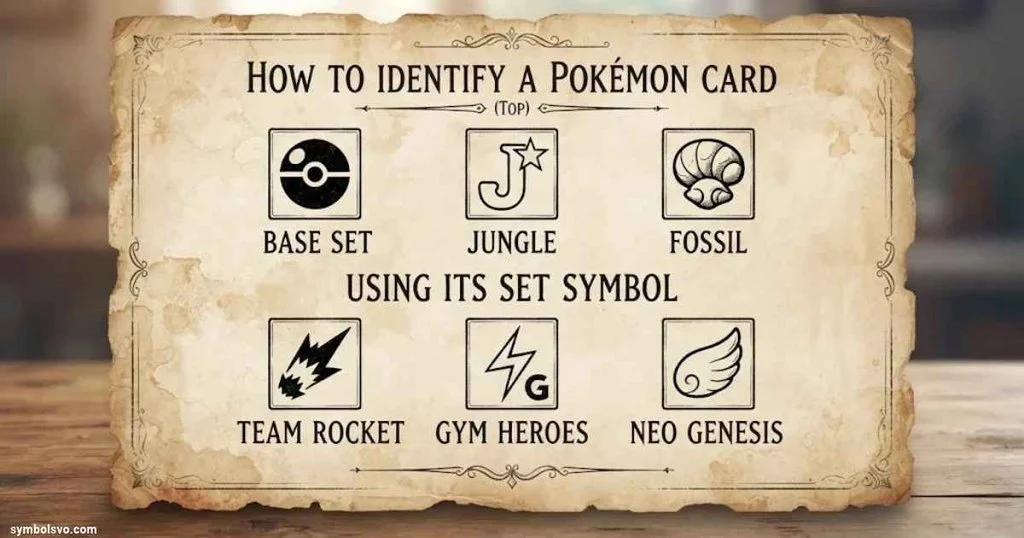
Finding the correct expansion doesn’t require expensive equipment or advanced collecting knowledge.
You can identify most Pokémon cards by examining a few printed details.
Follow these steps to narrow down the card’s original release.
Find the Set Symbol or Expansion Code
Start by examining the lower portion of the card.
Look for a small graphic symbol or an alphanumeric expansion identifier.
Older cards usually display a traditional symbol. Modern cards generally display a short code.
If the card has no visible symbol, don’t immediately assume something is wrong. Base Set and certain promotional releases require different identification methods.
Read the Collector Card Number
Next, locate the collector number.
A common example looks like this:
67/198
The first number identifies the card’s position. The second represents the printed set total.
Write down both numbers because they help narrow the search.
Match the Symbol or Code With the Expansion
Compare the marking with a reliable expansion checklist.
For example:
- SVI identifies Scarlet & Violet.
- PAL identifies Paldea Evolved.
- MEW identifies Pokémon 151.
- PAR identifies Paradox Rift.
For vintage cards, compare the actual graphic rather than trying to describe its appearance from memory.
Check the Card Name and Artwork
The Pokémon’s name provides another useful clue.
For example, Pikachu appears in many expansions. However, different printings may feature different illustrations, numbering, and card designs.
Artwork can help narrow the possibilities, but it shouldn’t replace the printed identification details.
Confirm the Printing
Finally, compare the card against a reliable card record.
Check these details together:
- Pokémon name
- Expansion
- Collector number
- Card artwork
- Rarity
- Language
- Promotional markings, when applicable
This approach helps distinguish different versions of the same Pokémon card.
How to Read Pokémon Card Numbers
Pokémon card numbering is one of the most useful parts of card identification.
A card number provides information about its position within an expansion. It can also reveal whether the card belongs to a standard checklist or a special numbering category.
What Does 123/198 Mean on a Pokémon Card?
The number 123/198 means the card occupies position 123 in an expansion with a printed checklist total of 198 cards.
The slash separates two different pieces of information.
| Number | Meaning |
| 123 | Individual card’s collector number |
| 198 | Printed expansion total |
The first number helps identify the individual card within its set.
The second helps collectors understand the size of the numbered checklist.
What Does the First Number Represent?
The first number is the card’s individual collector number.
For example, a card numbered 001/198 appears at the beginning of the numbered checklist.
A card numbered 150/198 appears later in that checklist.
This numbering system helps collectors arrange cards in their correct expansion order.
What Does the Second Number Represent?
The second number indicates the printed total associated with the expansion’s numbered checklist.
For example:
- 12/102 means card 12 in a 102-card checklist.
- 45/64 means card 45 in a 64-card checklist.
- 123/198 means card 123 in a 198-card checklist.
However, this number doesn’t always represent every physical card variant or promotional printing associated with a product.
What Are Secret Rare Card Numbers?
Some Pokémon expansions include cards numbered beyond their printed checklist total.
Collectors commonly call these secret rare cards.
Consider this example:
215/203
The card’s collector number exceeds the printed total of 203. This indicates that it belongs to the additional numbered portion of the expansion.
Secret rares often feature special artwork, unique finishes, or higher rarity classifications.
However, a number above the set total doesn’t automatically establish a card’s market value. Demand and condition still matter.
Why Do Some Pokémon Cards Have Numbers Above the Set Total?
Pokémon expansions sometimes include additional cards beyond the main numbered checklist.
These cards may include:
- Special illustration cards.
- Gold-colored cards.
- Secret rare Pokémon.
- Additional Trainer cards.
- Other special collector releases.
The numbering system allows these cards to remain connected to their original expansion.
Can Two Different Pokémon Cards Have the Same Collector Number?
Yes, especially when you compare cards from different expansions.
For example, two expansions may both contain a card numbered 25/198.
That doesn’t mean they’re the same card.
You must compare the expansion identifier alongside the collector number.
Promotional cards, reprints, and language variations also require careful identification.
Pokémon Card Symbols and Their Meanings
Not every symbol on a Pokémon card identifies its expansion.
Some markings describe rarity, gameplay requirements, promotional status, or tournament eligibility.
Understanding their differences prevents common identification mistakes.
Pokémon Set Symbols
A set symbol identifies the expansion associated with a card.
Older cards generally use graphic symbols while modern English releases use expansion codes.
The main purpose is expansion identification.
A set symbol doesn’t automatically tell you how rare or valuable the card is.
Pokémon Rarity Symbols
Pokémon rarity symbols indicate how a card is classified within its release.
Traditional English Pokémon cards commonly use three basic rarity symbols.
| Symbol | Traditional rarity |
| ● Circle | Common |
| ◆ Diamond | Uncommon |
| ★ Star | Rare |
These symbols appear in different positions depending on the card’s design.
Modern Pokémon cards use a more detailed rarity classification.
Common modern categories include:
| Modern rarity | General meaning |
| Common | Basic rarity category |
| Uncommon | More limited than common |
| Rare | Traditional rare classification |
| Double Rare | Special classification used for certain Pokémon ex cards |
| Illustration Rare | Features distinctive illustration-focused artwork |
| Ultra Rare | Higher rarity classification |
| Special Illustration Rare | Special artwork-focused high-rarity category |
| Hyper Rare | Includes distinctive gold-style card designs |
Rarity categories have changed over time. Therefore, don’t apply modern classifications to every vintage expansion.
Also, rarity doesn’t guarantee value. A common card featuring a popular Pokémon can sometimes attract more attention than an ordinary rare card.
Black Star Promo Symbols
A black star is commonly associated with Pokémon promotional cards.
These cards are distributed through special products, events, collections, or promotional releases rather than appearing only as ordinary cards in booster packs.
Promo cards often have their own identification prefixes.
Examples include:
- SWSH for Sword & Shield promotional cards.
- SVP for Scarlet & Violet promotional cards.
The number following the prefix helps identify the individual promotional release.
However, promotional card identification can vary. Always examine the complete marking rather than relying on the black star alone.
First Edition Symbol
The First Edition symbol identifies eligible first-printing cards from certain vintage English Pokémon releases.
It commonly appears as a small stamp on the left side of the card artwork.
First Edition cards are important to collectors because they represent a particular printing of an expansion.
For example, early Base Set cards include First Edition and unlimited-printing versions.
However, not every vintage expansion uses the same First Edition conventions.
Collectors should also understand the difference between First Edition, Shadowless, and unlimited Base Set cards.
| Printing type | General identification |
| First Edition | Displays the First Edition stamp |
| Shadowless | Lacks the usual drop shadow around the artwork frame |
| Unlimited | Standard later printing without the First Edition stamp |
These distinctions matter when identifying and evaluating vintage cards.
Pokémon Regulation Marks
A regulation mark is a small letter printed on modern Pokémon cards.
It helps determine whether a card can be used in the Standard tournament format.
Regulation marks became part of modern English Pokémon card identification with the Sword & Shield era.
The letters have changed over successive competitive seasons.
For example, the 2025 Standard rotation allowed cards carrying G and H marks while older F-mark cards rotated out under that season’s rules.
However, rotation doesn’t mean every older card becomes unusable in every format.
An older printing may remain legal when the same card has an eligible reprint. Players must also consider official card text updates and tournament rules.
Important: Regulation marks identify competitive eligibility, not expansion membership or rarity.
Energy Type Symbols
Energy symbols indicate the type of Energy required for attacks and certain gameplay effects.
The main Energy types include:
- Grass
- Fire
- Water
- Lightning
- Psychic
- Fighting
- Darkness
- Metal
- Dragon
- Colorless
These symbols are different from expansion identifiers.
For example, a Water Energy symbol beside an attack tells you what Energy the attack requires. It doesn’t identify the expansion.
The position of a symbol matters just as much as its appearance.
Pokémon Expansion Codes vs. Regulation Marks vs. Rarity Symbols
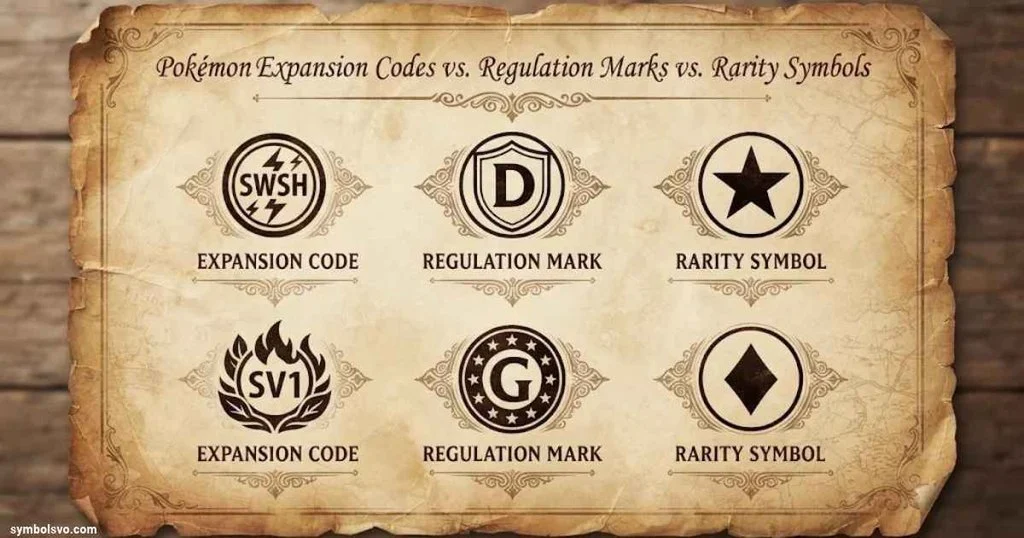
These three markings often appear close together on modern cards.
As a result, new collectors sometimes mistake one for another.
The easiest way to understand them is to ask what question each marking answers.
| Marking | Question it answers |
| Expansion code | Which expansion does this card belong to? |
| Regulation mark | Can this card be used in the current Standard format? |
| Rarity symbol | How is this card classified by rarity? |
| Collector number | Where does this card appear in the expansion checklist? |
What Do Three-Letter Expansion Codes Mean?
Three-letter expansion codes are short identifiers associated with modern English Pokémon TCG releases.
For example:
- PAL identifies Paldea Evolved.
- OBF identifies Obsidian Flames.
- TEF identifies Temporal Forces.
- SSP identifies Surging Sparks.
These codes make searching and cataloging much easier.
They also help collectors distinguish different expansions containing similar Pokémon.
What Does the Letter Beside a Pokémon Expansion Code Mean?
The small letter beside a modern expansion identifier is generally the regulation mark.
It isn’t part of the three-letter expansion code.
For example, a modern card may display an expansion identifier alongside a separate regulation letter.
The expansion code tells you where the card belongs. The regulation mark helps determine competitive eligibility.
Can Two Different Sets Share the Same Regulation Mark?
Yes.
Multiple expansions can carry cards with the same regulation mark.
That’s because regulation marks identify a competitive card group rather than a specific expansion.
A card from one expansion and another card from a later expansion may share the same regulation letter.
This is why players shouldn’t use expansion codes to determine Standard format legality.
Does a Regulation Mark Determine a Card’s Rarity?
No.
A regulation mark doesn’t classify a card as common, uncommon, rare, or special illustration rare.
Rarity and tournament eligibility are separate characteristics.
A card can have a particular regulation mark while belonging to any of several rarity categories.
Special Pokémon Card Sets, Subsets, and Promotional Cards
Not every Pokémon card belongs to a regular expansion in the same way.
Some releases focus on special collections, promotional distributions, or themed card selections. These products can use different numbering conventions and identification details.
Understanding these differences helps collectors avoid placing cards in the wrong checklist.
Pokémon Special Sets
Special sets often feature unusual themes, exclusive artwork, or collections built around particular Pokémon.
Some notable English releases include:
| Special set | Release year | Distinguishing feature |
| Shining Legends | 2017 | Shining Pokémon |
| Hidden Fates | 2019 | Shiny Pokémon cards |
| Champion’s Path | 2020 | Charizard-focused collector interest |
| Shining Fates | 2021 | Shiny Pokémon collection |
| Celebrations | 2021 | Pokémon anniversary collection |
| Pokémon GO | 2022 | Pokémon GO-inspired cards |
| Crown Zenith | 2023 | Galarian Gallery |
| Pokémon 151 | 2023 | Original 151 Pokémon |
| Paldean Fates | 2024 | Shiny Pokémon |
| Prismatic Evolutions | 2025 | Eevee and its Evolutions |
These releases can contain regular cards, special subsets, and promotional cards.
A special set’s collector checklist may also follow different numbering conventions from a standard expansion.
Trainer Gallery Cards
Trainer Gallery cards appeared in several Sword & Shield expansions.
These cards feature Pokémon alongside their Trainers in distinctive artwork.
Examples include cards from Brilliant Stars, Astral Radiance, Lost Origin, and Silver Tempest.
They commonly use a separate TG numbering prefix.
For example, a card marked TG01/TG30 belongs to the Trainer Gallery subset rather than the main numbered portion of the expansion.
This distinction matters when completing a set. Collectors who ignore the TG numbering may overlook cards included in the full checklist.
Galarian Gallery Cards
The Galarian Gallery is a special subset associated with Crown Zenith.
It features illustration-focused cards with distinctive artwork.
Its cards use the GG numbering prefix.
For example, GG01/GG70 indicates a card from the Galarian Gallery’s numbered subset.
These cards belong to Crown Zenith even though their numbering differs from the main expansion sequence.
Illustration Rare and Special Illustration Rare Cards
Illustration Rare and Special Illustration Rare cards use artwork as a major part of their appeal.
Illustration Rare cards typically feature distinctive scenes that extend beyond conventional card artwork.
Special Illustration Rare cards offer another high-rarity category with especially detailed artwork.
Collectors often pay close attention to these cards because of their visual appeal and demand.
However, the rarity designation alone doesn’t establish a card’s price.
Black Star Promo Cards
Black Star Promo cards are distributed through promotional products and other special releases.
They may appear in:
- Elite Trainer Boxes.
- Special collection boxes.
- Promotional bundles.
- Organized Play events.
- Retail promotions.
- Other official Pokémon products.
These cards often have identifying prefixes such as SWSH or SVP.
When adding a promo to your collection, record its complete number rather than assigning it to a regular expansion based only on its release date.
Pokémon TCG Subsets and Their Numbering Systems
A subset is a distinct group of cards associated with a larger release or collection.
Some recognizable examples include:
| Subset | Associated release |
| Trainer Gallery | Several Sword & Shield expansions |
| Galarian Gallery | Crown Zenith |
| Classic Collection | Celebrations |
| Shiny Vault | Hidden Fates |
| Shiny Vault | Shining Fates |
A subset can have its own numbering prefix while remaining connected to its parent expansion.
This explains why some cards don’t follow the standard 001/198-style numbering.
How to Identify Vintage and Modern Pokémon Cards
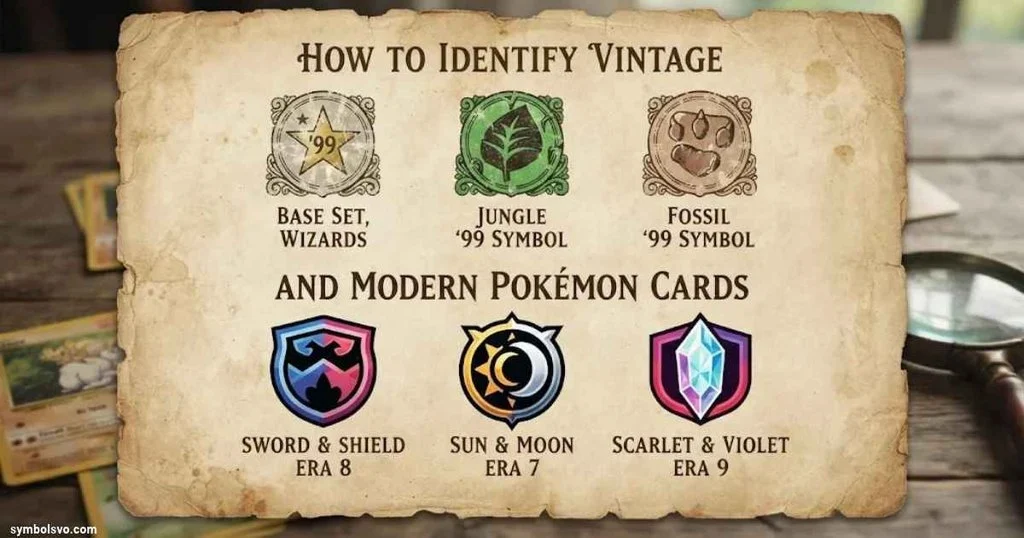
Vintage and modern Pokémon cards use different visual layouts and identification systems.
Learning these differences makes it easier to identify unfamiliar cards without relying entirely on a database.
How to Identify Vintage Pokémon Cards
Vintage cards generally come from the earlier Pokémon TCG generations.
Look for these identifying characteristics:
- Older yellow-bordered English card designs.
- Traditional expansion symbols.
- Older rarity classifications.
- First Edition stamps on eligible printings.
- Vintage collector numbering.
- Distinctive e-Reader layouts on applicable cards.
The original Base Set is particularly important because it lacks a traditional expansion symbol.
For that reason, collectors often use the collector number and other card characteristics to identify it.
For example, a card numbered 4/102 may indicate a Base Set card. However, you should check the card’s artwork, printing details, and other characteristics before confirming the exact version.
How to Identify Modern Pokémon Cards
Modern English cards use a more structured identification area.
Depending on the release, you may find:
- Three-letter expansion codes.
- Regulation marks.
- Collector numbers.
- Rarity classifications.
- Language indicators.
- Promotional prefixes.
A modern card from Paldea Evolved, for example, displays PAL as its expansion identifier.
A card from Temporal Forces displays TEF.
These codes make it easier to identify the correct expansion without memorizing dozens of graphic symbols.
Major Differences Between Vintage and Modern Pokémon Cards
| Feature | Vintage Pokémon cards | Modern Pokémon cards |
| Expansion identification | Traditional graphic symbols | Alphanumeric expansion codes |
| Card numbering | Older numbering conventions | Modern collector numbering |
| Rarity | Mostly common, uncommon, and rare classifications | Expanded rarity categories |
| Regulation marks | Generally absent | Present on modern cards |
| First Edition stamps | Present on eligible vintage releases | Not a standard modern marking |
| Promotional identification | Historical promo markings | Prefix-based promo identification is common |
| Card artwork | Older layouts and illustration styles | Modern full-art and special illustration designs |
Can You Identify a Pokémon Card Without a Set Symbol?
Yes.
A missing set symbol doesn’t prevent identification.
Several other details can help you find the correct expansion.
Try using:
- Card name: Search the Pokémon’s exact name.
- Collector number: Record the complete number and slash total.
- Artwork: Compare the illustration with known versions.
- Rarity: Check the rarity classification.
- Card layout: Identify the approximate generation.
- Promotional marking: Look for special prefixes or stamps.
For example, a Base Set card doesn’t have a traditional expansion symbol. Its collector number and other printed characteristics can still help identify it.
How to Look Up Pokémon Cards Using the Official Card Database
The official Pokémon TCG Card Database is a useful resource for identifying individual cards.
It allows collectors to search for cards using different characteristics rather than relying on expansion symbols alone.
This becomes particularly helpful when you have an unfamiliar card or multiple versions of the same Pokémon.
How to Search for a Pokémon Card by Name
Start by entering the Pokémon’s name into the database search.
For example, searching for Pikachu may return several different card versions.
Compare their artwork, expansion details, and collector numbers.
Avoid choosing the first result automatically. The same Pokémon can appear in many different releases.
How to Find a Card by Expansion
The database includes an expansion filter.
Use it when you already know the card’s expansion but need to locate its exact entry.
For example, selecting Scarlet & Violet narrows the search to cards from that release.
This is useful when completing an expansion checklist or comparing different cards from one set.
How to Identify a Card by Its Number
If you know the collector number, use it alongside the expansion information.
A number alone may match cards from different releases.
Combining the number with the Pokémon’s name and expansion code provides a more accurate result.
How to Compare Different Versions of the Same Card
A Pokémon can appear in multiple expansions and promotional releases.
Compare these details before deciding whether two cards are identical:
- Expansion identifier.
- Collector number.
- Artwork.
- Rarity.
- Card text.
- Promotional markings.
- Printing characteristics.
Two cards featuring Pikachu aren’t necessarily the same printing.
Even when their names match, their expansion and collector numbers may differ.
The official database’s search guidance also explains how to filter cards by expansion, rarity, Energy type, and other characteristics.
How to Organize Pokémon Cards by Set Symbols
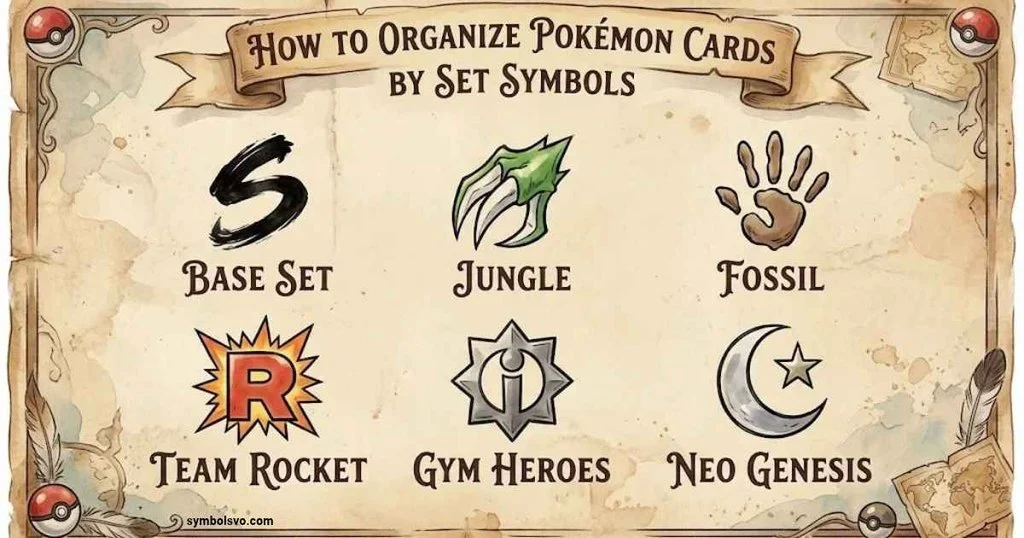
Once you understand Pokémon set symbols, organizing a collection becomes much easier.
Instead of storing every card randomly, create a system based on expansion and collector number.
This makes it easier to locate specific cards, identify duplicates, and track missing checklist entries.
Sort Cards by Expansion
Begin by separating your cards into individual expansions.
Create groups such as:
- Base Set
- Jungle
- Fossil
- Neo Genesis
- EX Ruby & Sapphire
- Diamond & Pearl
- XY
- Sun & Moon
- Sword & Shield
- Scarlet & Violet
- Mega Evolution
Keep promotional cards in a separate category unless you’re using a checklist that specifically includes them.
Arrange Cards by Collector Number
After separating the expansions, organize each group numerically.
For example:
| Order | Collector number |
| 1 | 001/198 |
| 2 | 002/198 |
| 3 | 003/198 |
| 4 | 004/198 |
| 5 | 005/198 |
This arrangement makes missing cards easier to identify.
Remember to keep special subsets separate when their numbering follows a different sequence.
Separate Promo Cards From Regular Expansions
Promotional cards deserve their own section.
Use a separate binder page or storage box for cards carrying promotional identifiers.
This prevents them from getting mixed with ordinary expansion cards.
Organize Duplicate Pokémon Cards
Duplicates are common when opening booster packs or purchasing collections.
Rather than mixing them with your main checklist, create a dedicated duplicate section.
You can sort duplicates by:
- Expansion.
- Pokémon name.
- Collector number.
- Rarity.
- Condition.
This arrangement makes it easier to trade duplicates or identify missing cards.
Create a Set Completion Checklist
A checklist helps you track progress toward completing an expansion.
For each card, record:
| Card number | Card name | Owned | Condition |
| 001/198 | Card A | Yes | Near Mint |
| 002/198 | Card B | No | — |
| 003/198 | Card C | Yes | Lightly Played |
| 004/198 | Card D | Yes | Near Mint |
This is only an organizational example. Replace the sample names with the actual cards from your expansion.
A digital spreadsheet works particularly well for large collections.
Store Vintage and Modern Cards Properly
Good storage protects your collection from unnecessary damage.
Consider using:
- Individual protective sleeves.
- Top loaders for selected valuable cards.
- Archival-quality binder pages.
- Suitable storage boxes.
- A dry storage environment away from direct sunlight.
Avoid placing valuable cards loosely in boxes where their surfaces can rub against other cards.
Do Pokémon Set Symbols Affect Card Value?
A set symbol helps identify a card, but it doesn’t automatically determine its market value.
Two cards from the same expansion can have very different prices.
One might be a common card with limited collector demand. Another might feature a popular Pokémon with highly desirable artwork.
Collectors should consider several factors before estimating a card’s value.
Does a Rare Set Symbol Make a Card Valuable?
Not necessarily.
An uncommon expansion symbol doesn’t automatically make every card from that release expensive.
The value depends on the individual card and its collector demand.
For example, a popular vintage holographic card may attract more interest than an ordinary card from the same expansion.
The symbol identifies the release. It doesn’t provide a price.
How Does Expansion Popularity Affect Demand?
Certain Pokémon expansions attract stronger collector interest.
This may happen because of:
- Popular Pokémon.
- Memorable artwork.
- Historical importance.
- Limited availability.
- Special card mechanics.
- Collector nostalgia.
Vintage expansions such as Base Set and Neo Destiny have strong historical significance.
Modern expansions can also attract attention when they contain popular Pokémon or desirable special illustration cards.
Why Do First Edition Cards Attract Collectors?
First Edition cards represent specific vintage printings.
Collectors often value them because of their historical significance and relative scarcity compared with unlimited printings.
However, not every First Edition card commands a high price.
The Pokémon, rarity, condition, and demand still matter.
How Do Card Condition and Printing Variations Affect Value?
Condition can make a substantial difference when evaluating Pokémon cards.
Collectors commonly examine:
- Surface scratches: Scratches can reduce visual quality.
- Whitening: White spots along the edges may indicate wear.
- Corner damage: Bent or damaged corners affect condition.
- Creases: Visible folds can significantly reduce desirability.
- Centering: Uneven borders can influence grading.
- Print variations: Certain printing characteristics may affect collector interest.
A valuable card in excellent condition may attract stronger offers than the same card with visible damage.
Why Isn’t Every Secret Rare Card Expensive?
Secret rare cards generally have special rarity classifications or numbering beyond the main checklist.
However, rarity and demand aren’t identical.
A card’s value depends on the number of interested collectors and the number of available copies.
Character popularity, artwork, condition, and market supply all influence demand.
A rare card isn’t automatically a valuable card.
That distinction is important when buying, selling, or trading Pokémon cards.
Common Mistakes When Identifying Pokémon Set Symbols
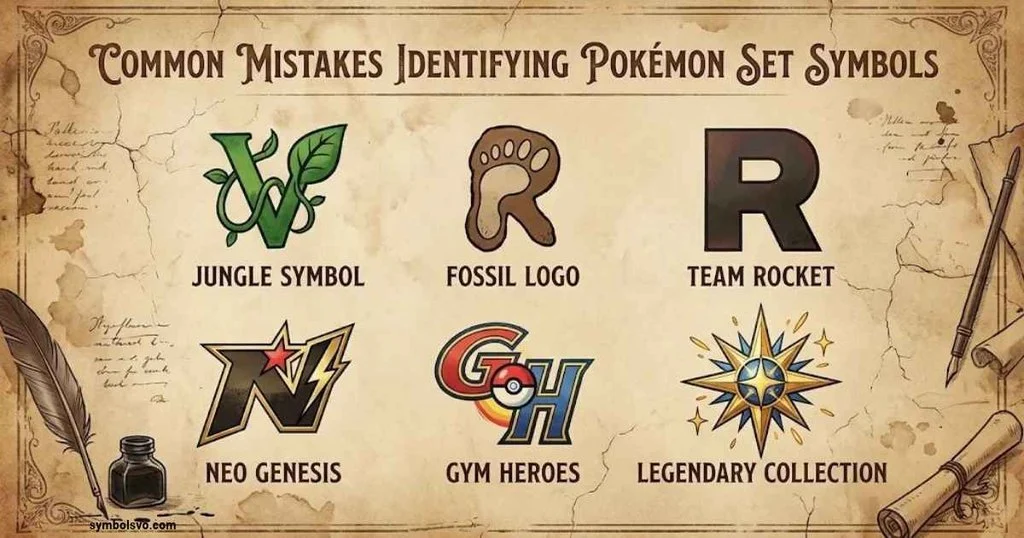
Even experienced collectors sometimes misidentify Pokémon cards. Most mistakes happen when people confuse different markings or overlook important numbering details.
Here are common errors worth avoiding.
Confusing Set Symbols With Rarity Symbols
A set symbol identifies the expansion. A rarity symbol indicates the card’s rarity classification.
These markings serve different purposes.
For example, a star beside a collector number can indicate rarity. It doesn’t automatically identify the expansion.
Treating Regulation Marks as Expansion Codes
A regulation mark is a letter used for competitive format identification.
An expansion code identifies the card’s release.
Both may appear close together, but they provide different information.
Assuming Every Pokémon Card Has a Set Symbol
Base Set is a well-known example of an expansion without a traditional set symbol.
Some promotional cards also use different identification methods.
Always examine the complete card before deciding that a missing symbol indicates a problem.
Ignoring the Collector Number
A set symbol alone might not distinguish different versions of a Pokémon.
The collector number adds another layer of identification.
Always check both details when researching a card.
Assuming Similar Artwork Means Identical Cards
Pokémon characters frequently appear in multiple expansions.
Two cards might feature similar artwork or the same Pokémon name while having different collector numbers.
Compare the complete identification details before treating them as duplicates.
Confusing Promotional Cards With Regular Expansion Cards
Promo cards can have special prefixes and numbering conventions.
They shouldn’t automatically be placed inside a regular expansion checklist.
Keep promotional releases separate when building your collection database.
Assuming Higher Numbers Mean Higher Value
A card numbered 215/203 might be a secret rare. However, the number doesn’t establish its market price.
Collector demand, condition, artwork, and availability all influence value.
Frequently Asked Questions About Pokémon Set Symbols
What Are Pokémon Set Symbols?
Pokémon set symbols are small graphic markings that identify the expansion associated with a Pokémon card. Older English cards generally use illustrated symbols while modern cards use alphanumeric expansion codes.
Collectors use these identifiers to organize cards, distinguish different releases, and complete expansion checklists.
What Do Pokémon Set Symbols Mean?
Each traditional set symbol represents a particular Pokémon TCG expansion.
For example, the Jungle symbol identifies cards from Jungle while the Fossil symbol identifies cards from Fossil.
Modern expansion codes perform a similar identification function.
Where Are Pokémon Set Symbols Located?
The location depends on the card’s generation.
Older cards commonly display expansion symbols near the lower-right area. Modern Sword & Shield and Scarlet & Violet cards generally show expansion identifiers along the bottom-left portion.
Some special releases use different layouts.
What Is a Pokémon Expansion Code?
A Pokémon expansion code is a short alphanumeric identifier printed on modern English Pokémon cards.
Examples include SVI for Scarlet & Violet, PAL for Paldea Evolved, and MEW for Pokémon 151.
These codes make digital card identification and collection management easier.
Did Pokémon Stop Using Traditional Set Symbols?
Pokémon moved away from traditional graphic expansion symbols on modern English cards.
The Sword & Shield era introduced alphanumeric expansion identifiers on English releases. Scarlet & Violet continued this approach.
The identification purpose remained similar even though the printed format changed.
Why Did Pokémon Change Its Set Symbol System?
Alphanumeric expansion codes provide a practical way to identify cards in digital databases and collection tools.
They are easier to type, search, and record than small graphic symbols.
The change also helps collectors distinguish modern releases more efficiently.
Are Pokémon Set Symbols the Same as Rarity Symbols?
No. They provide different information.
A set symbol identifies the expansion while a rarity symbol indicates the card’s rarity classification.
For example, a star can represent rarity on a traditional card. It doesn’t automatically identify which expansion contains that card.
What Is the Difference Between an Expansion Code and a Regulation Mark?
An expansion code identifies the Pokémon TCG release.
A regulation mark helps determine whether a card is eligible for the Standard competitive format.
For example, PAL identifies Paldea Evolved while a separate regulation letter indicates the card’s format designation.
How Do I Identify a Pokémon Card by Its Set Symbol?
First, locate the expansion symbol or code near the bottom of the card.
Next, record the collector number and compare both details with an expansion checklist.
Finally, confirm the Pokémon’s name, artwork, and printing information.
What Does 123/198 Mean on a Pokémon Card?
The number 123 identifies the card’s position within the expansion’s numbered checklist.
The number 198 represents the printed checklist total.
This format helps collectors organize cards and identify missing entries.
Can I Identify a Pokémon Card Without Its Set Symbol?
Yes. You can use the Pokémon’s name, collector number, artwork, rarity, and other printed markings.
Base Set cards are a good example because they don’t carry a traditional expansion symbol.
Promotional cards may also require alternative identification methods.
Do Pokémon Set Symbols Determine Card Value?
No. Set symbols identify expansions rather than market prices.
A card’s value depends on rarity, condition, character popularity, artwork, collector demand, and availability.
Two cards from the same expansion can have very different market values.
What Does the Black Star Symbol Mean on Pokémon Cards?
A black star commonly identifies a Pokémon promotional card.
These cards may come from special collections, promotional products, or organized Play! Pokémon events.
Many modern English promo cards also display prefixes such as SWSH or SVP.
What Is the Difference Between First Edition and Unlimited Pokémon Cards?
First Edition cards carry a special First Edition stamp on eligible vintage releases.
Unlimited cards come from later printings without that stamp.
Both can belong to the same expansion, but their printing characteristics differ.
Where Can I Find a Pokémon Set Symbols List?
A Pokémon set symbols list can be found in card-collecting databases and expansion checklists.
For official card information, the Pokémon TCG database provides searchable card records and expansion filters.
What Are the Scarlet & Violet Expansion Codes?
Some important Scarlet & Violet expansion codes include:
- SVI — Scarlet & Violet
- PAL — Paldea Evolved
- OBF — Obsidian Flames
- MEW — Pokémon 151
- PAR — Paradox Rift
- PAF — Paldean Fates
- TEF — Temporal Forces
- TWM — Twilight Masquerade
- SFA — Shrouded Fable
- SCR — Stellar Crown
- SSP — Surging Sparks
These codes help collectors identify modern English cards.
What Are Mega Evolution Pokémon Set Symbols?
Mega Evolution releases use the modern expansion identification approach rather than relying on the traditional vintage graphic-symbol system.
Collectors should examine the printed expansion identifier and collector number to identify the correct release.
The Mega Evolution series includes releases such as Mega Evolution, Phantasmal Flames, Ascended Heroes, Perfect Order, and Delta Reign.
Can Two Pokémon Cards Have the Same Number?
Yes. Different expansions can contain cards with identical collector numbers.
For example, two expansions might each include a card numbered 25/198.
The expansion identifier and Pokémon name help distinguish them.
How Can I Identify a Pokémon Promo Card?
Look for promotional markings and prefixes such as SWSH or SVP on modern English promotional cards.
Also examine the card’s artwork, collector number, and distribution history.
Some older promotional releases use different identification conventions.
How Do I Organize Pokémon Cards by Set?
Start by separating cards according to their expansions.
Next, arrange each group by collector number. Keep promotional cards and special subsets in separate sections.
A spreadsheet or collection checklist can help track duplicates and missing cards.
Conclusion: Understanding Pokémon Set Symbols
Pokémon set symbols are essential identification tools for anyone collecting the Trading Card Game. They help connect individual cards with their original expansions and make collection management much easier.
Older English cards generally use traditional graphic symbols while modern releases use alphanumeric expansion codes. Collector numbers provide additional information and help distinguish individual cards within each release.
However, set symbols aren’t the only markings worth understanding. Rarity symbols, regulation marks, promotional prefixes, and First Edition stamps all provide different information.
Once you understand these differences, identifying unfamiliar Pokémon cards becomes much simpler. You can sort expansions accurately, recognize different printings, track missing cards, and avoid common collecting mistakes.
The most reliable approach is to examine the expansion identifier and collector number together. When something still looks uncertain, verify the card’s complete details rather than relying on one marking alone.

I’m Nathan Holloway, a passionate researcher and writer with a deep interest in symbols, signs, and their hidden meanings. I enjoy exploring how symbols have influenced different civilizations, religions, and modern communication. Through my work, I aim to make complex historical and cultural concepts easy to understand for readers of all backgrounds. Every article I write is carefully researched to provide reliable and engaging information.
Books:
- Beyond the Symbol
- The Secret Meanings of Everyday Signs
Author 2: Grace Whitmore
Description:
My name is Grace Whitmore, and I love discovering the stories behind the world’s most fascinating symbols. I spend my time researching ancient civilizations, mythology, spiritual traditions, and modern iconography to uncover the meanings people often overlook. I believe that every symbol has a history worth telling, and I enjoy sharing that knowledge in a simple and reader-friendly way.
Books:
- Echoes of Ancient Symbols
- The Symbolic World
 Mason Ellington
 Daniel Brooks