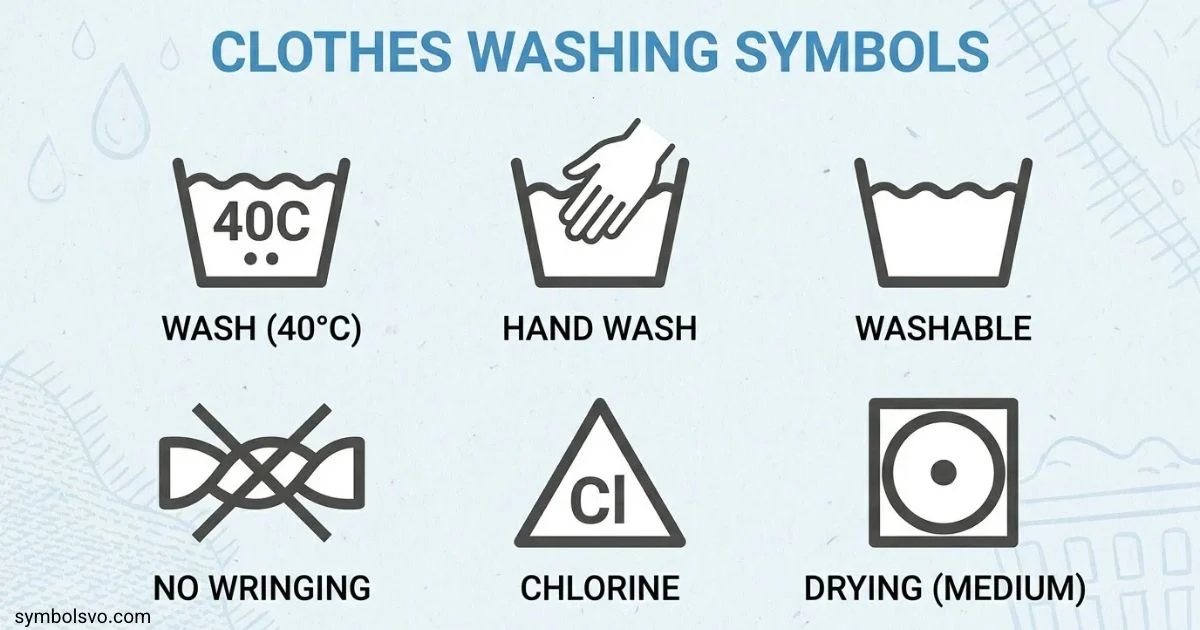
Have you ever looked at the tiny symbols on a clothing label and wondered whether you should wash the garment in hot water, tumble-dry it, or take it to a professional cleaner? You’re not alone. These small pictures provide important instructions that help you clean your clothes without damaging the fabric.
Clothes washing symbols explain how to wash, bleach, dry, iron, and professionally clean different textile items. Once you understand these laundry care symbols, you can make better decisions about water temperature, washing machine settings, drying methods, and heat levels.
This guide explains the most common clothing care symbols, their meanings, and how to use them in everyday laundry. You’ll also find a practical laundry symbols chart, explanations of special markings, fabric-specific tips, and answers to frequently asked questions.
Quick Reference: Clothes Washing Symbols Chart
Laundry labels typically organize care instructions into five categories: washing, bleaching, drying, ironing, and professional textile care. The international standard ISO 3758:2023 describes a symbol system for communicating these instructions. The exact appearance of symbols can vary between regional systems and labels. ISO 3758:2023 establishes the international framework for textile care labelling. <Entity value=”GINETEX” category=”organization” disambig=”International textile care labelling association”/> also explains the standard’s symbol categories in its official care symbols guide.
| Symbol appearance | Meaning | What you should do |
| Wash tub with a number | Maximum washing temperature | Do not exceed the stated temperature |
| Wash tub with one underline | Mild washing cycle | Choose a gentler machine program |
| Wash tub with two underlines | Very mild washing cycle | Use a delicate program with reduced agitation |
| Hand inside a wash tub | Hand washing | Wash gently according to the label |
| Crossed-out wash tub | Do not wash | Avoid ordinary home washing |
| Empty triangle | Bleaching permitted under the applicable symbol system | Follow the label and bleach product instructions |
| Triangle with diagonal lines | Non-chlorine or oxygen bleach only in the relevant system | Avoid chlorine bleach |
| Crossed-out triangle | Do not bleach | Skip bleach products |
| Square with a circle | Tumble drying instructions | Check dots or other markings inside |
| Square with a horizontal line | Flat drying | Dry the item on a flat surface |
| Square with a vertical line | Line or drip drying, depending on the markings | Hang or suspend as directed |
| Iron with dots | Ironing temperature | Match the heat setting to the number of dots |
| Crossed-out iron | Do not iron | Avoid direct ironing |
| Circle with letters | Professional cleaning instructions | Consult a professional cleaner |
Important: This is a simplified reference chart, not a complete reproduction of every official symbol. Regional standards and label designs can differ. When in doubt, read the full care label and check the manufacturer’s guidance.
What Are Clothes Washing Symbols?
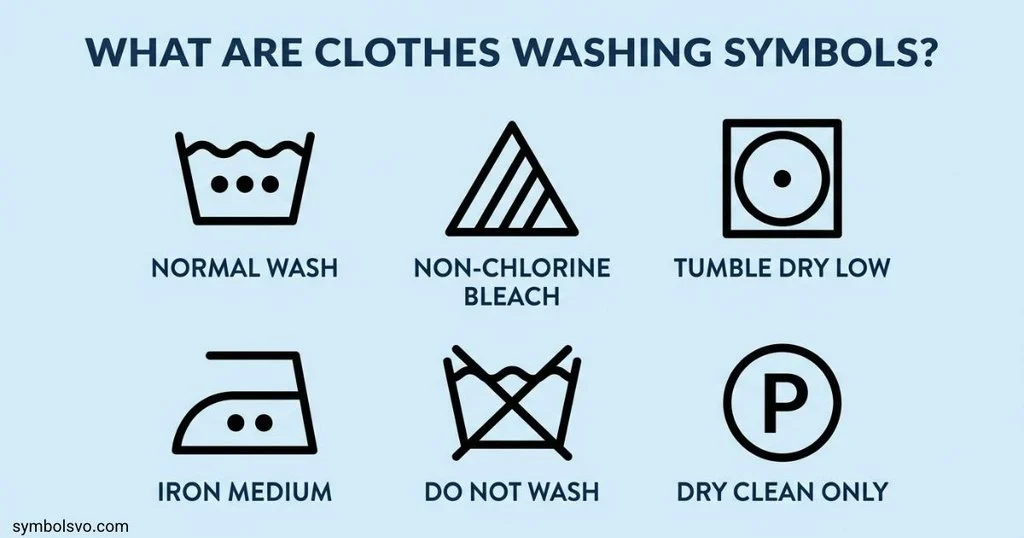
Clothes washing symbols, also called washing symbols, fabric care symbols, or laundry symbols, are small graphic instructions printed on clothing labels. They tell you which cleaning and finishing treatments a textile can tolerate.
Manufacturers use these symbols because pictures can communicate care instructions across language barriers. Instead of relying on a long paragraph, a label can show whether a garment can be machine-washed, bleached, tumble-dried, or ironed.
These instructions matter because two garments made from similar materials may need different treatment. A cotton shirt with a printed design, for example, may require more careful handling than a plain cotton towel. Dye, decorative details, fabric construction, and finishing treatments can all affect how a garment responds to washing.
Why Laundry Care Symbols Matter
Understanding laundry care symbols helps you:
- Reduce the risk of shrinking clothes.
- Prevent fading and color transfer.
- Avoid heat damage to delicate fabrics.
- Protect prints, embroidery, elastic, and decorative details.
- Choose suitable washing machine cycles.
- Decide when professional cleaning is necessary.
- Extend the useful life of clothing and household textiles.
A care label generally indicates the maximum treatment intended to be safe for the item. It does not guarantee that every stain will disappear. GINETEX notes that milder treatments and lower temperatures are permitted under its care-labelling guidance.
How to Read a Clothing Care Label
Before washing a new garment, locate its care label. You may find it inside a shirt near the side seam, inside the waistband of trousers, or along a seam in a dress. Bedding, towels, and other textiles may have labels sewn into an edge.
Read the complete sequence instead of focusing on just one symbol. A garment might be safe to wash in cool water but unsuitable for tumble drying or high-temperature ironing.
Follow the Symbols in Order
Many standardized care labels arrange instructions in this sequence:
- Washing
- Bleaching
- Drying
- Ironing
- Professional textile care
Each category answers a different question. Washing symbols describe wet cleaning, bleaching symbols address whitening treatments, drying symbols guide moisture removal, ironing symbols indicate heat limits, and professional-care symbols communicate specialized cleaning requirements.
Understand the Maximum-Treatment Principle
Think of a care label as a set of limits rather than a list of mandatory actions.
If a label allows washing at a maximum of 40°C, a cooler wash may be suitable when it still meets the garment’s cleaning needs. A lower temperature can also help reduce energy use. However, don’t assume that every lower-temperature wash will remove every type of stain.
Similarly, a garment marked for low-temperature ironing may tolerate less heat than a sturdy cotton item. Following the stated limit reduces the risk of damage.
Washing Symbols and Their Meanings
The wash tub is the main symbol for washing instructions. It indicates whether an item can be washed and, in many systems, specifies the maximum water temperature and the required level of washing action.
Wash Tub With a Number
A number inside the wash tub indicates the maximum permitted washing temperature in degrees Celsius under the ISO-style symbol system.
| Temperature marking | General interpretation | Typical use |
| 20°C | Very cool wash | Some delicate or color-sensitive items |
| 30°C | Cool wash | Many dark garments, synthetics, and delicate items |
| 40°C | Moderate-temperature wash | Many everyday garments, depending on the fabric |
| 50°C | Warmer wash | Selected items whose labels permit it |
| 60°C | Hotter wash | Certain durable textiles that tolerate the temperature |
| 95°C | Very hot wash | Limited items specifically designed for such treatment |
These examples are not universal recommendations for every fabric. Always follow the garment’s label. A 30°C symbol does not mean you must wash at exactly 30°C; it indicates that the temperature should not exceed that limit.
Why temperature matters: Hot water can contribute to shrinking, fading, or damage in some textiles. Cooler water may be appropriate for everyday clothing, especially when the detergent and washing program are suitable.
Wash Tub With One Underline
One underline beneath the wash tub indicates a mild washing cycle with reduced mechanical action.
This setting may be appropriate for clothing that needs gentler treatment than a regular cycle provides. It can help reduce rough handling, creasing, and unnecessary stress on the fabric.
Examples may include certain synthetic garments, easy-care clothing, and delicate blends. The exact suitable program depends on the garment and your washing machine.
Wash Tub With Two Underlines
Two underlines indicate a very mild washing cycle. This treatment uses especially reduced mechanical action and is often associated with delicate textiles, including some machine-washable wool garments.
To protect these items:
- Choose a suitable wool or delicate program.
- Avoid overloading the drum.
- Use a detergent appropriate for the fabric.
- Follow the label’s spin instructions.
- Remove the garment promptly when the cycle finishes.
A very mild wash is not the same as hand washing. The care label determines which method is suitable.
Hand-Wash Symbol
A hand inside a wash tub indicates hand washing under the relevant symbol system.
Hand washing is often used for garments that need controlled, gentle treatment. It can be helpful for selected delicate knits, lingerie, and embellished clothing, although not every delicate item should be washed at home.
For a garment labeled for hand washing:
- Fill a clean basin with water at the temperature indicated by the label.
- Add a suitable amount of detergent.
- Submerge the garment and move it gently through the water.
- Avoid vigorous rubbing, twisting, or pulling.
- Rinse as directed.
- Remove excess water carefully and follow the drying instructions.
Do not assume that every item can be hand-washed simply because it looks delicate. Some garments require professional care.
Crossed-Out Wash Tub
A crossed-out wash tub means do not wash under the applicable care-symbol system.
This warning can appear on garments that may be damaged by domestic wet cleaning. Water and agitation may affect special finishes, linings, trims, dyes, or fabric construction.
Check whether the label provides professional cleaning instructions. If it does, take the garment to a qualified cleaner and show them the complete label.
Bleaching Symbols Explained
Bleaching symbols use a triangle. They indicate whether a garment can tolerate bleaching and, where applicable, which types of bleach are permitted.
Bleach can help brighten certain washable textiles and treat specific stains. However, it can also remove color, weaken some fibers, and damage decorative finishes. Never assume that a white garment is automatically safe to bleach.
Empty Triangle
In the relevant international symbol system, an empty triangle indicates that bleaching is permitted, subject to the applicable care instructions.
Before using bleach, check the product label and garment instructions. A garment’s overall suitability for bleaching does not mean every bleach formula is appropriate for it.
Triangle With Two Diagonal Lines
A triangle containing two diagonal lines indicates a restriction to non-chlorine bleaching in the relevant symbol system. This is commonly associated with oxygen-based bleach products.
Check the product ingredients and directions rather than relying only on marketing terms. Follow the stated dosage and never mix cleaning chemicals.
Crossed-Out Triangle
A crossed-out triangle means do not bleach.
Avoid chlorine bleach and other bleaching products unless the manufacturer specifically confirms that a particular treatment is safe. For stain removal, use a suitable detergent or a fabric-compatible stain remover and test it on an inconspicuous area when the product instructions recommend doing so.
How to Choose a Safer Stain Treatment
When a stain appears, identify the fabric and check the label before applying a cleaning product.
- Grease: Use a detergent or stain treatment designed for oily stains.
- Food: Remove excess material gently and follow the product’s instructions.
- Ink: Check the garment and stain-remover guidance before applying a solvent.
- Sweat marks: Use a suitable laundry product and avoid excessive heat until the stain has been treated.
- Unknown stains: Avoid mixing several products in an attempt to remove them quickly.
Always follow the product’s safety instructions. Never mix bleach with ammonia, acids, or other cleaners because dangerous gases or reactions may result.
Drying Symbols and Their Meanings
Drying symbols generally use a square. A square with a circle provides tumble-drying instructions, while other markings inside the square can describe natural drying methods.
Correct drying is important because heat and mechanical movement can affect fabric size, shape, elasticity, and surface texture.
Square With a Circle
A square containing a circle indicates tumble drying. Additional markings specify whether it is permitted and which settings are suitable.
| Symbol feature | General meaning |
| Square with circle | Tumble-drying category |
| One dot inside the circle | Low heat |
| Two dots inside the circle | Normal or medium heat, according to the applicable system |
| Three dots inside the circle | Higher heat where the label permits it |
| Crossed-out square with circle | Do not tumble dry |
Follow the exact label. If tumble drying is prohibited, use an approved natural drying method instead.
Low-Heat Tumble Drying
Low heat may be suitable for certain synthetic or heat-sensitive garments that permit tumble drying.
To reduce unnecessary wear:
- Avoid overfilling the dryer.
- Use the recommended cycle.
- Remove garments promptly.
- Check whether elastic, prints, or trims need special care.
Normal-Heat Tumble Drying
A label permitting normal heat allows a suitable standard tumble-drying treatment within the system’s stated limits. It does not mean that every dryer program is appropriate.
Choose a cycle that matches the item and avoid adding delicate garments to a load that requires substantially different treatment.
Do Not Tumble Dry
A crossed-out tumble-drying symbol means the garment should not go into a tumble dryer.
Depending on the label, suitable alternatives may include line drying, drip drying, or flat drying. Avoid placing the item near intense heat unless the manufacturer permits it.
Natural Drying Symbols
Natural drying symbols use different lines and arrangements within a square. Their meaning depends on the full marking.
| Symbol feature | General interpretation |
| Horizontal line in a square | Dry flat |
| Vertical line or lines | Line drying or drip drying, depending on the marking |
| Additional diagonal line | Dry in the shade in the applicable symbol system |
| Combined markings | Follow the specific natural-drying instruction |
Dry flat means placing the garment on a suitable flat surface. This can help prevent some knits from stretching under their own weight.
Line drying means suspending the item to dry. Drip drying generally indicates that the garment should hang and drain without a conventional wringing or spinning treatment, as specified by the label.
If a shade marking appears, avoid direct sunlight. Strong sunlight may fade some dyes, particularly during prolonged exposure.
Ironing Symbols and Their Meanings
Ironing symbols use the outline of an iron. Dots inside the iron indicate the permitted heat level in the applicable symbol system.
The correct setting depends on the fabric and the garment’s construction. A high temperature may flatten wrinkles quickly, but it can also scorch, melt, or permanently mark some materials.
| Iron symbol feature | General meaning | Practical advice |
| One dot | Low heat | Suitable for selected heat-sensitive fabrics |
| Two dots | Medium heat | Use only when the label permits it |
| Three dots | High heat | Suitable for items that tolerate higher ironing temperatures |
| Crossed-out iron | Do not iron | Avoid ironing the garment |
| Iron with a no-steam marking, where shown | Iron without steam | Turn off steam and follow the label |
Low-Temperature Ironing
Low heat is often associated with materials that may be damaged by excessive temperature, such as some synthetic fabrics.
Use the lowest suitable setting and check the garment’s instructions. A pressing cloth may provide extra protection when appropriate, but it does not override a prohibition on ironing.
Medium-Temperature Ironing
A medium setting can suit some fabrics and blends, depending on the garment’s construction and finish.
Iron in small sections and avoid holding the iron in one place for too long. If the item has a printed design, embellishments, or delicate trim, follow the manufacturer’s specific guidance.
High-Temperature Ironing
High heat is intended only for textiles whose labels permit it. Some sturdy cotton or linen garments can tolerate higher ironing temperatures, but blended fabrics and finishes may behave differently.
When possible, iron while the garment is slightly damp only if its care instructions permit that approach. Use steam only when allowed.
Do Not Iron
A crossed-out iron means you should not iron the item.
If the garment looks wrinkled, consider an approved alternative such as hanging it neatly after washing or using a permitted steaming method. Do not assume a handheld steamer is safe simply because the label prohibits a conventional iron.
Professional Cleaning Symbols

Professional-care symbols generally use a circle. These professional cleaning symbols communicate information to dry cleaners and other textile-care specialists.
Some garments have linings, dyes, adhesives, trims, or finishes that require specialist treatment. The professional-care symbol helps the cleaner identify the type of treatment permitted by the label.
Circle With Letters
Letters inside a circle indicate information relevant to professional cleaning processes. The specific letter and any additional markings matter.
For example, a label may indicate a particular dry-cleaning solvent category or a professional wet-cleaning process. The meaning should be interpreted using the relevant standard rather than guessed from the letter alone.
| Symbol feature | General purpose |
| Circle | Professional textile-care category |
| Letter inside a circle | Specifies a permitted professional cleaning process or solvent category |
| Underline beneath the circle | May indicate a more restricted or gentler process |
| Crossed-out circle | Professional dry cleaning is prohibited in the applicable system |
Because these markings can be technical, show the cleaner the entire label rather than describing only one symbol.
Dry Cleaning Versus Professional Wet Cleaning
Dry cleaning uses specialized cleaning solvents rather than an ordinary household wash cycle. The process may also include controlled mechanical action and finishing.
Professional wet cleaning uses water-based cleaning with specialist equipment, detergents, and carefully controlled settings. It differs from simply putting a garment into a home washing machine.
Neither process is automatically appropriate for every garment. Follow the care label and the cleaner’s assessment.
Laundry Symbols Chart by Common Clothing Type
The right treatment depends on the exact garment, not just its broad fabric category. Use this table as a starting point and always confirm the label.
| Clothing or textile | What to check | Helpful care approach |
| Cotton T-shirts | Maximum wash temperature, tumble drying, ironing | Wash according to the label and avoid unnecessary high heat |
| Denim jeans | Wash temperature, bleaching, drying | Turn inside out when appropriate and avoid unauthorized bleach |
| Wool sweaters | Mild-cycle markings, hand washing, flat drying | Use a suitable wool program or hand wash only when permitted |
| Polyester sportswear | Temperature, cycle intensity, ironing | Choose a suitable gentle or regular cycle as directed |
| Silk garments | Washing restrictions, ironing, professional care | Follow the specific label closely |
| Printed shirts | Washing, drying, ironing | Avoid heat on printed areas when the manufacturer recommends it |
| Bras and delicate underwear | Washing intensity, drying | Use the stated delicate treatment and avoid prohibited dryer settings |
| Towels | Wash temperature, bleaching, tumble drying | Follow the label and separate colors when needed |
| Bed sheets | Temperature, bleaching, drying | Check the label, especially for blends and decorative finishes |
| Coats and structured jackets | Professional cleaning, ironing | Follow professional-care instructions where provided |
Cotton
Cotton comes in many constructions, from sturdy towels to lightweight shirts. Some cotton garments can tolerate warmer washing and higher ironing temperatures, but shrinkage, dyes, finishes, and blended fibers can change the appropriate treatment.
Wool
Wool may shrink or become felted under unsuitable combinations of moisture, heat, and mechanical action. Follow the garment’s specific washing and drying instructions. Some wool items are machine washable, while others require hand washing or professional care.
Silk
Silk garments may be sensitive to agitation, water, detergents, and heat. Don’t assume that all silk items require dry cleaning or that all can be hand-washed. The label provides the best starting point.
Polyester and Other Synthetics
Synthetic fabrics often have different heat tolerances from cotton and linen. Excessive dryer heat or ironing temperature may damage some synthetic fibers, elastic components, or finishes. Follow the stated temperature and drying limits.
Common Mistakes When Reading Clothes Washing Symbols
Even experienced laundry users can misread care labels. These mistakes are easy to avoid once you know what to look for.
Ignoring the Underlines
The number in a wash tub tells you the maximum temperature, but the underline adds another instruction. A mild or very mild cycle can be important for garments that need reduced mechanical action.
Treating Every Triangle the Same
Bleaching symbols communicate whether bleaching is allowed and, in some systems, which type is suitable. An empty triangle, a triangle with diagonal lines, and a crossed-out triangle do not mean the same thing.
Confusing Natural Drying With Tumble Drying
A square with a circle belongs to the tumble-drying category. A square with line markings may specify natural drying. Read the full marking before choosing a method.
Assuming Every White Garment Can Be Bleached
White fabric may contain dyes, coatings, trims, or fibers that react poorly to bleach. Check the label before using any bleaching product.
Using Too Much Heat
High heat can cause shrinkage, fading, distortion, or damage to certain fibers and finishes. Follow the label rather than relying on the assumption that hotter is always better.
Ignoring Professional-Care Instructions
A professional-care symbol may indicate that a garment needs specialized treatment. Home washing can damage an item that is not designed for domestic wet cleaning.
Cutting Off the Care Label
Removing a scratchy label may make clothing more comfortable, but it also removes useful information. Before cutting it off, take a clear photo of the instructions and keep the photo where you can find it later.
How to Wash Clothes Correctly Using Laundry Care Symbols
Knowing the symbols is only the first step. You also need to apply them when sorting, washing, drying, and finishing your laundry.
Step 1: Sort Your Laundry
Separate clothes according to color, fabric, and care requirements. Dark colors may transfer dye, while delicate garments may need a different washing cycle from towels or sturdy cotton items.
Step 2: Read Every Care Label
Check the washing, bleaching, drying, ironing, and professional-care instructions. If several garments need different treatments, follow a cycle suitable for the most delicate item in the load or wash the items separately.
Step 3: Choose the Correct Water Temperature
Use the temperature stated on the label as the maximum permitted level. A lower temperature may be suitable if the detergent and washing method can meet the garment’s cleaning needs.
Step 4: Select the Right Washing Cycle
Choose a regular, mild, very mild, or hand-washing method according to the label. Don’t rely on the cycle name alone because settings can vary between washing machines.
Step 5: Use Suitable Detergent
Select a detergent designed for the type of laundry you’re washing. Follow its dosage instructions and consider whether the garment requires a specialized product.
Step 6: Dry the Garment Correctly
Check whether tumble drying is permitted. If not, choose a suitable natural drying method, such as flat or line drying, when the label allows it.
Step 7: Iron Only When Permitted
Match the iron’s temperature to the label. If ironing is prohibited, use another approved method to reduce wrinkles.
Step 8: Seek Professional Advice When Necessary
If the label specifies professional cleaning or you can’t interpret a technical marking, consult a qualified textile-care professional. Keep the complete label available so the cleaner can assess all instructions.
Are Clothes Washing Symbols the Same Worldwide?
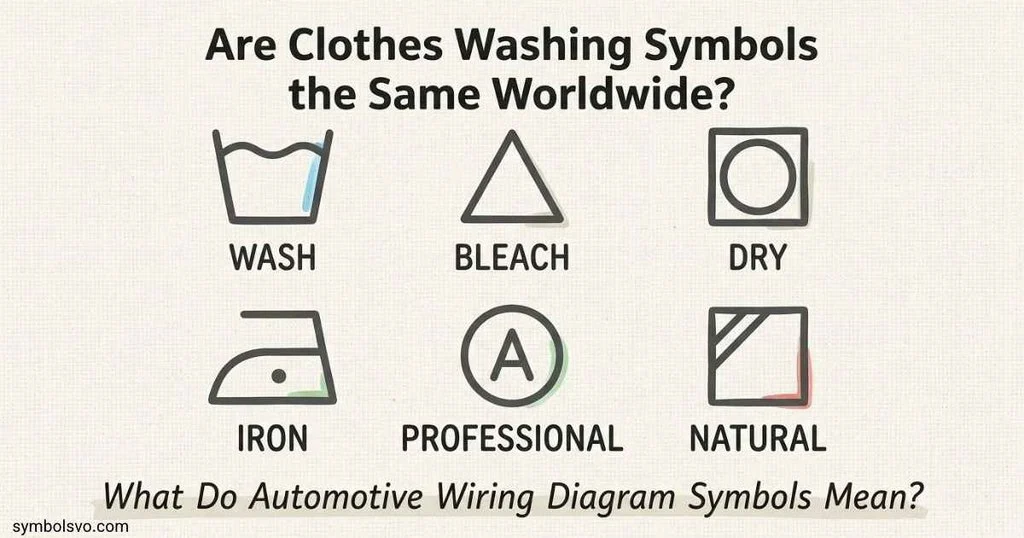
Many care-symbol systems share a common international framework, but labels may differ by region and market. The ISO 3758:2023 standard describes a system of symbols for domestic washing, bleaching, drying, ironing, and professional textile care. It is not a guarantee that every garment sold worldwide will use an identical label design..
Some labels also include written instructions, temperature values in different formats, or regional markings. US labels may use conventions that differ from those commonly seen on labels following the GINETEX system.
If you’re shopping internationally, don’t assume that every symbol looks exactly like the ones you’re familiar with. Look for written instructions when available and ask the manufacturer if a marking remains unclear.
What Is ISO 3758:2023?
ISO 3758:2023 is the fourth edition of the international standard titled Textiles — Care labelling code using symbols. Published in December 2023, it replaced the 2012 edition.
The standard describes a system of graphic symbols used to communicate the most severe care treatments intended not to cause irreversible damage to a textile article. It covers domestic washing, bleaching, drying, and ironing as well as professional dry and wet cleaning. Some specialized products, such as certain non-removable upholstery and mattress covers and carpets requiring professional carpet cleaning, fall outside its stated scope. provides the official scope.
GINETEX reported several changes in the 2023 edition, including new symbols for hand washing at ambient temperature and ironing without steam..
What Does GINETEX Do?
GINETEX is an international association associated with the development and promotion of textile care labelling. Its guidance explains how care symbols communicate permitted treatments and how the symbol sequence is organized.
The official organization also notes that its care symbols are protected trademarks in many countries. If you’re creating a commercial laundry guide, clothing label, or product design, check licensing and reproduction requirements before copying official symbol artwork. You can explain what symbols mean in original text without reproducing protected artwork.
Frequently Asked Questions About Clothes Washing Symbols
What are the five main laundry symbols?
The five main categories are washing, bleaching, drying, ironing, and professional textile care. Together, they communicate the primary treatments that a garment can tolerate.
What does a number inside a washing symbol mean?
A number inside the wash tub generally indicates the maximum washing temperature in degrees Celsius under the relevant international symbol system. Do not exceed the stated temperature.
What does one line under a washing symbol mean?
One underline indicates a mild washing cycle with reduced mechanical action. Choose a suitable gentle or mild program rather than assuming that a standard cycle is acceptable.
What do two lines under a washing symbol mean?
Two underlines indicate a very mild washing cycle. This instruction is particularly important for certain delicate textiles that need especially gentle handling.
What does a crossed-out washing symbol mean?
A crossed-out wash tub means the garment should not be washed under the applicable care-symbol system. Check the rest of the label for professional cleaning instructions.
What does a triangle mean on a clothing label?
A triangle belongs to the bleaching category. An empty triangle generally permits bleaching in the applicable system, a triangle with diagonal lines restricts the type of bleach, and a crossed-out triangle means not to bleach. Always interpret the complete marking.
What does a square with a circle mean?
A square containing a circle indicates tumble drying. Additional markings, such as dots or a cross, explain the permitted heat level or whether tumble drying is prohibited.
What does an iron with one dot mean?
One dot generally indicates a low-temperature ironing setting. Follow the garment’s label and the iron manufacturer’s temperature guidance.
Can I wash clothes at a lower temperature than the label shows?
A lower temperature is generally permitted when the label specifies a maximum temperature. However, use a suitable detergent and cycle for the garment and the type of soil you’re trying to remove.
Do laundry symbols tell me how to remove every stain?
No. Laundry symbols communicate care limits, not guaranteed stain-removal results. The right stain treatment depends on the stain, the fabric, and the products permitted for that garment.
Are washing symbols universal?
They are based on standardized systems, but label conventions and regional requirements can differ. When a symbol is unfamiliar, consult the manufacturer’s guidance or a reliable care-symbol reference.
What should I do if a clothing label is unclear?
Avoid guessing if the wrong treatment could damage the garment. Check the manufacturer’s website, look for written instructions, or ask a professional cleaner to interpret the complete label.
Final Thoughts on Clothes Washing Symbols
Learning clothes washing symbols makes laundry easier and helps you care for garments with more confidence. Start by recognizing the five main categories: washing, bleaching, drying, ironing, and professional textile care. Then look for details such as temperature numbers, underlines, dots, diagonal lines, and crossed-out markings.
The most important habit is simple: read the whole care label before washing or drying a garment. Choose a suitable cycle, avoid treatments the label prohibits, and seek professional advice when the instructions are unclear.
Once you understand these laundry symbols and their meanings, you’ll be better prepared to protect your clothing, avoid preventable damage, and make informed choices every time you do laundry.

I’m Daniel Brooks, a content creator and symbol enthusiast dedicated to researching the fascinating world of signs and symbols. I enjoy discovering the hidden meanings behind famous icons, emojis, historical emblems, and cultural symbols. Through my writing, I aim to provide trustworthy, well-researched, and reader-friendly information that helps people learn something new with every visit.
Books:
- The Complete Guide to World Symbols
- The Power of Universal Signs
 Mason Ellington
 Nathan Holloway