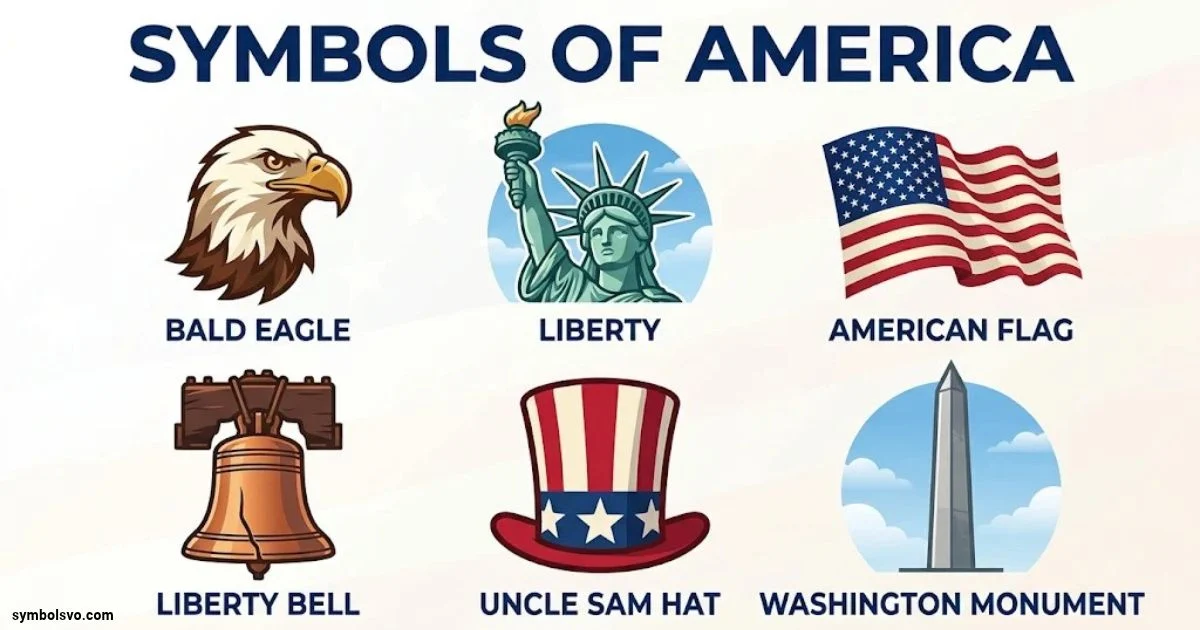
America has a rich collection of symbols that tell stories about its history, independence, culture, and national identity. Some represent freedom and democracy, while others honor important leaders, military sacrifices, and historic achievements. Together, these symbols help explain what the United States means to its people.
From the American Flag and Statue of Liberty to the Bald Eagle and Liberty Bell, each symbol carries a distinct story. Some emerged during the American Revolution, while others became important through immigration, political movements, and cultural traditions.
However, not every recognizable American symbol has the same official status. Congress has formally designated certain national symbols, while others gained recognition through historical events and public traditions.
In this guide, you’ll discover more than 25 important symbols of America, their meanings, historical origins, and connections to American freedom, patriotism, and heritage.
What Are the Symbols of America?
Symbols of America are objects, landmarks, documents, animals, songs, and traditions that represent the United States and its people. They communicate important ideas about the country’s history, government, culture, and shared values.
Some American symbols have official recognition under federal law. Others became meaningful because of their connection to major historical events or national traditions.
For example, the American Flag represents the nation itself, while the Statue of Liberty has become a powerful symbol of freedom and immigration. Similarly, the Constitution represents the country’s system of government and the principles behind its laws.
American symbols generally fall into several categories:
- National symbols: Officially recognized emblems, including the national flag, bird, flower, tree, and motto.
- Historical symbols: Objects and places connected to important events, such as Independence Hall and the Liberty Bell.
- Political symbols: Documents and emblems representing American government and democracy.
- Cultural symbols: Familiar figures, traditions, and ideas such as Uncle Sam and the American Dream.
- Patriotic symbols: Flags, songs, monuments, and memorials that express national pride and remembrance.
These symbols also help preserve American heritage. They remind people of the nation’s achievements, struggles, sacrifices, and continuing efforts to protect individual rights.
American Flag (Stars and Stripes)
National flag of the United States
The American Flag, commonly called the Stars and Stripes or Old Glory, is one of the most recognizable symbols of the United States. It represents the country, its people, and its national independence.
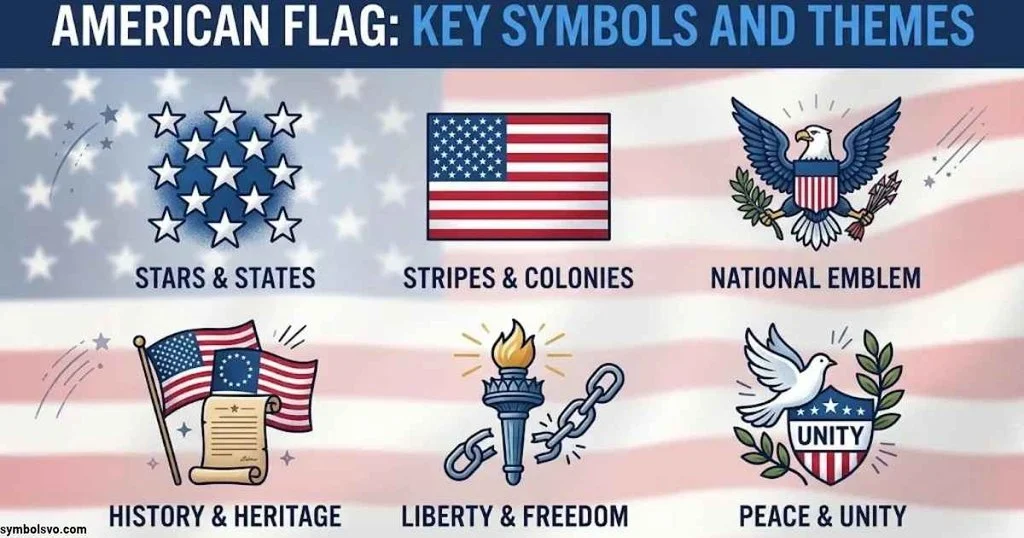
Its design features 13 alternating red and white stripes and a blue rectangle containing 50 white stars. Each element carries a connection to American history.
The 13 stripes represent the original British colonies that declared independence in 1776. The 50 stars represent the states that make up the modern United States.
The Continental Congress adopted the first official national flag resolution on June 14, 1777. As the country expanded, additional stars appeared whenever new states joined the Union.
The current 50-star design became official on July 4, 1960, following Hawaii’s admission as the 50th state.
The flag’s colors also carry traditional symbolic meanings:
| Color | Traditional meaning |
| Red | Valor and bravery |
| White | Purity and innocence |
| Blue | Vigilance, perseverance, and justice |
The familiar nickname Old Glory became popular through the story of American sea captain William Driver, who used the phrase for his flag in the nineteenth century.
Today, Americans display the flag during Independence Day, Memorial Day, Veterans Day, sporting events, and other national occasions. It remains a powerful emblem of American patriotism, unity, and independence.
Statue of Liberty
Symbol of freedom, liberty, and immigration
The Statue of Liberty stands on Liberty Island in New York Harbor. It represents freedom, opportunity, and the welcoming spirit associated with the United States.
France gave the monument to America as a gift celebrating the friendship between the two countries and the American ideals of liberty. French sculptor Frédéric Auguste Bartholdi designed the statue, while engineer Gustave Eiffel helped develop its internal structure.
The monument was officially dedicated on October 28, 1886.
Its most recognizable features carry important meanings:
- Raised torch: Represents enlightenment and the light of liberty.
- Seven-pointed crown: Traditionally represents the seven continents and seven seas.
- Stone tablet: Displays July 4, 1776, the date of American independence.
- Broken chains: Represent freedom from oppression and tyranny.
- Copper exterior: Gives the statue its distinctive green appearance through natural oxidation.
The Statue of Liberty also became closely associated with immigration. During the late nineteenth and early twentieth centuries, millions of immigrants arrived in America seeking safety, work, and new opportunities.
The nearby Ellis Island immigration station helped strengthen this association.
For generations, the statue has represented the hope of building a better future. It remains one of the most important American symbols of freedom and a lasting reminder of liberty and opportunity.
Bald Eagle
National bird of the United States
The Bald Eagle represents American strength, courage, independence, and freedom. Its powerful appearance and ability to soar high above the landscape made it a natural choice for a national emblem.
The Continental Congress selected the bald eagle for the Great Seal of the United States on June 20, 1782. Since then, the bird has appeared on official government documents, military insignia, and other national designs.
Congress officially designated the bald eagle as America’s national bird on December 23, 2024. This legislation formalized a role the bird had held in American symbolism for more than two centuries.
The eagle’s symbolism also appears in the Great Seal:
- The olive branch represents peace.
- The arrows represent readiness to defend the nation.
- The shield represents the United States.
- The eagle’s position connects the ideas of peace and national defense.
The bald eagle faced serious population declines during the twentieth century. Hunting, habitat loss, and the widespread use of the pesticide DDT contributed to its decline.
Federal protection and conservation programs helped the species recover. Its removal from the endangered species list in 2007 marked an important wildlife conservation achievement.
Today, the bald eagle represents both American national pride and the importance of protecting the country’s natural heritage.
Liberty Bell
Historical symbol of liberty and independence
The Liberty Bell is one of America’s most recognizable historical symbols. Located in Philadelphia, Pennsylvania, it represents liberty, independence, and the struggle for equal rights.
The Pennsylvania Provincial Assembly ordered the bell in 1751 to commemorate the fiftieth anniversary of William Penn’s 1701 Charter of Privileges. London foundry Whitechapel Bell Foundry produced it, and the bell arrived in Philadelphia in 1752.
Originally known as the State House Bell, it hung in the Pennsylvania State House, now called Independence Hall.
Its most famous inscription reads:
Proclaim Liberty Throughout All the Land Unto All the Inhabitants Thereof.
The wording comes from Leviticus 25:10 in the Bible.
The bell developed a major association with American independence after the Declaration of Independence was publicly read in Philadelphia on July 8, 1776. However, the popular story that the bell rang on that exact occasion is not firmly established.
Its famous crack eventually made the bell unusable. Nevertheless, that damage did not reduce its historical importance.
During the nineteenth century, abolitionists adopted the Liberty Bell as a symbol of their campaign against slavery. They used its message of liberty to demand freedom and equal rights for enslaved Americans.
Today, the bell stands in the Liberty Bell Center at Independence National Historical Park. It represents the ongoing American struggle to make liberty meaningful for everyone.
Great Seal of the United States
Official emblem of American sovereignty
The Great Seal of the United States is an official emblem used to authenticate government documents. It also communicates important ideas about national sovereignty, unity, peace, and strength.
Congress approved the final design on June 20, 1782, after several committees worked on different proposals.
The seal has two sides, each containing distinctive imagery.
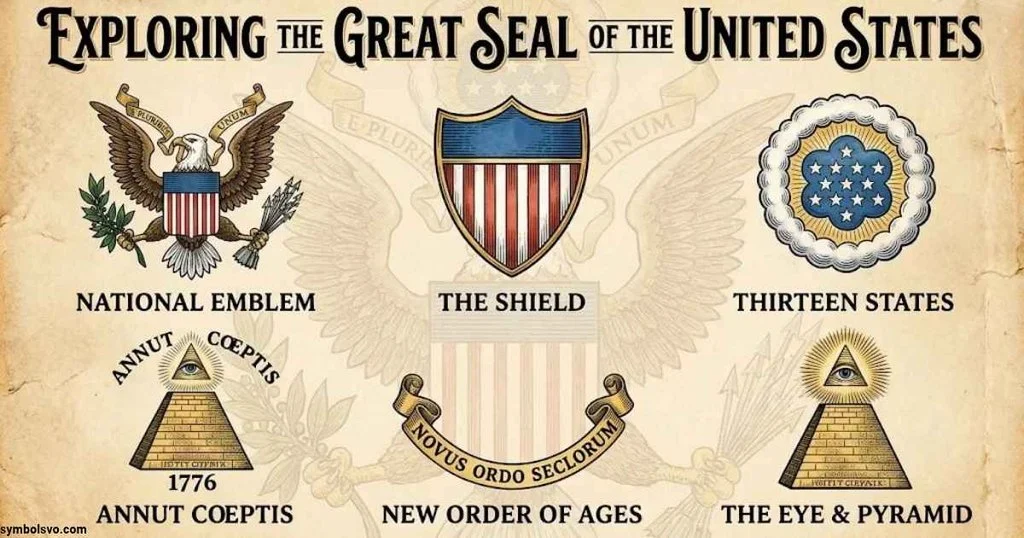
The front side features:
- A bald eagle representing the United States.
- A shield containing 13 red and white stripes.
- A blue upper section representing the Union.
- An olive branch with 13 leaves.
- A bundle of 13 arrows.
- A constellation of 13 stars.
- The Latin motto E Pluribus Unum, meaning “Out of Many, One.”
The olive branch and arrows express the country’s preference for peace while recognizing its responsibility to defend itself.
The reverse side features:
- An unfinished pyramid.
- The Eye of Providence above the pyramid.
- The Roman numerals MDCCLXXVI, representing 1776.
- The Latin phrases Annuit Cœptis and Novus Ordo Seclorum.
The unfinished pyramid represents strength and lasting development. The Eye of Providence traditionally represents divine oversight.
The reverse design also appears on the one-dollar bill, where it became part of the familiar Great Seal imagery used on American currency.
Uncle Sam
Personification of the United States government
Uncle Sam is a familiar personification of the United States. His appearance usually includes a white beard, tall hat, blue coat, and red-and-white clothing.
The character became popular during the War of 1812. His name is traditionally connected to Samuel Wilson, a meat supplier from Troy, New York, who provided food to American soldiers.
According to the popular historical account, soldiers associated meat barrels marked with the initials U.S. with Wilson’s nickname, Uncle Sam. The expression gradually became a humorous reference to the federal government.
During the nineteenth century, political cartoons helped establish Uncle Sam as a national character.
He became especially recognizable through the famous recruitment poster showing him pointing toward viewers with the words “I Want YOU for U.S. Army.”
Uncle Sam represents:
- The federal government.
- American military recruitment.
- National authority.
- Patriotism and civic responsibility.
- The broader American national identity.
Unlike the bald eagle or national flag, Uncle Sam is not an official national emblem. He is a cultural symbol that became deeply rooted in American political imagery.
Star-Spangled Banner
National anthem of the United States
The Star-Spangled Banner is the national anthem of the United States. Its history connects American patriotism with the country’s defense during the War of 1812.
On September 13–14, 1814, British forces attacked Fort McHenry in Baltimore, Maryland. Francis Scott Key watched the bombardment from a ship in Baltimore Harbor.
After the battle, Key saw the American flag still flying above the fort. The sight inspired him to write a poem titled “Defence of Fort M’Henry.”
The poem later became known as “The Star-Spangled Banner.” Its lyrics were eventually paired with a melody associated with the Anacreontic Society, an eighteenth-century British musical organization.
The song gained popularity during the nineteenth century. Congress officially designated it as the national anthem on March 3, 1931.
Its message celebrates perseverance, national survival, and the determination to defend American independence.
The original flag that inspired Key’s poem survives today at the Smithsonian National Museum of American History.
United States Constitution
Foundation of American government and constitutional rights
The United States Constitution is the supreme law of the country. It established the structure of the federal government and defined the relationship between national institutions and the states.
Delegates gathered at the Philadelphia Convention in 1787 to address weaknesses in the Articles of Confederation. Their work produced a new constitutional framework.
The Constitution was signed on September 17, 1787. It became effective after the required states ratified it in 1788, and the new federal government began operating in 1789.
Its original structure contains seven articles:
| Article | Main subject |
| Article I | Legislative branch |
| Article II | Executive branch |
| Article III | Judicial branch |
| Article IV | Relations among states |
| Article V | Constitutional amendments |
| Article VI | Supremacy of federal law |
| Article VII | Ratification |
The Constitution also begins with the Preamble, which introduces its central purposes.
Its famous opening words are:
We the People of the United States…
This phrase emphasizes that the government receives its authority from the people.
The Constitution represents American democracy, the rule of law, limited government, and the protection of constitutional rights. It remains one of the country’s most important political and historical symbols.
Bill of Rights
The Bill of Rights consists of the first ten amendments to the United States Constitution. It protects important individual freedoms and limits certain government powers.
James Madison introduced the proposed amendments in Congress in 1789. The states ratified ten of them on December 15, 1791.
These amendments protect several fundamental rights:
- First Amendment: Freedom of religion, speech, the press, assembly, and petition.
- Second Amendment: The right to keep and bear arms.
- Third Amendment: Protection against the quartering of soldiers in private homes during peacetime without the owner’s consent.
- Fourth Amendment: Protection against unreasonable searches and seizures.
- Fifth Amendment: Important protections for people accused of crimes, including due process.
- Sixth Amendment: Rights to a speedy and public criminal trial.
- Seventh Amendment: Jury trials in certain federal civil cases.
- Eighth Amendment: Protection against excessive bail, excessive fines, and cruel and unusual punishments.
- Ninth Amendment: Recognition that people retain rights beyond those specifically listed in the Constitution.
- Tenth Amendment: Powers not delegated to the federal government or prohibited to the states are reserved to the states or the people.
The Bill of Rights represents the American commitment to civil liberties, constitutional protections, and individual freedom.
Its influence remains visible in court decisions, public debates, and discussions about the relationship between citizens and government.
Declaration of Independence
The Declaration of Independence is one of the most important founding documents in American history. Adopted on July 4, 1776, it announced that the thirteen American colonies considered themselves independent states rather than British possessions.
Thomas Jefferson wrote the initial draft with input from the Committee of Five. The Continental Congress debated and approved the final document.
Its most famous passage declares:
We hold these truths to be self-evident, that all men are created equal…
The document identifies several important principles:
- People possess inherent rights.
- Governments receive their authority from the consent of the governed.
- Individuals have rights to life, liberty, and the pursuit of happiness.
- People can challenge governments that violate their fundamental rights.
The Declaration did not immediately establish equal rights for everyone. Slavery continued, women lacked equal political rights, and Indigenous peoples faced dispossession.
Nevertheless, its language became an important foundation for later abolitionist campaigns and the civil rights movement.
Today, the Declaration of Independence represents American independence, self-government, equality, and the continuing pursuit of liberty.
Washington Monument
The Washington Monument honors George Washington, the first president of the United States and commander of the Continental Army during the American Revolution.
Located on the National Mall in Washington, DC, the monument is a tall Egyptian-style obelisk made primarily from marble, granite, and bluestone gneiss.
Architect Robert Mills designed the original monument. Construction began in 1848 but experienced funding problems and political delays.
Workers completed the structure in 1884, and it officially opened to the public in 1888.
The monument reaches 555 feet and 5⅛ inches above ground, making it one of the most recognizable landmarks in the American capital.
Its simple shape conveys permanence, strength, and national remembrance.
The Washington Monument represents:
- George Washington’s leadership.
- American independence.
- National unity.
- Presidential legacy.
- The establishment of the United States.
Its position near the White House and other major memorials makes it an important part of America’s national landscape.
Lincoln Memorial
The Lincoln Memorial honors Abraham Lincoln, the sixteenth president of the United States. It stands at the western end of the National Mall in Washington, DC.
Architect Henry Bacon designed the memorial to resemble a classical Greek temple. Inside, a large seated sculpture of Lincoln by Daniel Chester French dominates the central chamber.
The memorial was dedicated on May 30, 1922.
Its walls display two important speeches: the Gettysburg Address and Lincoln’s Second Inaugural Address.
Both speeches reflect Lincoln’s views on national unity, the Civil War, and the moral challenge of slavery.
The memorial later became an important gathering place during the American civil rights movement.
On August 28, 1963, Martin Luther King Jr. delivered his famous “I Have a Dream” speech from the memorial’s steps.
Today, the Lincoln Memorial represents equality, freedom, national remembrance, and the ongoing struggle for civil rights.
Mount Rushmore
Mount Rushmore National Memorial is a monumental sculpture located in the Black Hills of South Dakota. It features the carved faces of four American presidents.
Sculptor Gutzon Borglum directed the project, which began in 1927 and reached completion in 1941.
The four presidents represent different periods and developments in American history.
| President | Historical significance |
| George Washington | Leadership during independence and the founding of the nation |
| Thomas Jefferson | Declaration of Independence and territorial expansion |
| Theodore Roosevelt | Progressive reforms and American development |
| Abraham Lincoln | Preservation of the Union and abolition of slavery |
The sculpture’s faces measure approximately 60 feet tall.
Mount Rushmore represents American presidential leadership, national history, and major political achievements.
However, its location carries a deeper history. The Black Hills hold spiritual and cultural significance for the Lakota people. The United States acquired control of the area following broken treaty agreements and conflicts with Indigenous nations.
Understanding this history gives visitors a fuller picture of the monument’s place in American heritage.
White House
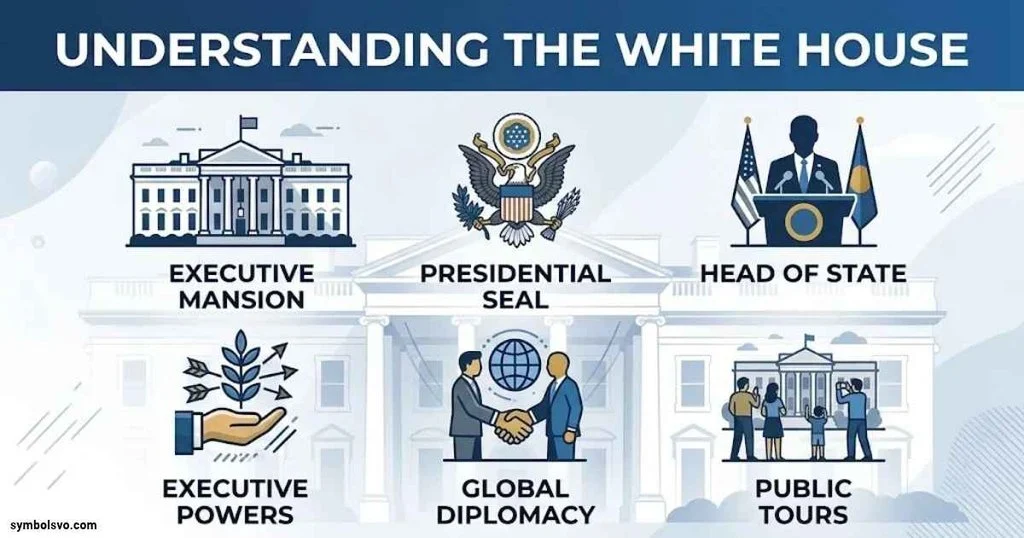
The White House is the official residence and principal workplace of the president of the United States. It stands at 1600 Pennsylvania Avenue NW in Washington, DC.
Irish-born architect James Hoban designed the building. Construction began in 1792, and President John Adams moved into it in 1800.
British forces burned the building during the War of 1812 in August 1814. Workers later rebuilt it, and it gradually became the recognizable presidential residence known today.
The building contains several important areas:
- Executive Residence: The main residential section.
- West Wing: Contains the Oval Office and other presidential working spaces.
- East Wing: Houses offices and functions connected to the first lady and other staff.
- State Rooms: Used for official receptions and diplomatic events.
The White House represents the American presidency, executive government, and the peaceful transfer of political authority.
It also serves as a symbol of American political leadership around the world.
Pledge of Allegiance
The Pledge of Allegiance is a patriotic statement expressing loyalty to the American flag and the republic it represents.
Francis Bellamy wrote the original pledge in 1892 for a national school celebration marking the four-hundredth anniversary of Christopher Columbus’s arrival in the Americas.
Congress officially recognized the pledge in 1942. In 1954, President Dwight D. Eisenhower signed legislation adding the words “under God.”
Its current wording is:
I pledge allegiance to the Flag of the United States of America, and to the Republic for which it stands, one Nation under God, indivisible, with liberty and justice for all.
The pledge appears at many school events, public ceremonies, and civic gatherings.
It represents patriotism, national loyalty, and the principles of liberty and justice. However, the First Amendment protects freedom of expression and religious belief, so public school students cannot constitutionally be forced to recite it.
American Rose
The rose is the official national floral emblem of the United States. It represents beauty, love, peace, and national pride.
President Ronald Reagan proclaimed the rose America’s national floral emblem on November 20, 1986.
The designation followed a congressional resolution recognizing the flower’s historical and cultural importance.
Roses have long appeared in American gardens, public parks, celebrations, and ceremonial events.
The White House Rose Garden is another familiar example of the flower’s connection to American public life. Established during the presidency of Woodrow Wilson and later redesigned by other administrations, it serves as an important setting for presidential ceremonies.
The rose is also associated with events such as the Rose Parade and the Rose Bowl.
Although the flower does not represent a specific political event, it contributes to the country’s broader American cultural symbols and traditions.
American Oak Tree
The oak tree became the official national tree of the United States in 2004.
Congress selected the oak because of its widespread presence, historical importance, and strong association with American landscapes.
Oak trees can live for hundreds of years. Their sturdy trunks, deep roots, and broad branches make them familiar symbols of strength and endurance.
Several oak species grow across the country, including white oak, northern red oak, and live oak.
The tree also has practical importance. Oak wood has traditionally been used for furniture, flooring, shipbuilding, and construction.
As a national symbol, the oak represents stability, resilience, and the enduring character of American natural heritage.
North American Bison
The North American bison became the official national mammal of the United States in 2016.
Often called the American buffalo, this large mammal played an important role in North America’s natural and cultural history.
For centuries, bison supported Indigenous communities across the Great Plains. They provided food, clothing, shelter materials, and resources for tools.
During the nineteenth century, commercial hunting and government-supported destruction caused bison populations to collapse.
Conservation programs later helped restore the species. Yellowstone National Park remains particularly important because it protects one of the country’s longest continuously surviving wild bison populations.
The bison represents:
- American wildlife heritage.
- Strength and resilience.
- Conservation and environmental protection.
- The history of the Great Plains.
- The cultural traditions of Indigenous peoples.
Its national designation also highlights the importance of protecting America’s native wildlife.
National Motto: In God We Trust
In God We Trust is the official national motto of the United States.
The phrase first appeared on American coins during the Civil War era. Congress authorized its use on certain coins in 1864.
In 1956, Congress adopted it as the official national motto, replacing the earlier emphasis on E Pluribus Unum as the country’s formal motto.
The phrase reflects a religious expression that became part of American national identity and public symbolism.
It appears on American currency, including paper money and coins.
However, the motto’s official status does not establish a national religion. The Constitution’s First Amendment protects religious liberty and prohibits government establishment of religion.
The Stars and Stripes Forever
The Stars and Stripes Forever is the official national march of the United States.
American composer and bandleader John Philip Sousa wrote the march in 1896. It received its first public performance in Philadelphia on May 14, 1897.
The composition became one of Sousa’s best-known works because of its energetic rhythm, memorable melody, and strong association with American celebrations.
Congress designated it the national march in 1987.
Today, marching bands frequently perform it during parades, patriotic ceremonies, and national celebrations.
The piece represents American musical heritage, patriotism, and the country’s long tradition of public celebrations.
The American Dream
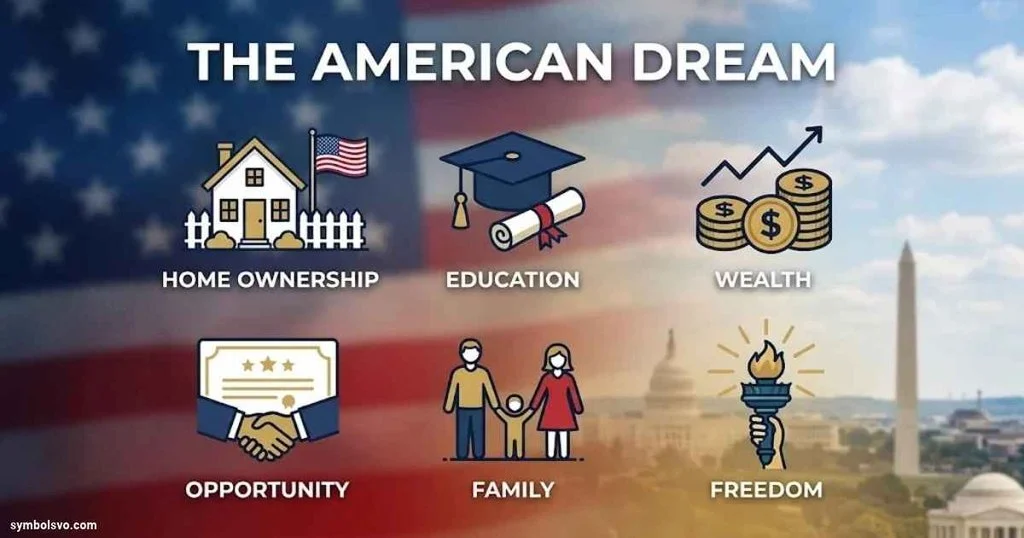
The American Dream is a cultural idea representing the belief that people can improve their lives through opportunity, hard work, and personal determination.
The phrase became especially popular after historian James Truslow Adams used it in his 1931 book The Epic of America.
The concept does not refer to one specific monument or official government emblem. Instead, it represents an important part of the American national identity.
For many people, the American Dream means:
- Access to education.
- Opportunities for employment and business ownership.
- Economic mobility.
- Personal independence.
- Freedom to pursue individual goals.
- A better future for the next generation.
The meaning has changed over time. Immigration, economic conditions, social movements, and changing expectations have all shaped how Americans understand this ideal.
It remains one of the most influential symbols of American opportunity.
Ellis Island
Ellis Island is a historic immigration site in New York Harbor. It represents immigration, hope, opportunity, and the experiences of millions of people who entered the United States.
The federal immigration station opened on January 1, 1892. It processed immigrants arriving by ship, particularly those coming from Europe.
Between 1892 and 1954, approximately 12 million immigrants passed through the Ellis Island immigration station.
For many families, the island marked the beginning of a new life. Immigrants hoped to find employment, escape political persecution, reunite with relatives, or build safer futures.
However, the immigration process could also involve medical inspections, legal questioning, and possible detention or exclusion.
Today, Ellis Island forms part of the Statue of Liberty National Monument. Its museum preserves photographs, records, and personal stories that help explain America’s immigration history.
It remains an important symbol of the country’s diverse population and changing national identity.
Independence Hall
Independence Hall is a historic building in Philadelphia, Pennsylvania, where two major documents shaped American history.
The Continental Congress adopted the Declaration of Independence there in 1776. Delegates also signed the United States Constitution in 1787.
Originally built as the Pennsylvania State House, the building became an important center of colonial political activity.
Its historical significance extends beyond the documents themselves. The building represents debate, political cooperation, and the creation of a new national government.
Independence Hall is now part of Independence National Historical Park and is recognized as a UNESCO World Heritage Site.
It remains one of the most important American historical symbols because it connects the nation’s founding principles with the physical place where leaders debated and adopted them.
Arlington National Cemetery and the Tomb of the Unknown Soldier
Arlington National Cemetery honors American military personnel who served the country. Located in Arlington, Virginia, it contains the graves of service members, veterans, and eligible family members.
The cemetery was established during the Civil War in 1864 on the grounds of the former Arlington estate.
One of its most important landmarks is the Tomb of the Unknown Soldier.
Dedicated on November 11, 1921, the tomb honors unidentified American service members who died in World War I. Unknown soldiers from later conflicts were also interred there.
The tomb’s changing of the guard ceremony reflects the nation’s commitment to remembering military service and sacrifice.
These landmarks represent:
- Military honor.
- National remembrance.
- Courage and sacrifice.
- Service to the United States.
- Respect for fallen soldiers.
They play an important role during Memorial Day, Veterans Day, and other national remembrance ceremonies.
National Mall
The National Mall is a large public park in Washington, DC, surrounded by some of America’s most important monuments and museums.
It stretches between the United States Capitol and the Lincoln Memorial, with the Washington Monument standing near its center.
The National Mall provides a setting for historical remembrance, public celebrations, political demonstrations, and national ceremonies.
Major landmarks include:
- Washington Monument.
- Lincoln Memorial.
- World War II Memorial.
- Vietnam Veterans Memorial.
- Korean War Veterans Memorial.
- National Museum of American History.
- Smithsonian National Museum of Natural History.
The National Mall has also hosted major civil rights gatherings and presidential events.
It represents civic participation, public expression, and the democratic tradition of allowing citizens to gather and communicate their views.
Unlike an official national emblem, the National Mall is a public landscape whose symbolic importance comes from the events and memorials associated with it.
American Symbols of Freedom, Liberty, and Independence
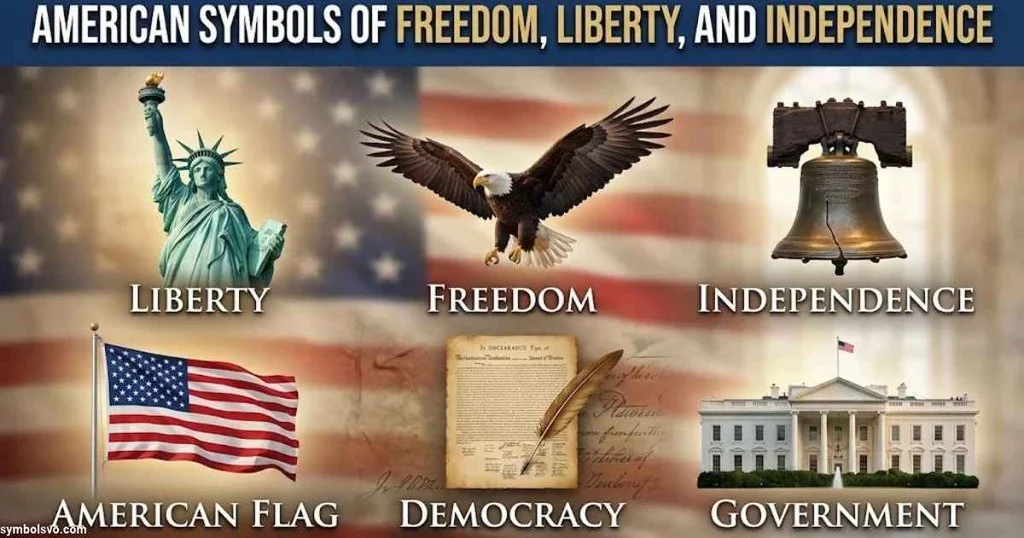
Freedom has played a major role in American history since the Revolutionary War. Many national landmarks, documents, and patriotic emblems represent the country’s efforts to establish independence and protect individual rights.
However, different symbols communicate different ideas. Some represent freedom from foreign rule, while others reflect constitutional protections, equality, and personal liberty.
Symbols That Represent Freedom
Several American symbols have become closely associated with freedom and individual rights.
| Symbol | Meaning |
| Statue of Liberty | Freedom, opportunity, and welcoming immigrants |
| Liberty Bell | Liberty and equal rights |
| Bald Eagle | Independence and strength |
| American Flag | National freedom and sovereignty |
| Broken Chains | Freedom from oppression and slavery |
| Bill of Rights | Protection of individual liberties |
The Statue of Liberty and Liberty Bell are particularly important because both connect historical struggles with the broader meaning of freedom.
Symbols That Represent American Independence
American independence began with the colonies’ separation from British rule in 1776.
Several historical documents and landmarks preserve that achievement.
- Declaration of Independence: Announces the colonies’ separation from Britain.
- Independence Hall: The building where the Declaration was adopted and the Constitution was signed.
- American Flag: Represents the independent nation and its original thirteen colonies.
- Great Seal of the United States: Represents national sovereignty and the authority of the federal government.
- Continental Army imagery: Represents the military struggle that helped secure independence.
Together, these symbols of American independence preserve the story of the nation’s founding.
Symbols That Represent Justice and Equality
American ideals include equal rights, constitutional protections, and justice under the law. Several national symbols reflect these principles.
- United States Constitution: Establishes the country’s legal and governmental framework.
- Bill of Rights: Protects fundamental freedoms and individual liberties.
- Lincoln Memorial: Honors the president who led the country during the Civil War.
- Declaration of Independence: Expresses the principle that people possess equal inherent rights.
- Civil rights movement memorials: Preserve the history of campaigns against racial discrimination.
These symbols also reflect an important distinction: declaring equality and achieving equality are not the same thing. American history includes ongoing struggles to extend constitutional protections and civil rights to everyone.
Symbols That Represent Strength and Courage
Strength and courage appear throughout American history, particularly during wars, national emergencies, and social movements.
The following symbols communicate those qualities:
- Bald Eagle: Represents strength, independence, and determination.
- Washington Monument: Honors leadership during the American Revolution.
- Mount Rushmore: Represents presidential leadership and national achievements.
- North American Bison: Reflects resilience and survival.
- Arlington National Cemetery: Honors military courage and sacrifice.
These American symbols of strength remind people of the individuals and communities that helped shape the country.
Symbols That Represent Hope and Opportunity
America’s history also includes stories of immigration, personal ambition, and the pursuit of a better future.
Some symbols represent these experiences more directly than others.
- Statue of Liberty: Represents welcome, freedom, and opportunity.
- Ellis Island: Represents the experiences of millions of immigrants.
- American Dream: Reflects the belief in personal advancement through opportunity.
- American Rose: Represents love, beauty, and national heritage.
- National Mall: Provides a place for public expression and democratic participation.
These symbols contribute to the broader meaning of the American spirit and the country’s cultural identity.
Official National Symbols of the United States
Not every famous American symbol has an official legal designation. Some represent the country through historical importance, while others receive formal recognition from Congress.
Title 36 of the United States Code identifies several national symbols, including the national anthem, motto, flower, march, tree, and bird. Congress has also designated the North American bison as the national mammal.
Here is a summary of America’s officially recognized national symbols.
| National symbol | Official designation | Meaning or significance |
| American Flag | National flag | National identity and sovereignty |
| Bald Eagle | National bird | Freedom and strength |
| Rose | National floral emblem | Love, beauty, and national heritage |
| Oak | National tree | Strength and endurance |
| North American Bison | National mammal | Wildlife heritage and resilience |
| The Star-Spangled Banner | National anthem | National perseverance and patriotism |
| In God We Trust | National motto | Official national motto |
| The Stars and Stripes Forever | National march | American musical and patriotic tradition |
The bald eagle received its official national bird designation in 2024, even though it had represented the country since 1782.
Similarly, the rose became the national floral emblem in 1986, while Congress designated the oak as the national tree in 2004.
The North American bison received its national mammal designation in 2016.
Every CRS Report
Important: The Statue of Liberty, Liberty Bell, Washington Monument, and Great Seal are important American symbols, but they do not all belong to the same category of statutory national symbols.
What Do the Colors and Symbols on the American Flag Mean?
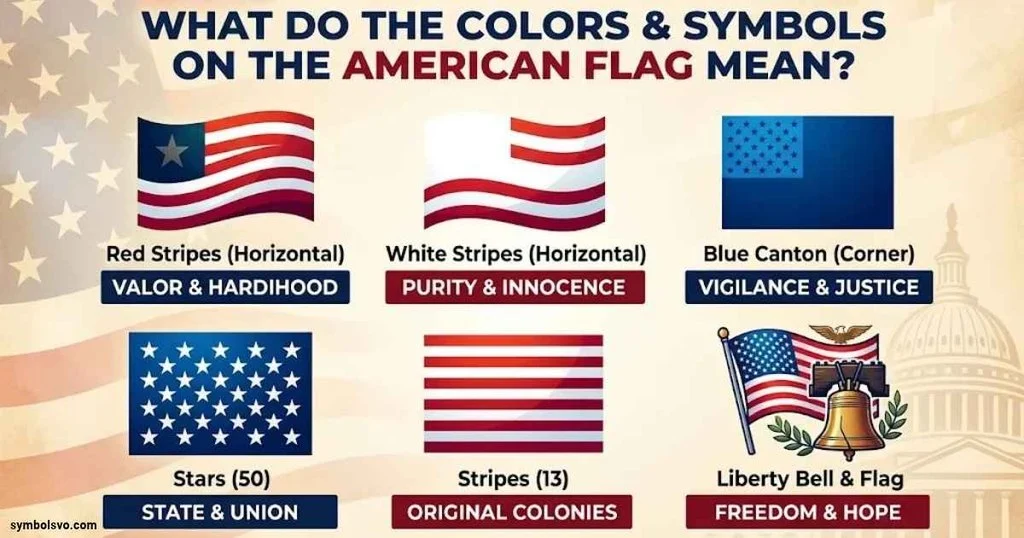
The American Flag is more than a national emblem. Its stars, stripes, and colors connect the modern United States with its revolutionary beginnings.
Understanding its design helps explain why it remains one of the strongest symbols of American patriotism.
Meaning of the 50 Stars
The American flag contains 50 white stars arranged across a blue field called the canton.
Each star represents one state in the Union.
The number of stars changed as the United States expanded. Congress established the principle of adding stars for new states while retaining thirteen stripes in 1818.
The current arrangement contains five rows of six stars alternating with four rows of five stars.
Meaning of the 13 Stripes
The flag contains thirteen horizontal stripes:
- Seven red stripes.
- Six white stripes.
Together, they represent the thirteen original colonies that declared independence from Great Britain.
These colonies eventually became the foundation of the United States.
The stripes remain unchanged even though the country expanded from thirteen states to fifty.
Meaning of Red, White, and Blue
The flag’s three colors have traditional symbolic interpretations.
| Color | Traditional symbolism |
| Red | Valor and bravery |
| White | Purity and innocence |
| Blue | Vigilance, perseverance, and justice |
These interpretations come from the symbolism associated with the Great Seal and traditional explanations of American heraldry. The original 1777 flag resolution did not formally assign these meanings to the colors.
Why Is the American Flag Called Old Glory?
The nickname Old Glory is traditionally associated with Captain William Driver, a nineteenth-century American sea captain.
Driver reportedly used the phrase when describing a large American flag he carried during his maritime travels.
The nickname became popular and eventually entered the American patriotic language.
Today, Old Glory represents national pride, loyalty, and respect for the United States.
How American Symbols Developed Throughout History
American national symbols developed over several centuries. Their stories connect the colonial period, the American Revolution, constitutional government, immigration, and modern national traditions.
The following timeline highlights major developments.
| Year | Historical event or development |
| 1776 | Declaration of Independence adopted on July 4 |
| 1777 | Continental Congress adopts the first official flag resolution |
| 1782 | Great Seal approved |
| 1787 | United States Constitution signed |
| 1789 | New federal government begins operating |
| 1791 | Bill of Rights ratified |
| 1800 | John Adams moves into the White House |
| 1814 | Francis Scott Key writes the poem that becomes the national anthem |
| 1884 | Washington Monument construction completed |
| 1886 | Statue of Liberty dedicated |
| 1892 | Francis Bellamy writes the Pledge of Allegiance |
| 1922 | Lincoln Memorial dedicated |
| 1931 | Star-Spangled Banner becomes the official national anthem |
| 1942 | Congress officially recognizes the Pledge of Allegiance |
| 1954 | Words “under God” added to the Pledge |
| 1956 | In God We Trust becomes the national motto |
| 1960 | Current 50-star American flag introduced |
| 1986 | Rose designated national floral emblem |
| 1987 | Stars and Stripes Forever designated national march |
| 2004 | Oak designated national tree |
| 2016 | North American bison designated national mammal |
| 2024 | Bald eagle officially designated national bird |
This timeline demonstrates how American historical symbols developed alongside the nation’s political, cultural, and social changes.
Why Are American Symbols Important?
American symbols play an important role in preserving national identity. They connect historical events with modern traditions and help people understand the country’s founding principles.
Their importance extends beyond flags and monuments.
Preserving American History and Heritage
Historical symbols keep important events visible for future generations.
For example, Independence Hall preserves the memory of the Declaration of Independence and the Constitution. The Liberty Bell connects visitors with the nation’s early struggles for freedom.
Without these landmarks and historical objects, many important stories would become harder to experience and understand.
Creating a Shared National Identity
National symbols provide familiar references that connect Americans across different states, backgrounds, and communities.
The American Flag is a good example. People display it at public ceremonies, schools, government buildings, and sporting events.
It provides a recognizable representation of the country, even when people have different political beliefs or cultural backgrounds.
Representing Freedom and Democracy
The Constitution, Bill of Rights, and Declaration of Independence communicate important principles of American government.
These documents explain the foundations of constitutional rights, representative government, and individual liberty.
They also provide a framework for public debates about freedom and government responsibility.
Honoring Military Service and Sacrifice
Military memorials preserve the memory of Americans who served and died during wars.
Arlington National Cemetery, the Vietnam Veterans Memorial, and the World War II Memorial are important examples.
They provide places for remembrance and reflection while honoring military service and sacrifice.
Celebrating National Holidays and Traditions
American symbols appear during major national celebrations.
Independence Day, Flag Day, Memorial Day, and Veterans Day all involve familiar national emblems and traditions.
These celebrations connect historical events with present-day American life.
Reflecting Different Perspectives on American History
American symbols can represent both national achievements and historical challenges.
Mount Rushmore, for example, honors four presidents, but its location also carries deep significance for Indigenous communities.
Likewise, the Declaration of Independence expresses equality, although American society did not originally extend equal rights to everyone.
Understanding these different perspectives creates a more complete picture of American heritage.
How Americans Celebrate and Display Their National Symbols
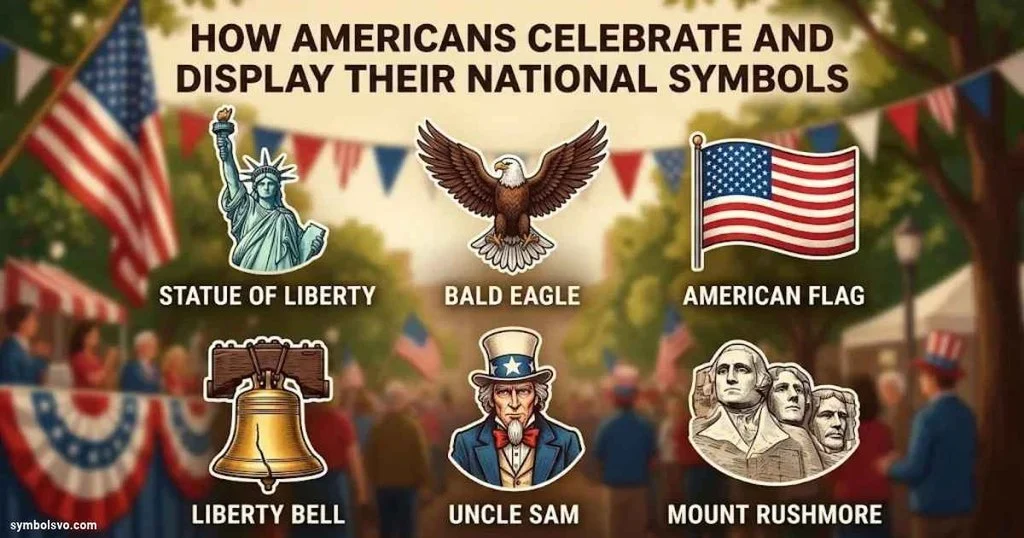
Americans use national symbols throughout the year. Their presence becomes particularly noticeable during holidays, sporting events, memorial ceremonies, and public celebrations.
Independence Day Celebrations
July 4
Independence Day commemorates the adoption of the Declaration of Independence in 1776.
Common celebrations include:
- Displaying the American Flag.
- Organizing parades and community gatherings.
- Watching fireworks.
- Performing patriotic songs.
- Visiting historical landmarks.
- Reading passages from the Declaration of Independence.
The holiday provides an opportunity to remember the American Revolution and the founding of the United States.
Memorial Day and Veterans Day
These holidays honor different aspects of American military service.
Memorial Day, observed on the last Monday of May, honors military personnel who died while serving the country.
Veterans Day, observed on November 11, recognizes military veterans who served in the United States Armed Forces.
Americans mark these occasions through cemetery visits, memorial ceremonies, flag displays, and public events.
Flag Day
June 14
Flag Day commemorates the adoption of the Stars and Stripes by the Continental Congress on June 14, 1777.
Communities, schools, and patriotic organizations sometimes organize ceremonies to celebrate the flag’s history.
The occasion also provides an opportunity to learn about the thirteen original colonies and the development of the modern flag.
National Anthem and Pledge Ceremonies
The Star-Spangled Banner and Pledge of Allegiance remain familiar parts of American public life.
The national anthem frequently plays before professional sporting events and official ceremonies.
The Pledge appears at some schools and civic gatherings, although participation remains protected by constitutional freedoms.
Together, these traditions express national identity, patriotism, and civic belonging.
Frequently Asked Questions About Symbols of America
What Are the Most Famous Symbols of America?
The most famous symbols of America include the American Flag, Statue of Liberty, Bald Eagle, Liberty Bell, Great Seal, Uncle Sam, and Star-Spangled Banner. These symbols represent American independence, freedom, national identity, and patriotism.
What Are the 15 Main Symbols of American Freedom?
Fifteen important symbols associated with American freedom include:
- Statue of Liberty
- American Flag
- Liberty Bell
- Bald Eagle
- Declaration of Independence
- United States Constitution
- Bill of Rights
- Great Seal of the United States
- Lincoln Memorial
- Independence Hall
- Washington Monument
- Pledge of Allegiance
- Ellis Island
- Arlington National Cemetery
- National Mall
Each represents a different aspect of American liberty, independence, constitutional government, or national history.
What Is the Most Recognizable Symbol of the United States?
The American Flag is arguably the most recognizable symbol of the United States. Its fifty stars and thirteen stripes represent the states and original colonies. It appears on government buildings, military uniforms, currency-related designs, and public celebrations.
What Does the Statue of Liberty Represent?
The Statue of Liberty represents freedom, independence, opportunity, and hope. Its raised torch symbolizes enlightenment, while the broken chains at its feet represent freedom from oppression. It also became a powerful symbol of immigration and new beginnings.
Why Is the Bald Eagle a Symbol of America?
The bald eagle represents strength, courage, independence, and freedom. Congress adopted it as part of the Great Seal in 1782. In December 2024, Congress officially designated it the national bird of the United States.
What Does the Liberty Bell Symbolize?
The Liberty Bell symbolizes liberty, independence, and equal rights. Its famous inscription calls for liberty throughout the land. Abolitionists later adopted it as an important symbol in their campaign against slavery.
What Do the Stars and Stripes Represent?
The fifty stars represent the fifty states, while the thirteen stripes represent the original thirteen colonies. Together, these elements connect America’s founding history with its modern national identity.
What Does the Great Seal of the United States Mean?
The Great Seal represents American sovereignty and the authority of the federal government. Its bald eagle symbolizes the nation, while the olive branch and arrows communicate peace and the ability to defend the country.
What Is the Official National Flower of America?
The rose is the official national floral emblem of the United States. President Ronald Reagan proclaimed it the national floral emblem on November 20, 1986.
What Is the Official National Bird of the United States?
The bald eagle is the official national bird of the United States. Congress formally designated it on December 23, 2024, under Public Law 118-206.
What Are the Official National Symbols of America?
Official national symbols designated in federal law include the national anthem, national motto, national floral emblem, national march, national tree, and national bird. Congress has also designated the North American bison as the national mammal.
What Symbols Represent American Independence?
The Declaration of Independence, American Flag, Great Seal, and Independence Hall are important symbols of American independence. They preserve the history of the colonies’ separation from Britain and the establishment of an independent republic.
Which American Symbols Represent Equality and Justice?
The Constitution, Bill of Rights, Lincoln Memorial, and Declaration of Independence represent important American ideals related to equality and justice. They connect constitutional protections with the country’s continuing civil rights history.
Why Is Uncle Sam a Symbol of America?
Uncle Sam represents the United States government and American national identity. The character became popular during the War of 1812 and later appeared in political cartoons and military recruitment campaigns.
What Is the Difference Between Freedom, Liberty, and Independence?
These terms have related but different meanings.
- Freedom: The ability to act, think, and make choices without unnecessary restrictions.
- Liberty: Freedom protected through rights, laws, and constitutional principles.
- Independence: The ability of a country or person to govern themselves without external control.
In American history, independence describes the country’s separation from Britain, while liberty and freedom describe the rights and principles associated with its political system.
Why Are American Symbols Important to National Identity?
American symbols help preserve history, express national values, and create a shared cultural identity. They also honor important achievements, remember sacrifices, and encourage discussions about freedom, equality, and democracy.
Conclusion: What American Symbols Represent Today
The symbols of America tell a story that extends far beyond flags, monuments, and patriotic traditions. They preserve the nation’s founding history while representing its cultural identity, political principles, and national aspirations.
The American Flag represents the country itself. The Statue of Liberty communicates freedom and opportunity, while the Bald Eagle symbolizes strength and independence. Meanwhile, the Constitution and Bill of Rights preserve the legal foundations of American democracy.
Other symbols reveal different parts of the American experience. Ellis Island represents immigration, Arlington National Cemetery honors military sacrifice, and the Lincoln Memorial recalls the continuing struggle for equality.
Together, these American national symbols, historical landmarks, and cultural emblems help explain the country’s past and present. Their meanings also remind Americans that freedom, justice, and national unity require continued commitment.

Mason Ellington is a creative and dedicated Content Writer and Symbols Expert with a passion for words, communication, and symbolic meanings. He specializes in crafting engaging, informative, and well-structured content while exploring the deeper meanings and interpretations behind symbols. With a creative mindset and attention to detail, Mason transforms ideas into meaningful content that informs, inspires, and connects with readers. His expertise combines powerful storytelling, clear communication, and a deep understanding of symbolism.
 Daniel Brooks