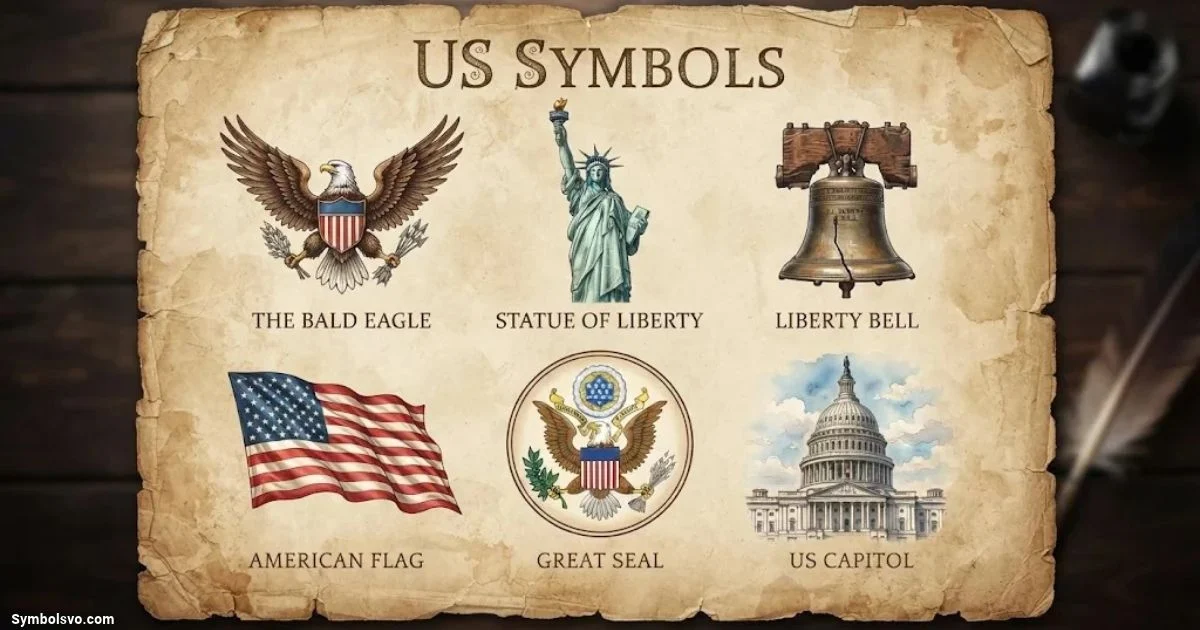
The United States has a rich collection of symbols that tell stories about its history, independence, government, and cultural identity. From the Stars and Stripes to the bald eagle, these familiar images represent ideas that have shaped the country for generations. Some stand for freedom and democracy, while others reflect national unity, strength, and American heritage.
US symbols include officially recognized national emblems as well as historical landmarks, patriotic figures, and cultural icons. The American flag, Great Seal, North American bison, Statue of Liberty, and Liberty Bell are among the best-known examples. Each has a different background and meaning.
However, not every famous American symbol holds the same official status. Congress has formally designated the bald eagle as the national bird, the oak as the national tree, and the rose as the national floral emblem. Other icons, such as Uncle Sam and the Liberty Bell, gained recognition through historical events and popular culture.
Understanding these United States symbols helps explain how Americans express their shared history and national values. Let’s explore their origins, meanings, and importance.
What Are the National Symbols of the United States?
National symbols of the United States are objects, images, songs, monuments, and emblems that represent the country’s identity. They communicate important ideas such as independence, liberty, democracy, courage, and unity.
Some symbols have official recognition under federal law. Others became meaningful through wars, political movements, public celebrations, and cultural traditions.
For example, the American flag represents the nation as a whole, while the Liberty Bell became closely associated with the struggle for freedom and equality. Similarly, the bald eagle represents national strength and independence.
The Library of Congress identifies the flag, bald eagle, Liberty Bell, national anthem, Uncle Sam, and Statue of Liberty among the country’s important symbols.
Library of Congress
Official National Symbols vs. Popular American Symbols
It’s useful to understand the difference between an official designation and a widely recognized cultural symbol.
| Symbol | Official recognition or role | Main association |
| United States Flag | National flag | Independence and unity |
| Bald Eagle | National bird | Freedom and strength |
| North American Bison | National mammal | Heritage and conservation |
| Great Seal | Official national seal | Sovereignty and unity |
| Star-Spangled Banner | National anthem | Patriotism |
| In God We Trust | National motto | National motto and public tradition |
| Rose | National floral emblem | Beauty and heritage |
| Oak Tree | National tree | Strength and endurance |
| The Stars and Stripes Forever | National march | Patriotism and military tradition |
| Liberty Bell | Historical American icon | Freedom and equality |
| Statue of Liberty | National monument | Liberty and welcome |
| Uncle Sam | National personification | American government |
The distinction matters because people sometimes describe every famous American landmark as an official national emblem. That’s not accurate. A symbol can represent the United States without receiving a specific federal designation.
Official National Symbols of the United States
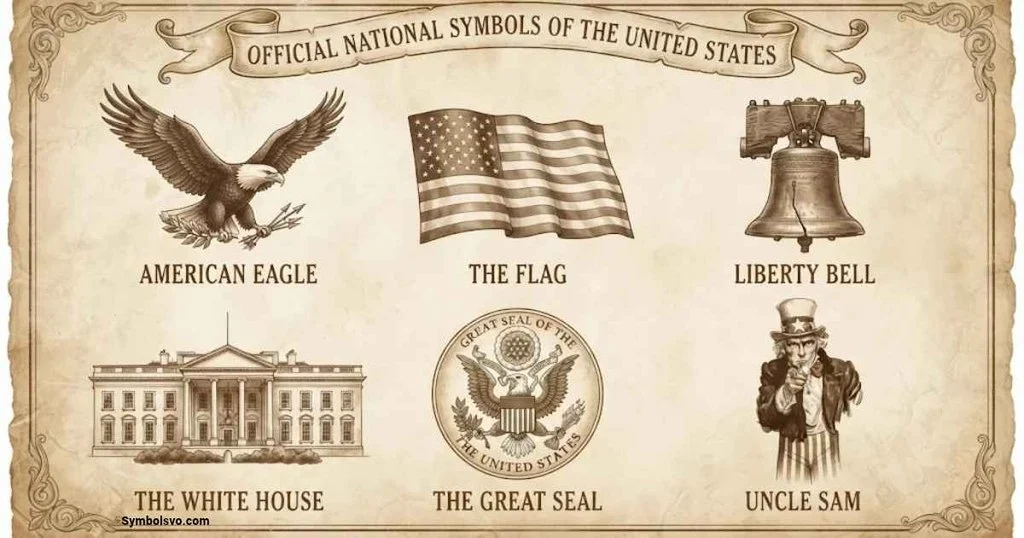
Several American symbols have formal recognition in federal law. These include the national flag, bird, mammal, anthem, motto, floral emblem, tree, and march.
United States Flag – The Stars and Stripes
The United States flag, commonly called the American flag, Stars and Stripes, or Old Glory, is perhaps the most recognizable symbol of the country. Its design represents the nation’s original colonies and its present-day states.
The Continental Congress adopted the first official national flag resolution on June 14, 1777. It established a design with 13 alternating red and white stripes and 13 white stars on a blue field.
As the country expanded, the flag changed to reflect the growing number of states. Today, it features 50 white stars and 13 horizontal stripes.
What do the 13 stripes and 50 stars represent?
- 13 stripes: The original 13 colonies that declared independence from Great Britain.
- 50 stars: The 50 states that make up the United States.
- Red: Commonly associated with valor and bravery.
- White: Associated with purity and innocence.
- Blue: Associated with vigilance, perseverance, and justice.
These color meanings appear in the US government’s explanation of the flag.
USAGov
Why is the American flag called Old Glory?
The nickname Old Glory is associated with American sea captain William Driver. In the early 19th century, he gave this name to his flag, which became a treasured symbol of his patriotism.
Over time, the expression spread throughout the country. Americans began using Old Glory as an affectionate name for the national flag.
Who designed the first American flag?
Betsy Ross is traditionally credited with making the first American flag. According to popular accounts, she created a flag with 13 stars at the request of George Washington and other revolutionary leaders.
However, historians haven’t established conclusive evidence that Ross designed the original flag. Her story remains an important part of American folklore rather than a proven historical fact.
The flag received its most recent star addition on July 4, 1960, when Hawaii became the 50th state.
USAGov+1
Bald Eagle – National Bird of the United States
The bald eagle is one of the strongest visual representations of American identity. With its white head, dark brown body, powerful wings, and hooked yellow beak, this North American bird has appeared on American government emblems for centuries.
The Continental Congress adopted the bald eagle as part of the Great Seal on June 20, 1782. Its appearance on government documents, military insignia, currency, and official buildings helped establish its connection with the United States.
An important historical update came on December 23, 2024. President Joe Biden signed Public Law 118-206, officially designating the bald eagle as the national bird. Before that law, Americans widely recognized it as a national emblem, but Congress had not formally given it the national bird title.
U.S. Code+1
What does the bald eagle symbolize?
The bird represents several important American ideals:
- Freedom: Its ability to soar across open skies makes it a natural image of liberty.
- Independence: Its historical connection to the country’s founding reflects national sovereignty.
- Strength: Its powerful build and hunting abilities suggest courage and resilience.
- Leadership: Its appearance on government and military insignia reinforces authority and national identity.
The bald eagle also has deep spiritual and cultural importance for many Indigenous peoples and Tribal communities. Its significance extends beyond government imagery.
Another remarkable part of its story is its conservation recovery. Habitat protection and legal safeguards helped restore populations after serious declines caused by human activity. Congress specifically acknowledged these recovery efforts in the 2024 national bird legislation.
North American Bison – National Mammal of the United States
The North American bison, commonly called the American bison, represents the wildlife heritage of the United States. Its large shoulders, thick coat, curved horns, and powerful frame make it one of the most recognizable animals associated with the Great Plains.
Congress designated the bison as the national mammal in 2016 through the National Bison Legacy Act. This recognition highlighted its historical, ecological, and cultural importance.
For centuries, bison shaped life across North America. Indigenous communities relied on them for food, clothing, shelter materials, tools, and other essential resources. The animals also held spiritual and cultural significance for many Tribal nations.
However, commercial hunting and westward expansion caused a devastating decline in bison populations during the 19th century. Conservation efforts eventually helped protect remaining herds and restore bison to several natural areas.
What does the American bison symbolize?
The bison commonly represents:
- Strength and physical endurance.
- The natural heritage of the Great Plains.
- The relationship between wildlife and Indigenous cultures.
- Conservation and environmental responsibility.
- The importance of protecting American natural resources.
Today, visitors can see bison in places such as Yellowstone National Park and Wind Cave National Park. These animals remain an important part of America’s wildlife conservation story.
Great Seal of the United States
The Great Seal of the United States is one of the country’s most important government symbols. It represents the authority, independence, and sovereignty of the federal government.
The Continental Congress began working on a national seal in 1776, the same year the Declaration of Independence was adopted. Several committees contributed ideas before Charles Thomson, the secretary of Congress, helped develop the final design.
Congress approved the Great Seal on June 20, 1782.
Its design includes two sides: the obverse, featuring the bald eagle, and the reverse, featuring an unfinished pyramid with an eye above it.
What does the eagle on the Great Seal represent?
The eagle holds an olive branch in its right talon and a bundle of arrows in its left talon. These objects communicate an important message about American foreign policy and national defense.
- Olive branch: Represents peace.
- Arrows: Represent the ability and willingness to defend the nation.
- Shield: Represents the United States and its federal government.
- Thirteen stars: Represent the original 13 states.
- Eagle: Represents strength, independence, and national authority.
The eagle faces the olive branch, traditionally expressing a preference for peace while maintaining the ability to defend the country.
What does E Pluribus Unum mean?
The Latin phrase E Pluribus Unum means “Out of many, one.”
It expresses the idea that separate states and diverse communities form one nation. The phrase appears on the Great Seal and became an important expression of American national unity.
What do the pyramid and eye represent?
The reverse side of the Great Seal features an unfinished pyramid with 13 levels. It represents the strength and endurance of the new American nation.
Above the pyramid sits the Eye of Providence, surrounded by rays of light. It is a traditional symbol associated with divine providence.
Two Latin inscriptions appear on this side:
- Annuit Coeptis: Commonly translated as “He has favored our undertakings.”
- Novus Ordo Seclorum: Commonly translated as “A new order of the ages.”
The Roman numerals MDCCLXXVI at the pyramid’s base represent 1776, the year of American independence.
The Great Seal is not simply decorative artwork. It appears on official government documents and helps authenticate important acts of the federal government.
The Star-Spangled Banner – National Anthem of the United States
The Star-Spangled Banner is the national anthem of the United States. Its history connects American music with the War of 1812 and the defense of Baltimore.
The lyrics came from a poem written by Francis Scott Key in September 1814. He witnessed the British bombardment of Fort McHenry while aboard a ship near Baltimore, Maryland.
After the attack, Key saw the American flag still flying above the fort. That sight inspired him to write a poem originally titled Defence of Fort M’Henry.
The poem was later set to the melody of a popular British song called “To Anacreon in Heaven.”
Congress officially designated The Star-Spangled Banner as the national anthem on March 3, 1931.
What does the national anthem represent?
The anthem represents:
- American independence and national identity.
- Courage during military conflict.
- The defense of the country.
- Patriotism and national pride.
- The endurance of the United States through difficult periods.
Americans commonly perform it at sporting events, military ceremonies, public celebrations, and national commemorations.
In God We Trust – National Motto of America
In God We Trust is the official national motto of the United States. The phrase appears on American coins and paper currency and has a long connection with the country’s public and religious history.
The motto gained wider recognition during the Civil War. In 1864, it appeared on certain US coins following a request from religious leaders who wanted a reference to God included in national currency.
Congress officially adopted In God We Trust as the national motto in 1956. Its designation now appears in Title 36 of the United States Code, Section 302.
GovInfo
What does In God We Trust mean?
The phrase expresses trust in God. Its use on American money and government-related symbols reflects a particular tradition in the country’s public history.
It is important to distinguish this motto from E Pluribus Unum. Both phrases appear in American national symbolism, but only In God We Trust is the statutory national motto.
Oak Tree – National Tree of the United States
The oak tree became the national tree of the United States in 2004. Congress officially recognized the tree genus Quercus, which includes many different oak species.
Oak trees grow across large parts of the country. They are known for their strong wood, long life, extensive root systems, and ability to thrive in different environments.
These qualities make the oak a fitting representation of American endurance and strength.
What does the oak tree symbolize?
- Strength: Its sturdy trunk and branches represent physical and national strength.
- Endurance: Many oak species can survive for centuries.
- Stability: Their extensive roots suggest a strong foundation.
- Heritage: Mature oak trees often become lasting features of historic landscapes.
The oak’s national recognition also reflects the importance of American forests and natural resources.
Rose – National Floral Emblem of the United States
The rose is the national floral emblem of the United States. President Ronald Reagan officially proclaimed it the national floral emblem on November 20, 1986.
Congress had passed legislation recognizing the rose earlier that year. The designation appears in Section 303 of Title 36 of the United States Code.
Roses have a long history in American gardens, celebrations, public ceremonies, and cultural traditions. Their different colors also carry familiar symbolic associations.
| Rose color | Common symbolic association |
| Red | Love and courage |
| White | Purity and remembrance |
| Yellow | Friendship and happiness |
| Pink | Appreciation and gratitude |
These color meanings are cultural interpretations, not separate official national designations.
The rose represents beauty, heritage, and the country’s connection with nature.
The Stars and Stripes Forever – National March
The United States also has an officially recognized national march: The Stars and Stripes Forever.
John Philip Sousa composed the famous military march in 1896. It became one of his most celebrated works and remains closely associated with American patriotic celebrations.
Congress designated it the national march in 1987.
The composition is known for its energetic rhythm, strong brass melodies, and lively percussion. Military bands, marching ensembles, and patriotic events often feature it.
Unlike the national anthem, which expresses national identity through lyrics and music, the national march communicates patriotism through instrumental performance.
Famous American Symbols of Freedom, Liberty, and Independence
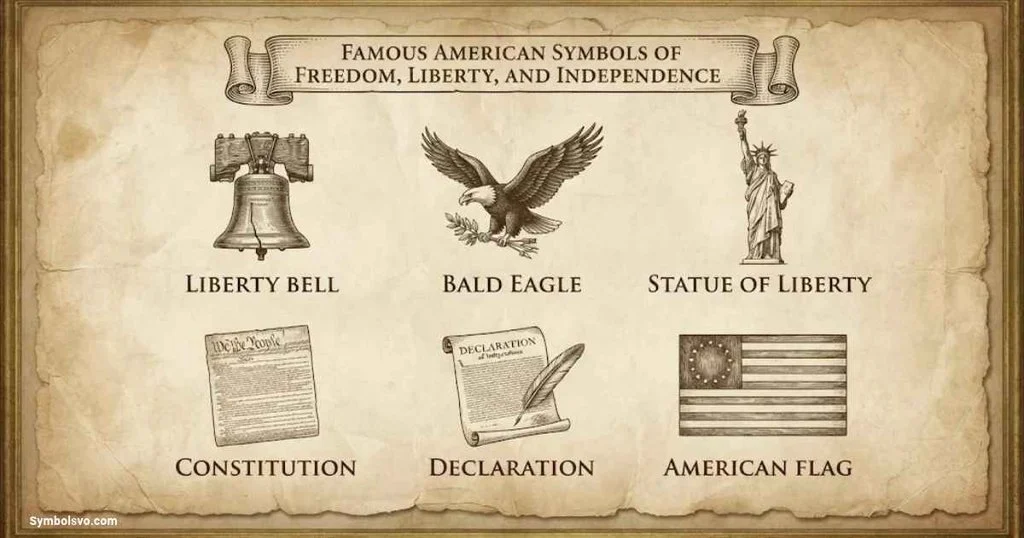
Beyond officially designated national symbols, the United States has several historical landmarks and cultural icons that represent freedom, equality, and independence. These symbols developed through important events and social movements.
Statue of Liberty – A Symbol of Freedom and Welcome
The Statue of Liberty is one of the most famous symbols of America. Standing on Liberty Island in New York Harbor, it represents freedom, hope, and the ideals of liberty.
France gave the statue to the United States as a gift celebrating the friendship between the two nations and their shared commitment to liberty. French sculptor Frédéric Auguste Bartholdi designed the monument, while engineer Gustave Eiffel helped develop its internal iron framework.
The statue arrived in New York in sections and was dedicated on October 28, 1886.
Its full name is Liberty Enlightening the World, a name that reflects its symbolic purpose.
What do the Statue of Liberty’s features represent?
Each major feature carries a meaning:
- Torch: Represents enlightenment and the light of freedom.
- Crown: Its seven rays traditionally represent the seven continents and seven seas.
- Tablet: Displays the Roman numerals JULY IV MDCCLXXVI, representing July 4, 1776, the date of the Declaration of Independence.
- Broken chains: Represent freedom from oppression and tyranny.
- Robe: Reflects the classical image of Libertas, the Roman personification of liberty.
The statue became especially meaningful to immigrants arriving in the United States through New York. For many newcomers, its appearance in the harbor offered a powerful image of hope and a new beginning.
Its connection with immigration grew stronger through its proximity to Ellis Island, where millions of immigrants were processed between 1892 and 1954.
Today, the Statue of Liberty remains a powerful representation of freedom, independence, human dignity, and opportunity.
Liberty Bell – A Symbol of American Liberty
The Liberty Bell is one of America’s most recognizable historical symbols. Located in Philadelphia, Pennsylvania, it represents liberty, equality, and the continuing struggle for freedom.
The Pennsylvania colonial government commissioned the bell in 1751 for the Pennsylvania State House, now known as Independence Hall. Its purpose was practical: to announce public meetings and important civic events.
However, its inscription eventually gave it a much deeper meaning.
The bell carries the words:
Proclaim LIBERTY throughout all the land unto all the inhabitants thereof.
This quotation comes from Leviticus 25:10 in the Bible. Its message made the bell particularly meaningful to Americans who supported liberty and equal rights.
Why does the Liberty Bell have a crack?
The bell developed cracks after repeated use and required repairs during its early history. Its most famous crack eventually prevented it from ringing properly.
The exact history of the final crack isn’t completely established. However, the damaged bell became an even stronger visual representation of the country’s complicated journey toward freedom.
How did the Liberty Bell become a symbol of equality?
During the 1830s, American abolitionists adopted the bell as an emblem of their campaign against slavery. They helped popularize the name Liberty Bell and connected its inscription with the fight for equal rights.
Later, women’s suffrage activists and civil rights advocates also used the bell’s image to represent their causes.
This history makes the Liberty Bell more than a reminder of the American Revolution. It also represents the ongoing effort to extend freedom and equality to everyone.
Uncle Sam – Personification of the American Government
Uncle Sam is a familiar personification of the United States government. His recognizable appearance includes a white beard, white hair, a tall hat, and clothing decorated with red, white, and blue.
Unlike the bald eagle or national flag, Uncle Sam is not an official national emblem established by federal law. Instead, he developed through American folklore, political cartoons, and patriotic illustrations.
Who was the real person behind Uncle Sam?
The character is traditionally connected with Samuel Wilson, a meat supplier from Troy, New York, during the War of 1812.
Wilson supplied meat to American troops. The barrels reportedly carried markings that included the initials “U.S.” for United States. A popular story claims soldiers jokingly interpreted the initials as Uncle Sam.
Although the exact origin story has some uncertainty, Samuel Wilson became closely associated with the character.
Why is Uncle Sam associated with the United States government?
Over time, political cartoonists used Uncle Sam to represent the federal government and the American nation.
His most famous appearance came through the recruitment poster created by illustrator James Montgomery Flagg during World War I. The image showed Uncle Sam pointing toward the viewer with the words “I Want YOU for U.S. Army.”
The illustration became an enduring piece of American patriotic imagery.
Uncle Sam represents:
- The federal government.
- American military recruitment.
- National responsibility and public service.
- Patriotism and civic identity.
Pledge of Allegiance – A Symbol of National Unity
The Pledge of Allegiance is a patriotic statement expressing loyalty to the American flag and the republic it represents.
Francis Bellamy wrote the original pledge in 1892 as part of a national school celebration marking the 400th anniversary of Christopher Columbus’s arrival in the Americas.
The original wording was shorter than the version Americans use today. Congress later made several changes, including adding the words “under God” in 1954.
The pledge is commonly recited in schools, public ceremonies, and other civic settings.
What does the Pledge of Allegiance represent?
Its main themes include:
- Loyalty to the United States.
- National unity across different states and communities.
- Commitment to the republic and its democratic institutions.
- The principles of liberty and justice.
The pledge is a civic tradition rather than a separate national symbol formally listed alongside the flag or national anthem.
Broken Chains – Symbols of Freedom and Emancipation
Broken chains are a widely recognized visual representation of freedom from oppression. In American historical imagery, they often communicate emancipation, liberation, and the rejection of tyranny.
One of the best-known examples appears at the feet of the Statue of Liberty. A broken shackle and chain represent the end of oppression and the pursuit of freedom.
This imagery also connects with the history of abolition in the United States.
During the 19th century, abolitionists used broken chains in posters, illustrations, publications, and other materials to oppose slavery. The image communicated a simple but powerful message: people should not live under forced control.
The symbolism continued during later movements for civil rights and equality.
Today, broken chains remain an important part of American freedom symbols, particularly when discussing emancipation and human rights.
Other Important American Cultural and Patriotic Symbols
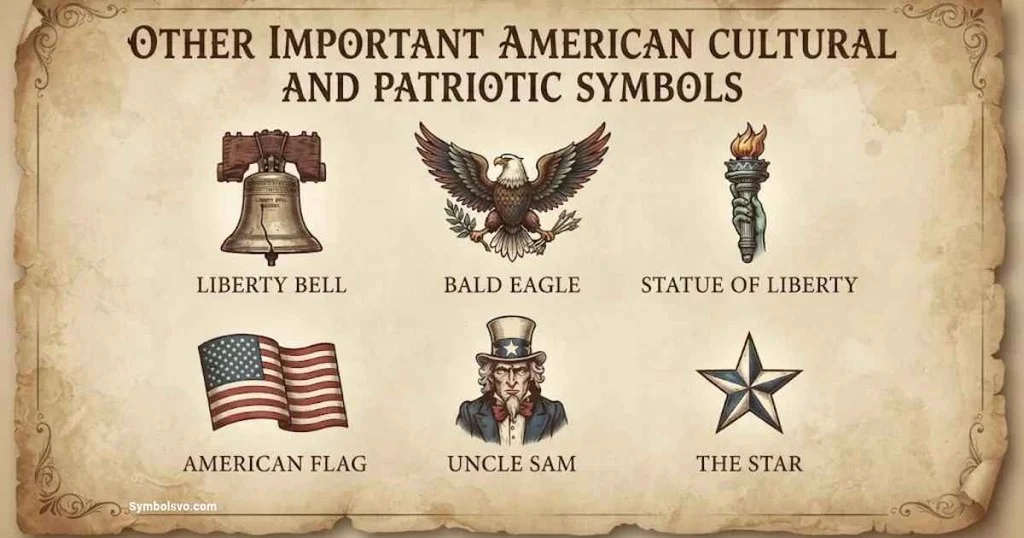
Some American symbols don’t belong to a single official category. They represent broader traditions, public celebrations, and historical experiences.
These symbols help people understand how American identity developed beyond government seals and national designations.
The American Flag Colors
The colors of the American flag have become familiar representations of national values. Red, white, and blue appear in government buildings, military uniforms, public decorations, and patriotic celebrations.
The traditional interpretations are:
| Color | Common meaning |
| Red | Valor and bravery |
| White | Purity and innocence |
| Blue | Vigilance, perseverance, and justice |
These interpretations are useful when explaining the flag’s symbolism. However, the original 1777 flag resolution specified its design rather than assigning these meanings to individual colors.
The colors also appear throughout American cultural traditions, especially during Independence Day celebrations, Memorial Day, and Veterans Day.
The American Coat of Arms and Government Seals
The term American Coat of Arms often refers to the eagle-and-shield design on the front of the Great Seal.
The bald eagle carries the shield on its chest, with the shield’s stripes representing the original states and its blue upper section representing the Union.
Although people sometimes use the term coat of arms interchangeably with the Great Seal, they are not exactly the same thing. The Great Seal is an official government device with an obverse and reverse design. The eagle-and-shield image is its most familiar side.
The design also influenced other American government symbols, including presidential and military insignia.
What Do American Symbols Represent?
Different American national symbols and their meanings communicate different aspects of the country’s identity. Some focus on independence, while others represent peace, strength, democracy, and cultural heritage.
The following categories make these connections easier to understand.
Symbols of Freedom and Liberty
Freedom has remained a central theme in American history. Several important symbols reflect the country’s founding ideals and the continuing struggle for individual rights.
- Statue of Liberty: Represents freedom, opportunity, and welcome.
- Liberty Bell: Represents liberty, equality, and the abolitionist movement.
- Broken chains: Represent emancipation and freedom from oppression.
- Bald eagle: Represents independence and freedom.
These symbols often appear during public celebrations and historical commemorations.
Symbols of Strength and Independence
Strength and independence are recurring themes in American historical symbols.
The bald eagle represents national power and sovereignty. The bison reflects physical endurance and the country’s wildlife heritage. Meanwhile, the oak tree represents stability and long-term resilience.
The Great Seal also communicates these ideals through its eagle, shield, arrows, and olive branch.
Together, these symbols express the idea of a nation that values independence while maintaining the ability to protect itself.
Symbols of Peace and Unity
Peace and national unity are important parts of American patriotic imagery.
The olive branch on the Great Seal represents peace, while the phrase E Pluribus Unum communicates unity among different states and people.
Other symbols also reinforce these ideas:
- American flag: Represents the unity of the 50 states.
- Pledge of Allegiance: Expresses civic loyalty and commitment to the republic.
- Olive branch: Represents peace and diplomacy.
- E Pluribus Unum: Represents unity through diversity.
These images show that American national identity includes cooperation and peaceful relationships alongside military strength.
Symbols of American Heritage and Patriotism
Several symbols connect directly with American celebrations, public ceremonies, and historical traditions.
The Stars and Stripes appears during national holidays and sporting events. Uncle Sam represents the federal government in political cartoons and patriotic artwork. The Star-Spangled Banner and The Stars and Stripes Forever bring national symbolism into music.
These symbols help preserve American heritage and traditions while reminding people of important historical events.
How Have US Symbols Changed Throughout History?
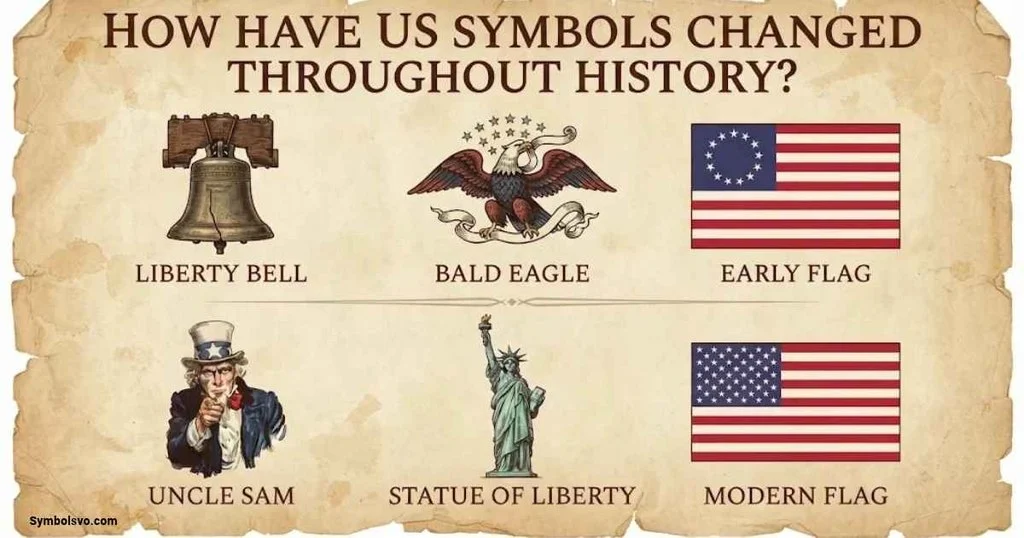
The history of US symbols closely follows the development of the country itself. Many familiar emblems didn’t become popular overnight. Their meanings developed through wars, political decisions, social movements, and cultural traditions.
Understanding this timeline helps explain why certain images became permanent parts of American identity.
Before American Independence
Before 1776, the American colonies remained under British rule. Colonial flags, British royal emblems, and local insignia represented the different territories.
However, growing opposition to British policies encouraged colonists to develop symbols of resistance and independence.
The Continental Congress eventually adopted the Declaration of Independence on July 4, 1776. This event established a new political identity and created the need for national emblems.
The American Revolution and the First National Symbols
The American Revolutionary War helped establish several important patriotic symbols.
In 1777, the Continental Congress adopted the first official national flag resolution. Its 13 stripes and 13 stars represented the original colonies.
In 1782, Congress approved the Great Seal, featuring the bald eagle and other symbolic elements.
These early designs established a visual identity for the new country.
The 19th Century: Liberty and National Identity
During the 19th century, American symbols gained new meanings through military conflicts and social movements.
The War of 1812 inspired Francis Scott Key to write the poem that eventually became the national anthem.
The Liberty Bell also developed a stronger connection with freedom. Abolitionists adopted it as a symbol of their campaign against slavery during the 1830s.
Meanwhile, Uncle Sam became a familiar representation of the federal government.
The Late 19th and 20th Centuries
Several major American symbols received wider public recognition during this period.
Important developments included:
- 1886: The Statue of Liberty was dedicated in New York Harbor.
- 1931: Congress officially designated The Star-Spangled Banner as the national anthem.
- 1956: In God We Trust became the official national motto.
- 1986: The rose was proclaimed the national floral emblem.
- 1987: The Stars and Stripes Forever became the national march.
- 2004: The oak became the national tree.
Modern Recognition of American National Symbols
The United States continues to recognize the importance of its natural and cultural heritage.
Two notable developments include:
- 2016: Congress designated the North American bison as the national mammal.
- 2024: Congress officially designated the bald eagle as the national bird.
These decisions demonstrate how national symbols can reflect both historical traditions and modern conservation priorities.
Why Are National Symbols Important to American Identity?
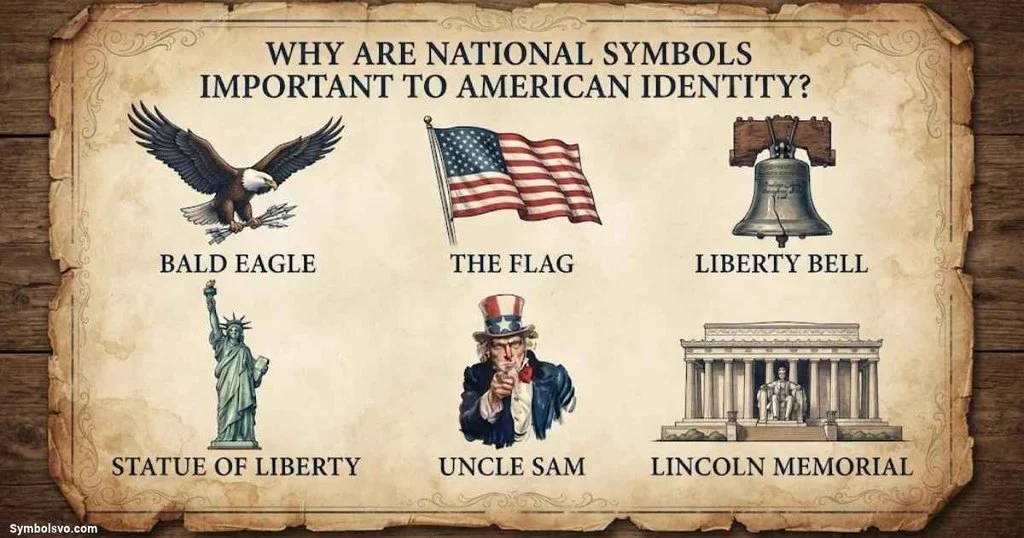
American national symbols help people connect with the country’s history, institutions, and shared values. They make complicated historical ideas easier to recognize and understand.
A flag, monument, or national song can communicate a message that would otherwise require an entire history lesson.
Here are some important reasons these symbols matter.
They Preserve American History
Many national emblems remind Americans of important events and historical figures.
The Great Seal reflects the country’s founding period. The Star-Spangled Banner recalls the War of 1812, while the Liberty Bell connects with the history of independence and abolition.
These symbols preserve memories that might otherwise become distant for future generations.
They Represent National Unity
The United States includes people from different backgrounds, cultures, languages, and traditions.
Symbols such as the American flag and E Pluribus Unum express the idea of a shared national identity despite these differences.
The phrase “Out of many, one” captures this principle particularly well.
They Reflect American Values
Many symbols of America represent principles that have shaped its political and cultural history.
For example:
- Freedom: Statue of Liberty and Liberty Bell.
- Independence: American flag and bald eagle.
- Strength: Oak tree and American bison.
- Peace: Olive branch on the Great Seal.
- Democracy: National flag and founding documents.
- Patriotism: National anthem and national march.
These meanings help people understand the ideals associated with American national identity.
They Support Public Celebrations and Traditions
American symbols appear during important national occasions.
Some familiar examples include:
| Celebration | Common symbols |
| Independence Day | American flag, fireworks, bald eagle |
| Memorial Day | American flag, patriotic memorials |
| Veterans Day | American flag, military emblems |
| Presidents’ Day | Great Seal, presidential symbols |
| Flag Day | Stars and Stripes |
| National Anthem performances | Star-Spangled Banner |
These traditions keep historical symbols visible in everyday American life.
They Encourage Wildlife and Environmental Conservation
Not all national symbols represent political or historical ideas.
The bald eagle, bison, oak tree, and rose also connect with America’s natural heritage.
Their recognition highlights the importance of protecting wildlife, preserving forests, and maintaining the country’s natural resources.
The bison’s designation as the national mammal is particularly meaningful because it draws attention to the consequences of commercial hunting and the importance of conservation.
Frequently Asked Questions About US Symbols
What are the most important symbols of the United States?
The most recognizable US symbols include the American flag, bald eagle, Great Seal, Statue of Liberty, Liberty Bell, Star-Spangled Banner, and Uncle Sam. Each represents a different part of American history, government, freedom, or cultural identity.
How many official national symbols does the United States have?
There isn’t one universally established total for every American symbol. However, Title 36 of the US Code identifies seven specific national designations: the national anthem, motto, floral emblem, march, tree, mammal, and bird. The national flag and Great Seal also hold official national status.
What is the most recognizable symbol of America?
The American flag is arguably the most recognizable symbol of the United States. Its 50 stars and 13 stripes make it instantly identifiable around the world. Americans display it during national holidays, sporting events, military ceremonies, and other patriotic occasions.
What are the five most famous American symbols?
Five widely recognized American symbols are:
- American flag – National identity and unity.
- Bald eagle – Freedom and strength.
- Statue of Liberty – Liberty and opportunity.
- Liberty Bell – Freedom and equality.
- Uncle Sam – American government and patriotism.
These symbols have different historical origins but all contribute to the country’s public identity.
What symbol represents freedom in the United States?
The Statue of Liberty is one of the strongest representations of freedom in the United States. Its torch symbolizes enlightenment, while the broken chains at its feet represent liberation from oppression. The Liberty Bell and bald eagle also have strong associations with freedom and independence.
What is the oldest national symbol of the United States?
The American flag and the Great Seal are among the earliest officially adopted national emblems. Congress adopted the flag resolution on June 14, 1777, while it approved the Great Seal on June 20, 1782. Both emerged during the country’s founding period.
What is the difference between E Pluribus Unum and In God We Trust?
E Pluribus Unum means “Out of many, one” and appears on the Great Seal. It represents unity among different states and communities. In God We Trust is the official national motto of the United States. Congress adopted it in 1956.
Which American symbols represent peace and strength?
The olive branch on the Great Seal represents peace, while the bald eagle represents strength and independence. The American bison and oak tree also symbolize endurance and resilience. Together, these emblems communicate important ideas about American heritage and national identity.
Why does the United States use the bald eagle as its emblem?
The bald eagle became an American emblem because of its association with strength, freedom, and independence. Congress included it in the Great Seal in 1782. Its widespread use on government documents and military insignia strengthened its connection with the nation. Congress formally designated it the national bird in December 2024.
What are the symbols of American independence?
Important symbols of American independence include the United States flag, Great Seal, Declaration of Independence, and Liberty Bell. The flag represents the original colonies, while the Great Seal reflects the sovereignty of the new nation. The Liberty Bell later became associated with freedom and equality.
Is the Statue of Liberty an official national symbol?
The Statue of Liberty is a nationally recognized monument and one of America’s most famous cultural icons. It isn’t one of the specific national designations listed in Title 36 alongside the national bird, tree, or floral emblem. Nevertheless, it represents American ideals of freedom, opportunity, and welcome.
Why are national symbols important to American culture?
National symbols help preserve history, communicate shared values, and strengthen cultural identity. They appear in schools, government institutions, public celebrations, and historical monuments. They also remind people of important events and the ongoing efforts to protect freedom, equality, and national unity.
Final Thoughts on US Symbols and Their Meanings
US symbols tell the story of a country built around independence, liberty, and national identity. From the American flag and Great Seal to the bald eagle and Statue of Liberty, each emblem carries a different historical meaning.
Some symbols represent official government institutions, while others emerged through public movements, historical events, and cultural traditions. Together, they reflect the country’s development and its changing understanding of freedom, equality, and unity.
Learning about these American symbols and their meanings provides more than a list of familiar images. It offers a closer look at the people, events, and principles that helped shape the United States.

I’m Daniel Brooks, a content creator and symbol enthusiast dedicated to researching the fascinating world of signs and symbols. I enjoy discovering the hidden meanings behind famous icons, emojis, historical emblems, and cultural symbols. Through my writing, I aim to provide trustworthy, well-researched, and reader-friendly information that helps people learn something new with every visit.
Books:
- The Complete Guide to World Symbols
- The Power of Universal Signs
 Mason Ellington
 Nathan Holloway