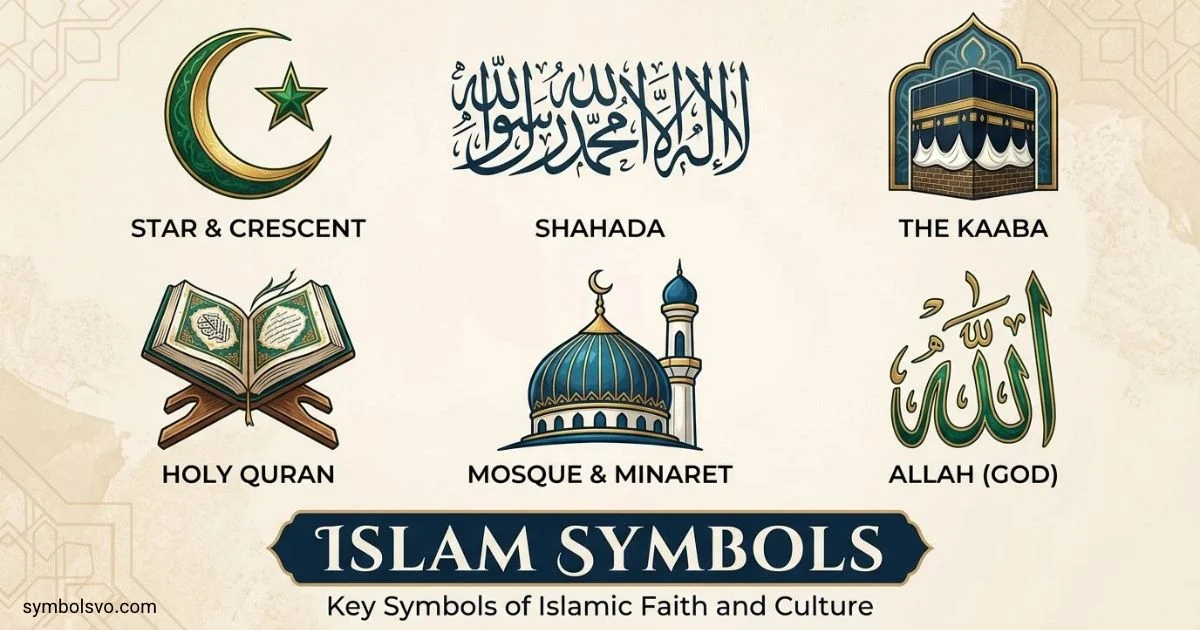
Islam symbols include visual emblems, Arabic calligraphy, geometric designs, sacred references, and cultural motifs associated with the Islamic faith and Muslim communities. You’ll find them in mosques, Quranic manuscripts, traditional artwork, national flags, clothing, and modern digital designs. However, not every design associated with Islam carries an official religious meaning.
The crescent and star, for example, has become widely recognized as an emblem associated with Islam. Yet the Shahada, the name Allah in Arabic, and the Kaaba hold different kinds of religious significance. Meanwhile, geometric patterns and arabesque designs represent rich artistic traditions that developed across many Muslim societies.
Understanding these differences helps you recognize important Islamic symbols without confusing religious teachings with cultural customs or decorative art.
In this guide, you’ll discover the names and meanings of important Islamic symbols, their historical backgrounds, their role in worship and architecture, and their use in modern design. You’ll also find a practical chart and copy-and-paste characters for digital use.
What Are Islam Symbols?
Islam symbols are visual signs, written expressions, objects, or artistic motifs that people associate with Islam, Islamic history, or Muslim cultural identity. Some communicate religious beliefs directly. Others serve practical purposes or reflect traditions that developed in particular regions.
Unlike some religions that use a single emblem as a central visual identifier, Islam has no universally prescribed visual symbol that every Muslim must recognize as its official emblem. Muslims express their faith through belief in one God, prayer, charity, fasting, pilgrimage, Quranic recitation, and other religious practices.
Islamic visual culture reflects this emphasis in several ways:
- Religious calligraphy: Arabic writing that presents the name Allah, the Shahada, Bismillah, or Quranic passages.
- Architectural features: Mosque elements such as the mihrab, minaret, and dome.
- Geometric designs: Repeating shapes, stars, polygons, and symmetrical patterns.
- Devotional objects: Prayer rugs and prayer beads used in certain Muslim practices.
- Cultural emblems: The crescent and star, which appears on flags and in many institutions associated with Muslim communities.
Museums document how these traditions developed across different places and historical periods. For example, the Smithsonian’s National Museum of Asian Art explains how Quranic manuscripts inspired elaborate calligraphy and nonfigurative decoration. Explore the Smithsonian’s overview of Quranic art.
Is There an Official Symbol of Islam?
No single visual emblem serves as the universally prescribed symbol of Islam.
The crescent and star is widely recognized as an Islamic-associated emblem, but its historical use doesn’t make it a required part of Islamic belief or worship. Likewise, Arabic calligraphy, geometric patterns, and mosque silhouettes often represent Islam in artwork without functioning as official religious symbols.
The distinction matters because a symbol can represent a religion culturally without being required by that religion’s teachings.
What Is the Difference Between Islamic Symbols and Muslim Symbols?
The terms overlap, but they emphasize slightly different things.
- Islamic symbols generally refers to imagery, writing, objects, and artistic traditions connected with the religion of Islam.
- Muslim symbols often refers to signs or objects that Muslim individuals and communities use to express faith, identity, or cultural belonging.
For example, the Shahada is a religious declaration central to Islamic belief. A crescent-and-star flag may represent a country with a Muslim-majority population. Both can be associated with Islam, but they don’t carry the same religious status.
Similarly, a prayer cap may reflect religious practice, cultural tradition, or both. Its design and use vary among communities.
Islam Symbols and Their Meanings: Quick Reference Chart
The following table summarizes important Islamic symbols and meanings, along with the context you need to understand each one accurately.
| Symbol or element | Name | Meaning or association |
| ☪️ | Crescent and star | Widely recognized emblem associated with Islam and Muslim cultural identity |
| الله | Allah | Arabic name for God |
| Shahada | Declaration of faith | Expresses belief in the oneness of God and Muhammad’s prophethood |
| Bismillah | Opening devotional phrase | Begins with “In the name of Allah” |
| 🕋 | Kaaba | Represents the sacred sanctuary in Makkah |
| ۞ | Rub el Hizb | Eight-pointed sign used in Quranic organization and ornamentation |
| Islamic geometric patterns | Geometric ornament | Features symmetry, repetition, and intricate mathematical designs |
| Arabesque | Ornamental design | Uses flowing, interlaced vegetal forms |
| Misbaha or Tasbih | Prayer beads | Helps count devotional recitations |
| Sajjada | Prayer rug | Provides a suitable surface for prayer |
| Mihrab | Mosque prayer niche | Indicates the direction of prayer |
| Minaret | Mosque tower | Historically associated with the call to prayer |
| Zulfiqar | Sword motif | Associated with Imam Ali and especially prominent in some Shia traditions |
| Turbah | Prayer tablet | Used as a prostration surface in certain Shia practices |
| Alam | Ceremonial standard | Used in some Shia commemorations, particularly those connected with Karbala |
These examples don’t all belong to the same category. The Shahada is a declaration of faith, the Kaaba is a sacred sanctuary, and the mihrab is an architectural feature. Understanding these distinctions makes the meanings easier to interpret.
The Crescent and Star: History and Meaning
The crescent and star is probably the most recognizable visual emblem associated with Islam. It appears on flags, public buildings, cultural organizations, and decorative artwork across many countries. Despite this recognition, its historical origins and religious meaning require careful explanation.
The crescent represents a curved lunar shape, while the star usually appears beside it. Artists and communities have interpreted these elements in different ways. Some associate them with the lunar calendar, while others view them as familiar signs of Muslim identity.
However, there isn’t one universally accepted theological explanation for the combined design.
What Does the Crescent Moon Symbolize in Islam?
The crescent moon symbol has a practical connection with the Islamic calendar. Islam follows a lunar calendar, and the beginning of Ramadan, Shawwal, and other months relates to the appearance of the new crescent according to established calendar methods and local religious practice.
Muslims use the lunar calendar to determine important dates, including Ramadan and the two major annual Eids. Moon sighting has therefore become an important part of religious life in many communities.
Still, the crescent’s role in the calendar doesn’t mean that the crescent-and-star emblem itself is a required Islamic symbol.
What Does the Star Represent?
The star beside the crescent has no single meaning accepted by all Muslims. Depending on the setting, it may function as a decorative feature, a national emblem, or part of a design associated with Muslim identity.
Some modern interpretations connect stars with guidance or light. These associations can be meaningful in particular contexts, but they shouldn’t be presented as a universal religious definition.
Is the Crescent and Star Mentioned in the Quran?
The Quran refers to celestial bodies, including the moon and stars, in several contexts. However, that is different from prescribing the combined crescent-and-star design as an emblem of Islam.
Historical evidence shows that the combined motif became strongly associated with Muslim identity through later political and cultural developments. Its association with the Ottoman Empire played a major role in its modern recognition.
The key distinction: The moon has a place in the Islamic calendar, but the crescent-and-star emblem is a historical and cultural association rather than a universal requirement of Islamic faith.
For a discussion of the religious distinction, see Islam Qestion & Answer’s explanation of the crescent and star.
Allah, Shahada, and Bismillah: Important Islamic Calligraphy
Islamic calligraphy holds a special place in Muslim artistic traditions because it allows artists to present religious language through carefully shaped letters. You’ll see calligraphy in Quranic manuscripts, mosque interiors, ceramics, textiles, and contemporary artwork.
The words themselves matter. A beautiful design doesn’t change their meaning, and different calligraphic styles don’t automatically represent different beliefs.
Allah Symbol and Its Meaning
The Arabic word Allah (الله) means God. Muslims use this name when speaking about the one God they worship.
Calligraphers have developed many ways to write Allah’s name, from simple lettering to elaborate compositions. Some designs stretch the letters vertically, while others arrange them within circles, medallions, or flowing shapes.
The written name may appear in:
- Mosque decorations and religious buildings
- Quranic manuscripts and Islamic books
- Wall art and framed calligraphy
- Educational materials and digital graphics
- Traditional crafts and contemporary design
The Unicode character ﷲ is a typographic ligature associated with the Arabic spelling of Allah. It isn’t a separate deity or a universally prescribed religious logo.
Shahada Symbol and Meaning
The Shahada is the Islamic declaration of faith. It expresses two central beliefs: that there is no deity worthy of worship except Allah and that Muhammad is the Messenger of Allah.
Its Arabic wording is:
لا إله إلا الله محمد رسول الله
The declaration occupies a central place in Islam. Muslims express it in worship, religious teaching, and other contexts connected with their faith.
Calligraphers sometimes display the Shahada as a prominent inscription. It also appears on certain flags and religious objects. However, the written design is a visual presentation of the declaration rather than a separate religious requirement.
The Shahada should also be distinguished from the crescent and star. The former communicates a specific statement of belief, while the latter functions primarily as a historical and cultural emblem.
Bismillah Symbol and Meaning
Bismillah comes from the Arabic phrase Bismillah al-Rahman al-Rahim, commonly translated as “In the name of Allah, the Most Compassionate, the Most Merciful.”
The phrase appears at the beginning of most chapters of the Quran and is widely used by Muslims when beginning activities. It expresses an intention to begin in the name of God.
Artists often render Bismillah in decorative Arabic lettering. Some designs feature balanced curves and extended strokes, while others fit the phrase into a circular or rectangular composition.
Remember that Bismillah is a phrase rather than one fixed graphic symbol. Its meaning remains the same even when the calligraphic style changes.
Other Common Islamic Phrases in Calligraphy
| Arabic phrase | Meaning | Common context |
| الله | Allah | The name of God |
| بِسْمِ ٱللَّٰهِ | In the name of Allah | Beginning activities and religious writing |
| الْحَمْدُ لِلَّٰهِ | Praise belongs to Allah | Expressing gratitude and praise |
| مَا شَاءَ ٱللَّٰهُ | What Allah has willed | Acknowledging something admirable or favorable |
| سُبْحَانَ ٱللَّٰهِ | Glory be to Allah | Remembrance and glorification of God |
| ﷺ | Blessings and peace upon him | A conventional blessing written after the Prophet Muhammad’s name |
Arabic calligraphy isn’t limited to religious phrases. Artists have also used Arabic script for poetry, historical inscriptions, scientific texts, and literary works. Museums document these varied traditions across manuscripts and decorative objects.
The Los Angeles County Museum of Art’s Islamic art collection explains the importance of calligraphy and patterned decoration throughout Islamic artistic history.
The Kaaba and Other Important Sacred References
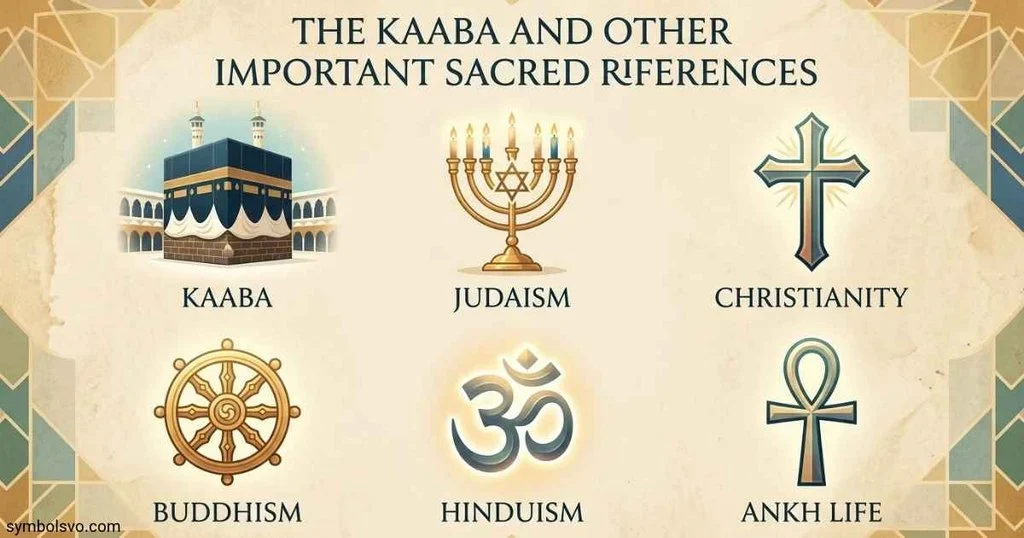
Some Islamic religious symbols are better understood as sacred places or objects than as graphic emblems. The Kaaba, the Quran, prayer beads, and prayer rugs all have distinct roles in Muslim life.
What Does the Kaaba Symbolize?
The Kaaba is a sacred sanctuary located within Masjid al-Haram in Makkah, Saudi Arabia. Muslims around the world face its direction when performing their formal prayers.
This direction is called the Qibla. The Kaaba also serves as the central destination of Hajj, the annual pilgrimage that Muslims who meet the relevant conditions are obligated to perform once in their lives.
The Kaaba is therefore closely connected with worship, pilgrimage, and the unity of Muslims in prayer.
Its familiar cube-like appearance also makes it easy to recognize in educational illustrations, religious publications, and digital graphics. The Kaaba emoji, 🕋, provides a simplified visual representation, but the emoji itself doesn’t carry the same religious significance as the sacred sanctuary.
The Quran and Quranic Inscriptions
The Quran is the central sacred scripture of Islam. Muslims believe it contains God’s revelations to the Prophet Muhammad.
Quranic verses appear in manuscripts, mosque decorations, architectural inscriptions, and other forms of Islamic art. Calligraphers have developed different scripts and page layouts to present the text clearly and beautifully.
Historical manuscripts demonstrate the variety of these artistic approaches. The Metropolitan Museum of Art’s Quran manuscript collection, for example, documents decorated pages containing geometric forms, floral motifs, and carefully arranged calligraphy.
These decorative elements help organize and embellish the manuscript. They shouldn’t be confused with the Quran’s actual words.
Prayer Beads: Misbaha, Tasbih, and Subha
Misbaha, Tasbih, and Subha are terms associated with prayer beads or devotional recitation practices in various Muslim communities.
Prayer beads can help a person count repeated phrases during dhikr, the remembrance of Allah. Some Muslims use beads to keep track of recitations such as Subhan Allah, Alhamdulillah, and Allahu Akbar.
Others count using their fingers or follow different devotional practices.
Prayer beads are therefore a devotional aid rather than a required symbol of Islam. Their materials, designs, and names vary across regions.
Prayer Rug or Sajjada
A prayer rug, also called a sajjada or sajjadah, provides a clean surface for Muslim prayer.
Many prayer rugs feature a decorative arch-like design that points toward the direction in which the worshipper should face. Others use geometric borders, floral motifs, or repeating patterns.
However, the rug’s design doesn’t necessarily carry a specific religious message. Its primary purpose is practical, and Muslims can pray without a dedicated rug when a suitable clean surface is available.
The Five Pillars of Islam: Beliefs, Practices, and Visual Representations
The Five Pillars of Islam describe five foundational practices in Sunni Islamic teaching. They are the Shahada, Salah, Zakat, Sawm, and Hajj.
These pillars are religious practices rather than five standardized visual symbols. Designers often use simple illustrations to explain them, but those illustrations are educational aids, not official emblems.
| Pillar | Meaning | Possible educational illustration |
| Shahada | Declaration of faith | Arabic calligraphy |
| Salah | Formal daily prayer | Prayer mat or prayer posture |
| Zakat | Obligatory charitable giving | Charitable donation |
| Sawm | Fasting during Ramadan | Ramadan calendar or sunset |
| Hajj | Pilgrimage to Makkah | Kaaba or pilgrims |
Shahada: Declaration of Faith
The Shahada expresses belief in the oneness of Allah and the prophethood of Muhammad. It serves as the foundation of Islamic faith and is often presented through Arabic calligraphy.
Salah: Daily Prayer
Salah refers to the five daily formal prayers. These prayers structure a Muslim’s day around worship and remembrance of God.
Prayer rugs, prayer spaces, and illustrations of prayer postures can help explain Salah. However, no single picture or object fully represents the practice.
Zakat: Obligatory Charity
Zakat is an obligatory form of charitable giving subject to Islamic rules about eligible wealth and recipients. It supports people who qualify for assistance and reflects the importance of social responsibility.
An illustration of giving or charitable support can represent Zakat in an educational chart. Such an image is a modern explanatory choice, not a traditional official symbol.
Sawm: Fasting During Ramadan
Sawm refers to fasting, especially the obligatory fast during Ramadan. Observant Muslims abstain from food and drink from dawn until sunset during the fasting hours, with exemptions and specific rules applying in different circumstances.
A calendar, a sunset scene, or a crescent moon may illustrate Ramadan. However, these images represent aspects of the month and its observance rather than a standardized symbol for fasting.
Hajj: Pilgrimage to Makkah
Hajj is the pilgrimage to Makkah that Muslims who meet the required conditions must perform once in their lifetime.
The Kaaba is central to the pilgrimage, and educational illustrations often show the sanctuary or pilgrims in its vicinity. Hajj includes specific rites performed at designated locations and times.
Important distinction: The Five Pillars are fundamental practices. Their icons can make them easier to understand, but the icons themselves aren’t religious obligations.
The Rub el Hizb and Other Islamic Geometric Symbols
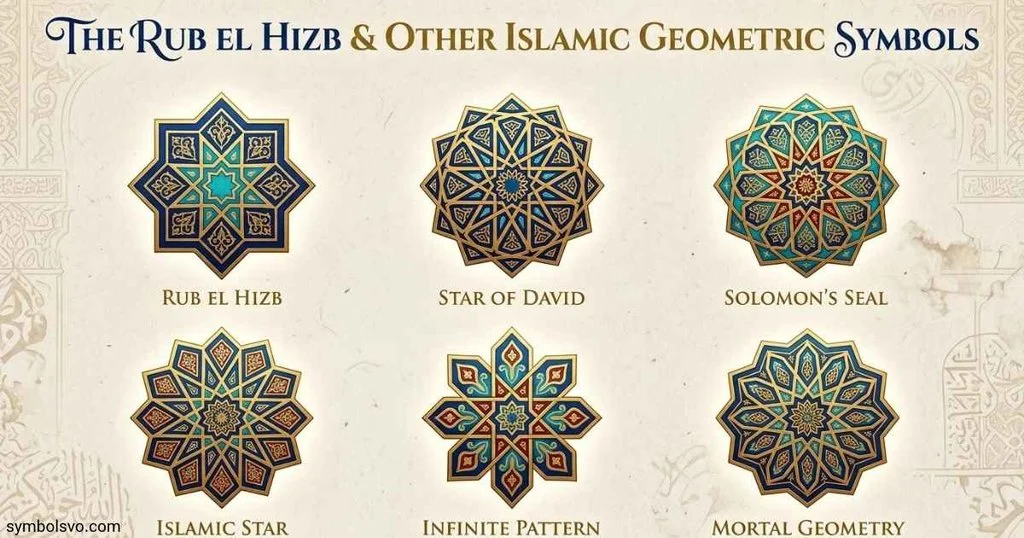
Islamic geometric patterns are among the most recognizable features of Islamic visual culture. Artists have used repeated shapes, interlocking lines, circles, and stars to decorate manuscripts, buildings, ceramics, textiles, and many other objects.
These designs can look complex, but artists often construct them using repeated geometric rules. A small group of shapes can produce an intricate pattern across a large surface.
What Is the Rub el Hizb Symbol?
The Rub el Hizb (۞) is an eight-pointed ornamental sign associated with Quranic text organization and decorative use.
The Arabic term rubʿ means a quarter, while hizb refers to a division of the Quran. In Quranic reading traditions, a hizb represents one of 60 divisions of the text. The sign is associated with marking divisions and is also used ornamentally.
Its recognizable shape resembles two overlapping squares that form an eight-pointed star.
However, not every eight-pointed star in Islamic art is a Rub el Hizb. Similar shapes appear in decorative designs that serve different purposes. Context helps distinguish a Quranic organizational sign from a general geometric motif.
Eight-Pointed Star in Islamic Art
The eight-pointed star appears in tilework, manuscript borders, carved wood, plaster decoration, and architectural surfaces.
Artists create these stars by arranging squares, intersecting lines, and other geometric shapes. They may combine the stars with polygons or repeat them across a surface to create a larger design.
The motif doesn’t have one universal theological meaning. Its significance depends on the particular artwork, its history, and the context in which it appears.
Islamic Geometric Patterns and Their Meaning
Geometric designs often emphasize symmetry, balance, and repetition. Artists use circles, triangles, squares, hexagons, and polygons to create patterns that connect individual shapes into a unified composition.
Some viewers interpret the repeating designs as an artistic reflection of unity, order, or the infinite nature of creation. These interpretations can be meaningful, but they shouldn’t be treated as the fixed religious meaning of every geometric pattern.
The Museum With No Frontiers’ exhibition on geometric decoration explores how geometric and floral motifs developed in Islamic manuscripts and decorative traditions.
Arabesque, Floral, and Vegetal Motifs
An arabesque is an ornamental design featuring flowing, interlaced forms. Artists often use stylized leaves, stems, vines, and flowers to create continuous patterns.
These designs appear in architecture, book decoration, ceramics, woodwork, and textiles. They may accompany Arabic calligraphy or geometric compositions.
Although arabesque decoration is strongly associated with Islamic art, it isn’t limited to religious buildings or sacred objects. Artists have also used it in secular settings, including palaces and household objects.
Islamic Symbols in Architecture: Mosque Features and Their Meanings
Islamic architecture includes a wide range of building traditions developed across the Middle East, North Africa, South Asia, Central Asia, Europe, and Southeast Asia. Mosques often contain recognizable architectural features, but these features don’t all function as religious symbols.
Mosque and Mosque Silhouette
A mosque, or masjid, is a place where Muslims gather for prayer and other community activities. Depending on the building, it may also provide space for religious instruction, community services, and study.
A mosque silhouette often appears in educational posters, greeting graphics, and digital designs. Its domes, arches, or minarets make it recognizable, even when the illustration is simplified.
However, mosque architecture varies widely. Some mosques feature large domes and tall minarets, while others have simpler designs shaped by local materials, climate, and building traditions.
Mihrab: The Direction of Prayer
The mihrab is a niche in the wall of many mosques that indicates the direction of the Qibla.
Architects often decorate the mihrab with tiles, stonework, inscriptions, or geometric patterns. Some are simple and understated, while others feature elaborate craftsmanship.
The mihrab’s main function is directional. Its decoration may carry artistic or religious significance, but the architectural feature itself isn’t a separate object of worship.
Minaret: The Mosque Tower
A minaret is a tower associated historically with the call to prayer, known as the adhan.
Minarets vary in height, shape, and decoration. Ottoman, Persian, North African, and South Asian architectural traditions, for example, developed distinctive styles.
Not every mosque has a minaret, and the tower’s appearance doesn’t determine whether a building functions as a mosque.
Dome, Minbar, and Quran Stand
Other recognizable mosque features include:
- Dome: A rounded architectural structure used in many, but not all, mosque designs.
- Minbar: A raised pulpit from which an imam delivers sermons, especially the Friday sermon.
- Quran stand: Often called a rehal, this stand supports the Quran while someone reads or recites it.
- Arches: Structural or decorative features found in many Islamic architectural traditions.
- Quranic inscriptions: Written passages used to decorate walls, arches, domes, and other surfaces.
These features reflect the diversity of Islamic symbols in architecture. Some serve practical functions, while others contribute to the building’s visual identity.
Shia Islam Symbols and Their Meanings
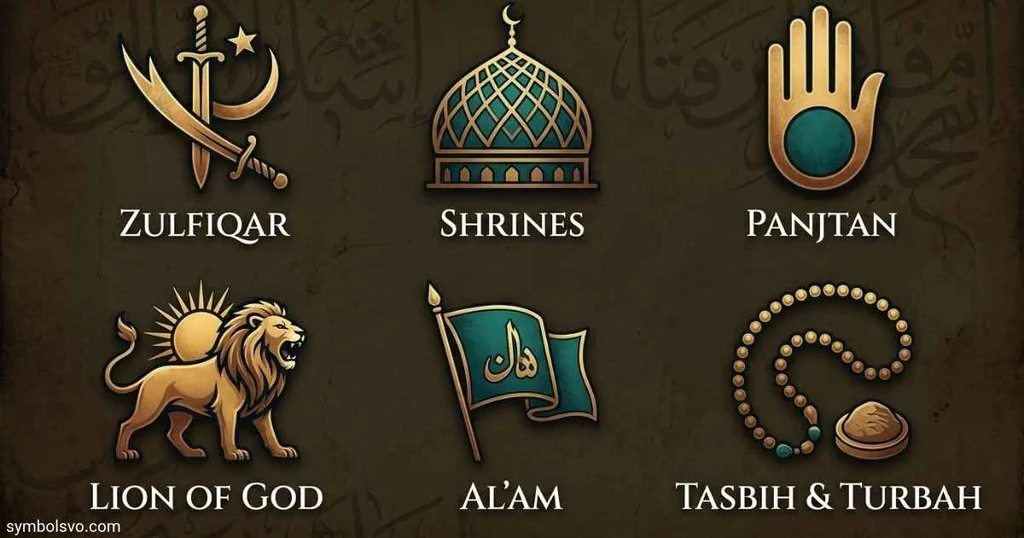
Certain Shia Islam symbols carry particular importance because of their connection with the Prophet Muhammad’s family, historical events, and devotional practices.
Their use varies among Shia communities and regions. Understanding the context behind each symbol helps explain why it appears in religious gatherings, artwork, and commemorative events.
Zulfiqar: The Sword Associated With Imam Ali
Zulfiqar is the name of a sword traditionally associated with Imam Ali, the cousin and son-in-law of the Prophet Muhammad.
In popular artistic depictions, the sword sometimes appears with a split or forked blade. That shape has become familiar in certain Islamic and especially Shia visual traditions, although artistic representations vary.
Zulfiqar may appear in calligraphy, banners, jewelry, and historical or religious artwork. Its association with Imam Ali gives it particular importance in some Shia communities.
The motif should be understood through its historical and religious associations rather than treated as a universal emblem of Islam.
Turbah: A Prayer Tablet in Shia Practice
A turbah is a small tablet or piece of natural material used as a surface for prostration in certain Shia prayer traditions.
During prayer, worshippers place their forehead on the turbah when performing prostration. Some turbahs are made from clay associated with Karbala, a city of special importance in Shia history.
The turbah isn’t an object of worship. Its role is connected with the physical practice of prostration and the religious understanding followed by those who use it.
Not all Muslims use a turbah, and prayer practices differ among Islamic traditions.
Panj Tan and the Ahl al-Bayt
Panj Tan refers to five revered figures in traditions associated particularly with Shia devotion:
- Prophet Muhammad
- Imam Ali
- Fatimah
- Imam Hasan
- Imam Husayn
The term is associated with reverence for the Prophet’s family. The broader Arabic term Ahl al-Bayt refers to the Prophet’s household, although its precise scope and interpretation vary across Islamic traditions and scholarly discussions.
Artwork featuring these figures may appear in religious settings, commemorative displays, and cultural traditions. Such imagery often expresses devotion, remembrance, and respect for the Prophet’s family.
Alam, Karbala, Ashura, and Muharram
An alam is a ceremonial standard used in some Shia religious gatherings, particularly during commemorations connected with Muharram and Karbala.
Karbala is the Iraqi city associated with the death of Imam Husayn in 680 CE. His death became a central event in Shia religious memory.
Ashura, observed on the tenth day of Muharram, holds particular importance for many Shia Muslims because of its connection with the events of Karbala. Commemorations may include gatherings, sermons, poetry, processions, and symbolic standards.
The alam’s design varies by region. Some feature metalwork, inscriptions, hand-shaped ornaments, or colors associated with local commemorative traditions.
Black, green, and red may appear in certain Shia settings, but their meanings aren’t identical across every community. Local history and custom influence how people interpret them.
Islamic Symbols in Art, Textiles, and Decorative Design
Islamic artistic traditions developed across many regions, bringing together local craftsmanship, religious influences, trade, and cultural exchange.
Islamic symbols in art can include calligraphy, geometric patterns, floral decoration, and recognizable architectural forms. Yet the meaning of a particular motif depends on its use and historical background.
Manuscripts and Ceramics
Quranic manuscripts often combine written passages with carefully designed borders, ornamental markers, and decorative illumination.
Some manuscripts use geometric forms to mark sections of the text. Others feature floral decoration, gold accents, or elaborate calligraphic layouts.
Ceramics and glazed tiles use similar visual elements. Artists may arrange stars, polygons, or repeated floral motifs across walls, vessels, and architectural panels.
These examples show how Islamic art combines practical craftsmanship with visual beauty. They also demonstrate why a decorative motif shouldn’t automatically be assigned a fixed theological meaning.
Carpets and Textiles
Islamic textiles include woven carpets, embroidered garments, decorative panels, and fabrics used in homes or religious settings.
Geometric borders, repeating shapes, and floral patterns often appear in these textiles. Their styles can reveal regional influences and the techniques of particular weaving communities.
Some designs incorporate religious inscriptions, while others are primarily ornamental. A pattern on a carpet doesn’t necessarily represent a Quranic teaching or a formal religious symbol.
Modern Graphic Design
Designers continue to use Islamic visual traditions in websites, educational graphics, event materials, and contemporary artwork.
Common elements include:
- Arabic calligraphy featuring religious phrases
- Crescent-and-star motifs
- Eight-pointed stars and geometric borders
- Mosque silhouettes
- Floral and arabesque decoration
- Patterns inspired by traditional tiles and manuscripts
When using these elements, designers should check the meaning and spelling of Arabic text. They should also distinguish authentic historical motifs from newly created designs.
For more historical examples, the Museum of Islamic Art in Doha documents the artistic traditions of Muslim societies through manuscripts, decorative objects, and other works.
Islamic Clothing and Dress: What Counts as a Symbol?
Islamic clothing reflects a mix of religious teachings, modesty practices, cultural traditions, regional styles, and personal choices. Some garments have strong associations with Muslim identity, but clothing isn’t automatically a religious symbol.
Hijab, Khimar, Abaya, and Jilbab
These garments are commonly associated with Muslim women’s dress, although their styles and meanings vary.
- Hijab: Commonly refers to a head covering worn by many Muslim women. The term also has a broader meaning related to modesty and boundaries.
- Khimar: A garment that covers the head and usually extends over the shoulders and upper body.
- Abaya: A loose outer garment worn in many Muslim communities.
- Jilbab: A term used for an outer garment, with its precise style varying across regions and traditions.
Muslim women make different choices about clothing based on religious understanding, local customs, personal preference, and practical needs.
Niqab and Burqa
The niqab covers the face while leaving the eyes visible. The burqa commonly refers to a garment that covers the body and face, often incorporating a mesh screen over the eyes.
These garments aren’t interchangeable. Their use also varies considerably among countries, communities, and individuals.
Neither garment should be treated as something every Muslim woman wears.
Thobe, Kufi, Taqiyah, and Turban
Men’s clothing also varies across Muslim societies.
- Thobe or thawb: A long garment commonly worn in parts of the Middle East and elsewhere.
- Kufi: A rounded cap worn in several African, Middle Eastern, and other Muslim communities.
- Taqiyah: A term used for a cap worn by some Muslim men, particularly in religious settings.
- Turban: A head covering made by wrapping fabric around the head, with styles varying by region and community.
Some people wear these garments during prayer or religious occasions. Others wear them as everyday clothing or as expressions of cultural identity.
Do Islamic Clothes Have Specific Symbols?
Some garments feature Arabic calligraphy, geometric patterns, embroidered borders, or regional designs. However, these decorations don’t necessarily have fixed religious meanings.
For example, an embroidered prayer cap may reflect a local craft tradition rather than a specific Islamic teaching. Similarly, a garment bearing Quranic writing has a different context from one featuring purely geometric decoration.
The best approach is to distinguish religious dress, cultural clothing, and decorative motifs rather than treating them as one category.
Sunni and Shia Traditions: Shared Beliefs and Different Symbols
Sunni and Shia Muslims share central Islamic beliefs, including belief in one God and the Quran. Both traditions also recognize the Prophet Muhammad, although they differ in important historical and theological understandings.
These differences influence some religious practices and symbolic traditions.
For example, the turbah and alam have particular significance in some Shia communities, especially in contexts connected with prayer and commemorations of Karbala. Zulfiqar also has a prominent place in certain Shia artistic traditions because of its association with Imam Ali.
However, these examples don’t mean that all Shia Muslims use the same objects or that Sunni Muslims never encounter similar imagery.
The crescent and star, meanwhile, has a broad cultural association with Islam and isn’t exclusive to either tradition.
Remember: Muslim communities are diverse. Regional customs, religious interpretations, family traditions, and individual choices all influence how people use and understand particular symbols.
Islamic Symbols Copy and Paste: Text, Unicode, and Emoji
If you’re looking for Islam symbols copy and paste, the following table provides useful characters and text for digital use.
Some entries are Unicode characters, some are emoji, and others are Arabic words or phrases. They don’t all belong to the same technical category.
| Symbol or text | Name | Copy |
| ☪️ | Crescent and star emoji | ☪️ |
| ﷲ | Allah calligraphic ligature | ﷲ |
| ﷺ | Arabic blessing ligature | ﷺ |
| ۞ | Rub el Hizb sign | ۞ |
| 🕋 | Kaaba emoji | 🕋 |
| 🕌 | Mosque emoji | 🕌 |
| الله | Allah in Arabic | الله |
| بِسْمِ ٱللَّٰهِ | Bismillah phrase | بِسْمِ ٱللَّٰهِ |
| ٱلْحَمْدُ لِلَّٰهِ | Alhamdulillah phrase | ٱلْحَمْدُ لِلَّٰهِ |
| مَا شَاءَ ٱللَّٰهُ | Masha Allah phrase | مَا شَاءَ ٱللَّٰهُ |
How to Copy and Paste Islamic Symbols
Follow these simple steps:
- Find the character or phrase you want to use.
- Select it with your mouse or touchscreen.
- Copy it using your device’s usual copy command.
- Paste it into your message, document, website, or design.
- Check how it appears on the target platform.
Arabic text may look different across fonts and applications. Some platforms also display emoji differently, so a symbol’s appearance can change between devices.
Are There Official Islamic Unicode Symbols?
Unicode is a standard for representing text characters and emoji across digital systems. It doesn’t decide which symbols are religiously official or how Muslims should interpret them.
For example, the crescent and star emoji is a digital character that resembles a familiar emblem. The Arabic Allah ligature represents a written form of God’s name, while the Rub el Hizb is a specific ornamental sign.
These distinctions matter when creating educational material or publishing religious content.
If you use Quranic text or religious phrases in a graphic, verify the spelling and intended meaning before publishing. This is especially important for permanent designs, printed materials, and public-facing educational resources.
How to Use Islamic Symbols Respectfully and Accurately
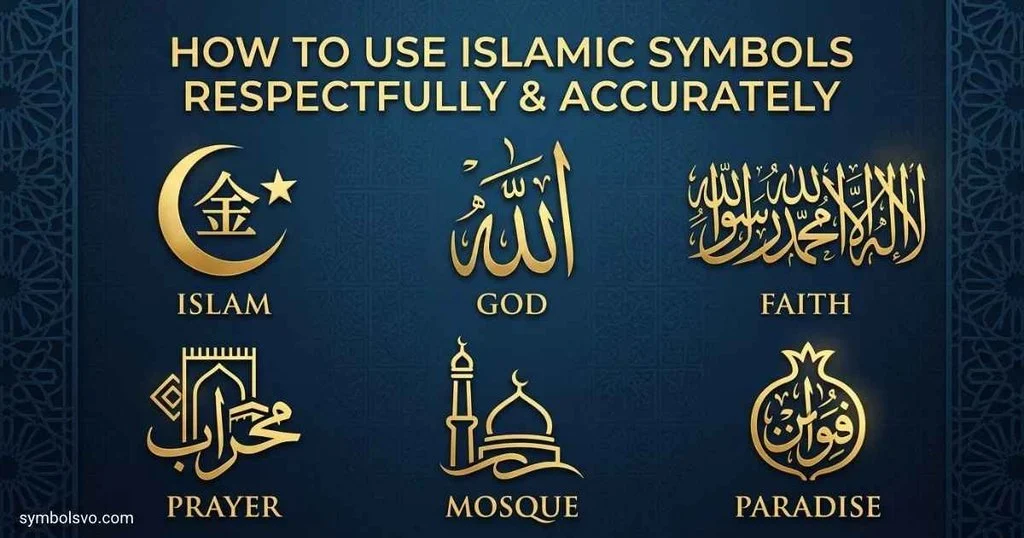
Islamic symbols can help communicate religious ideas, cultural history, and artistic heritage. However, careless use can spread inaccurate information or confuse decorative designs with religious requirements.
Keep these points in mind:
- Verify religious meanings. Use reliable sources when explaining the Shahada, Quranic phrases, or other religious references.
- Check Arabic spelling. A visually attractive design still needs accurate text.
- Avoid unsupported interpretations. Not every star, circle, or floral motif has a specific theological meaning.
- Respect regional differences. A symbol may have particular significance in one community but not another.
- Distinguish history from belief. The crescent and star’s widespread association with Islam doesn’t make it a universally prescribed religious emblem.
- Use sacred text carefully. Consider context and respect when placing Quranic verses or devotional phrases on products, clothing, or decorative items.
- Identify cultural associations accurately. Don’t describe every mosque feature, garment, or devotional object as an official symbol of Islam.
These principles help keep articles, educational resources, and designs both informative and respectful.
Frequently Asked Questions About Islam Symbols
What Is the Most Important Symbol in Islam?
Islam doesn’t have one universally prescribed visual emblem. The Shahada is a central declaration of faith, while the crescent and star is a widely recognized cultural emblem associated with Islam. These serve different purposes.
What Is the Sign of Islam Religion?
The crescent and star is commonly recognized as a sign associated with Islam. However, its use developed through historical and cultural traditions rather than a universal religious requirement.
Is the Crescent and Star Mentioned in the Quran?
The Quran mentions the moon and stars, but it doesn’t prescribe the combined crescent-and-star design as the official symbol of Islam.
What Does the Crescent Moon Symbolize in Islam?
The crescent is associated with the Islamic lunar calendar and the timing of important months, including Ramadan. Its meaning as part of a combined emblem varies across cultural and historical settings.
What Is the Muslim Symbol for God?
The Arabic name for God is Allah (الله). Artists often write it in calligraphic styles, but no single decorative form is the universally prescribed symbol for God.
What Is the Shahada Symbol?
The Shahada is the declaration of Islamic faith. It expresses belief in the oneness of God and Muhammad’s prophethood. Artists may present it in different Arabic calligraphic styles.
What Does the Kaaba Symbolize?
The Kaaba is the sacred sanctuary in Makkah toward which Muslims face during formal prayer. It also holds a central place in Hajj and other pilgrimage-related worship.
What Is the Rub el Hizb Symbol?
The Rub el Hizb is an eight-pointed sign associated with Quranic organization and ornamental use. It can mark divisions in Quranic text and also appears in decorative designs.
What Are the Five Pillars of Islam Symbols?
The Five Pillars are the Shahada, Salah, Zakat, Sawm, and Hajj. They represent foundational religious practices rather than five standardized visual symbols.
What Are the Main Shia Islam Symbols?
Examples include Zulfiqar, the turbah, the Panj Tan, and the alam. Their significance varies by community and context, particularly in traditions associated with Imam Ali, the Prophet’s family, and the commemoration of Karbala.
Are Islamic Geometric Patterns Religious Symbols?
Islamic geometric patterns are important features of Islamic artistic traditions. Some people interpret their symmetry and repetition as reflections of unity and order, but individual patterns don’t all have fixed religious meanings.
Are Islamic Symbols the Same as Muslim Symbols?
The terms overlap. Islamic symbols often emphasizes religious traditions and artistic forms, while Muslim symbols can include objects and imagery associated with Muslim identity and cultural practices.
Conclusion
Islam symbols encompass much more than the crescent and star. They include the Shahada, Allah calligraphy, the Kaaba, the Rub el Hizb, Islamic geometric patterns, mosque architecture, devotional objects, and symbols associated with particular Muslim traditions.
Each example has its own context. The Shahada expresses a central statement of faith, the Kaaba holds a central place in prayer and pilgrimage, and geometric patterns reflect a rich artistic heritage. Meanwhile, the crescent and star has become a familiar emblem associated with Islam through historical and cultural developments.
Understanding these distinctions helps you recognize the meanings of Islamic symbols without confusing religious teachings, cultural identity, and decorative art.

I’m Nathan Holloway, a passionate researcher and writer with a deep interest in symbols, signs, and their hidden meanings. I enjoy exploring how symbols have influenced different civilizations, religions, and modern communication. Through my work, I aim to make complex historical and cultural concepts easy to understand for readers of all backgrounds. Every article I write is carefully researched to provide reliable and engaging information.
Books:
- Beyond the Symbol
- The Secret Meanings of Everyday Signs
Author 2: Grace Whitmore
Description:
My name is Grace Whitmore, and I love discovering the stories behind the world’s most fascinating symbols. I spend my time researching ancient civilizations, mythology, spiritual traditions, and modern iconography to uncover the meanings people often overlook. I believe that every symbol has a history worth telling, and I enjoy sharing that knowledge in a simple and reader-friendly way.
Books:
- Echoes of Ancient Symbols
- The Symbolic World
 Mason Ellington
 Daniel Brooks