The and symbol (&) is one of the most recognizable characters in written English. Known as the ampersand, it represents the word “and” and connects words, names, ideas, and expressions in a compact form. You’ll find it in business names, book titles, abbreviations, academic citations, and digital text.
Although this symbol looks simple, its history stretches back to ancient Roman writing. It also has specific grammar rules, keyboard shortcuts, Unicode codes, and HTML uses. Knowing when to use it can make your writing clearer and help you avoid common punctuation mistakes.
Whether you want to copy and paste the ampersand symbol, learn its meaning, or understand how it works in formal writing, this guide covers the essentials.
And Symbol (&) Copy and Paste
If you need the and symbol for copy and paste, you can copy the character below and use it in documents, messages, websites, or other text fields.
&
Ampersand symbol — copy and paste
Copy Ampersand (&)
The standard ampersand works in most modern writing applications, operating systems, and digital platforms. Its exact appearance may vary depending on the font, but the underlying character remains the same.
And Symbol at a Glance
Here are the essential facts about the ampersand character.
| Property | Details |
| Symbol | & |
| Official character name | Ampersand |
| Meaning | And |
| Unicode code point | U+0026 |
| HTML named character reference | & |
| HTML decimal reference | & |
| HTML hexadecimal reference | & |
| Character category | Basic Latin punctuation and symbol |
| Common keyboard shortcut (US layout) | Shift + 7 |
The Unicode Standard identifies U+0026 as AMPERSAND and notes that the character originally developed from a ligature of the letters e and t. See the official Unicode Basic Latin chart.
What Is the And Symbol Called?
The and symbol (&) is called an ampersand. It represents the English conjunction “and,” which joins words, phrases, or clauses.
For example, instead of writing “research and development” in full, a company might use “research & development” in a heading or label. Similarly, a publisher might use an ampersand in its official name.
The symbol is more than a decorative mark. It has a recognized character identity and a long history in written communication.
What Is an Ampersand in Grammar?
In grammar, the ampersand functions as a compact written substitute for the conjunction “and.” It can connect two names, two related concepts, or parts of an established expression.
Consider these examples:
- Bread & butter: Connects two related foods.
- Design & development: Joins two related professional activities.
- Smith & Jones: Connects two surnames.
- R&D: Represents research and development.
- Q&A: Represents questions and answers.
The ampersand usually appears in names, labels, headings, and established abbreviations. In ordinary sentences, writers generally spell out the word “and” because it reads more naturally.
For instance:
- Standard prose: “The team researched the topic and prepared a report.”
- Compact heading: “Research & Report Preparation”
Both forms communicate a connection, but each suits a different context.
Is the Ampersand a Logogram?
A logogram is a written sign that represents a word or meaningful linguistic unit. The ampersand is commonly described as a logogram because it represents the word “and” rather than spelling that word out with three separate letters.
However, its classification can depend on the linguistic framework being used. For everyday purposes, calling it a symbol or a written representation of “and” is accurate and easy to understand.
The key point is simple: & and the word “and” express the same basic connection, but they aren’t always interchangeable in writing.
What Does the Ampersand Symbol Mean?
The ampersand symbol meaning is straightforward: it stands for “and.” However, its precise function depends on where it appears.
In a business name, it may connect two founders or partners. In an abbreviation, it can shorten a familiar phrase. In a book title, it may be part of the title’s official wording.
Here are common examples:
| Example | Meaning |
| Food & Drinks | Food and drinks |
| Arts & Crafts | Arts and crafts |
| Research & Development | Research and development |
| Bed & Breakfast | Bed and breakfast |
| Questions & Answers | Questions and answers |
| Sales & Marketing | Sales and marketing |
The symbol doesn’t automatically imply a special relationship between the connected words. Usually, it simply joins them.
For example, “Sales & Marketing” identifies two related business functions. It doesn’t mean that sales and marketing are the same activity.
Ampersand Meaning in Different Contexts
The context helps readers understand how the symbol works.
- In business: It connects names or parts of an official company name.
- In abbreviations: It represents “and” within a shortened expression.
- In titles: It forms part of the published or officially recognized title.
- In academic writing: It follows specific citation conventions.
- In digital text: It can introduce an HTML character reference.
This flexibility explains why the ampersand remains useful even though the word “and” is easy to write.
History and Origin of the Ampersand
The history of the ampersand begins with Latin, the language of ancient Rome. Its development illustrates how a quick handwritten form can gradually become a recognized character.
The Latin word et means “and.” Writers sometimes joined its letters, e and t, into a ligature. A ligature combines two or more letters into a connected written form.
Over time, this joined form developed into the ampersand used today. Historical examples are associated with Roman cursive writing, and the symbol continued to evolve as handwriting and typography changed.
How Did the Ampersand Evolve?
The symbol’s history spans several stages of written communication.
- Ancient Roman writing: The letters e and t were sometimes joined when writing the Latin conjunction et.
- Roman cursive traditions: Connected letterforms helped writers produce text efficiently.
- Medieval manuscripts: Scribes continued using and refining the ligature.
- Renaissance typography: Printers incorporated ampersands into printed books, while different type styles developed distinctive forms.
- Modern typography: The ampersand became a standard character in print, digital text, and font design.
These stages weren’t a single, perfectly linear process. Different scribes and type designers produced different forms, and some historical details remain uncertain. The broad connection to Latin et, however, is well established.
Why Was the Ampersand the 27th Letter of the Alphabet?
The ampersand was historically taught at the end of some English alphabets, after Z. This led to its popular description as the 27th letter of the alphabet.
It wasn’t a letter in quite the same sense as A or B. Instead, it was a symbol that represented a complete word.
When students recited the alphabet, adding the ampersand after Z could make the ending sound repetitive: “X, Y, Z, and … and.” To distinguish the character’s name from the conjunction, people used the phrase “and per se and.”
The expression meant approximately “and, by itself, means and.” Over time, the phrase evolved into the word ampersand. The word is documented in English from the late 18th century.
What Does “Per Se” Mean in Ampersand History?
The Latin expression per se means “by itself” or “in itself.”
In the historical phrase “and per se and,” the expression clarified that the character itself represented the word “and.” It helped distinguish the symbol from the conjunction spoken aloud during alphabet recitation.
This unusual origin explains why the word ampersand doesn’t look or sound much like the character it names.
How to Type the And Symbol on a Keyboard
Typing the ampersand symbol (&) is simple on most standard US keyboards. You can also find it on mobile devices through the symbols section of the on-screen keyboard.
How to Type & on Windows
On a standard US QWERTY keyboard, follow these steps:
- Find the number 7 on the top row of the keyboard.
- Hold down the Shift key.
- Press 7 while holding Shift.
- Release both keys.
The ampersand should appear: &
This shortcut works in many Windows applications, including word processors, browsers, and text editors. However, keyboards configured for other languages may use different layouts.
How to Type & on Mac
On a Mac using the standard US keyboard layout, press Shift + 7.
The same shortcut generally works in common applications such as Pages, Notes, and web browsers. If it produces a different character, check your active keyboard layout in macOS settings.
How to Type the Ampersand on a Phone
You don’t need a physical keyboard to enter an ampersand.
On most iPhone and Android keyboards:
- Open the app where you want to type.
- Tap the button that switches from letters to numbers or symbols.
- Find & among the available characters.
- Tap the symbol to insert it into your text.
The exact location varies by keyboard app and device. If you can’t find it quickly, copying the symbol from the beginning of this article is an easy alternative.
How to Write the And Symbol by Hand
Handwritten ampersands vary considerably. Some look like a compact loop, while others resemble a joined lowercase e and t. More elaborate forms may contain several curves.
You don’t need to reproduce a decorative version to write the symbol correctly. For everyday notes, the clearest recognizable form is usually the best choice.
How to Use the Ampersand Correctly in Writing
The ampersand usage rules depend on the type of writing, the surrounding words, and the style guide you’re following.
Although the symbol is widely recognized, it isn’t a universal replacement for the word “and.” In polished prose, using it too often can make the text feel like a collection of labels rather than connected sentences.
The Chicago Manual of Style generally limits ampersands in edited prose to established abbreviations, company names that use them, verbatim quotations, and certain titles. Read the Chicago Manual of Style’s ampersand guidance.
Ampersand in Formal and Informal Writing
In informal writing, the ampersand often saves space. You might see it in a short message, a graphic, a menu, or a social media heading.
Formal writing requires more care. Academic papers, business reports, and professional articles usually spell out “and” in ordinary sentences unless a particular convention calls for the symbol.
Compare the examples below.
| Context | Recommended example | Reason |
| Formal prose | “The researchers reviewed the data and published their findings.” | The word reads naturally in a sentence. |
| Business name | “Johnson & Johnson” | The symbol belongs to the established name. |
| Heading | “Benefits & Limitations” | The compact form works well in a heading. |
| Abbreviation | “R&D department” | The ampersand is part of the standard abbreviation. |
| Academic citation | “(Taylor & Morgan, 2025)” | The ampersand may be required by the citation style. |
The best rule is to follow the convention of the text you’re writing rather than replacing every occurrence of “and.”
Ampersand Grammar and Spacing Rules
Spacing around an ampersand depends on its use.
When the symbol connects complete words in a heading or business expression, spaces on both sides are common:
- Research & Development
- Food & Drinks
- Art & Design
Established abbreviations typically omit spaces:
- R&D
- Q&A
- R&B
Company names and official titles should retain their recognized spelling. If a brand uses an ampersand without spaces, don’t add them merely to apply a general rule.
Also, don’t insert an ampersand between words simply because you want a shorter sentence. The symbol works best when it suits the context.
Ampersand in Academic Writing
Academic writing has some of the clearest examples of style-dependent ampersand use.
The American Psychological Association (APA) uses an ampersand in parenthetical citations for works by two authors. Its reference-list conventions also use an ampersand before the final author’s name in applicable entries.
For example, a parenthetical citation might appear as:
(Taylor & Morgan, 2025)
A narrative citation, by contrast, uses the word “and”:
Taylor and Morgan (2025) examined the results.
These examples illustrate the difference between parenthetical citations and narrative citations. The correct format depends on how the authors’ names appear in the sentence.
Always check the current requirements of the style guide you’re using. APA, MLA, and Chicago don’t follow identical rules in every situation. The symbol’s appearance in a reference list may also depend on the number of authors and the type of source.
Common Uses of the Ampersand Symbol
The ampersand symbol appears in many areas of everyday communication. Its main advantage is that it connects related terms without spelling out the conjunction.
Ampersand in Business Names and Branding
Companies sometimes use an ampersand as part of their official name. It can connect founders’ surnames, distinguish a brand’s identity, or create a compact visual mark.
Examples include:
- AT&T: An established telecommunications brand.
- Johnson & Johnson: A company whose name retains the ampersand.
- Simon & Schuster: A publishing company with an ampersand in its name.
When writing about a company, preserve its official name instead of replacing the symbol with the word “and.” This matters in articles, citations, business documents, and branded materials.
Ampersand in Abbreviations
The ampersand is common in abbreviations because it saves space and makes familiar expressions easy to recognize.
| Abbreviation | Full form | Common context |
| R&D | Research and development | Business and science |
| Q&A | Questions and answers | Interviews and discussions |
| R&B | Rhythm and blues | Music |
| B&B | Bed and breakfast | Accommodation |
| L&D | Learning and development | Workplace training |
| AT&T | Official company name | Telecommunications |
Some expressions have become established with an ampersand. Replacing it with “and” may still communicate the meaning, but it can change the recognized abbreviation or official name.
Ampersand in Book, Movie, TV, and Game Titles
An ampersand can be part of a work’s official title. In such cases, it isn’t merely a stylistic shortcut; it’s part of the title as published or presented.
Examples include:
- Thelma & Louise — a film.
- Drake & Josh — a television series.
- Dungeons & Dragons — a tabletop role-playing game.
- Pride & Prejudice — a common stylized variation of Jane Austen’s novel title, which is conventionally published as Pride and Prejudice.
The last example highlights an important distinction: a title containing an ampersand may be a particular adaptation, edition, or stylized presentation. Don’t assume that every familiar title uses the symbol officially.
When referencing a book, movie, TV show, or game, check the actual title rather than changing “and” to & for convenience.
Ampersand in Professional and Creative Industries
The symbol also has a specific role in some professional naming conventions.
The Writers Guild of America uses an ampersand between writers’ names in certain screenwriting credits to indicate a writing team. The distinction matters because an ampersand and the word “and” can represent different kinds of writing credit under the applicable guild conventions.
This is a useful reminder that the ampersand’s meaning isn’t always limited to saving space. In specialized settings, an established convention can give it a more precise role.
Ampersand Symbol Unicode and HTML Codes
The ampersand Unicode code and HTML character references are useful when working with websites, source code, text-processing systems, and digital documents.
Unicode gives the character a consistent code point. HTML provides character references that allow authors to represent it safely in markup.
What Is the Unicode for the Ampersand Symbol?
The standard ampersand has the Unicode code point U+0026.
Unicode assigns code points to characters so software can represent and exchange text consistently. The code point identifies the ampersand even when different fonts draw it differently.
| Property | Value |
| Character | & |
| Unicode name | AMPERSAND |
| Unicode code point | U+0026 |
| Decimal value | 38 |
| Hexadecimal value | 26 |
| Unicode block | Basic Latin |
You can find this character in the official Unicode Basic Latin chart.
What Is the Ampersand HTML Entity?
In HTML, the ampersand introduces a character reference. A named character reference uses a recognized name to represent a character.
The standard named reference for the ampersand is:
&
When a browser processes this reference in an appropriate HTML text context, it displays the ampersand character.
For example, the following HTML:
<p>Research & Development</p>
displays:
Research & Development
This distinction is important because the ampersand also has a technical role in HTML syntax. Writing it as a character reference helps prevent it from being confused with the beginning of another reference.
Ampersand Decimal and Hexadecimal Codes
You can also represent the ampersand using numeric character references.
| Format | Code | Meaning |
| Literal character | & | The ampersand itself |
| Named HTML reference | & | Named reference for the ampersand |
| Decimal HTML reference | & | Uses decimal code point 38 |
| Hexadecimal HTML reference | & | Uses hexadecimal code point 26 |
| Unicode notation | U+0026 | Unicode code point |
The HTML Standard explains that character references begin with U+0026, the ampersand character. Named references use recognized names, while numeric references identify characters through numeric values. Read the official HTML character-reference rules.
When Should You Escape an Ampersand in HTML?
When writing HTML, use & when you need to represent a literal ampersand in a context where a character reference is appropriate.
For example:
<p>Arts & Crafts</p>
A browser displays “Arts & Crafts.”
However, the rule isn’t that every ampersand must always be escaped in every possible context. HTML parsing rules vary according to the location and surrounding syntax. URLs, attribute values, and plain text may have different practical requirements.
When placing a URL inside an HTML attribute, you need to account for HTML attribute syntax and appropriate escaping. In HTML source, that may mean writing the ampersand as & within the attribute value. The browser then interprets the resulting URL correctly.
The safest approach is to follow the HTML specification and use a suitable HTML encoder when inserting dynamic values into markup.
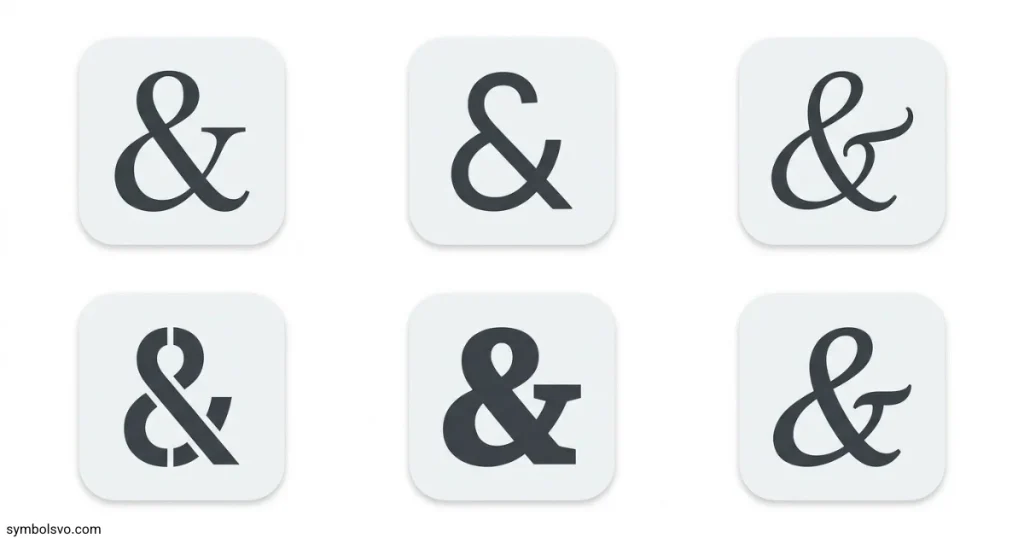
Different Ampersand Symbol Styles and Variations
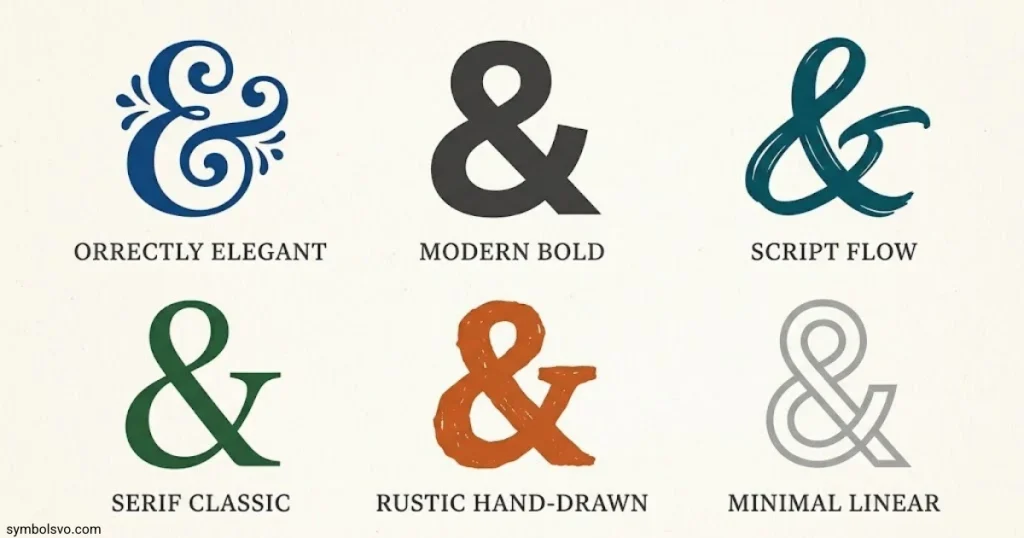
Although the standard ampersand has one Unicode code point, its appearance can change dramatically across typefaces.
A traditional serif font might draw the symbol with fine strokes and elegant curves. A sans-serif font may use a cleaner, simpler design. A script typeface might make it look like a handwritten flourish.
These are usually typographic variations, not different characters.
Serif and Sans-Serif Ampersands
&
Serif ampersand
Often features contrasting strokes and decorative terminals. It suits traditional editorial design and print typography.
&
Sans-serif ampersand
Usually has a more streamlined appearance. It works well in modern interfaces, headings, and minimalist designs.
The examples above illustrate general typographic tendencies. The exact shape depends on the font, and some typefaces blur the distinction between traditional and modern styles.
Ampersand in Handwriting
In handwriting, people often simplify the symbol into a form they can draw quickly. Some versions make the original e and t connection easier to recognize, while others look like a single continuous loop.
Handwritten variations are useful in personal notes, invitations, and informal design. For professional documents, consistency and readability matter more than artistic complexity.
Decorative Ampersand and Ornamental Designs
An ornamental ampersand can become a focal point in a logo, wedding invitation, magazine cover, or brand identity.
Designers may use elaborate curves, extended strokes, flourishes, or unusual proportions. These changes affect the character’s appearance rather than necessarily changing its identity.
A decorative symbol should still be recognizable. If the design is so elaborate that readers can’t identify it, it may work better as artwork than as ordinary text.
Are There Upside-Down Ampersand Symbols?
An upside-down or rotated ampersand may appear in decorative typography, illustrations, or experimental lettering. However, rotating the standard ampersand doesn’t automatically create a new standard character with a separate Unicode identity.
Unicode also includes related but distinct characters, such as the turned ampersand at U+214B and the heavy ampersand ornament at U+1F674. These characters aren’t simply interchangeable with the standard ampersand in every context.
If you need a symbol for ordinary writing or a website, use the standard & unless you have a specific reason to choose a different character.
Ampersand vs. the Word “And” vs. the Plus Sign
The ampersand, the word “and,” and the plus sign may seem similar because they can all suggest a connection. However, they serve different purposes.
| Feature | Ampersand (&) | Word “and” | Plus sign (+) |
| Primary role | Represents the conjunction “and” | Connects words, phrases, or clauses | Usually represents addition |
| Common use | Names, abbreviations, headings | Ordinary sentences and formal prose | Mathematics and technical notation |
| Example | Research & Development | Research and development | 5 + 3 = 8 |
| Best suited for | Compact expressions and established names | General writing | Arithmetic and mathematical expressions |
When Should You Write “And” Instead of “&”?
In most ordinary sentences, write the word “and.” It creates a natural reading flow and follows standard conventions in formal English.
For example:
- Preferred: “The teacher explained the lesson and answered questions.”
- Less suitable in formal prose: “The teacher explained the lesson & answered questions.”
The second version is understandable, but the ampersand can make a complete sentence feel informal or abbreviated.
There are exceptions. If a company, publication, or organization uses an ampersand in its official name, preserve it. The same applies to established abbreviations and titles.
Is an Ampersand the Same as a Plus Sign?
No. The ampersand represents “and,” while the plus sign most commonly represents addition.
For example, “tea & coffee” names two items. In arithmetic, “2 + 3” expresses an operation that produces five.
In some contexts, a plus sign can suggest combining things, but that doesn’t make it a universal substitute for the ampersand. Choose the character that matches your intended meaning.
Examples of the Ampersand in Sentences
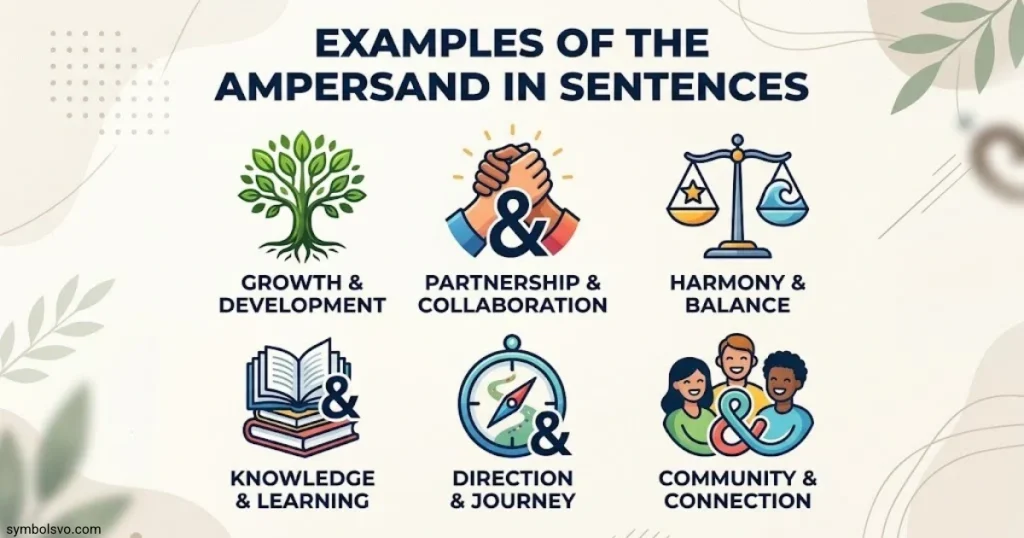
Practical examples make ampersand usage rules easier to understand. The following examples show how the symbol works across different kinds of writing.
Correct Ampersand Usage Examples
| Example | Context | Why it works |
| “The shop sells Arts & Crafts supplies.” | Business heading | The symbol creates a compact heading. |
| “The company expanded its R&D department.” | Business writing | R&D is an established abbreviation. |
| “She enjoys R&B music.” | Everyday writing | R&B is a familiar genre abbreviation. |
| “The publisher is Simon & Schuster.” | Company name | The ampersand belongs to the official name. |
| “See the Questions & Answers section.” | Website navigation | The symbol connects two related labels. |
| “The article discusses research and development.” | Formal prose | The word “and” reads naturally in a complete sentence. |
Notice that the ampersand isn’t necessary in every example. The goal isn’t to use it as often as possible; it’s to use it where it fits.
Common Ampersand Mistakes to Avoid
Even a familiar symbol can create problems when writers ignore context.
Replacing every “and” with &
This can make an article feel rushed or overly informal. Spell out “and” in ordinary prose unless the context calls for the symbol.
Changing an official name
Don’t rewrite a company or publication’s name just to match your preferred style. Preserve the established spelling.
Using inconsistent spacing
Expressions such as research & development usually have spaces, while established abbreviations such as R&D do not. Follow the relevant convention.
Confusing the ampersand with a plus sign
The symbols aren’t universally interchangeable. Use the ampersand for the conjunction and the plus sign for addition or another clearly defined technical meaning.
Writing HTML character references incorrectly
When encoding a literal ampersand in HTML, use the appropriate character reference, such as &, where required. A missing semicolon or malformed reference can cause parsing problems.
Frequently Asked Questions About the And Symbol
What Is the And Symbol Called?
The and symbol (&) is called an ampersand. It represents the word “and” and appears in business names, abbreviations, titles, and other compact expressions.
What Does the Ampersand Mean?
The ampersand means “and.” It connects words, names, or ideas, as in “food & drinks.” Its exact function depends on the context.
Why Was the Ampersand the 27th Letter?
Some historical English alphabets included the ampersand after Z. It was treated as an additional character representing a word rather than a conventional letter. The phrase “and per se and” eventually developed into the modern word ampersand.
How Do You Type an Ampersand on a Keyboard?
On a standard US keyboard, press Shift + 7. On a phone, open the numbers or symbols keyboard and tap &.
What Is the Unicode for the And Symbol?
The standard ampersand has the Unicode code point U+0026. Its decimal value is 38, and its hexadecimal value is 26.
Should You Put Spaces Around an Ampersand?
Use spaces when the symbol connects words in ordinary expressions, such as “Sales & Marketing.” Established abbreviations, including R&D and Q&A, generally don’t use spaces. Official names should retain their established styling.
Can You Use an Ampersand in Formal Writing?
Yes, when the context permits it. Formal writing often uses the ampersand in established names, abbreviations, and specific citation formats. In ordinary sentences, spelling out “and” is usually the better choice.
How Do You Write an Ampersand in HTML?
Use & to represent a literal ampersand in HTML contexts where a character reference is appropriate. Numeric alternatives include & and &. Follow the HTML rules for the specific context in which the character appears.
Is an Ampersand the Same as a Plus Sign?
No. The ampersand represents “and,” while the plus sign generally represents addition. Although both can suggest a connection, they have different conventional meanings.
What Is the Difference Between an Ampersand and a Ligature?
A ligature combines two or more letters into a connected form. The ampersand developed from a ligature of the letters e and t in the Latin word et. Today, the ampersand is recognized as an independent character, even though its historical form came from joined letters.
Conclusion
The and symbol (&) is a compact character with a surprisingly long history. Originating from a connected form of the Latin word et, it developed through handwritten manuscripts, printed typography, and modern digital communication.
Today, the ampersand appears in business names, abbreviations, titles, academic citations, and web development. Its Unicode code point is U+0026, and its standard HTML named reference is &.
The most important rule is to use the ampersand when it suits the context. Preserve it in official names and established abbreviations, follow the applicable citation or style guide, and generally spell out “and” in ordinary formal sentences.
Once you understand these distinctions, you’ll know when the ampersand makes your writing more concise and when the full word is the clearer choice.

Mason Ellington is a creative and dedicated Content Writer and Symbols Expert with a passion for words, communication, and symbolic meanings. He specializes in crafting engaging, informative, and well-structured content while exploring the deeper meanings and interpretations behind symbols. With a creative mindset and attention to detail, Mason transforms ideas into meaningful content that informs, inspires, and connects with readers. His expertise combines powerful storytelling, clear communication, and a deep understanding of symbolism.
 Nathan Holloway
 Daniel Brooks