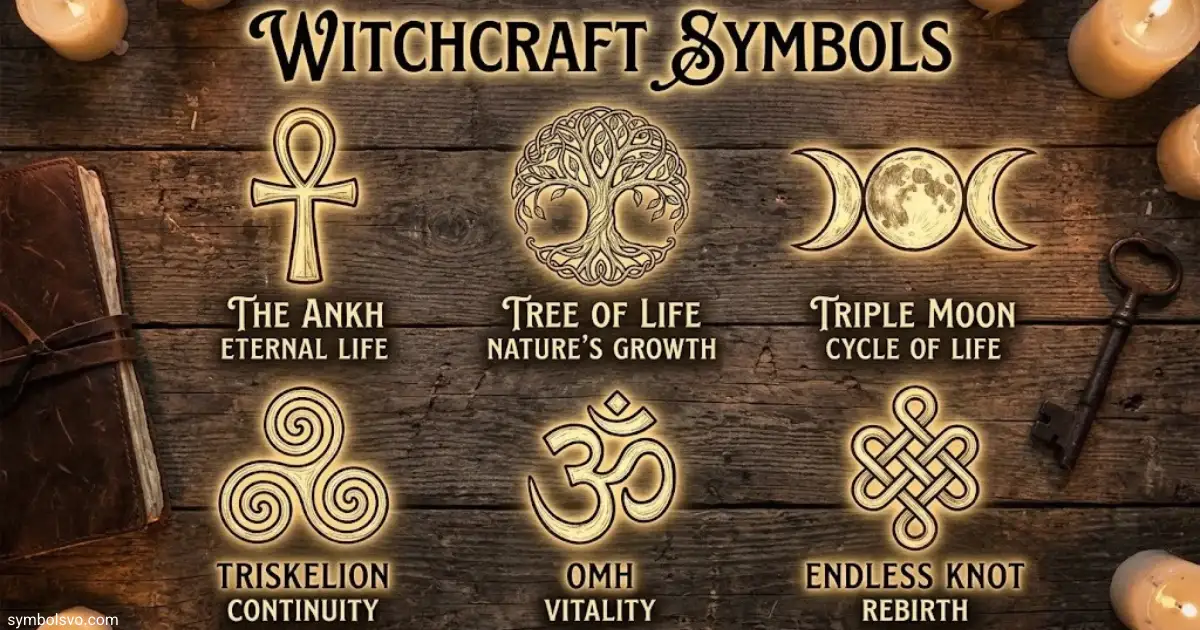
Witchcraft symbols carry a fascinating mix of spiritual meaning, cultural history, and personal expression. From the five-pointed pentacle to the three phases of the Triple Moon, these designs help people explore ideas about nature, protection, transformation, and the cycles of life.
However, not every symbol associated with witchcraft began in a magical tradition. Some have roots in ancient Egyptian religion, medieval European art, or Christian imagery. Others gained their present meanings through modern Wicca and contemporary Pagan practices.
Understanding these differences makes it easier to recognize witchcraft symbols and meanings without confusing historical facts with modern spiritual interpretations.
Whether you’re curious about the pentagram, the Triquetra, elemental symbols, or the Wheel of the Year, this guide explores their appearances, common interpretations, and cultural backgrounds. You’ll also learn how to distinguish Pagan symbols from Wiccan symbols and other forms of occult symbolism.
What Are Witchcraft Symbols?
Witchcraft symbols are signs, shapes, and designs that people associate with witchcraft, magical traditions, spiritual beliefs, or particular religious practices. They can represent natural forces, spiritual ideas, protective intentions, or connections between people and the world around them.
Some symbols have recognizable associations within specific traditions. For example, the pentacle appears in modern Wiccan practice, while the ankh comes from ancient Egyptian religious imagery.
Other symbols have broader meanings. A spiral might represent growth or continuity in one setting, while a similar design could serve a decorative purpose in another.
How Are Symbols Used in Witchcraft?
Symbols can help people express ideas that are otherwise difficult to describe. Their uses depend on the tradition and the person interpreting them.
Common examples include:
- Spiritual expression: Representing beliefs about nature, divinity, or the relationship between the physical and spiritual worlds.
- Ritual symbolism: Marking objects or spaces used in particular religious or spiritual ceremonies.
- Protection symbolism: Expressing protective intentions through designs associated with warding or folk beliefs.
- Nature symbolism: Representing the elements, lunar phases, seasonal changes, and natural cycles.
- Personal meaning: Using jewelry, artwork, or other objects to reflect an individual’s spiritual interests.
These uses don’t mean every symbol has supernatural powers. A symbol’s spiritual significance depends on the beliefs and traditions surrounding it.
Are Witchcraft Symbols the Same as Pagan Symbols?
No. The terms overlap, but they describe different things.
Witchcraft refers to a broad range of practices and beliefs. Paganism encompasses diverse religious and spiritual traditions, including Wicca and other modern Pagan paths. Some Pagans practice witchcraft, while others don’t.
Likewise, some symbols associated with witchcraft have origins outside Paganism. The ankh, for example, originated in ancient Egyptian culture, while the Triquetra appears in Christian as well as contemporary Pagan contexts.
The key is to consider a symbol’s history and context rather than assuming that every unusual design represents witchcraft.
Common Witchcraft Symbols and Their Meanings
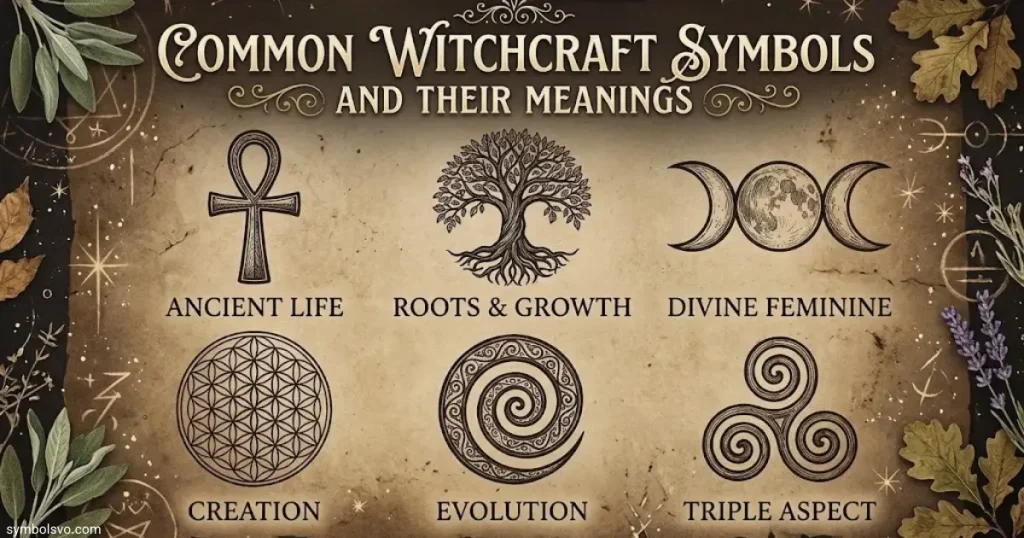
The best way to understand witch symbols and meanings is to look at each design individually. Its shape, history, and use within a particular tradition often reveal more than its appearance alone.
Pentacle: Protection, Balance, and the Five Elements
The pentacle is one of the best-known symbols associated with modern witchcraft and Wicca. It usually consists of a five-pointed star enclosed within a circle, although specific designs vary.
In many Wiccan interpretations, the five points represent Earth, Air, Fire, Water, and Spirit. The surrounding circle can suggest unity, wholeness, or the interconnected nature of these elements.
The pentacle also appears in jewelry, ritual objects, and altar decorations. For some practitioners, it expresses spiritual identity or serves as a reminder of their beliefs.
Common associations include:
- Protection: A symbol connected with protective intentions in some traditions.
- Balance: A representation of the relationship between the five elements.
- Unity: The circle brings the star’s points together into one design.
- Spiritual connection: A reminder of the relationship between human life and the natural world.
It’s important to distinguish the pentacle from a pentagram. The pentacle commonly includes the surrounding circle, while a pentagram refers to the five-pointed star itself.
Does the pentacle represent Satanism? Not automatically. Many Wiccans and other Pagan practitioners use an upright pentacle as a positive religious or spiritual symbol. Its meaning depends on the context in which it appears.
Pentagram: The Five-Pointed Star
The pentagram is a five-pointed star formed by five connected straight lines. It has appeared in different historical and cultural settings, so its meaning isn’t limited to witchcraft.
In contemporary Wicca and some Western esoteric traditions, the pentagram represents elemental relationships, spiritual harmony, or the connection between different aspects of existence.
Its five points are sometimes associated with the four classical elements and Spirit. However, this interpretation isn’t universal.
The star’s orientation can also affect how people interpret it. An upright pentagram appears with one point at the top, while an inverted pentagram has two points at the top.
In some modern occult and religious settings, the inverted form carries meanings different from those associated with an upright pentagram. Certain forms also appear in modern Satanist symbolism, but the design shouldn’t be interpreted without considering its specific religious context.
Pentacle vs. pentagram: A pentagram is the five-pointed star. A pentacle commonly refers to that star enclosed within a circle, although historical terminology isn’t always consistent.
Triple Moon Symbol: The Three Lunar Phases
The Triple Moon symbol features a waxing crescent, a full moon, and a waning crescent arranged side by side. It’s particularly recognizable in contemporary Wiccan and Goddess-centered spiritual traditions.
The three moon shapes represent different stages of the lunar cycle. In modern Pagan interpretations, the design is also associated with the Triple Goddess, often expressed through the Maiden, Mother, and Crone framework.
Each phase carries common symbolic associations:
- Waxing moon: Growth, development, and increasing possibility.
- Full moon: Wholeness, fulfillment, and illumination.
- Waning moon: Reflection, release, and transition.
The Triple Moon can therefore represent cycles of change, renewal, and the movement from one stage of life to another.
Some people wear the symbol as jewelry or display it as an expression of spiritual identity. Others use it in artwork or personal devotional settings.
One distinction matters here: the moon’s changing appearance is an astronomical fact, but the meanings assigned to its phases are cultural and spiritual interpretations. Not every Pagan tradition follows the same lunar symbolism.
Triquetra: Unity and Threefold Connections
The Triquetra is a three-part interlaced design made from connected arcs that form a continuous-looking knot. Its name comes from Latin and relates to a three-cornered form.
The design appears in early medieval art, including works associated with Celtic artistic traditions. It also appears in Christian imagery, where threefold forms can carry religious associations.
In some contemporary Pagan and Wiccan settings, the Triquetra represents the Triple Goddess, interconnected aspects of existence, or ideas about life, death, and rebirth.
Its threefold structure makes it suitable for interpretations involving unity, continuity, and relationships among three elements.
However, the symbol doesn’t have one universally accepted meaning. A Triquetra in a Christian manuscript and one used in modern Pagan jewelry may express different beliefs.
Why is the Triquetra called a Celtic symbol? Its appearance in Celtic-influenced art has helped establish that association. Still, the design shouldn’t automatically be treated as an exclusive marker of Celtic religion or witchcraft.
Witch’s Knot: Protection and Binding Symbolism
The Witch’s Knot is a name used for certain interlaced designs associated with contemporary witchcraft and protective symbolism. The term doesn’t identify one universally standardized shape, so it’s important to establish which design a source describes.
In modern interpretations, the knot may represent protection, warding, or the symbolic binding of an intention. These associations connect with the broader role knots have played in folk traditions and magical symbolism.
Knots naturally suggest connections, enclosure, and things held together. In symbolic settings, those qualities can represent continuity or the idea of keeping something contained.
However, a historical knot design doesn’t automatically have a documented magical purpose. The name and interpretation may reflect a modern spiritual use rather than the original reason someone created it.
When researching the Witch’s Knot meaning, look for the specific design and its historical or religious context instead of assuming that every interlaced knot carries the same message.
Wheel of the Year: Seasonal Cycles and Nature
The Wheel of the Year is a circular calendar associated with many modern Wiccan and Pagan traditions. It represents the recurring seasons and the festivals that mark significant points throughout the year.
The commonly recognized calendar includes eight festivals, often called Sabbats.
| Festival | General seasonal association in the Northern Hemisphere |
| Samhain | Autumn’s end and the beginning of winter |
| Yule | Winter solstice |
| Imbolc | Early spring and returning light |
| Ostara | Spring equinox |
| Beltane | Spring’s growth and the approach of summer |
| Litha | Summer solstice |
| Lammas or Lughnasadh | Early harvest |
| Mabon | Autumn equinox |
The exact observance dates can vary, especially for festivals tied to astronomical events or local agricultural seasons.
These celebrations reflect themes such as planting, growth, harvest, rest, and renewal. Some practitioners also connect them with stories about deities and the changing seasons.
Although individual festivals draw on varied cultural and historical influences, the familiar eight-festival Wheel of the Year is a modern Pagan framework. It shouldn’t be described as one unchanged calendar followed by all ancient European communities.
As a symbol, the wheel represents seasonal cycles, the passage of time, and the relationship between spiritual observance and the natural world.
Earth Symbol: Stability and Grounding
In common Western elemental symbolism, the Earth symbol is a downward-pointing triangle crossed by a horizontal line.
Earth represents the physical world and is often associated with stability, grounding, growth, and material foundations. In some modern witchcraft traditions, it also relates to the natural environment and the practical side of everyday life.
The elemental glyph belongs to a broader Western esoteric system rather than to witchcraft alone. Similar ideas about Earth appear in other philosophical and religious traditions, although their symbols may differ.
Within a four-element framework, Earth sits alongside Air, Fire, and Water. Some Wiccan interpretations also include Spirit as a fifth element.
Air Symbol: Thought and Communication
The Air symbol is commonly represented by an upward-pointing triangle crossed by a horizontal line.
In modern elemental symbolism, Air is often connected with thought, communication, learning, and intellect. Its associations make sense within a symbolic system that contrasts the unseen movement of air with the visible, physical qualities assigned to Earth.
Some practitioners use the elemental glyph in artwork, ritual diagrams, or other expressions of their spiritual beliefs.
These meanings aren’t universal, however. Different cultures have developed their own ways of representing wind, breath, sky, and the atmosphere.
Fire Symbol: Energy and Transformation
The Fire symbol is an upward-pointing triangle. It belongs to the same Western elemental system as the Earth, Air, and Water glyphs.
Fire is commonly associated with energy, action, warmth, and transformation. Its ability to change materials and release heat has made it a powerful image in many symbolic systems.
In modern witchcraft interpretations, Fire may represent motivation, courage, creativity, or change. These associations can vary according to the practitioner’s tradition.
The triangle itself also appears in historical alchemy, so its presence doesn’t prove that an object belongs to witchcraft.
Water Symbol: Emotion and Flow
The Water symbol is a downward-pointing triangle. In Western elemental symbolism, it represents Water and is often contrasted with the upward-pointing Fire triangle.
Contemporary spiritual interpretations connect Water with flow, receptivity, emotion, and change. These associations reflect water’s ability to move, adapt to its surroundings, and sustain life.
Some modern practitioners incorporate the symbol into personal artwork or ritual settings. Others understand it primarily as a traditional elemental glyph.
Its meaning depends on context, and the design shouldn’t be confused with every other downward-pointing triangle found in art or architecture.
Spirit Symbol: Unity and Wholeness
Unlike the four classical elemental glyphs, the Spirit symbol doesn’t have one universally accepted form across all witchcraft traditions.
Some Wiccan and Western esoteric systems recognize Spirit as a fifth element alongside Earth, Air, Fire, and Water. It can represent the unifying principle that connects the other four.
Depending on the system, Spirit may be drawn using a circle, a triangle, or another geometric design. Those forms aren’t interchangeable across every tradition.
The broader concept connects with unity, wholeness, and the relationship between physical existence and spiritual understanding.
It’s worth remembering that not all witches or Pagan practitioners use the five-element model. Some traditions emphasize different frameworks or don’t assign symbolic roles to elements at all.
Spiral Symbol: Growth and Transformation
The spiral symbol appears in many forms of art, from prehistoric carvings to contemporary decorative designs. Its curved line moves inward or outward around a central point.
Because a spiral suggests movement, it often lends itself to interpretations involving growth, change, continuity, and recurring patterns.
In modern spiritual settings, some people associate spirals with personal development or the cycles of nature. Others value them for their appearance or cultural significance.
The design has no single universal meaning. A spiral carved into an archaeological object must be interpreted within its particular setting, while a spiral used in contemporary witchcraft may carry a newer personal or spiritual association.
Ankh: Life and Vitality
The ankh is an ancient Egyptian symbol shaped like a cross with a loop at the top. Its name means “life” in ancient Egyptian, and the sign appears frequently in Egyptian religious art.
Gods are often depicted holding the ankh or presenting it to rulers, visually connecting the symbol with life and divine power. It also appears in amulets and other objects.
The Global Egyptian Museum provides an overview of the sign’s role in ancient Egyptian imagery: Ankh in the Global Egyptian Museum.
Today, the ankh appears in various spiritual, artistic, and cultural contexts. Some modern practitioners incorporate it into their personal symbolism, but its ancient Egyptian origins remain important to understanding the design.
The ankh meaning in spirituality may include life, vitality, and continuity. These are broad interpretations, however, and its modern uses shouldn’t erase its specific place in Egyptian religious history.
Horned God Symbol: Nature and Divine Masculinity
In Wicca, the Horned God is a deity associated in many traditions with nature, animals, wilderness, and seasonal cycles. Some depictions use a circle topped by crescent-shaped horns, although iconography varies.
The Horned God is often discussed alongside the Goddess in Wiccan theology. Their relationship and meaning differ among groups and individual practitioners.
The symbol shouldn’t automatically be equated with Satan. The Horned God belongs to a particular modern Pagan religious framework, while Satan has distinct meanings in Christian traditions and some forms of modern Satanism.
Historical images of horned deities also come from different cultures and periods. Similar-looking figures don’t necessarily represent the same deity or belief system.
Daisy Wheel or Hexafoil: A Historical Protective Mark?
The daisy wheel, also called a hexafoil, is a geometric design formed from overlapping circles that create a flower-like pattern.
It appears on historic buildings and objects, particularly in parts of Europe. Some researchers and heritage organizations have interpreted certain examples as apotropaic marks—marks intended to avert harm or evil influences.
Historic England documents examples on timber, plaster, stone, churches, and domestic buildings. However, the purpose of these marks remains debated. Some may have served protective or ritual purposes, while others may reflect decorative work or geometric practice.
This distinction matters because the popular label “witches’ mark” doesn’t prove that a design was made by a witch or used exclusively in witchcraft.
The hexafoil is a useful example of how historical symbolism requires careful interpretation. The shape is easy to identify, but its original purpose may be harder to establish.
Witchcraft Symbols for Protection
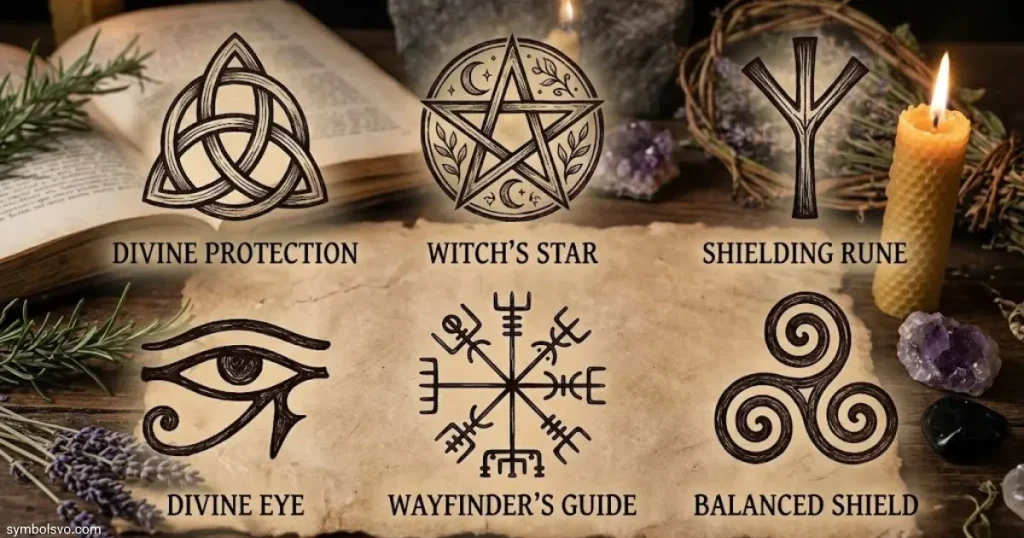
Protection is one of the most common themes in discussions of witchcraft symbols and meanings. Across different cultures, people have used signs, charms, inscriptions, and religious objects to express the hope of keeping danger or misfortune away.
However, protective symbolism doesn’t belong exclusively to witchcraft. Christian devotional marks, folk charms, and objects from other religious traditions can also carry protective meanings.
Common Symbols Associated With Protection
| Symbol | Common association | Important context |
| Pentacle | Protection and balance | Used in some Wiccan and Pagan traditions |
| Pentagram | Protection in certain historical and modern contexts | Its meaning varies by tradition and orientation |
| Witch’s Knot | Warding and binding intentions | Designs and interpretations vary |
| Daisy wheel or hexafoil | Possible protective use | The original purpose of individual examples may be disputed |
| Ankh | Life and vitality | Originated in ancient Egyptian religion |
These associations describe how people have interpreted the symbols. They don’t establish that the symbols can prevent harm or guarantee a particular result.
What Are Apotropaic Symbols?
The word apotropaic describes something intended to ward off evil or avert harm. Historians use the term when discussing certain marks, objects, and practices associated with protective beliefs.
Historic examples include inscriptions or designs placed near doorways, windows, and fireplaces. Some people believed these locations needed special protection because they served as entrances or boundaries.
Historic England has documented marks on old buildings that may have served such purposes. Yet researchers continue to debate the original function of some designs, particularly geometric patterns such as the hexafoil.
The distinction is simple: a mark’s intended protective meaning is a historical belief, not proof of supernatural effectiveness.
Moon and Goddess Symbols in Witchcraft
Moon imagery holds a prominent place in some modern Pagan and Wiccan traditions. The changing lunar phases provide a natural pattern that people can connect with time, transition, renewal, and personal reflection.
What Does the Triple Goddess Symbol Mean?
The Triple Goddess symbol commonly appears as the Triple Moon: a waxing crescent, a full moon, and a waning crescent.
In some modern Goddess-centered traditions, these phases correspond to the Maiden, Mother, and Crone. The three figures represent different stages or aspects of feminine divinity and life.
| Figure | Common contemporary associations |
| Maiden | Youth, beginnings, discovery |
| Mother | Creation, nurturing, abundance |
| Crone | Wisdom, experience, transition |
These associations form one influential modern spiritual framework. They aren’t universal descriptions of women, and they don’t represent the beliefs of every Pagan or Wiccan community.
The framework also shouldn’t be confused with an established ancient system shared by all historical cultures. Modern practitioners may draw inspiration from older myths, but the familiar Maiden–Mother–Crone model has its own modern religious context.
What Do Moon Phases Represent?
The moon changes appearance throughout its approximately 29.5-day cycle. Many contemporary spiritual traditions attach symbolic meanings to those visible changes.
- New moon: Beginnings, reflection, and considering future possibilities.
- Waxing moon: Growth, development, and increasing momentum.
- Full moon: Fulfillment, illumination, and wholeness.
- Waning moon: Reflection, release, and transition.
These interpretations can help explain why lunar imagery appears in modern spiritual art, jewelry, and devotional settings.
Still, moon symbolism varies between cultures. Astronomical phases are observable phenomena; their spiritual meanings come from human beliefs and traditions.
The Four Elements in Witchcraft Symbolism
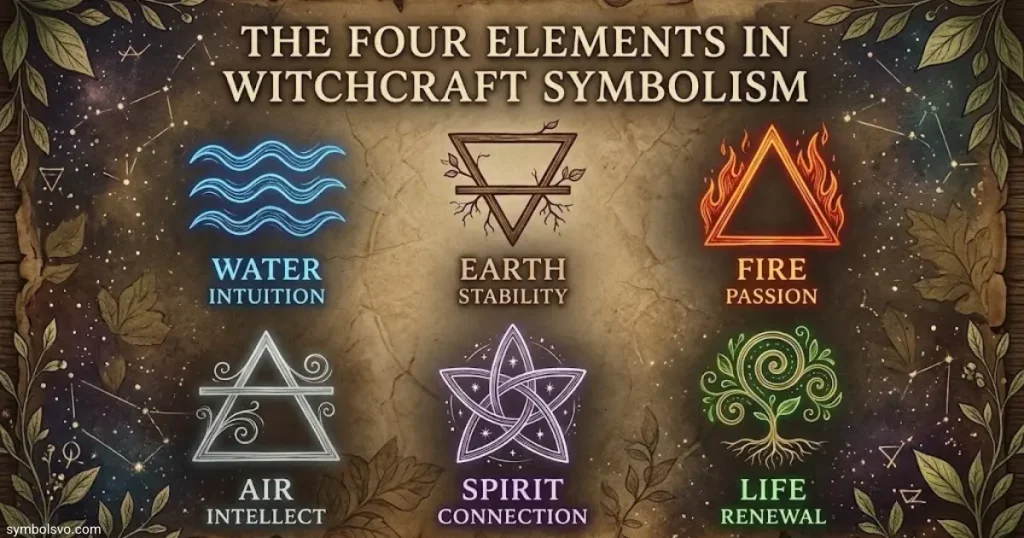
The four classical elements—Earth, Air, Fire, and Water—form an important symbolic framework in some Wiccan and Western esoteric traditions.
These elements aren’t simply the modern chemical elements found on the periodic table. They come from older philosophical models that used natural forces to explain qualities of the physical and spiritual worlds.
Elemental Symbols at a Glance
| Element | Common symbolic meanings | Traditional Western glyph |
| Earth | Stability, grounding, nature | Downward triangle with a horizontal line |
| Air | Thought, communication, intellect | Upward triangle with a horizontal line |
| Fire | Energy, action, transformation | Upward-pointing triangle |
| Water | Emotion, flow, receptivity | Downward-pointing triangle |
| Spirit | Unity and spiritual connection | Varies by system |
The four elemental glyphs belong to Western alchemical symbolism and related esoteric traditions. Their later use in contemporary witchcraft reflects the exchange of ideas between these systems.
Why Do Some Traditions Include Spirit?
Some Wiccan and esoteric frameworks add Spirit as a fifth element. In these systems, Spirit can represent the principle that brings the four elements together.
The idea is symbolic rather than a claim that Spirit is a physical substance. It provides a way to discuss wholeness, spiritual awareness, and relationships between different aspects of existence.
Not every witchcraft tradition uses this model. When identifying an elemental symbol, consider the system in which it appears rather than assuming that all practitioners assign it the same meaning.
Historical Origins of Witchcraft Symbols
The history of witch symbols is more complicated than a list of ancient magical designs might suggest. Many symbols now associated with witchcraft have appeared in several different traditions, often with different meanings.
Understanding their history requires separating the age of a design from the age of its present interpretation.
Ancient Egyptian Symbols and the Ankh
The ankh has a well-established place in ancient Egyptian religious art. Its association with life appears in depictions of gods, rulers, and religious objects.
Modern spiritual communities may adopt the ankh for additional reasons, but those contemporary interpretations don’t change its Egyptian origins.
Celtic Art and the Triquetra
Interlaced patterns appear in early medieval art associated with Celtic-influenced traditions. The Triquetra is one recognizable example.
Later spiritual movements have assigned the design additional meanings, including connections with threefold divinity. Christian imagery also uses the Triquetra in contexts that may suggest the Trinity.
Its appearance alone doesn’t establish a single religious meaning or prove that its maker practiced witchcraft.
European Folk Traditions and Protective Marks
European folk practices included a variety of objects, inscriptions, and markings intended to guard people, homes, livestock, or possessions from harm.
Some historic marks may reflect these beliefs, but interpreting them can be difficult. A design might have served a protective purpose, acted as a craftsman’s mark, or been created for another reason.
For example, Historic England records both suspected protective marks and ordinary carpenters’ marks. Its heritage resources explain why researchers must examine the location and construction of a mark before assigning a meaning. See Historic England’s guide to different types of marks.
Modern Wicca and Contemporary Pagan Symbolism
Modern Wicca developed during the 20th century and brought together ritual practices, religious beliefs, and influences from earlier esoteric traditions.
Symbols such as the pentacle, Triple Moon, and Wheel of the Year now feature prominently in many contemporary Pagan contexts. However, their modern popularity doesn’t mean every design originated in ancient witchcraft.
A symbol can have a long history and still acquire new meanings. That process is part of how religious and cultural traditions evolve.
What’s the Difference Between Witchcraft, Pagan, Wiccan, and Occult Symbols?
These terms overlap, but they aren’t interchangeable. Understanding the differences helps you identify symbols more accurately.
| Category | What it describes | Relationship to symbols |
| Witchcraft | A broad range of practices and beliefs | Some practitioners use ritual, protective, or personal symbols |
| Paganism | A diverse group of religious and spiritual traditions | Symbols vary widely between traditions |
| Wicca | A modern Pagan religion | The pentacle, Triple Moon, and seasonal imagery are common in many Wiccan settings |
| Occult traditions | Diverse esoteric systems and practices | May use geometric, planetary, alchemical, or other symbolic designs |
| Christianity | A major religious tradition with diverse branches | Includes crosses, the Trinity’s imagery, and other religious symbols |
Are All Pagan Symbols Witchcraft Symbols?
No. Paganism includes traditions that don’t involve witchcraft. Some practitioners focus on deity worship, seasonal observances, philosophy, or other religious practices.
Likewise, some witchcraft practitioners don’t identify as Pagan. Their beliefs and practices may draw on different sources.
Are All Wiccan Symbols Used by Witches?
Not necessarily. Wicca is a specific religion, while witchcraft is a broader category. Some Wiccans practice witchcraft, but individual practices differ.
A symbol associated with Wicca may be unfamiliar to someone who practices a different form of witchcraft.
Are Occult Symbols Always Connected to Witchcraft?
No. Occult symbols can appear in astrology, alchemy, ceremonial magic, esoteric philosophy, and other traditions. Some overlap with witchcraft, but others have separate histories and uses.
The best approach is to examine the actual design and its context instead of treating all spiritual or unusual imagery as part of one system.
How Are Witchcraft Symbols Used Today?
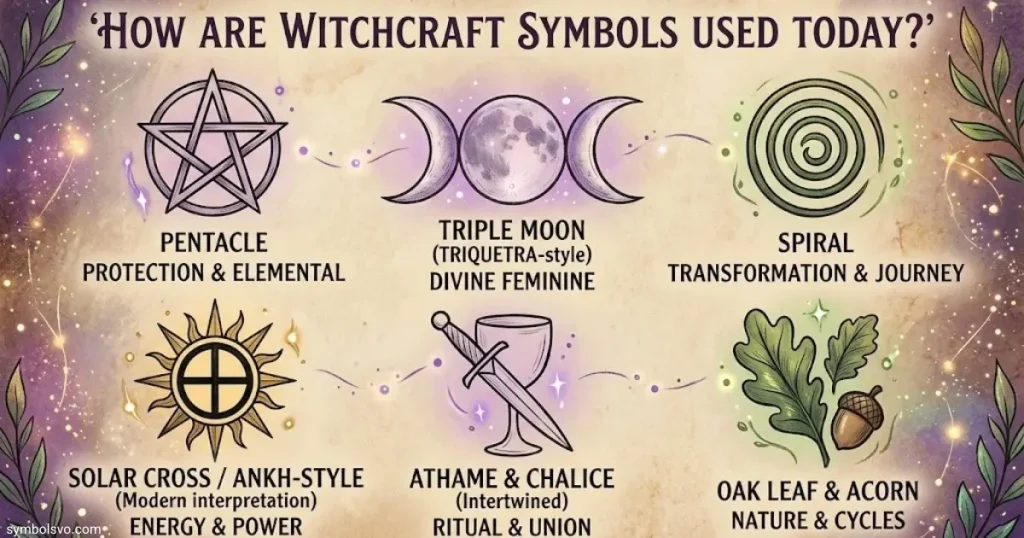
Today, symbols used in modern witchcraft appear in many settings. Their role depends on the person’s beliefs, the tradition involved, and the purpose of the object.
Jewelry and Personal Accessories
Pendants, rings, necklaces, and other accessories often display symbols such as the pentacle, Triple Moon, or ankh.
For some people, these designs express spiritual identity. Others appreciate their historical significance or visual style.
Wearing a symbol doesn’t necessarily indicate membership in a religion. A person may choose a design for cultural, artistic, or personal reasons.
Altars and Ritual Settings
Some practitioners display symbols on an altar or incorporate them into objects used during religious or spiritual ceremonies.
An altar may include images, candles, natural materials, or other items meaningful to the person or tradition. Elemental symbols may also appear in ritual arrangements.
These practices vary considerably. There isn’t one required altar design that every witch must follow.
Art, Journals, and Personal Symbolism
Symbols also appear in illustrations, notebooks, decorative objects, and personal creative projects.
Someone might use a spiral to represent a period of personal growth or choose a moon design to reflect an interest in lunar cycles. Such interpretations can be meaningful without being part of an established religious tradition.
This distinction is useful when discussing personal meaning: an individual’s interpretation may be sincere even when it isn’t a traditional or historically documented meaning.
Seasonal Festivals and Spiritual Observances
Some Pagan and Wiccan communities use seasonal imagery during observances associated with the Wheel of the Year.
Symbols of sunlight, plants, harvests, and changing seasons can help express the connection between spiritual beliefs and the natural world.
However, the festivals and their symbolism differ across communities. Not every Pagan celebrates all eight festivals or interprets them in the same way.
How to Identify a Witchcraft Symbol Without Making Assumptions
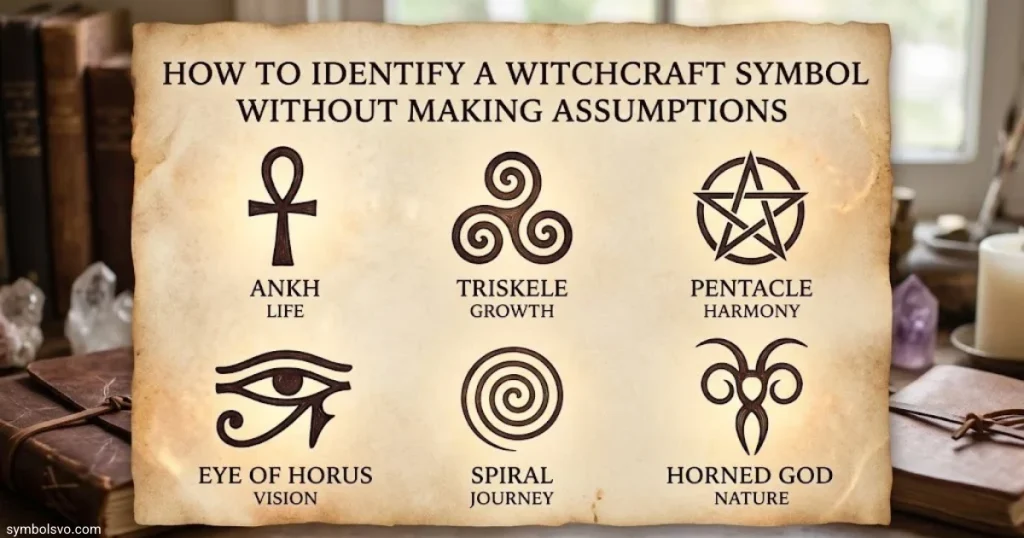
Recognizing a design is only the first step. Identifying its meaning requires context.
If you encounter an unfamiliar symbol, use these principles to assess it carefully:
- Examine the shape. Look at the number of points, lines, circles, arcs, and other distinctive features.
- Check the orientation. An upright design may have a different interpretation from an inverted version.
- Consider the setting. A symbol on a historical religious object may have a different meaning from the same design on modern jewelry.
- Identify the tradition. Determine whether reliable sources connect it with Wicca, a particular Pagan tradition, ancient Egyptian religion, Christianity, or another context.
- Separate fact from interpretation. A documented historical use is different from a spiritual meaning assigned later.
- Avoid judging the wearer. Jewelry or a tattoo doesn’t reliably establish someone’s religion, beliefs, or practices.
For example, finding a five-pointed star inside a circle may suggest a pentacle. Yet you would need more context to determine how the person displaying it understands the design.
This method also prevents a common research mistake: assuming that every spiral, knot, star, or crescent has one fixed meaning.
Frequently Asked Questions About Witchcraft Symbols
What Are the Most Common Witchcraft Symbols?
Commonly recognized witchcraft symbols include the pentacle, pentagram, Triple Moon, Triquetra, Witch’s Knot, elemental glyphs, and Wheel of the Year. The ankh also appears in some modern spiritual contexts, although it originated in ancient Egyptian religion. Their meanings vary between traditions.
What Do Witchcraft Symbols Mean?
Witchcraft symbols and meanings vary according to their history, religious setting, and personal interpretation. A pentacle may represent protection and elemental balance in Wicca, while the Triple Moon often represents lunar phases and the Triple Goddess in some modern Pagan traditions.
What Is the Difference Between a Pentacle and a Pentagram?
A pentagram is a five-pointed star. A pentacle commonly refers to a pentagram enclosed within a circle. Both designs have appeared in different historical and religious contexts, so their meaning depends on how and where they’re used.
Is the Pentacle a Satanic Symbol?
No, not inherently. Many Wiccans and other Pagan practitioners use an upright pentacle as a spiritual or religious symbol. Certain inverted pentagrams have associations with modern Satanism, but the pentacle shouldn’t automatically be interpreted as Satanic.
What Does the Triple Moon Symbol Represent?
The Triple Moon symbol commonly represents the waxing moon, full moon, and waning moon. In some modern Wiccan and Goddess-centered traditions, these phases correspond to the Maiden, Mother, and Crone. Other people use the design to represent cycles, change, or renewal.
What Does the Triquetra Symbolize Spiritually?
The Triquetra may represent threefold unity, interconnectedness, or the Triple Goddess in some contemporary Pagan contexts. It also appears in Christian and early medieval decorative art. Its meaning depends on the religious or cultural setting rather than the shape alone.
Are All Witchcraft Symbols Ancient?
No. Some symbols have ancient or medieval histories, while others gained their current meanings through modern spiritual movements. The ankh, for example, comes from ancient Egyptian religion, whereas the familiar eight-festival Wheel of the Year is a modern Pagan framework.
Are Witchcraft Symbols Religious?
Some are explicitly connected with religious traditions, including the pentacle in many Wiccan settings. Others have appeared in several cultures or serve decorative and personal purposes. A symbol’s presence doesn’t automatically establish that an object or its owner has a religious meaning.
Do All Witches Use the Same Symbols?
No. Witchcraft encompasses diverse practices and beliefs. Some practitioners use symbols associated with Wicca, while others draw on folk traditions, personal imagery, or different spiritual systems. Some don’t use a defined collection of symbols at all.
How Can You Tell Whether a Symbol Is Connected to Witchcraft?
Start by identifying the design and researching its documented history. Check its context, orientation, and use within particular traditions. When evidence is limited, distinguish a possible interpretation from an established fact rather than assigning the symbol a meaning without support.
Final Thoughts on Witchcraft Symbols and Their Meanings
Witchcraft symbols bring together history, spirituality, cultural traditions, and personal expression. The pentacle, pentagram, Triple Moon, Triquetra, and elemental glyphs each have recognizable associations, but none should be interpreted without considering its context.
Some designs have well-documented historical origins. Others gained their present meanings through modern Wicca, contemporary Paganism, or individual spiritual practice.
The most reliable way to understand witch symbols and meanings is to look beyond appearances. Learn where a design originated, how different communities use it, and which interpretations have historical support.
That approach reveals something important: symbols aren’t simply pictures with fixed definitions. They’re part of a larger story about how people understand nature, express beliefs, preserve traditions, and find meaning in the world around them.

I’m Daniel Brooks, a content creator and symbol enthusiast dedicated to researching the fascinating world of signs and symbols. I enjoy discovering the hidden meanings behind famous icons, emojis, historical emblems, and cultural symbols. Through my writing, I aim to provide trustworthy, well-researched, and reader-friendly information that helps people learn something new with every visit.
Books:
- The Complete Guide to World Symbols
- The Power of Universal Signs
 Nathan Holloway
 Mason Ellington