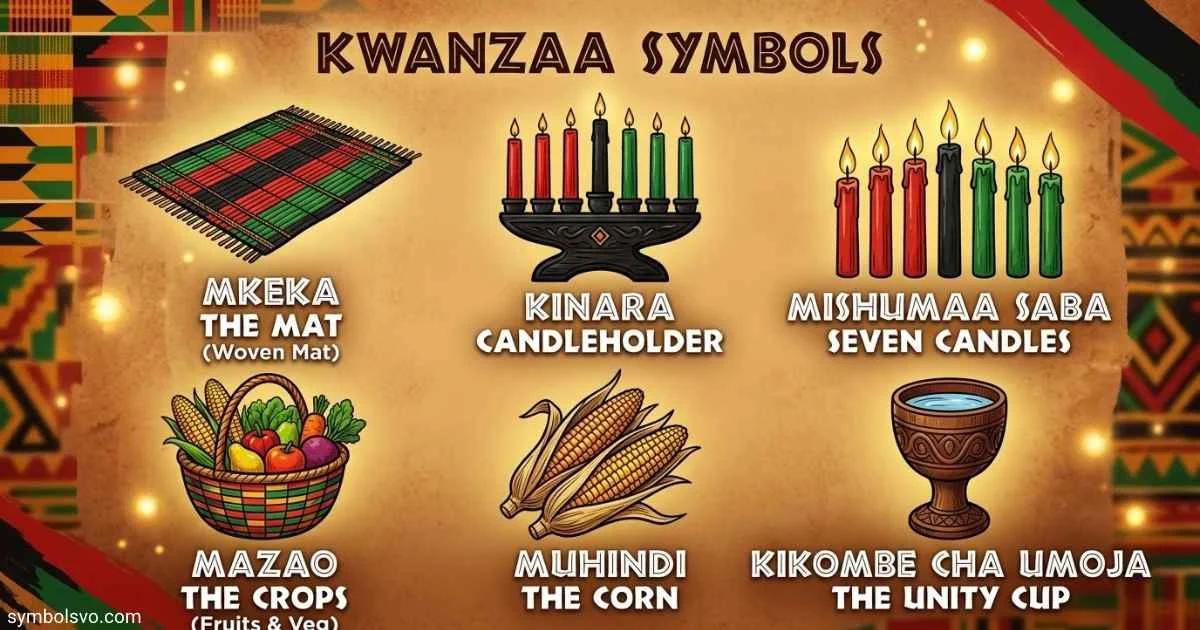
Kwanzaa symbols tell a meaningful story about African heritage, family, community, and shared responsibility. From the seven candles and their traditional colors to the unity cup and harvest crops, each symbol represents an important part of this weeklong celebration.
Kwanzaa takes place every year from December 26 through January 1. During these seven days, families and communities reflect on their cultural roots, discuss the seven principles of Kwanzaa, and celebrate values that help bring people together.
Understanding the seven Kwanzaa symbols makes the holiday easier to appreciate. Each object has a purpose, and together they create a visual reminder of the traditions, values, and aspirations that shape the celebration.
Whether you’re learning about Kwanzaa for the first time or exploring its cultural significance more deeply, this guide explains what each symbol means, why its colors matter, and how families use these objects during their celebrations.
What Are the Seven Symbols of Kwanzaa?
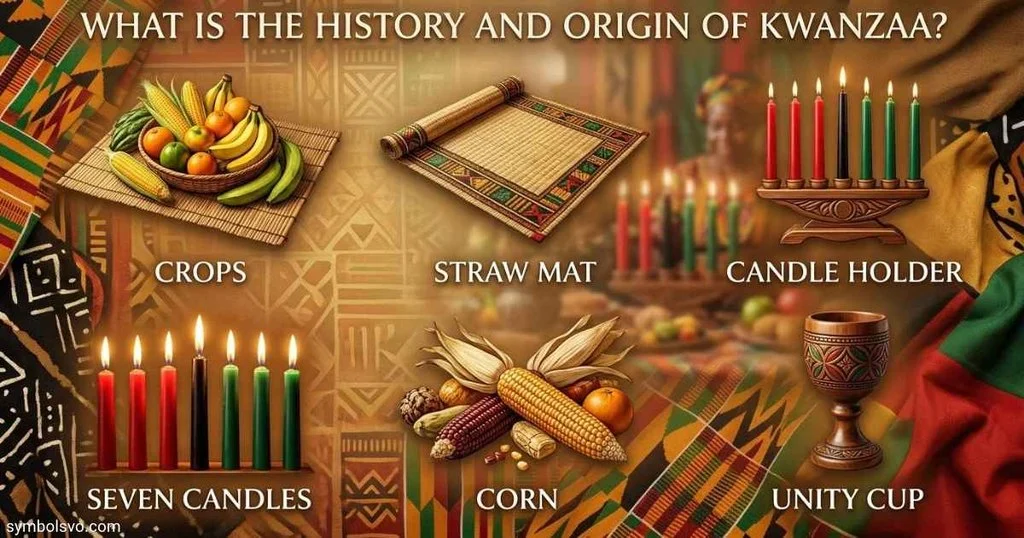
The seven symbols of Kwanzaa are traditional objects that express the holiday’s central values. They reflect harvest traditions, cultural history, African ancestry, children, unity, shared principles, and meaningful gifts.
Families arrange these objects on a table during Kwanzaa. Each one has a specific meaning, and together they help explain the celebration’s purpose.
The seven basic symbols are called maz ao, mkeka, kinara, muhindi, mishumaa saba, kikombe cha umoja, and zawadi in Swahili. Their English meanings are crops, mat, candleholder, corn, seven candles, unity cup, and gifts.
Here’s a quick overview:
| Kwanzaa symbol | English meaning | What it represents |
| Mazao | Crops | Harvest, productive work, and shared rewards |
| Mkeka | Mat | Tradition, history, and cultural foundations |
| Kinara | Candleholder | African ancestry and roots |
| Muhindi | Corn | Children and future generations |
| Mishumaa Saba | Seven candles | The seven principles of Kwanzaa |
| Kikombe cha Umoja | Unity cup | Unity and togetherness |
| Zawadi | Gifts | Love, commitment, and achievement |
These are the seven basic symbols recognized by the Official Kwanzaa Website. The celebration also includes two supplemental symbols: the bendera, or flag, and a poster displaying the seven principles.
What Does Each Kwanzaa Symbol Mean?
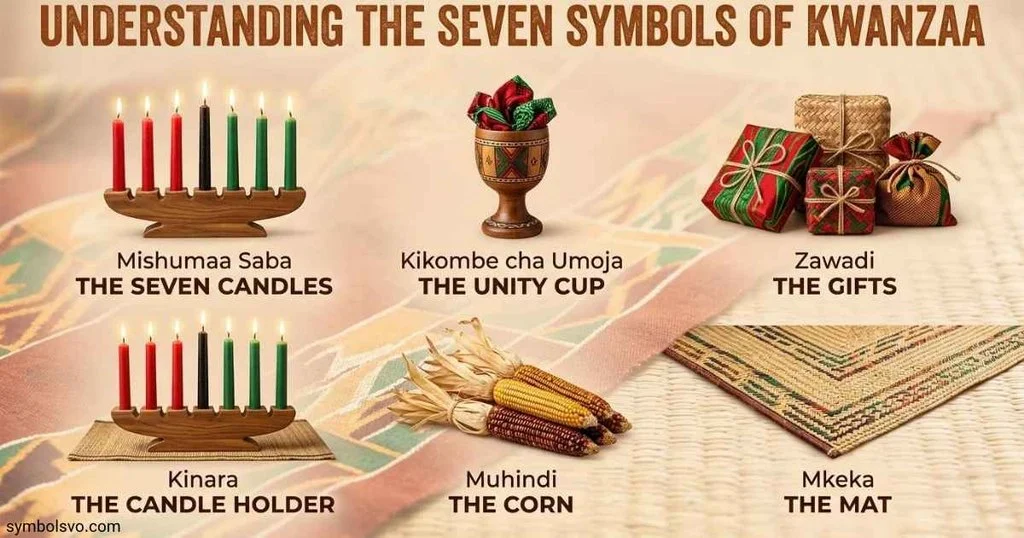
Each symbol has a distinct role in the celebration. Learning their meanings helps you understand why families display them and how they connect to Kwanzaa’s larger cultural message.
Mazao (Crops): The Rewards of Collective Work
Mazao means crops and represents the harvest, productive labor, and rewards people receive when they work together.
In traditional Kwanzaa displays, mazao often includes fruits, vegetables, nuts, and other agricultural produce. These items recall the importance of farming and harvest celebrations in many African societies. They also represent the results of a community’s shared effort.
The symbol carries a message that goes beyond agriculture. A successful harvest requires planning, patience, cooperation, and care. Likewise, a strong community depends on people contributing their time, skills, and resources toward shared goals.
For example, a family might place oranges, sweet potatoes, corn, or other seasonal produce in a bowl on its Kwanzaa table. The specific foods can vary by household and availability.
Mazao also encourages people to appreciate the work behind the things they enjoy. Food reaches the table because farmers, workers, sellers, cooks, and families all contribute in different ways.
What mazao symbolizes:
- Harvest and abundance: The results of productive effort.
- Collective labor: People achieving more through cooperation.
- Gratitude: Appreciation for food and the people who help provide it.
- Community responsibility: Recognizing that shared effort benefits everyone.
The central message is simple: a community grows stronger when people work together and share the rewards.
Mkeka (The Mat): The Foundation of Tradition
The mkeka is a traditional mat that represents history, cultural heritage, and the foundation on which people build their future.
During Kwanzaa, families place the mkeka beneath the other ceremonial objects. This arrangement carries a clear message: the values and achievements of the present rest on the traditions and experiences that came before them.
The mat can be made from straw, raffia, or other woven materials. Its appearance may vary, but its symbolic purpose remains the same.
Think of the mkeka as the foundation of a house. A house needs a stable base before anyone can build its walls and roof. In a similar way, cultural identity develops through family stories, shared customs, historical knowledge, and lessons passed between generations.
The mkeka also reminds families that honoring tradition doesn’t mean refusing to change. People can preserve valuable cultural knowledge while adapting their practices to modern life.
For instance, parents might explain family history while arranging the Kwanzaa table with their children. That simple activity connects a physical symbol to the living traditions it represents.
What the mkeka symbolizes:
- African heritage: A connection to cultural roots.
- History and tradition: Knowledge passed from one generation to another.
- Cultural identity: Understanding the experiences that shape a community.
- A foundation for the future: Using lessons from the past to guide future choices.
Among the Kwanzaa traditional symbols, the mkeka provides a visible reminder that people build the future on the foundations of history and shared experience.
Kinara (The Candleholder): African Ancestry and Roots
The kinara is the candleholder used to display the seven Kwanzaa candles. It symbolizes African ancestry and the roots that connect African Americans to the African continent.
The kinara is one of the most recognizable objects associated with the celebration. It holds the mishumaa saba, or seven candles, in a deliberate arrangement that reflects the holiday’s central principles.
Its meaning extends beyond its practical purpose. The kinara reminds celebrants that cultural identity has a history. Families and communities inherit traditions, knowledge, and values that help shape their sense of belonging.
Many households place the kinara on the mkeka alongside the other Kwanzaa symbols. The candleholder becomes the centerpiece of the daily candle-lighting ceremony.
Families may also use this moment to discuss ancestors, family history, and the contributions of earlier generations. These conversations help younger family members understand how the past influences the present.
What the kinara symbolizes:
- African ancestry: Connection to African roots.
- Cultural heritage: Recognition of a shared history.
- Continuity: The relationship between earlier generations and those living today.
- Reflection: A reminder to consider the values passed down through families and communities.
Remember the distinction between the kinara and the candles. The kinara is the holder, while the seven candles represent the seven principles of Kwanzaa.
Muhindi (Corn): Children and Future Generations
Muhindi means corn and represents children, family continuity, and the future generations who will carry cultural traditions forward.
Corn holds a place on the Kwanzaa table because children represent both the promise and the responsibility of the future. Families invest time and care in helping young people learn, grow, and contribute to their communities.
In many Kwanzaa traditions, families display one ear of corn for each child in the household. Some explanations use the term vibunzi for an ear of corn used in this symbolic context.
The symbol also has a broader community meaning. Children need support, education, encouragement, and opportunities to develop their abilities. Their future depends partly on the choices adults make today.
For example, parents might use the display as an opportunity to discuss family traditions with children or encourage them to participate in preparing the celebration. These activities help young people become active participants rather than simply observers.
What muhindi symbolizes:
- Children: The young members of a family or community.
- Future generations: People who will carry traditions forward.
- Family continuity: The connection between parents, children, and ancestors.
- Shared responsibility: Supporting children’s learning and development.
Muhindi reminds celebrants that preserving cultural heritage involves more than remembering the past. It also means preparing the next generation to understand and carry that heritage forward.
Mishumaa Saba (The Seven Candles): The Seven Principles
The mishumaa saba, or seven candles, represent the seven principles of Kwanzaa, collectively known as the Nguzo Saba.
Each candle corresponds to one principle. Together, they provide a visual reminder of the values that guide the seven-day celebration.
The candles use three colors: one black candle, three red candles, and three green candles. The black candle sits in the center of the kinara, with the red and green candles arranged on either side.
The colors carry symbolic meaning, while the candles connect those meanings to the seven principles. During Kwanzaa, families light a candle each day and discuss the principle associated with that day.
The candle-lighting ceremony often becomes a time for conversation, reflection, storytelling, poetry, music, or other cultural activities. The precise details vary among families and communities.
What the mishumaa saba symbolizes:
- Umoja: Unity.
- Kujichagulia: Self-determination.
- Ujima: Collective work and responsibility.
- Ujamaa: Cooperative economics.
- Nia: Purpose.
- Kuumba: Creativity.
- Imani: Faith.
The candles are more than decorative objects. They help turn abstract values into a daily practice of reflection and community engagement. The Smithsonian National Museum of African American History and Culture explains how candle lighting connects the principles with activities during Kwanzaa.
Kikombe cha Umoja (The Unity Cup): Togetherness and Shared Community
The kikombe cha umoja is the unity cup. It represents the principle of Umoja, which means unity, and highlights the importance of maintaining strong family and community relationships.
The cup can be used during a libation ceremony, a practice in which a liquid is poured as a symbolic act of remembrance or honor. In Kwanzaa observances, this practice may recognize ancestors and express gratitude for the generations that came before.
The unity cup also reflects the idea that people share responsibilities and experiences. Families may incorporate the cup into a gathering as they reflect on their connections to one another and to their wider community.
Practices vary. Not every household performs a libation ceremony, and families may interpret or observe the tradition in different ways.
What the unity cup symbolizes:
- Unity: The bonds that connect family members and communities.
- Remembrance: Recognition of ancestors and earlier generations.
- Shared identity: A sense of belonging and mutual connection.
- Cooperation: The understanding that communities thrive when people support one another.
The unity cup brings the principle of Umoja into a physical object. It reminds celebrants that unity requires more than simply gathering in one place. It also involves care, respect, and shared responsibility.
Zawadi (Gifts): Love, Commitment, and Achievement
Zawadi means gifts. In Kwanzaa, gifts symbolize the love and effort invested in children, along with commitments made and kept.
Gift-giving offers families a chance to recognize personal growth, encourage learning, and reinforce cultural values. The emphasis is on meaning rather than simply the size or price of a present.
Some families choose handmade gifts, books, artwork, educational materials, or items connected to African heritage. These choices can encourage creativity, knowledge, and an appreciation of cultural traditions.
The exchange of gifts often takes place on January 1, the final day of Kwanzaa, which focuses on Imani, or faith. Families may also incorporate gifts into their own household customs.
A thoughtful gift might be a book about African American history, a handmade craft, or a family keepsake. Such items can carry a message that lasts longer than the moment of exchange.
What zawadi symbolizes:
- Love and care: The effort people invest in one another.
- Learning: Encouraging knowledge and personal growth.
- Commitment: Recognizing promises and responsibilities.
- Cultural identity: Sharing objects that preserve or celebrate heritage.
The meaning of zawadi centers on intention. A gift becomes more meaningful when it reflects care, encourages growth, or strengthens a connection between people.
What Do the Kwanzaa Colors Mean?
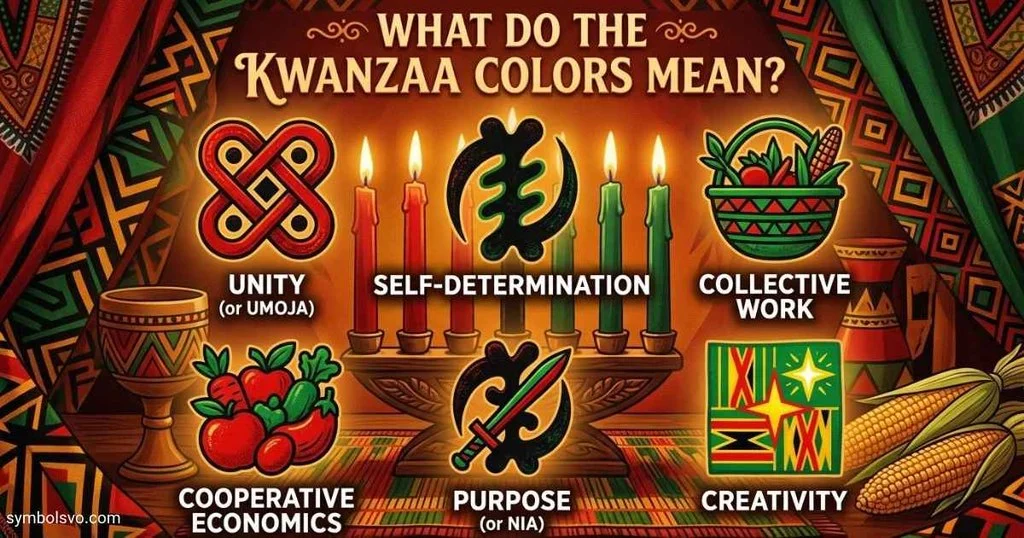
The three main Kwanzaa colors are black, red, and green. They come from the Pan-African colors associated with African identity, struggle, and hope for the future.
These colors appear in the candles, clothing, flags, table decorations, and other elements of the celebration. Each color carries a distinct meaning.
Black: The People
Black represents African people and their collective identity. In Kwanzaa, the black candle sits in the center of the kinara, emphasizing the importance of the people at the heart of the celebration.
Red: The Struggle
Red represents the struggles and sacrifices of African people. It recognizes the challenges faced by communities working toward freedom, dignity, and a better future.
Green: The Future
Green represents the future and the hope that grows from past struggles. It points toward progress, opportunity, and the possibilities communities can create together.
The colors are connected to the Pan-African flag associated with Marcus Garvey and the broader movement for African unity. Their Kwanzaa meanings place people first, recognize their struggles, and look toward the future.
How Are the Seven Kwanzaa Candles Arranged?
The traditional kinara holds seven candles in a specific arrangement:
- One black candle sits in the center.
- Three red candles sit on one side.
- Three green candles sit on the other side.
The black candle represents Umoja, or unity. The remaining six candles represent the other six principles of Kwanzaa.
The candles are lit over the seven days of the celebration, beginning with the black candle on December 26. Each day focuses on a different principle.
| Candle color | Number of candles | Principles represented |
| Black | 1 | Umoja — Unity |
| Red | 3 | Kujichagulia, Ujamaa, Kuumba |
| Green | 3 | Ujima, Nia, Imani |
The arrangement creates a visual connection between the people, their struggles, and the hope for their future.
What Are the Seven Principles of Kwanzaa?
The seven principles of Kwanzaa, known as the Nguzo Saba, form the foundation of the celebration. Each day highlights one principle and encourages families to consider how it applies to everyday life.
Although the principles connect closely with the symbols, they are not the same thing. Symbols are physical objects, while principles are values people can practice.
| Day | Principle | Meaning | Everyday example |
| December 26 | Umoja | Unity | Strengthening family relationships |
| December 27 | Kujichagulia | Self-determination | Defining your identity and goals |
| December 28 | Ujima | Collective work and responsibility | Helping solve a community problem |
| December 29 | Ujamaa | Cooperative economics | Supporting local businesses |
| December 30 | Nia | Purpose | Working toward a shared community goal |
| December 31 | Kuumba | Creativity | Creating something that benefits others |
| January 1 | Imani | Faith | Maintaining confidence in family and community |
These principles encourage reflection, cultural awareness, and community involvement throughout Kwanzaa.
Umoja: Unity
Umoja encourages people to maintain unity within their families, neighborhoods, and communities. It emphasizes cooperation, respect, and a shared sense of belonging.
Kujichagulia: Self-Determination
Kujichagulia means defining yourself and speaking for yourself. It encourages people to shape their identities and make decisions rather than allowing others to define them.
Ujima: Collective Work and Responsibility
Ujima focuses on solving shared problems through collective effort. It reminds people that community challenges often require cooperation instead of individual action alone.
Ujamaa: Cooperative Economics
Ujamaa encourages economic cooperation and community support. Supporting local businesses and strengthening shared economic opportunities are practical examples of this principle.
Nia: Purpose
Nia asks people to consider how their goals can contribute to their family’s and community’s well-being. It emphasizes meaningful work and a shared sense of direction.
Kuumba: Creativity
Kuumba encourages people to use creativity to improve their communities. Art, education, problem-solving, and cultural expression can all reflect this principle.
Imani: Faith
Imani means faith. It encourages confidence in people, family, community, and the ability to work toward a better future.
Together, the seven principles give Kwanzaa its daily structure and connect the celebration’s symbols with practical values.
What Is the Difference Between Kwanzaa Symbols and Principles?
The difference is simple: Kwanzaa symbols represent ideas through physical objects, while the seven principles express the values people are encouraged to practice.
For example, the kinara is a symbol you can see on a Kwanzaa table. Umoja, the principle of unity, is a value that people can put into practice by supporting their families and communities.
Here’s how the two work together:
| Kwanzaa symbols | Seven principles |
| Physical objects displayed during the celebration | Values that guide the celebration |
| Include the mat, candles, crops, and unity cup | Include unity, purpose, creativity, and faith |
| Help communicate cultural meaning visually | Encourage reflection and action |
| Often arranged on a ceremonial table | Discussed and emphasized each day |
The seven candles provide a particularly clear connection between these categories. The candles are physical symbols, but each one represents a principle within the Nguzo Saba.
This distinction matters because Kwanzaa isn’t only about displaying traditional objects. The symbols help people understand the values behind the celebration and consider how those values can shape everyday life.
How Are Kwanzaa Symbols Used During the Celebration?
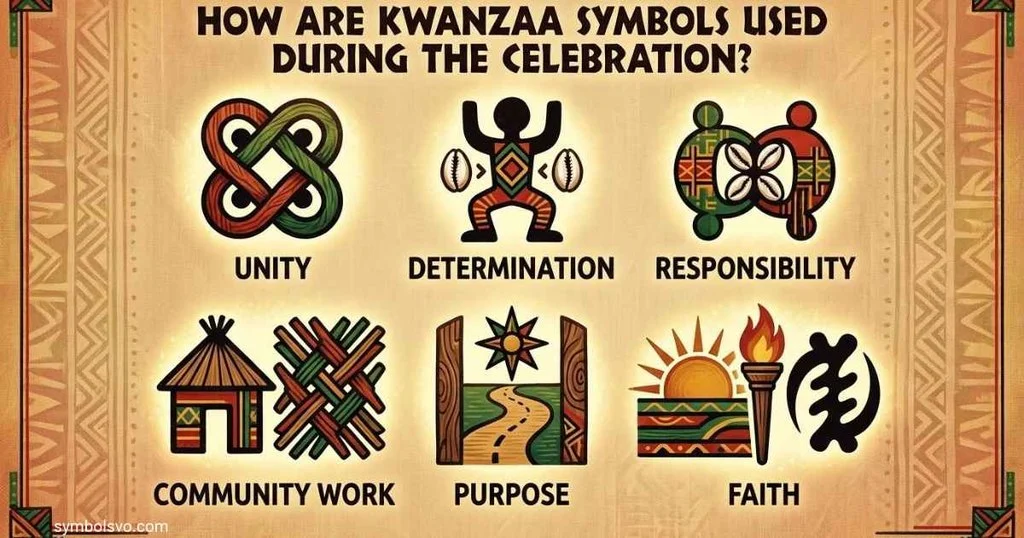
Kwanzaa symbols become especially meaningful when families incorporate them into their celebrations. Each object contributes to the setting, the daily rituals, or the conversations that take place throughout the week.
Setting Up the Kwanzaa Table
The Kwanzaa table brings the symbols together in one place. Although household arrangements vary, the display typically uses an African-inspired cloth or the mkeka as its foundation.
Families commonly arrange the symbols as follows:
- Mkeka: Place the mat beneath the other objects.
- Mazao: Arrange fruits, vegetables, or other harvest produce.
- Muhindi: Display ears of corn to represent children.
- Kinara: Position the candleholder on the mat.
- Mishumaa Saba: Place the seven candles in the kinara.
- Kikombe cha Umoja: Include the unity cup.
- Zawadi: Display meaningful gifts when appropriate.
Families may also include a Kwanzaa flag or a written display of the seven principles. These supplemental symbols help communicate the holiday’s cultural meaning.
The goal isn’t to create a perfect arrangement. It’s to understand why the objects are present and how they relate to the celebration’s values.
Lighting the Candles Each Day
The daily candle-lighting ceremony is one of the best-known Kwanzaa traditions.
Kwanzaa begins on December 26 and ends on January 1. Each day focuses on one principle, beginning with Umoja and concluding with Imani.
A family might follow this simple routine:
- Gather around the Kwanzaa table.
- Light the candle associated with the day’s principle.
- Discuss what the principle means.
- Share a story, poem, song, or personal reflection.
- Consider how to apply the principle in everyday life.
For example, a family celebrating Ujima might discuss a neighborhood project that would benefit from everyone’s help. On the day devoted to Kuumba, family members might share artwork or talk about creative ways to improve their community.
The Smithsonian’s National Museum of African American History and Culture describes activities such as poetry, music, drumming, and shared meals as ways people engage with the principles.
Sharing the Unity Cup and Remembering Ancestors
The kikombe cha umoja can play a role in family gatherings and libation ceremonies. These ceremonies may involve pouring a liquid as an expression of remembrance and respect for ancestors.
The practice connects the present generation with those who came before. It can also encourage families to reflect on the experiences, sacrifices, and traditions that helped shape their lives.
Not every family observes a libation ceremony. Some focus instead on sharing stories, discussing family history, or expressing gratitude during their gathering.
Whatever form the observance takes, the underlying message centers on unity, remembrance, and the relationships that connect generations.
Exchanging Gifts and Sharing a Kwanzaa Feast
Gift-giving is another important part of many Kwanzaa family traditions. The symbol of zawadi emphasizes meaningful gifts that encourage learning, growth, and cultural awareness.
Books, handmade items, artwork, and heritage-related gifts can all reflect the holiday’s values. The emphasis is on thoughtfulness rather than expense.
Kwanzaa also includes Karamu, a communal feast traditionally held on December 31. Families and communities may gather to share food, music, storytelling, and other cultural activities.
The menu can vary widely. Some gatherings feature foods connected to African American culinary traditions, while others include dishes reflecting different parts of the African diaspora.
Together, the gifts and feast emphasize generosity, family connections, and the enjoyment of shared cultural traditions.
What Is the History and Origin of Kwanzaa?
Kwanzaa is a modern African American and Pan-African cultural celebration created in 1966 by Dr. Maulana Karenga, a scholar and activist.
Karenga developed the holiday during a period of significant social and political change in the United States. The 1965 Watts uprising in Los Angeles formed part of the broader historical context in which African American communities were confronting racial inequality and seeking stronger cultural connections.
Kwanzaa offered a way to celebrate African heritage, strengthen community bonds, and reflect on shared cultural values. It drew inspiration from first-fruits celebrations found in various African societies.
The holiday’s name comes from the Swahili phrase matunda ya kwanza, meaning “first fruits.” Swahili provides the language used for Kwanzaa’s name, seven principles, and many of its traditional symbols.
Today, Kwanzaa is celebrated from December 26 through January 1. It is a cultural holiday rather than a religious observance, so people from different religious backgrounds can participate.
Its seven-day structure provides a framework for celebrating African heritage and discussing values that support families and communities.
Frequently Asked Questions About Kwanzaa Symbols
What are the seven symbols of Kwanzaa?
The seven basic symbols are Mazao (crops), Mkeka (mat), Kinara (candleholder), Muhindi (corn), Mishumaa Saba (seven candles), Kikombe cha Umoja (unity cup), and Zawadi (gifts). Each represents an aspect of cultural heritage, family, community, or shared values.
What do Kwanzaa symbols represent?
Kwanzaa symbols represent African heritage, ancestry, history, children, unity, collective effort, and meaningful achievement. Together, they help explain the cultural values behind the celebration and encourage people to reflect on their responsibilities to their families and communities.
What are the three colors of Kwanzaa?
The three main colors are black, red, and green. Black represents the people, red represents their struggle, and green represents the future and hope that emerge from that struggle. These colors appear in the seven candles and many Kwanzaa decorations.
What do the seven Kwanzaa candles mean?
The seven candles represent the Nguzo Saba, or seven principles of Kwanzaa. These principles are Umoja, Kujichagulia, Ujima, Ujamaa, Nia, Kuumba, and Imani. Families light a candle each day and reflect on the corresponding principle.
Why does Kwanzaa have seven symbols?
The seven basic symbols represent different elements of Kwanzaa’s cultural and community-centered philosophy. They cover harvest, tradition, ancestry, children, principles, unity, and gifts. Together, they help make the celebration’s values visible and meaningful.
What is the difference between the kinara and the mishumaa saba?
The kinara is the candleholder, while the mishumaa saba are the seven candles placed inside it. The kinara represents African ancestry, and the candles represent the seven principles of Kwanzaa.
What does the Kwanzaa unity cup symbolize?
The kikombe cha umoja represents unity and togetherness. Families may use it during a libation ceremony to honor ancestors or incorporate it into a gathering that emphasizes remembrance, shared identity, and community bonds.
Why is corn a symbol of Kwanzaa?
Corn, known as muhindi, represents children and future generations. It highlights the importance of supporting young people and passing cultural traditions, knowledge, and values from one generation to the next.
When is Kwanzaa celebrated?
Kwanzaa takes place every year from December 26 through January 1. Each of its seven days focuses on one principle, beginning with Umoja, or unity, and ending with Imani, or faith.
Are there additional Kwanzaa symbols?
Yes. In addition to the seven basic symbols, Kwanzaa recognizes two supplemental symbols: the bendera, or flag, and a poster displaying the seven principles. The flag uses black, red, and green to represent the people, their struggle, and their future.
Conclusion: Understanding the Meaning of Kwanzaa Symbols
The seven Kwanzaa symbols offer a meaningful way to understand the holiday’s focus on African heritage, family, and community. Each object carries a distinct message, from the mkeka’s cultural foundation to the kinara’s connection with African ancestry and the unity cup’s emphasis on togetherness.
The seven candles connect these objects to the Nguzo Saba, encouraging people to reflect on unity, self-determination, responsibility, cooperation, purpose, creativity, and faith.
Understanding these symbols makes Kwanzaa more than a display of traditional objects. It reveals the values behind the celebration and the importance of preserving cultural heritage while building stronger communities.

I’m Daniel Brooks, a content creator and symbol enthusiast dedicated to researching the fascinating world of signs and symbols. I enjoy discovering the hidden meanings behind famous icons, emojis, historical emblems, and cultural symbols. Through my writing, I aim to provide trustworthy, well-researched, and reader-friendly information that helps people learn something new with every visit.
Books:
- The Complete Guide to World Symbols
- The Power of Universal Signs
 Nathan Holloway
 Mason Ellington