The symbols of the Greek god Apollo reveal much more than his identity. They tell stories about music, prophecy, healing, divine punishment, victory, and the sacred traditions of ancient Greece. From the lyre in his hands to the laurel wreath on his head, each attribute connects Apollo to a different part of Greek religious and cultural life.
Apollo was the son of Zeus and Leto and the twin brother of Artemis. He became one of the most widely honored Olympian gods, with important sanctuaries, festivals, and oracles dedicated to him. His influence extended from music and poetry to archery, medicine, and the interpretation of divine messages.
The most recognizable Apollo symbols include the bow and arrows, lyre, laurel branch, laurel wreath, raven, Python, and prophetic tripod. His association with sunlight also became an important part of his identity, although the relationship between Apollo and the sun developed over time.
Understanding these symbols means looking beyond their simple definitions. Each one has a story, a religious connection, or a cultural meaning that explains why Apollo remained such an important figure in classical mythology.
What Are Apollo Symbols?
The main symbols of Apollo and their meanings reflect his many roles as a god of music, prophecy, archery, healing, and light. Some represent specific myths, while others identify his sacred places or cultural influence.
| Apollo symbol | Main meaning | Mythological connection |
| Bow and arrows | Archery, divine authority, punishment | Apollo’s role in the Trojan War and his victory over Python |
| Lyre | Music, harmony, poetry, artistic skill | Apollo’s musical mastery and his encounter with Hermes |
| Laurel branch | Sacred devotion, remembrance, transformation | The myth of Apollo and Daphne |
| Laurel wreath | Victory, honor, artistic achievement | The Pythian Games at Delphi |
| Raven | Messages, divine anger, consequences | The story of Apollo, Coronis, and the messenger bird |
| Python | Sacred authority and victory | Apollo’s association with Delphi |
| Tripod | Prophecy and divine consultation | The Oracle of Delphi |
| Rays of light | Radiance, illumination, clarity | Apollo’s association with light |
| Solar chariot | The sun’s journey across the sky | Solar mythology associated primarily with Helios in early Greek tradition |
These symbols don’t all carry the same historical weight. The lyre, bow, and tripod are recognizable attributes in ancient Greek art. The raven belongs to particular mythological stories, while the solar chariot requires more historical context because early Greek tradition associated it chiefly with Helios.
Things That Represent Apollo in Greek Mythology
Apollo is represented by several objects, animals, plants, and artistic features in Greek mythology. These attributes help explain his different roles as a god of music, prophecy, healing, archery, and light. Some represent specific myths, while others connect him to ancient Greek religious traditions.
The most recognizable things that represent Apollo include:
| Symbol or Attribute | What It Represents |
| Lyre | Music, poetry, and harmony |
| Bow and arrows | Archery, divine power, and punishment |
| Laurel branch | Sacred devotion and transformation |
| Laurel wreath | Victory, honor, and achievement |
| Raven | Messages and divine anger |
| Swan | Beauty, music, and artistic associations |
| Tripod | Prophecy and the Oracle of Delphi |
| Python | Apollo’s victory and authority at Delphi |
| Kithara | Musical excellence and public performance |
| Rays of light | Radiance and illumination |
These attributes don’t all have the same meaning. The lyre represents Apollo’s artistic side, while the bow reflects his ability to punish and protect. The tripod connects him to prophecy and the famous sanctuary at Delphi.
Apollo’s youthful appearance and long hair also became common features in ancient Greek art. Artists often used these details alongside his traditional objects to make his identity recognizable.
Together, these things reveal why Apollo was much more than a god of music. His symbols represent several important parts of ancient Greek religion, mythology, and cultural life.
Apollo Bow And Arrow Symbol
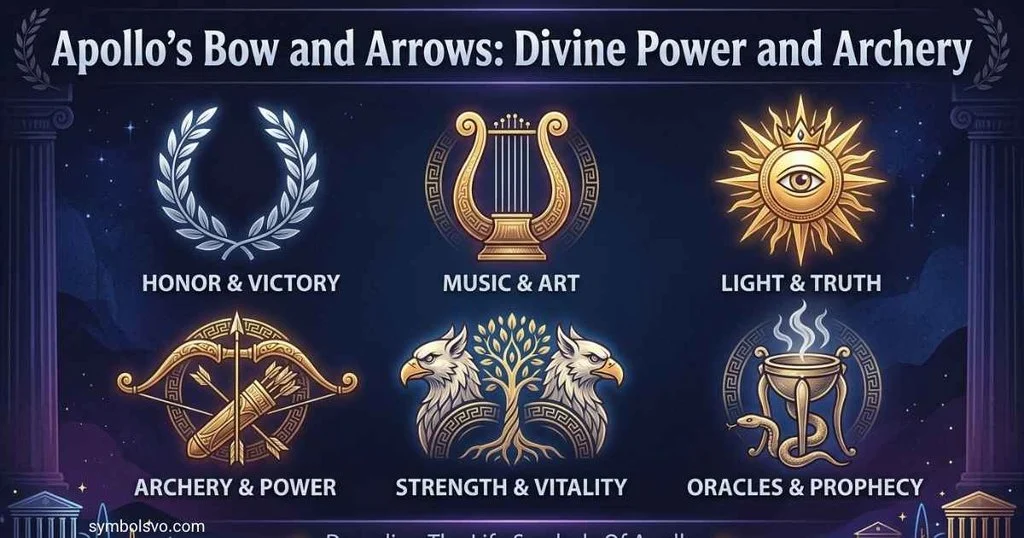
The bow and arrows are among Apollo’s most recognizable attributes. They identify him as a skilled divine archer whose weapons could bring sudden punishment, sickness, or death. Yet his archery represents more than physical strength. It also reflects his authority to respond when mortals violate sacred obligations.
Apollo’s bow often appears alongside his lyre in ancient Greek representations. This pairing captures two sides of his character: he could create beautiful music and impose terrible consequences when his honor or divine order was challenged.
What does Apollo’s bow and arrow symbolize?
Apollo’s bow and arrows have several related meanings:
- Divine power: His weapons demonstrate his authority over mortals and his ability to act from a distance.
- Archery and precision: Apollo represents exceptional skill with the bow.
- Punishment: His arrows can deliver consequences when people offend the gods.
- Protection: In certain religious contexts, Apollo could protect communities from disease and danger.
- The balance between harm and healing: Apollo’s association with plague exists alongside his role as a healing deity.
These meanings depend on the myth or religious setting. The bow doesn’t always symbolize anger, and Apollo’s divine power isn’t limited to warfare.
Apollo’s silver bow in Greek mythology
Apollo is often described in ancient poetry through epithets connected to archery, including hekēbolos, commonly translated as “far-shooter.” Such titles emphasize his ability to strike targets from a distance.
His bow is frequently described as silver in modern summaries and artistic interpretations. Ancient depictions, however, don’t always use one consistent material or color. The essential attribute is the bow itself, which helps viewers identify Apollo.
Apollo’s arrows in the Trojan War
One of the clearest examples of Apollo’s archery appears at the beginning of Homer’s Iliad.
Agamemnon, the Greek commander, refuses to return Chryseis to her father, Chryses, a priest of Apollo. Chryses prays to the god for help. Apollo responds by sending a plague through the Greek camp.
The episode establishes an important principle in Greek mythology: a powerful ruler cannot assume that his status protects him from divine consequences.
Apollo’s arrows become a symbol of punishment when sacred obligations are ignored. The story also links his destructive power to healing because the Greeks must identify the cause of their suffering and correct their behavior.
Lyre Apollo Symbols
The lyre is perhaps Apollo’s clearest symbol of music and artistic excellence. In ancient Greek culture, the instrument connected music with poetry, education, religious ceremonies, and public performance.
Apollo’s musical identity distinguishes him from gods whose principal attributes concern war, the sea, or agriculture. His lyre represents the ability to create order and beauty through sound.
What does Apollo’s lyre represent?
Apollo’s lyre is associated with several important ideas:
- Music and song: Apollo is a divine patron of musical performance.
- Poetry: Ancient Greek poetry often combined words with musical accompaniment.
- Harmony: The lyre represents balance, proportion, and carefully arranged sound.
- Artistic excellence: Apollo embodies exceptional musical skill.
- The Muses: Apollo is closely connected with these goddesses of artistic and intellectual inspiration.
The lyre’s meaning extends beyond entertainment. Music formed part of religious festivals and social life in ancient Greece, making Apollo’s instrument a symbol of cultural refinement.
How did Apollo receive the lyre?
The story of Apollo and Hermes explains how the instrument became associated with the god.
According to the Homeric Hymn to Hermes, Hermes created a lyre using a tortoise shell and other materials. He later stole cattle belonging to Apollo, beginning a conflict between the two divine brothers.
Their dispute eventually led to an exchange involving Hermes’ lyre. Apollo admired the instrument and accepted it, while Hermes gained other benefits from their reconciliation.
The myth connects Apollo’s musical mastery with Hermes’ cleverness and invention. It also illustrates how rivalry between the gods could end in cooperation.
The lyre and the kithara
Apollo appears in Greek art holding both the lyre and the kithara, a more substantial instrument associated with skilled public performers.
Although the names sometimes appear interchangeably in general explanations, the instruments were not identical in every historical context. The kithara had a more formal role in professional musical performance.
Ancient artists often showed Apollo holding a stringed instrument, wearing a laurel wreath, or pouring a ritual offering. A fifth-century BCE drinking cup displayed at the Delphi Archaeological Museum, for example, depicts Apollo with a seven-stringed lyre and a laurel wreath.
This combination links his musical identity to his religious role. See the Delphi Museum’s selected exhibits for further context.
Apollo’s Laurel Branch: The Story of Daphne
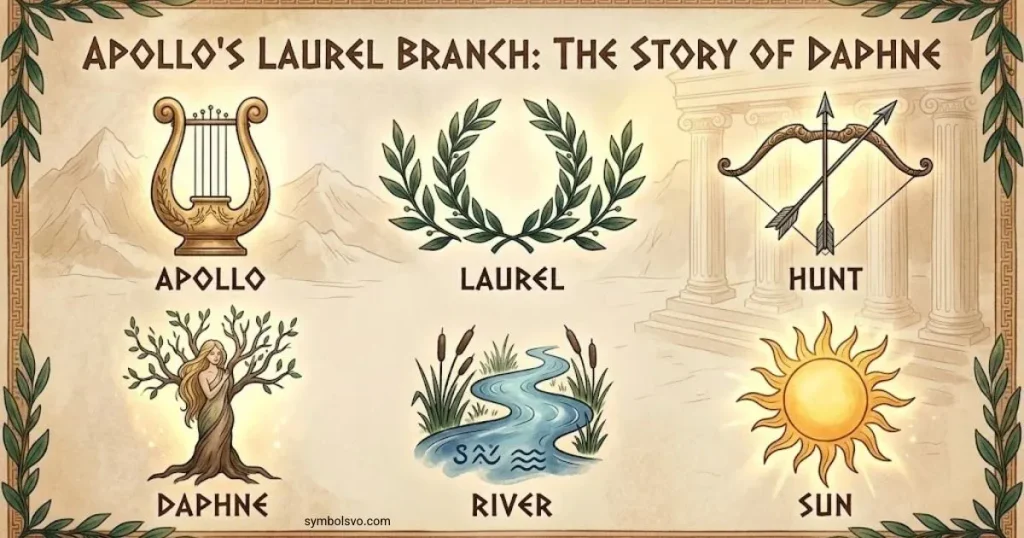
The laurel branch is one of Apollo’s most meaningful sacred attributes. Its connection to the god comes from the myth of Daphne, a story that combines desire, transformation, and the origins of a lasting religious symbol.
Unlike the bow, which represents Apollo’s archery, the laurel connects him to a particular myth and to later Greek traditions involving ritual and honor.
Why is the laurel sacred to Apollo?
The best-known explanation comes from the story of Apollo and Daphne.
Apollo encounters Eros, the god of love, and mocks his skill with the bow. Eros retaliates by using his arrows to influence Apollo and Daphne in opposite ways: Apollo becomes overwhelmed by desire, while Daphne wants to avoid romantic attachment.
Apollo pursues Daphne, who attempts to escape him. In a widely known version of the myth, her father, the river god Peneus, transforms her into a laurel tree.
Apollo cannot reverse the transformation. Instead, he declares the laurel sacred to him and adopts its leaves as a lasting emblem.
The story appears in different forms across classical literature. Roman poet Ovid tells a particularly influential version in Metamorphoses, Book One.
What does Apollo’s laurel branch symbolize?
The laurel branch carries several connected meanings:
- Sacred association: The plant becomes closely linked to Apollo and his worship.
- Transformation: Daphne’s change into a tree explains the mythological connection.
- Remembrance: The laurel keeps Daphne’s story attached to Apollo’s identity.
- Honor and achievement: Later traditions use laurel to recognize excellence.
- Religious practice: Laurel had a role in traditions associated with Apollo’s sanctuary at Delphi.
It’s important to distinguish these meanings. The myth of Daphne explains the laurel’s association with Apollo, while the branch’s broader connection to achievement developed through cultural and religious practices.
Apollo’s connection to Delphi
Laurel also appears in traditions connected with Delphi, one of Apollo’s most important sanctuaries.
The Delphic oracle attracted visitors seeking guidance on personal, religious, and political questions. Apollo’s prophetic authority made the sanctuary a major center of Greek religious life.
The laurel branch therefore connects a mythological story to an actual place where people worshiped Apollo. This relationship between mythology, sacred plants, and religious practice helps explain why the plant remained closely associated with him.
Apollo’s Laurel Wreath: Victory, Honor, and Achievement
The laurel wreath is one of the most recognizable symbols associated with Apollo. It consists of laurel leaves arranged in a crown and represents victory, distinction, and achievement in several ancient and later traditions.
Although it shares the same plant as Apollo’s laurel branch, the wreath has a more specific cultural meaning. A branch emphasizes the god’s sacred association, while a wreath can mark a person who has earned public recognition.
Why did the Greeks use laurel wreaths?
The ancient Greeks honored successful athletes, poets, and other distinguished individuals through different forms of public recognition. Wreaths made from particular plants became important prizes at festivals and competitions.
The Pythian Games, held at Delphi in honor of Apollo, included athletic and artistic contests. Laurel wreaths became prizes for victors, connecting public achievement with Apollo’s sanctuary.
The official archaeological site of Delphi describes the laurel wreaths awarded at the Pythian Games and their role in the festival’s traditions.
A useful distinction is that the ancient Olympic Games at Olympia traditionally awarded olive wreaths rather than laurel wreaths. These festivals belonged to the broader world of Greek religious and athletic competition, but their customs weren’t identical.
What does Apollo’s laurel wreath symbolize?
The wreath represents:
- Victory: Recognition of success in a competition.
- Honor: Public acknowledgment of an individual’s achievement.
- Poetry and artistic excellence: A connection to Apollo’s musical and poetic domains.
- Cultural prestige: The lasting influence of Greek traditions of recognition.
Over time, laurel crowns became widely used in European art, literature, and education as emblems of achievement. Their later meanings developed across many centuries, so it’s more accurate to describe them as an enduring cultural tradition than to attribute every modern use directly to ancient worship.
Apollo’s Raven: Messages, Coronis, and Divine Anger
The raven is associated with Apollo through a myth involving Coronis, a woman connected to the god and the mother of Asclepius in several traditions.
Unlike the lyre or bow, the raven’s symbolism depends heavily on the story being told. It isn’t simply a universal emblem of wisdom or prophecy. Its best-known association with Apollo concerns the delivery of unwelcome news and the god’s reaction.
Why is the raven associated with Apollo?
In one widely repeated version, Apollo learns that Coronis has a relationship with Ischys. A raven brings the news to the god.
Apollo reacts with anger. Some ancient accounts explain that he changed the raven’s feathers from white to black as punishment for delivering the report. The details vary between authors, and not every version includes the same explanation.
The story links the raven with messages, betrayal, and consequences. However, these meanings belong to this particular myth rather than establishing one fixed interpretation of ravens across Greek religion.
Coronis and Asclepius
The Coronis story also explains part of Apollo’s family mythology.
Asclepius, the son of Apollo and Coronis, becomes an important deity of healing and medicine. In some versions, Apollo rescues the child after Coronis dies and places him under the care of the centaur Chiron, who teaches him healing arts.
This relationship adds an important dimension to Apollo’s character. The god associated with plague and punishment is also the father of a deity famous for medicine.
The story’s details differ among classical authors. Apollodorus, Pindar, Pausanias, and Ovid don’t all tell the episode in exactly the same way. For a source-based comparison, consult Apollodorus in the Perseus Digital Library.
What does Apollo’s raven symbolize?
The raven can represent:
- The delivery of important or unwelcome news.
- The consequences of reporting information to a powerful figure.
- Divine anger within the Coronis story.
- The role of birds as messengers in Greek mythology.
Key distinction: The raven is a recognized animal associated with Apollo, but ancient Greek traditions also connect him with other birds and animals. Avoid calling it his only sacred animal.
Python: Apollo’s Victory and His Connection to Delphi
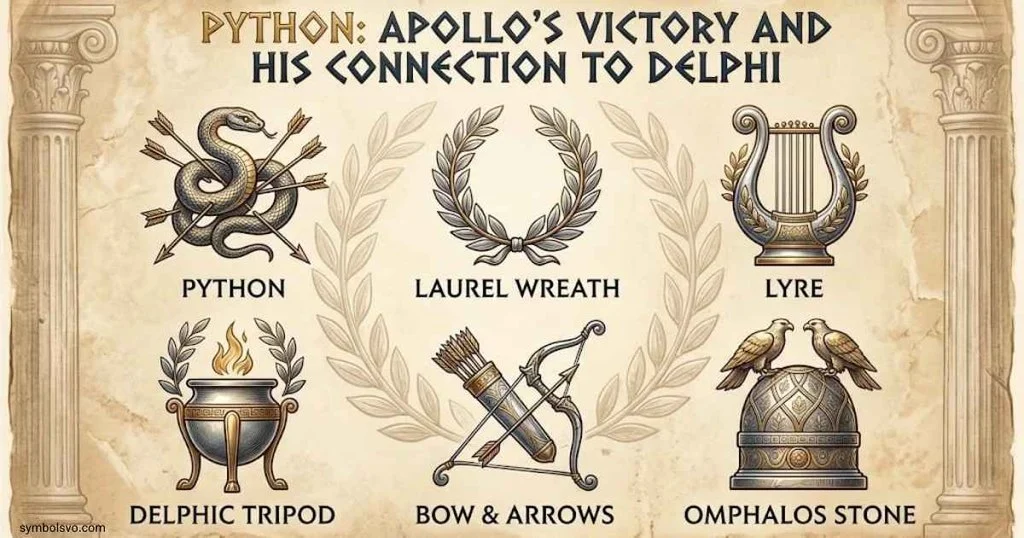
Python, often depicted as a great serpent or dragon-like creature, plays a central role in the mythology of Apollo’s sanctuary at Delphi. Although Python isn’t a physical object or an animal attribute in the same sense as the raven, its story helps explain Apollo’s authority as a god of prophecy.
The myth connects a dramatic divine victory to one of the most important religious sites in ancient Greece.
Who was Python in Greek mythology?
Python was a formidable serpent associated with Delphi. In traditions about Apollo’s rise to authority there, the creature occupied or guarded the sacred landscape before Apollo established his own connection with the sanctuary.
Accounts differ in their details, including Python’s origins and its precise relationship to the earlier religious powers at Delphi. The central theme, however, remains recognizable: Apollo defeats Python and becomes closely associated with the site.
How did Apollo defeat Python?
According to the familiar myth, Apollo uses his archery skills to kill Python. His victory establishes his power at Delphi and helps explain why the sanctuary became known as a center of his worship.
The name Pythian reflects this mythological connection. It appears in the title of the Pythian Games, the festival held at Delphi in Apollo’s honor.
The victory also connects two of Apollo’s important attributes. His bow demonstrates his ability to defeat a powerful opponent, while Delphi becomes the place where his prophetic authority is expressed.
What does Python symbolize in Apollo’s mythology?
Python’s significance comes from the role it plays in the story rather than from a universal symbolic meaning.
- Divine victory: Apollo defeats a formidable supernatural opponent.
- Sacred authority: The myth explains his association with Delphi.
- Prophecy: The defeat helps establish the setting for Apollo’s oracular role.
- Religious tradition: The story connects the sanctuary, its festivals, and Apollo’s worship.
Python should not be confused with every serpent in Greek mythology. Snakes could carry different meanings in other stories, including associations with healing, renewal, and divine knowledge.
Apollo’s Tripod: The Symbol of Prophecy and the Oracle of Delphi
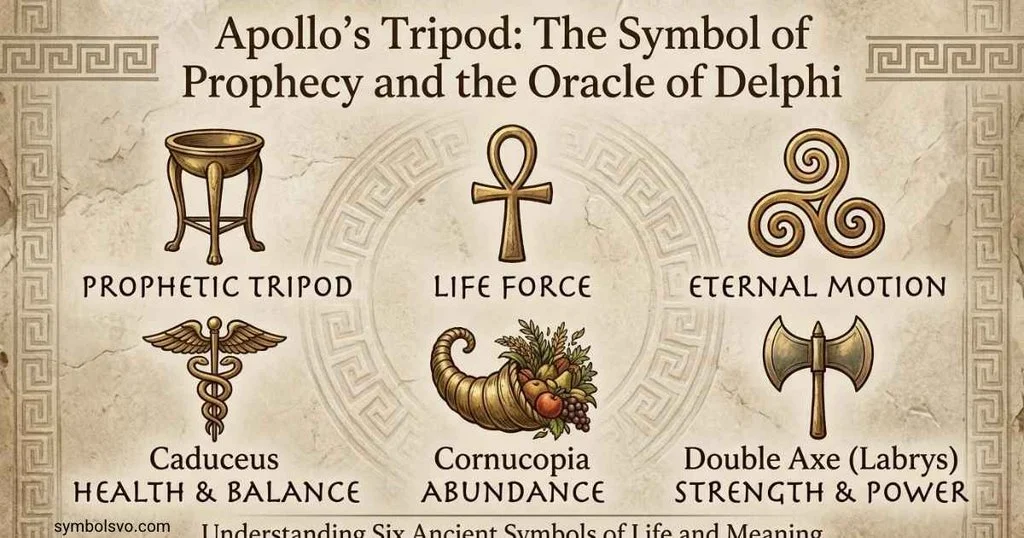
The tripod is one of Apollo’s most important religious attributes. A tripod is a three-legged stand that could support a vessel or other object. In the context of Delphi, it became closely connected with prophecy and the sanctuary’s oracular traditions.
Unlike the raven, which appears in a particular myth, the tripod has a direct connection to Apollo’s religious worship.
What does Apollo’s tripod symbolize?
The tripod represents prophecy, sacred consultation, and the authority of the Oracle of Delphi.
People traveled to Delphi to seek guidance on questions that could affect personal decisions, public affairs, religious obligations, and political plans. Apollo’s oracle gave the sanctuary influence beyond its immediate region.
The tripod appears in ancient literary descriptions and artistic representations of the Delphic oracle. It helps identify the scene as one involving divine consultation rather than a general depiction of Apollo.
Who was the Pythia?
The Pythia was the priestess who delivered the oracle at Delphi. People consulted her in the sanctuary associated with Apollo, and her responses held religious and political importance in the ancient Greek world.
Ancient literature often presents oracular answers as difficult to interpret. The story of Croesus, king of Lydia, illustrates this theme: an oracle predicted that crossing the Halys River would destroy a great empire, but Croesus misunderstood which empire the prediction referred to.
Such stories show that prophecy in Greek mythology and religious tradition wasn’t always a straightforward prediction. Interpretation mattered.
Why is the tripod important among Apollo’s symbols?
The tripod highlights a side of Apollo that the bow and lyre cannot fully express.
- The bow represents archery and divine power.
- The lyre represents music and artistic skill.
- The tripod represents prophecy and sacred consultation.
Together, these attributes reveal the range of Apollo’s roles. He wasn’t simply a god of music or a skilled archer; he also held an important place in Greek religious life.
For additional historical and visual context, the [Antikenmuseum Basel’s Apollo exhibit](https://herogames.antikenmuseum basel.ch/en/def/) discusses Apollo’s role in prophecy, his musical attributes, and the Pythia’s connection to the tripod.
Apollo Symbols and Powers: What Each Symbol Reveals
Apollo’s symbols reflect the different powers and responsibilities associated with him. Unlike gods with a single dominant role, Apollo influenced several areas of ancient Greek life. His abilities included archery, music, prophecy, healing, and protection.
Each symbol helps explain a different part of his divine identity.
Music and artistic power
The lyre represents Apollo’s extraordinary musical abilities. He was considered a master musician and had a close relationship with the Muses, who inspired poetry, music, and other artistic activities.
His musical power also represented harmony, discipline, and artistic excellence.
Archery and divine punishment
Apollo’s bow and arrows demonstrate his skill as an archer. In Homer’s Iliad, he sends a plague against the Greek army after Agamemnon dishonors his priest, Chryses.
This story shows how Apollo could use his divine power to punish those who violated sacred obligations.
Prophecy and divine knowledge
Apollo’s prophetic power is closely connected with Delphi. The tripod represents the Oracle of Delphi, where the priestess known as the Pythia delivered Apollo’s oracular messages.
People from different Greek communities visited the sanctuary to seek guidance about personal, religious, and political matters.
Healing and protection
Apollo was also associated with healing and protection from disease. However, his role was complex because he could both send illness and help prevent or remove it.
His son Asclepius later became one of the most important Greek deities associated with medicine.
Light and illumination
Apollo became increasingly associated with light and solar imagery in later traditions. His epithet Phoebus means bright or shining, reflecting his connection with radiance.
His different powers show how Greek mythology connected music, knowledge, health, and divine authority through one god. His symbols make these relationships easier to understand.
Apollo and the Sun: Rays of Light and Solar Symbolism
Apollo’s association with light and the sun is familiar today, but it requires a little historical context. His identity developed across Greek and Roman traditions, and the later image of Apollo as a solar deity shouldn’t be treated as the only form he took in ancient mythology.
His connection to light fits naturally with his traditional roles in prophecy and healing. However, these associations don’t mean that every ancient depiction of Apollo was intended to represent the physical sun.
Why is Apollo associated with the sun?
Apollo became closely linked with light, radiance, and illumination. The epithet Phoebus, commonly translated as “bright” or “shining,” reflects this association.
Over time, Apollo’s identity became increasingly connected with the sun, particularly in later Greek and Roman traditions. Yet early Greek mythology also recognized Helios as the personification of the sun, responsible for its daily journey across the sky.
This distinction matters because Apollo’s many domains existed alongside those of other gods. Greek mythology wasn’t a single fixed system in which every deity always had one exclusive function.
What do Apollo’s rays of light symbolize?
Rays of light often appear in later artistic representations of solar deities. When associated with Apollo, they can suggest:
- Radiance: The god’s shining or luminous nature.
- Illumination: Light as a visual sign of revelation and clarity.
- Knowledge: A useful interpretive connection between light and Apollo’s prophetic role.
- Solar power: His increasingly prominent association with the sun.
Some of these meanings are interpretations of artistic imagery rather than formal definitions established by every ancient source. It’s best to distinguish the historical evidence from the symbolism modern readers draw from it.
What is the meaning of Apollo’s golden chariot?
The golden chariot is commonly used to represent the sun’s journey across the heavens. In early Greek traditions, this role belongs primarily to Helios, who drives the sun across the sky.
Later representations sometimes merge Apollo with solar imagery, making the chariot part of his broader visual identity. That association is real within later classical tradition, but it shouldn’t be projected unchanged onto every early Greek account.
The chariot therefore illustrates the historical development of Apollo’s symbolism. It is a useful symbol to discuss, provided the article explains its connection to Helios rather than presenting it as Apollo’s universally established attribute.
Apollo and Helios: What’s the difference?
| Feature | Apollo | Helios |
| Primary traditional roles | Music, prophecy, archery, healing, and light | Personification of the sun |
| Musical attributes | Lyre and kithara | Not chiefly identified by a lyre |
| Prophetic connection | Central to Apollo’s role at Delphi | Not his defining role |
| Solar chariot | Associated with Apollo in later solar traditions | A major attribute in early Greek solar mythology |
| Historical relationship | Became increasingly associated with the sun | Represented the sun’s journey across the sky |
The two gods became more closely identified over time, but their earlier mythological roles were distinct. The Antikenmuseum Basel’s Apollo exhibit provides a useful introduction to Apollo’s connection with light and prophecy.
Apollo Symbols Copy and Paste
Apollo’s traditional symbols are popular in mythology-inspired artwork, educational projects, tattoos, usernames, and social media posts. However, ancient Greek mythology doesn’t provide one official Unicode symbol specifically representing Apollo.
You can still use related characters and decorative combinations to express different aspects of his identity.
Apollo-inspired symbols
| Symbol | Meaning or Association |
| ☀ | Sun and light |
| ♫ | Music and artistic expression |
| ♪ | Apollo’s musical identity |
| ♡ | Love and the Daphne myth |
| ☽ | Decorative lunar imagery, more closely associated with Artemis |
| ✦ | Light and radiance |
| 🏹 | Bow and archery |
| 🌿 | Laurel and sacred plants |
| 🪶 | Birds and mythological associations |
| 🐦⬛ | Raven |
| 🦢 | Swan |
| 🐍 | Python and serpent mythology |
Note: These are modern Unicode characters and emojis used for decorative or thematic purposes. They aren’t all historically established ancient Greek symbols of Apollo.
Copy-and-paste Apollo symbol combinations
Here are some decorative combinations you can copy and use:
- ☀️ Apollo and Light
- 🎵 Apollo and Music
- 🏹 Apollo the Archer
- 🌿 Apollo and Laurel
- 🦢 Apollo and the Swan
- ☀️🎵 Apollo’s Divine Arts
- 🏹🌿 Apollo’s Sacred Attributes
These combinations are useful for captions, mythology notes, creative designs, and social media profiles.
If you’re creating historically inspired artwork, use recognizable attributes such as the lyre, bow, and laurel wreath rather than treating modern emojis as ancient religious symbols.
Artemis and Apollo Symbols: Key Differences
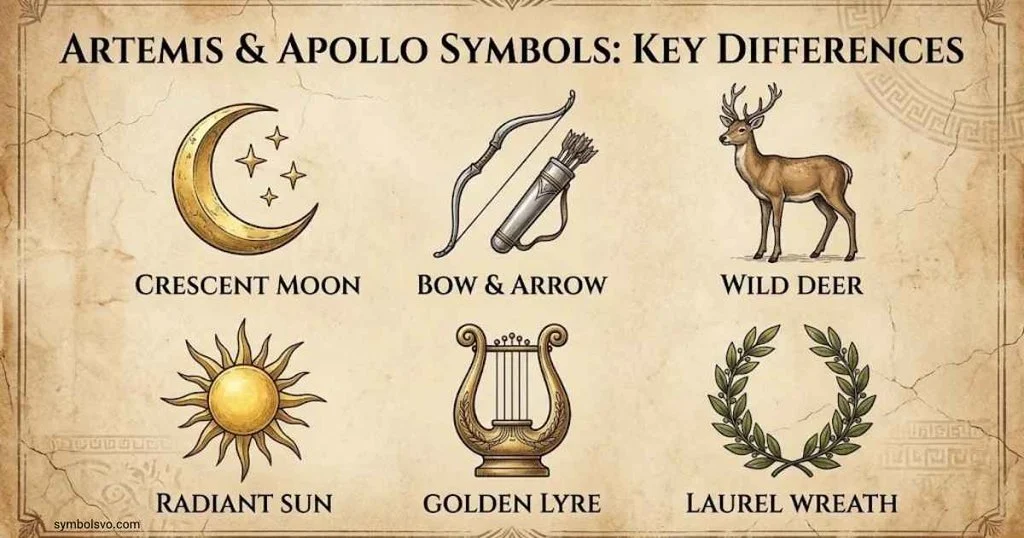
Artemis and Apollo are twin siblings in Greek mythology. Both are children of Zeus and Leto, but they have different responsibilities, symbols, and divine identities.
Apollo is associated with music, prophecy, archery, healing, and light. Artemis is closely connected with hunting, wilderness, wild animals, and the protection of young people.
Their symbols help distinguish their roles in ancient Greek mythology.
Apollo and Artemis symbols compared
| Category | Apollo | Artemis |
| Main symbols | Lyre, bow, laurel wreath | Bow, arrows, deer, crescent imagery |
| Main associations | Music, prophecy, healing, light | Hunting, wilderness, nature |
| Sacred plants | Laurel | Cypress and other plants in different traditions |
| Animal associations | Raven, swan, wolf, dolphin | Deer, bear, hunting dogs |
| Main instrument or weapon | Lyre and bow | Bow and arrows |
| Famous location | Delphi | Ephesus and other sanctuaries |
| Mythological role | God of music, prophecy, and archery | Goddess of hunting and wilderness |
Shared symbols and similarities
Although Apollo and Artemis have different identities, they share some important characteristics.
Both are skilled archers and are frequently represented with bows and arrows. Their weapons reflect their divine abilities and their connection to distance shooting.
They also share a close family relationship through Zeus and Leto. Ancient Greek stories sometimes present them acting together, particularly when defending their mother or responding to challenges involving their family.
How to recognize Apollo and Artemis in ancient art
Apollo is often shown holding a lyre, wearing a laurel wreath, or carrying a bow. His appearance is commonly represented as youthful and idealized.
Artemis is frequently depicted with a hunting bow, arrows, a short hunting garment, and a deer or hunting dog nearby. Some later artistic traditions also associate her with a crescent moon.
Their visual attributes make it easier to identify the twins in Greek mythology and classical artwork.
Offerings to Apollo in Ancient Greek Religion
Offerings to Apollo played an important role in ancient Greek religious practices. Worshipers honored him through prayers, sacrifices, music, and other ritual activities. These acts expressed respect, devotion, and requests for divine protection or guidance.
The exact offerings varied according to the sanctuary, festival, and purpose of worship.
Common offerings associated with Apollo
1. Laurel branches
Laurel was closely associated with Apollo because of the myth of Daphne. Its presence in religious traditions and ceremonies helped strengthen the connection between the god and his sacred plant.
2. Animal sacrifices
Animal sacrifices formed part of many ancient Greek religious ceremonies. Worshipers offered animals to different gods during festivals and other sacred occasions. The particular animal and ritual depended on local traditions.
3. Music and hymns
Music was especially appropriate for Apollo because of his relationship with the lyre and the Muses. Hymns, musical performances, and poetic celebrations formed part of religious life at festivals dedicated to him.
4. Incense and ritual gifts
Incense and other valuable offerings could be presented in ancient Greek sanctuaries. Worshipers used such gifts to demonstrate devotion and respect toward the gods.
5. Votive offerings
People sometimes dedicated objects to Apollo after receiving help or seeking divine favor. These offerings could include inscriptions, statues, vessels, and other valuable items.
Offerings at the sanctuary of Delphi
Delphi was one of the most important religious centers dedicated to Apollo. Visitors traveled there to consult the oracle, participate in religious activities, and present offerings.
The sanctuary contained numerous dedications from individuals and city-states. These objects reflected gratitude, political relationships, religious devotion, and public prestige.
The Pythian Games also strengthened Apollo’s connection with music, poetry, and athletic competition.
Why did people make offerings to Apollo?
People honored Apollo for several reasons:
- To seek protection from disease and danger.
- To request guidance through his oracle.
- To express gratitude for blessings.
- To honor him during religious festivals.
- To recognize his influence over music and artistic activities.
These practices show that Apollo’s worship extended beyond mythology. His symbols, stories, and sacred places were closely connected to the everyday religious life of ancient Greek communities.
Other Sacred Animals and Attributes of Apollo
Apollo’s identity extends beyond the seven main symbols. Ancient Greek art and religious traditions associate him with several animals, instruments, and sacred objects. These additional attributes help explain how worshipers and artists recognized different aspects of the god.
Apollo’s sacred animals
Apollo had multiple animal associations, and their meanings varied across myths and local traditions.
| Animal | Connection to Apollo | Symbolic context |
| Raven | The story of Coronis | Messages and divine anger in a particular myth |
| Swan | Apollo’s musical and divine associations | Beauty, song, and artistic imagery |
| Wolf | Apollo’s cultic and literary traditions | An animal associated with certain aspects of his worship |
| Dolphin | Apollo’s connection to Delphi | The foundation myth of the Delphic sanctuary |
| Snake | Apollo’s victory over Python and his prophetic traditions | Sacred authority and specific mythological narratives |
These animals don’t all function as equal or interchangeable symbols. The raven, for example, has a specific story connected to Coronis, while the dolphin belongs to a tradition explaining Apollo’s association with Delphi.
The swan and wolf also appear in wider Greek religious and mythological contexts. Their presence in a work of art doesn’t automatically prove that its subject is Apollo. Other details, such as an inscription, a lyre, or the surrounding scene, can help establish the identification.
Apollo’s other artistic attributes
Several objects and visual features appear in representations of Apollo.
- Kithara: A stringed instrument that emphasizes his musical role.
- Quiver: A container for arrows that identifies him as an archer.
- Tripod: A sacred object associated with prophecy and Delphi.
- Omphalos: A sacred stone at Delphi associated with the idea that the sanctuary marked the center of the world.
- Youthful appearance: A common artistic convention that presents Apollo as an idealized young god.
- Long hair and laurel wreath: Features frequently used to portray Apollo in ancient and later classical art.
These attributes serve different purposes. Some are physical objects Apollo holds, while others belong to the sacred places associated with him. His youthful appearance is an artistic convention rather than a separate sacred object.
The distinction matters when interpreting Apollo’s symbols in ancient Greek art. A lyre or tripod may identify a particular divine role, while a hairstyle or wreath contributes to the overall visual representation.
Apollo Symbolism in Medicine and Healing
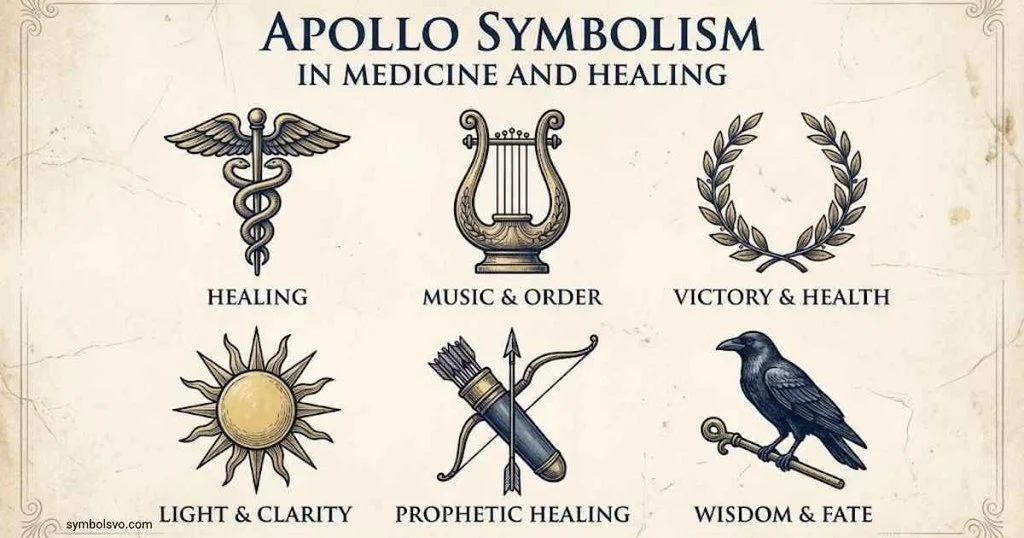
Apollo’s connection to medicine is an important but sometimes overlooked part of his mythology. Although he is widely recognized for music, prophecy, and archery, ancient Greek traditions also associated him with healing and protection against disease.
His role reflects an interesting contrast: Apollo could bring illness through his arrows, but he could also help protect people from suffering.
Apollo as a god of healing
Apollo was associated with healing, purification, and protection from disease. People could appeal to him for relief from illness and protection against harmful forces.
His connection to medicine also appears in his relationship with his son, Asclepius, who became a major deity of healing.
Apollo and Asclepius
Asclepius was the son of Apollo and Coronis in well-known mythological traditions. According to the familiar story, Apollo rescued the child after Coronis died and entrusted him to the centaur Chiron.
Chiron taught Asclepius the healing arts, helping him develop extraordinary medical abilities. Asclepius eventually became famous for his power to heal the sick.
Their relationship connects Apollo’s divine authority with the development of healing traditions in Greek mythology.
What symbol represents Apollo’s connection to medicine?
Apollo doesn’t have one universally recognized medical emblem comparable to the lyre or bow. His connection to healing is better understood through his mythology and relationship with Asclepius.
| Symbol or Figure | Medical Connection |
| Apollo | Healing, purification, and protection from disease |
| Asclepius | Medicine and healing |
| Serpent | Strong association with Asclepius and healing traditions |
| Laurel | Sacred and ritual associations with Apollo |
One important distinction is that the serpent-entwined staff belongs primarily to Asclepius, not Apollo. It shouldn’t be presented as Apollo’s main medical symbol.
Apollo’s healing role reveals another side of his character. His mythology connects illness, protection, purification, and medicine within the same divine family.
What Do Apollo’s Symbols Have in Common?
Although Apollo’s symbols represent different things, they share an important feature: each connects the god to a particular power, story, or cultural tradition.
Divine power and punishment
The bow and arrows show Apollo’s ability to punish those who violate divine obligations. His victory over Python also demonstrates his strength and authority.
However, Apollo’s power isn’t limited to destruction. His role in healing and medicine shows that Greek mythology often gave the same deity several connected responsibilities.
Music, poetry, and artistic excellence
The lyre and kithara identify Apollo as a master musician. His relationship with the Muses further connects him to poetry and artistic inspiration.
These symbols reflect the importance of music in ancient Greek society, where performances could form part of religious festivals, public celebrations, and poetic traditions.
Prophecy and sacred authority
The tripod, Python, and Delphi belong to the prophetic side of Apollo’s identity.
Together, they connect a mythological victory to a real ancient sanctuary. Delphi became an important place where people sought divine guidance, demonstrating how mythology and religious practice could reinforce one another.
Nature, honor, and cultural memory
The laurel branch and wreath connect Apollo with Daphne, religious traditions, and public recognition.
The raven adds a different dimension. Its association with Apollo comes from a specific myth about messages and punishment, showing how stories could shape the meaning of an animal.
Light and solar identity
Apollo’s association with light became increasingly important in later traditions. Rays of light and solar imagery communicate this aspect of his identity, while the golden chariot connects his later representations with the wider mythology of the sun.
Understanding the distinction between Apollo and Helios helps readers recognize how these symbols developed rather than assuming every attribute belonged to Apollo in every historical period.
Apollo’s Symbols in Ancient Greek Art and Modern Culture
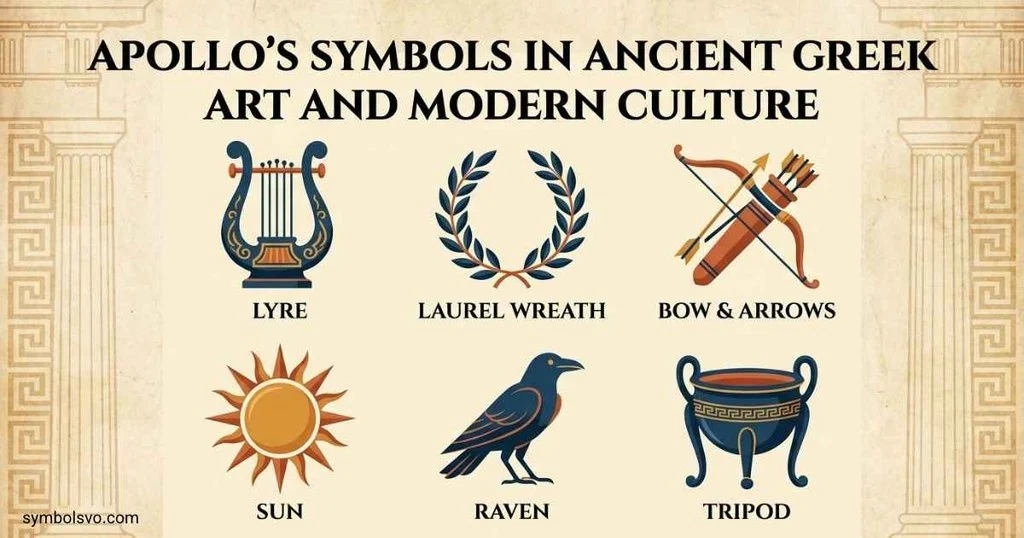
Apollo’s symbols remain recognizable because artists repeatedly used them to communicate his identity. Their meanings, however, depend on the time period, medium, and cultural setting.
How ancient Greek artists depicted Apollo
Ancient Greek artists represented Apollo through sculpture, painted pottery, reliefs, and other forms of visual art.
A figure holding a lyre might represent Apollo’s musical role, while a bow and quiver would emphasize his archery. A tripod or a scene set at Delphi could point toward his prophetic identity.
The Delphi Archaeological Museum’s collection includes a fifth-century BCE cup depicting Apollo with a lyre and laurel wreath. A black bird appears in the scene, although its identity and meaning have been interpreted in different ways.
This example demonstrates why context matters. An individual object may support several interpretations, and reliable identification often depends on inscriptions, comparable artworks, and the scene as a whole.
Apollo’s influence on later art and literature
Apollo became an influential figure in later Greek and Roman culture and remained important in European art and literature.
Writers and artists used him to explore music, beauty, knowledge, and the relationship between human achievement and divine inspiration. His laurel wreath also became a broader emblem of literary and artistic distinction.
These later interpretations drew on classical mythology but sometimes emphasized different aspects of Apollo’s identity. The solar Apollo, the musician, and the prophetic god could receive different levels of attention depending on the work.
How to recognize Apollo in a work of art
Use several clues together rather than relying on one symbol.
- A lyre or kithara suggests his musical identity.
- A bow and quiver point to his archery.
- A laurel wreath may connect him with Apollo, poetry, or victory.
- A tripod or Delphic setting suggests his prophetic role.
- A combination of attributes can strengthen the identification.
A laurel wreath alone isn’t conclusive because other figures may wear wreaths. Likewise, a stringed instrument doesn’t automatically identify every figure as Apollo.
For reliable identification, consult museum catalogues and look for the artwork’s date, provenance, inscriptions, and established scholarly interpretation.
Frequently Asked Questions About Apollo Symbols
What are the main symbols of Apollo?
Apollo’s most recognizable symbols include the bow and arrows, lyre, laurel branch, laurel wreath, raven, Python, and tripod. Light and solar imagery also became important in later traditions. Each symbol connects him to a particular myth, divine power, religious practice, or artistic convention.
What is Apollo’s most famous symbol?
The lyre and laurel wreath are two of Apollo’s most recognizable attributes. The lyre represents music and artistic excellence, while the wreath connects him to Daphne, the Pythian Games, and the wider symbolism of victory and honor. The bow and arrows are also among his defining visual attributes.
What does Apollo’s bow and arrow symbolize?
Apollo’s bow and arrows represent archery, divine authority, and punishment. In Homer’s Iliad, Apollo sends a plague against the Greek army after Agamemnon dishonors his priest, Chryses. The episode demonstrates the god’s power to impose consequences when people violate sacred obligations.
What does Apollo’s lyre represent?
The lyre symbolizes music, song, harmony, and artistic skill. Apollo’s connection with the instrument also reflects the importance of music and poetry in ancient Greek culture. Myths involving Hermes explain how the lyre became part of Apollo’s identity.
Why is the raven associated with Apollo?
The raven appears in a myth involving Apollo and Coronis. In one version, the bird reports news about Coronis and Ischys, prompting Apollo’s anger. Some accounts explain that Apollo changed the raven’s feathers from white to black. The details vary across ancient sources.
Why does Apollo wear a laurel wreath?
Apollo’s laurel wreath connects him to the myth of Daphne, who transforms into a laurel tree while escaping him. Apollo adopts the plant as sacred. Laurel wreaths later became associated with victory and distinction, including prizes awarded at the Pythian Games held in Apollo’s honor.
What is Apollo’s sacred plant?
The laurel is Apollo’s best-known sacred plant. Its association with him comes from the story of Daphne and continues through traditions connected with Delphi and the Pythian Games. The laurel branch and laurel wreath share this connection, although their cultural uses aren’t identical.
What is Apollo’s sacred animal?
Apollo has several animal associations rather than one universally exclusive sacred animal. The raven appears in the Coronis myth, while swans, wolves, and dolphins also have connections with Apollo in different traditions. The meaning of each animal depends on its particular story or religious context.
Is Apollo the Greek god of the sun?
Apollo became closely associated with the sun, light, and radiance, particularly in later Greek and Roman traditions. However, Helios was the sun’s personification in early Greek mythology and was traditionally responsible for driving the solar chariot across the sky. Their identities became increasingly linked over time.
What does Apollo’s golden chariot symbolize?
The golden chariot represents the sun’s journey across the heavens in solar mythology. Early Greek traditions associate this role primarily with Helios, although later representations sometimes connect Apollo with the chariot. The distinction helps explain the historical development of Apollo’s solar identity.
How are Apollo and Artemis related?
Apollo and Artemis are twin children of Zeus and Leto. Apollo is associated with music, prophecy, archery, healing, and light, while Artemis is closely connected with hunting, wilderness, and protection associated with young people. Their shared parentage links them within the Olympian family, but each has distinct attributes.
What is Apollo’s connection to Delphi?
Delphi was one of Apollo’s most important sanctuaries. According to mythology, he defeated Python and established his authority there. The sanctuary became famous for its oracle, delivered by the Pythia, and hosted the Pythian Games in Apollo’s honor. Delphi is essential to understanding his prophetic symbolism.
What Is Apollo the God Of?
Apollo is the Greek god of music, poetry, prophecy, archery, and healing. He is also associated with light and became increasingly connected with the sun in later Greek and Roman traditions. His many responsibilities make him one of the most influential Olympian gods in Greek mythology.
What Flower Is Associated with Apollo?
The laurel is the plant most closely associated with Apollo. Although people sometimes call it his sacred flower, laurel is actually an evergreen tree or shrub. Its connection to Apollo comes from the myth of Daphne, who transforms into a laurel tree while escaping the god. Apollo later adopts its leaves as his sacred emblem.
What Are Apollo’s Healing Symbols?
Apollo’s healing associations are connected with purification, protection from disease, and his son Asclepius. The serpent and healing staff are primarily associated with Asclepius rather than Apollo. Apollo’s own healing role is best understood through ancient myths and religious traditions instead of one specific medical emblem.
What Are the Symbols of Apollo and Artemis?
Apollo’s main symbols include the lyre, bow and arrows, laurel wreath, raven, and tripod. Artemis is commonly represented by a bow, arrows, deer, hunting dogs, and wilderness imagery. Both gods share an association with archery because they are skilled divine archers and twin children of Zeus and Leto.
Conclusion:
The symbols of Apollo reveal a god whose influence extended far beyond one divine responsibility. His bow and arrows represent archery and divine power, while the lyre reflects music and artistic skill. The laurel branch and wreath connect him to Daphne, religious tradition, and achievement. The raven, Python, and tripod reveal other parts of his mythology, particularly the stories and sacred practices associated with Delphi.
His association with light and the sun adds another layer to his identity, especially when viewed through the historical relationship between Apollo and Helios.
The key to understanding Apollo symbolism is to consider each attribute in context. Some symbols come from specific myths, others from religious worship, and still others from artistic traditions that developed over centuries.
Together, these symbols provide a richer understanding of Apollo’s place in Greek mythology, ancient Greek religion, and the artistic traditions that continued to draw inspiration from the classical world.

I’m Nathan Holloway, a passionate researcher and writer with a deep interest in symbols, signs, and their hidden meanings. I enjoy exploring how symbols have influenced different civilizations, religions, and modern communication. Through my work, I aim to make complex historical and cultural concepts easy to understand for readers of all backgrounds. Every article I write is carefully researched to provide reliable and engaging information.
Books:
- Beyond the Symbol
- The Secret Meanings of Everyday Signs
Author 2: Grace Whitmore
Description:
My name is Grace Whitmore, and I love discovering the stories behind the world’s most fascinating symbols. I spend my time researching ancient civilizations, mythology, spiritual traditions, and modern iconography to uncover the meanings people often overlook. I believe that every symbol has a history worth telling, and I enjoy sharing that knowledge in a simple and reader-friendly way.
Books:
- Echoes of Ancient Symbols
- The Symbolic World
 Mason Ellington
 Daniel Brooks