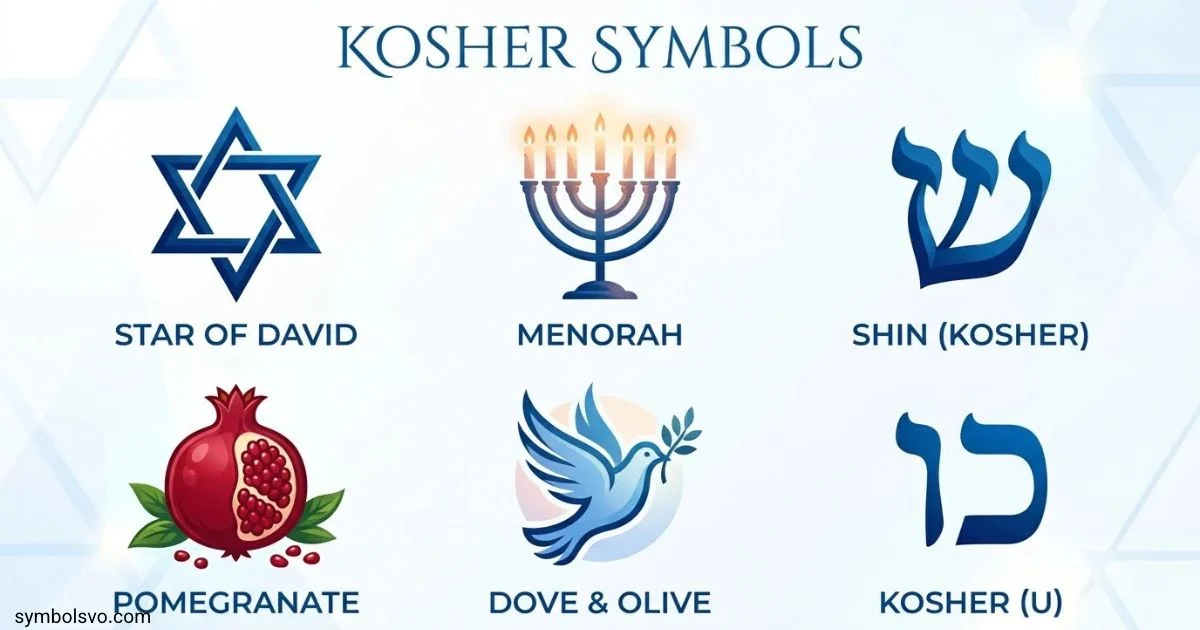
Kosher symbols help you understand whether a food product meets the requirements of Jewish dietary law. You’ll often find these small marks on cereal boxes, snack bags, dairy products, sauces, beverages, and packaged foods. Although they may look like simple letters or logos, each mark connects to a particular certification system.
The most important thing to know is that not all kosher symbols mean the same thing. A product marked OU may have a different kosher classification from one marked OU-D or OU-P. Understanding these differences can help you make informed choices when shopping for food.
This guide explains the most common kosher symbols, including OU, OK, and Star-K. You’ll learn what their accompanying letters mean, how kosher certification works, and how to check whether a product meets your dietary requirements.
What Are Kosher Symbols?
Kosher symbols are marks printed on food packaging to identify certification or supervision by a kosher certification organization. These marks tell consumers that a particular product has been reviewed under the certifier’s kosher standards.
The word kosher comes from a Hebrew term meaning fit or suitable. In Judaism, it describes food that meets the requirements of kashrut, the body of Jewish dietary laws.
A kosher certification mark is also called a hechsher. The term refers to kosher approval and is commonly used for the symbol that appears on a certified product.
For example, a package might display a circled U, a circled K, or a Star-K logo. A letter such as D or P may appear beside the logo to provide additional information about the product’s classification.
These marks are especially useful for processed foods because their kosher status may depend on more than the ingredients listed on the package.
Why Do Food Products Have Kosher Symbols?
Kosher symbols help consumers identify products that have undergone review by a particular certification organization. Manufacturers also use them to communicate certification status to customers and retailers.
Certification may involve reviewing:
- Ingredients and their sources.
- Suppliers and ingredient documentation.
- Production equipment and manufacturing processes.
- Meat and dairy separation requirements.
- Cleaning and equipment preparation procedures.
- Packaging and approved product labels.
- Ongoing compliance with the certifier’s requirements.
A product’s ingredients might appear acceptable at first glance. However, certain flavorings, enzymes, processing aids, or equipment arrangements can affect its kosher status.
A kosher symbol provides information about religious dietary compliance, not a guarantee that a product is healthier, more nutritious, or allergen-free.
Common Kosher Symbols and Their Meanings
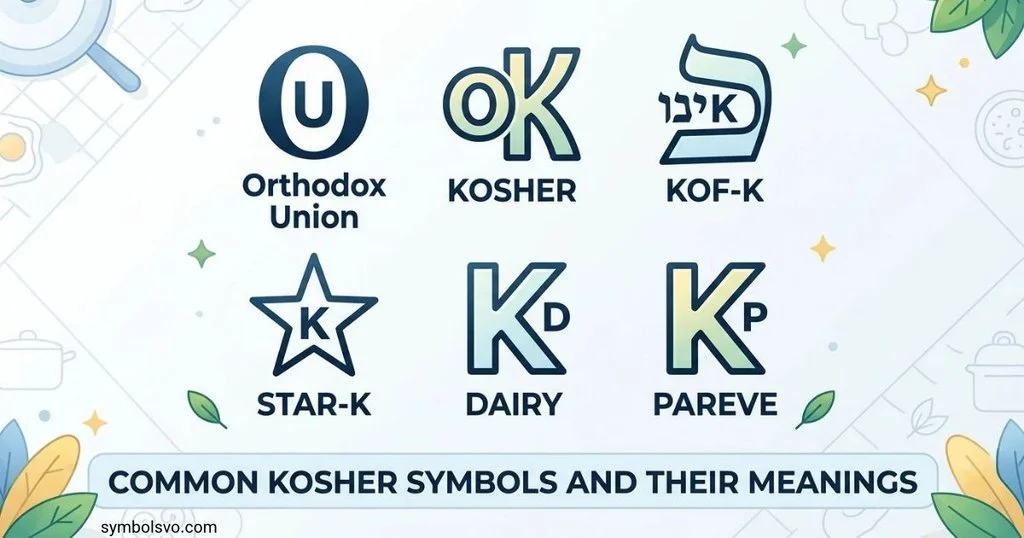
Several organizations certify kosher products around the world. In the United States, the Orthodox Union, OK Kosher, and Star-K are among the recognizable names consumers may encounter.
Each organization uses its own certification mark and may add letters to indicate a product’s kosher classification. The safest approach is to learn the major symbols and verify unfamiliar designations through the issuing organization.
OU Symbol: Orthodox Union
The OU kosher symbol features a U inside a circle. It identifies products certified by Orthodox Union Kosher, a major kosher certification organization.
Under the OU system, the standard OU symbol generally indicates a pareve product. This means the product is neither meat nor dairy and wasn’t made on dairy or meat equipment under the applicable certification rules.
You may see the symbol on packaged snacks, cereals, beverages, canned foods, and other products.
However, the plain OU mark doesn’t automatically mean a product is certified for Passover. That requires the appropriate additional designation.
OU-D: Kosher Dairy
The OU-D symbol indicates that a product is dairy or has dairy-equipment status under Orthodox Union certification rules.
A product may receive this designation because it contains dairy ingredients or because manufacturers produce it using equipment also used for dairy products.
For people following Jewish dietary laws, this distinction matters because kosher rules require meat and dairy to remain separate.
An OU-D mark doesn’t necessarily mean the product contains milk as an ingredient. Check the ingredient list if you need information about allergens or dairy content.
OU-DE: Dairy Equipment
The OU-DE symbol identifies a product made on dairy equipment under the OU’s applicable certification rules.
This designation differs from OU-D. A product with dairy-equipment status may not contain dairy ingredients, but its production equipment affects its kosher classification.
For example, a packaged food made on equipment used for dairy production may carry a dairy-equipment designation even if its own recipe doesn’t contain milk.
Consumers should follow the guidance of their own kosher authority when deciding whether such a product meets their requirements.
OU-P: Kosher for Passover
The OU-P symbol indicates certification for Passover under the Orthodox Union’s system. Passover, also called Pesach, has additional dietary requirements beyond ordinary year-round kosher rules.
During Passover, observant Jewish communities avoid certain grain products and their derivatives according to their religious practices. Manufacturers may therefore need additional ingredient reviews and production controls to certify products for the holiday.
A regular OU symbol doesn’t automatically establish Passover suitability. Look for the specific Passover designation or verify the product with the certifier.
OK Kosher Symbol
The OK kosher symbol is associated with OK Kosher Certification. Its logo features the letters OK within a circle.
The symbol identifies products or establishments certified under the organization’s standards. Additional letters can explain whether a product is dairy, meat, pareve, or certified for Passover.
For example, an OK-D designation differs from OK-DE, while OK-P refers to Passover certification rather than pareve status.
This distinction is important because a letter’s meaning depends on the certification system in which it appears.
OK-D: Dairy
The OK-D symbol indicates a dairy product or one containing dairy ingredients under OK Kosher’s certification system.
Dairy products must meet kosher requirements for their ingredients and production. The designation also helps consumers determine how a product fits into a meal.
Remember that kosher dairy classification and milk-allergen labeling serve different purposes. If you have a food allergy, always review the package’s allergen information.
OK-DE: Dairy Equipment
The OK-DE symbol identifies dairy-equipment status under OK Kosher’s system.
According to the organization’s published guidance, this designation can apply to products that are essentially pareve but made on dairy equipment that hasn’t undergone the required kosherization after dairy production.
The difference between OK-D and OK-DE can affect how observant consumers use the product. For instance, some consumers may treat a dairy-equipment product differently from a product that actually contains dairy ingredients.
OK-M: Meat
The OK-M symbol identifies meat status within OK Kosher’s system.
Kosher meat must meet requirements involving permitted animal species, slaughter, preparation, and supervision. A product’s certification may also depend on its ingredients and manufacturing process.
This designation helps consumers distinguish meat products from dairy and pareve products.
OK-F: Fish
The OK-F symbol identifies fish-related ingredients under OK Kosher’s labeling system.
Fish has a distinct place in kosher dietary law. Fish with fins and scales can qualify as kosher, while other aquatic species do not meet that criterion.
Fish is generally classified as pareve, but it has its own dietary considerations. A fish designation therefore provides useful information even when a product isn’t classified as meat or dairy.
OK-P: Kosher for Passover
The OK-P symbol indicates Passover certification under OK Kosher’s system.
It isn’t interchangeable with a pareve designation. A product’s Passover status and its meat, dairy, or pareve classification are separate pieces of information.
Some products may carry multiple designations when their certification requires them.
Star-K Symbol
The Star-K symbol identifies certification associated with STAR-K Kosher Certification. The organization provides kosher supervision for food products and other items.
Star-K reviews ingredients, equipment, production processes, and other relevant details to determine whether products meet its certification requirements.
Consumers can use the organization’s official website to search certified products and find additional information about kosher practices.
Star-D: Kosher Dairy
The Star-D symbol identifies dairy certification administered by Star-K.
According to Star-K, the mark indicates that a product or establishment contains or serves dairy ingredients. The designation helps consumers recognize dairy status when following kosher rules that separate meat and milk.
Some consumers specifically require Cholov Yisroel, a form of dairy production involving additional on-site Jewish supervision. Standard dairy certification doesn’t automatically mean a product meets that additional requirement.
Star-S: Sephardic Mehadrin Certification
The Star-S symbol represents a specialized Sephardic Mehadrin certification developed with Star-K.
It addresses particular kosher standards and customs followed by many Sephardic communities. These can include requirements concerning meat, baked goods, grain products, and Passover practices.
Star-S isn’t simply another name for ordinary Star-K certification. Its purpose is to identify products that meet additional requirements relevant to the communities it serves.
K, Circle-K, Triangle-K, and Other K-Based Symbols
You may encounter kosher marks that use a K inside a circle, triangle, or another shape. Different certification organizations use different logos, so the letter alone doesn’t tell you which authority supervises the product.
A standalone K may appear as a manufacturer’s or certifier’s designation, but its meaning depends on its source and context.
When you see an unfamiliar kosher certification symbol, take these steps:
- Look for the full logo and the organization’s name.
- Check whether the organization provides a certified-product directory.
- Confirm that the exact product appears in its records when verification is needed.
- Contact the organization if the mark remains unclear.
Don’t assume that every unfamiliar K-based mark is invalid. Equally, don’t assume that every K automatically identifies a particular certification agency.
Quick Reference: Kosher Symbols and Their Meanings
The following table summarizes the major marks covered above.
| Kosher symbol | General meaning |
| OU | Pareve under OU’s system |
| OU-D | Dairy or dairy-equipment status under OU rules |
| OU-DE | Dairy equipment |
| OU-P | Kosher for Passover |
| OK | OK Kosher certification; check the full designation |
| OK-D | Dairy |
| OK-DE | Dairy equipment |
| OK-M | Meat |
| OK-F | Fish-related designation |
| OK-P | Kosher for Passover |
| Star-K | Star-K kosher certification |
| Star-D | Star-K-administered dairy designation |
| Star-S | Sephardic Mehadrin certification |
| K or other K-based marks | Identify the issuing organization before drawing conclusions |
Important: These descriptions summarize each organization’s labeling system. Don’t assume that every agency uses the same letters or applies identical definitions to them. The certifier’s official guidance is the best source when a particular designation affects your dietary practice.
What Do the Letters Next to Kosher Symbols Mean?
The letters beside a kosher logo often tell you more about a product than the logo alone. They identify specific classifications or additional requirements within a certification system.
Here are the most useful designations to understand.
D Means Dairy
A D designation generally indicates dairy status under the relevant certifier’s rules. The product may contain dairy ingredients or fall into a dairy classification for another certification-related reason.
Kosher dietary practice separates meat and dairy. Therefore, a D mark helps consumers determine whether a product is appropriate for their intended meal.
DE Means Dairy Equipment
DE stands for dairy equipment in certification systems that use this designation.
A product may not contain dairy ingredients but may have been made on equipment used for dairy production. Its classification depends on the certifier’s standards and the equipment’s kosher status.
M Means Meat
An M designation identifies meat status when used by the relevant certification organization.
Meat certification involves more than the presence of beef or poultry. The species, slaughter, preparation, ingredients, and production process may all affect kosher status.
P Means Passover
A P designation can indicate Passover certification. However, it must be interpreted alongside the certification logo.
For example, OU-P and OK-P identify Passover status within their respective systems. Don’t confuse this designation with pareve, which means neither meat nor dairy.
F Means Fish
Some certifiers use F to identify fish-related ingredients.
Although kosher fish is generally pareve, consumers may benefit from knowing that a product contains fish ingredients. The exact meaning of the designation depends on the certifier.
CY Means Cholov Yisroel
Cholov Yisroel refers to a particular standard of dairy supervision involving Jewish oversight of milk production.
Some Jewish communities require this designation for dairy products they consume. Others accept dairy certified under different recognized standards.
If Cholov Yisroel is important to your practice, check for the specific designation rather than assuming every kosher dairy product meets it.
PY Means Pas Yisroel
Pas Yisroel refers to certain baked grain products prepared under specific requirements involving Jewish participation in the baking process.
Some communities follow this standard more strictly than others. A PY designation is therefore relevant to consumers who observe that particular requirement.
These designations aren’t a universal code. Always read the complete symbol and consult the issuing organization’s guidance.
What Is Kosher Food?
Understanding kosher food makes it easier to interpret kosher symbols correctly. Jewish dietary laws determine which foods are permitted and how they must be prepared.
These rules are rooted in the Torah and developed through Jewish legal interpretation. The Hebrew term kashrut describes the broader system of dietary requirements.
Kosher status doesn’t depend only on the food itself. Ingredients, equipment, preparation methods, and production conditions can also matter.
The Three Main Kosher Food Categories
Jewish dietary law commonly classifies food into three categories: meat, dairy, and pareve.
| Category | Hebrew term | Examples |
| Meat | Fleishig | Kosher beef, lamb, and poultry |
| Dairy | Milchig | Milk, cheese, yogurt, and butter |
| Neither meat nor dairy | Pareve or parve | Many fruits, vegetables, grains, and eggs from permitted birds |
These categories help explain why kosher labels include additional letters.
A product’s category may affect when and how someone can eat it, which utensils they can use, and whether they can serve it alongside another food.
What Does Pareve Mean?
Pareve means that a food is neither meat nor dairy under kosher dietary classification.
Fresh fruits, vegetables, grains, and many other plant foods are naturally pareve. However, processed products may require certification because their ingredients and production methods can change their classification.
Kosher fish and eggs from permitted birds are also generally classified as pareve.
One important distinction: pareve doesn’t automatically mean vegan. Eggs and kosher fish can be pareve even though they come from animals.
Likewise, pareve doesn’t automatically mean allergen-free. Always check ingredients and allergen statements when those concerns apply.
Why Must Meat and Dairy Stay Separate?
One of the central principles of kosher dietary laws is the separation of meat and dairy.
For people who observe these rules, separation can extend beyond the meal itself. Depending on their practice, they may use separate cookware, utensils, preparation areas, and storage arrangements.
The rules also affect processed foods. For example, a sauce containing dairy ingredients may require a dairy designation even if it looks similar to a pareve sauce.
This is why a kosher symbol can provide information that isn’t obvious from the food’s appearance.
Which Foods Are Kosher?
Whether a food qualifies as kosher depends on the applicable rules and how the product was prepared.
Common examples include:
- Properly certified beef, lamb, and poultry.
- Fish species that have both fins and scales.
- Eggs from permitted bird species, subject to relevant requirements.
- Fruits, vegetables, nuts, and grains that meet applicable inspection and preparation rules.
- Packaged foods made with approved ingredients and under appropriate kosher supervision.
Some foods that appear acceptable may still need further review. Processed cheese, flavorings, gelatin, enzymes, and other ingredients can raise questions about their sources or manufacturing processes.
For packaged products, a reliable certification mark can help consumers navigate these details.
How to Read Kosher Symbols on Food Labels
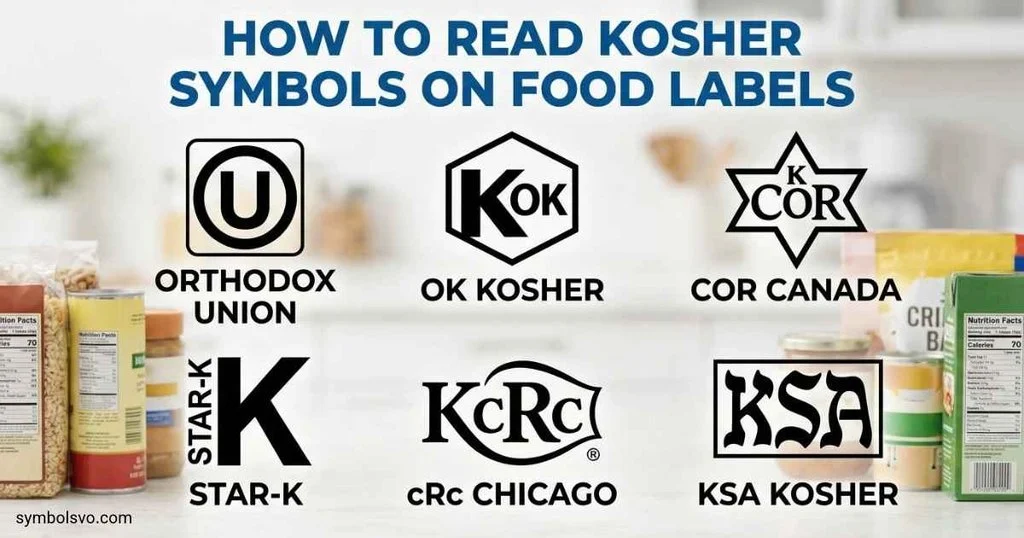
Recognizing a logo is only the first step. You also need to understand what the designation applies to and whether it matches your requirements.
Find the Complete Certification Mark
Look at the front, back, or side of the package. Kosher marks often appear near the ingredient panel or other product information.
Check the complete logo rather than focusing only on a single letter.
A circled U and a circled K, for example, are different marks associated with different certification organizations.
Read Any Additional Letters
Letters beside a symbol can indicate dairy, meat, pareve, fish, or Passover status.
Consider these examples:
- OU: Generally pareve under OU’s system.
- OU-D: Dairy or dairy-equipment status.
- OU-P: Passover certification.
- OK-DE: Dairy-equipment status under OK Kosher’s system.
Don’t interpret a letter without considering the full logo. The same letter can have different meanings in other contexts.
Check the Exact Product
A certification mark on one product doesn’t automatically establish the status of every item sold under the same brand.
Manufacturers may produce different flavors, recipes, or product varieties using different ingredients or facilities. Certification may also cover some products but not others.
When in doubt, search the certifier’s official product directory or contact the organization.
Check Passover Certification Separately
If you need food suitable for Passover, look for a relevant Passover designation.
Regular kosher certification doesn’t automatically mean a product meets the additional requirements of Pesach. Some ingredients and production processes need special consideration during this holiday.
Use This Quick Shopping Checklist
Before choosing a product, ask yourself:
- Can I identify the full certification logo?
- Do I understand the letters beside it?
- Does the certification cover this exact product?
- Do I need an additional designation, such as Passover or Cholov Yisroel?
- Have I checked the ingredient and allergen information relevant to my needs?
- If something is unclear, can I verify it with the certifier?
These simple steps can help you interpret kosher food symbols without making assumptions based on a single letter.
Are All Kosher Symbols Reliable?
Not every mark that looks like a kosher symbol communicates the same thing. Before relying on an unfamiliar logo, identify the organization behind it and check the product’s certification status.
What Makes a Kosher Symbol Trustworthy?
A useful starting point is whether the mark belongs to an identifiable certification organization with clear information about its standards and certified products.
Look for these signs:
- The certifier identifies itself clearly.
- The organization explains its certification process.
- Consumers can find information about certified products.
- The mark corresponds to the actual product and its current certification status.
- The organization provides a way to ask questions or resolve concerns.
These checks help you establish what a symbol represents. They don’t require you to assume that one organization is always better than another.
Does a K on a Package Mean the Product Is Kosher-Certified?
Not necessarily. A standalone K doesn’t always tell you which organization, if any, is responsible for the certification.
Some certification marks use a K inside a distinctive shape. Others may display a letter without an immediately obvious organization name.
If you cannot identify the mark, check the manufacturer’s product information or contact the relevant organization. Don’t treat every K as invalid, but don’t assume that all K marks mean the same thing.
Can Kosher Symbols Be Used Incorrectly?
Yes. Labels can sometimes be outdated, unauthorized, or applied incorrectly. Certification organizations may publish alerts when they identify a problem with a particular product or mark.
For example, Star-K maintains consumer information and kosher alerts on its website. Such resources can help consumers investigate specific concerns.
However, an unfamiliar symbol alone isn’t evidence of a problem. Verification is more useful than guessing.
Kosher Symbols vs. Other Food Labels
Food packages often display several labels at once. Although these claims can overlap, they answer different questions.
| Label | What it generally indicates | What it doesn’t automatically guarantee |
| Kosher-certified | Certification under a kosher authority’s standards | Vegan status or improved nutrition |
| Pareve | Neither meat nor dairy under kosher classification | That the product contains no animal-derived ingredients |
| Dairy-free | A claim about dairy content under the applicable labeling rules | Kosher certification |
| Vegan | No animal-derived ingredients according to the claim’s intended meaning | Kosher certification |
| Organic | Compliance with applicable organic standards | Kosher certification |
| Gluten-free | Compliance with applicable gluten-free requirements | Kosher certification |
| Kosher for Passover | Suitability under applicable Passover certification requirements | Acceptance under every community’s customs |
For example, a vegan snack might contain ingredients that require further kosher review. Conversely, a kosher pareve product might contain eggs, which means it isn’t vegan.
The key difference is simple: each label serves a particular purpose. If you follow kosher dietary laws and also have an allergy or other dietary restriction, check each relevant label separately.
What Is Kosher Certification and How Does It Work?
Kosher certification is a process in which a certification organization evaluates whether a product and its production arrangements meet applicable kosher requirements.
The process can be straightforward for some products and more involved for others. A packaged food with multiple ingredients, complex manufacturing steps, and shared production equipment may require extensive review.
What Is a Hechsher?
A hechsher is a term commonly used for kosher approval or certification. On food packaging, it often refers to the certification mark that identifies the supervising organization.
The mark helps consumers connect a product with the organization responsible for its kosher status.
What Do Kosher Certification Organizations Check?
The exact process depends on the product and the certifier. Reviews may include:
- Ingredients: Whether each ingredient meets kosher requirements.
- Suppliers: Whether raw materials come from acceptable sources.
- Equipment: Whether production machinery meets relevant kosher requirements.
- Manufacturing: Whether production methods follow the required standards.
- Documentation: Whether ingredient lists and production records support the certification.
- Labeling: Whether the correct symbol and designation appear on the approved product.
- Ongoing supervision: Whether the manufacturer continues to meet certification conditions.
These checks help explain why a food’s ingredient list alone may not establish its kosher status.
Which Organizations Provide Kosher Certification?
Several organizations certify products and food establishments. Examples include:
- Orthodox Union (OU Kosher).
- OK Kosher Certification.
- STAR-K Kosher Certification.
- Kof-K.
- Chicago Rabbinical Council (cRc).
Each organization has its own marks and published guidance. Consumers should use the relevant organization’s information when checking a particular product.
How Can a Food Manufacturer Get Kosher Certification?
Manufacturers typically begin by contacting a certification agency and submitting details about their products, ingredients, suppliers, and facilities.
The agency reviews the information and may inspect the production site. If the company meets the applicable requirements, the parties establish the terms of certification and the manufacturer receives authorization to use the approved mark.
Ongoing supervision may include periodic visits and reviews of ingredients, production, and labeling. STAR-K outlines these steps in its kosher certification process guide.
How Much Does Kosher Certification Cost?
There isn’t one universal price for kosher certification. Fees depend on factors such as the certification organization, the number of products, manufacturing complexity, facility inspections, and ongoing supervision requirements.
Businesses should request a quote directly from their chosen certifier rather than relying on a generic online estimate.
For consumers, the more relevant question is whether the exact product has valid certification and whether its designation meets their needs.
What Does Kosher for Passover Mean?
Kosher for Passover means that a product meets additional dietary requirements associated with the Jewish holiday of Passover, also called Pesach.
These requirements go beyond ordinary year-round kosher certification. Certain grain products and their derivatives require special attention, and community customs may differ.
How Is Passover Certification Different From Regular Kosher Certification?
Year-round kosher certification establishes a product’s status under the relevant kosher rules. Passover certification addresses additional holiday-specific requirements.
Manufacturers may need to review ingredients, suppliers, equipment, and production procedures before a product can receive the appropriate Passover designation.
Are All Kosher Products Suitable for Passover?
No. A product can be kosher throughout the year without being certified for Passover.
For example, a cereal might carry a regular kosher symbol but lack the additional certification required by a consumer who observes Passover dietary restrictions.
If you need Passover-certified food, check the exact product and its certification rather than assuming that an ordinary kosher mark is sufficient.
Do Passover Requirements Differ Among Jewish Communities?
Yes. Jewish communities can follow different customs regarding certain foods during Passover. One example is kitniyot, a category that includes certain legumes and seeds.
Some communities avoid kitniyot during Passover, while others permit them under their traditions. Therefore, a Passover designation doesn’t automatically resolve every community-specific dietary question.
When a particular custom matters, consult the relevant certification guidance or a trusted religious authority.
Common Misconceptions About Kosher Symbols
A few misunderstandings can make kosher labels more confusing than they need to be.
- Every K means the same thing. Different organizations use different marks, so identify the issuing authority.
- All kosher food is vegetarian. Kosher certification can cover meat, poultry, fish, dairy, and pareve products.
- Pareve means vegan. Pareve products may include eggs or kosher fish.
- Dairy-free means pareve. A dairy-free claim doesn’t establish kosher classification or certification.
- Every kosher product is suitable for Passover. Passover requirements involve additional considerations.
- Kosher certification guarantees better nutrition. Kosher status addresses religious dietary requirements, not a product’s overall nutritional quality.
- Every certification agency uses the same symbols. Organizations have their own marks and designation systems.
Knowing these distinctions makes it easier to interpret packaging accurately and avoid assumptions.
Frequently Asked Questions About Kosher Symbols
What are kosher symbols?
Kosher symbols are marks that identify certification or supervision by a kosher authority. They help consumers recognize products that have been reviewed under a particular organization’s standards.
What is the most common kosher symbol?
The OU symbol is one of the most widely recognized kosher certification marks, particularly in the United States. However, recognition varies by region and market.
What does OU mean on food?
The OU mark identifies certification by Orthodox Union Kosher. Its standard designation generally indicates pareve status under OU’s system.
What does OU-D mean?
OU-D indicates dairy or dairy-equipment status under the Orthodox Union’s certification rules. Check the ingredient and allergen information separately if you need to know whether the product contains milk.
What does OU-P mean?
OU-P indicates that a product is certified for Passover under the Orthodox Union’s system. It shouldn’t be confused with the ordinary OU designation.
What does OK mean on food packaging?
The OK symbol identifies certification associated with OK Kosher. Additional letters can indicate dairy, meat, dairy equipment, fish, or Passover status.
What does Star-K mean?
Star-K identifies certification associated with STAR-K Kosher Certification. The organization provides kosher supervision and information about certified products.
Does a K symbol mean food is kosher?
A K alone may not identify the organization responsible for certification. Check the complete mark and verify the product when necessary.
What is a hechsher?
A hechsher is a term for kosher approval or certification. It commonly refers to the symbol identifying the certifying organization on a food package.
What does pareve mean?
Pareve means neither meat nor dairy under kosher classification. Many fruits, vegetables, grains, and other foods are pareve, but the classification doesn’t automatically mean vegan.
Are all kosher symbols the same?
No. Different organizations use different logos, and accompanying letters may indicate different product classifications. Interpret each mark according to its issuing organization.
How can I check whether a product is kosher?
Identify the complete certification mark, read its designation, and check the certifier’s official product directory or contact the organization if something is unclear.
Is kosher food automatically suitable for Passover?
No. A product needs the appropriate Passover certification or confirmation that it meets the requirements relevant to your practice.
Are kosher symbols the same as halal symbols?
No. Kosher and halal are distinct religious dietary systems with different rules and certification marks. A product’s status under one system doesn’t automatically establish its status under the other.
Final Thoughts on Kosher Symbols
Understanding kosher symbols doesn’t require memorizing every certification logo on the market. Start with the major marks, learn what their accompanying letters mean, and verify unfamiliar designations through the relevant organization.
The OU, OK, and Star-K symbols are useful starting points because their published guidance explains their certification systems. Once you understand the difference between dairy, dairy equipment, meat, pareve, and Passover designations, food labels become much easier to interpret.
Most importantly, don’t judge a product by a single letter or by its ingredients alone. Check the complete symbol, confirm the product’s certification, and follow the requirements that apply to your dietary practice.That simple approach gives you a clearer understanding of kosher food labels and helps you make informed choices when shopping.

Mason Ellington is a creative and dedicated Content Writer and Symbols Expert with a passion for words, communication, and symbolic meanings. He specializes in crafting engaging, informative, and well-structured content while exploring the deeper meanings and interpretations behind symbols. With a creative mindset and attention to detail, Mason transforms ideas into meaningful content that informs, inspires, and connects with readers. His expertise combines powerful storytelling, clear communication, and a deep understanding of symbolism.
 Nathan Holloway
 Daniel Brooks