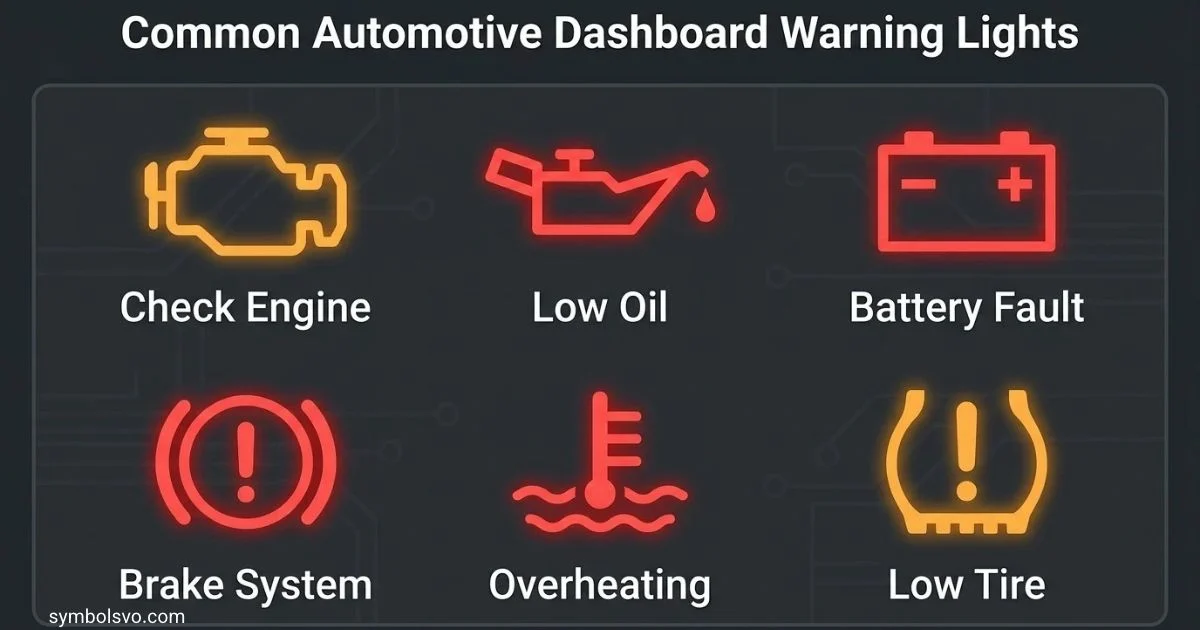
A strange light on your dashboard can turn an ordinary drive into a guessing game. One symbol might tell you that your headlights are on. Another could warn you about low oil pressure, overheating, or a problem with your brakes.
Understanding car dashboard symbols helps you recognize these messages and respond before a small issue becomes a costly repair. However, not every warning means the same thing across different vehicles. Your car’s make, model, year, and owner’s manual all matter.
This guide explains the most common car dashboard symbols and meanings, including engine warnings, battery alerts, brake indicators, tire pressure lights, diesel symbols, and hybrid vehicle warnings. You’ll also learn which warning lights require you to stop, when you may be able to continue driving, and how to identify an unfamiliar symbol.
What Do Car Dashboard Symbols Mean?
Car dashboard symbols are visual indicators that communicate information about your vehicle’s condition and operating systems. You’ll usually find them in the instrument cluster behind the steering wheel or on a central dashboard display.
Some indicators show that a feature is active. Others alert you to a fault, a maintenance need, or a potentially dangerous condition.
For example, a green turn signal indicator confirms that your turn signal is operating. A red oil pressure warning, on the other hand, can indicate that the engine isn’t receiving adequate lubrication.
Most dashboard indicators fall into three main categories:
- Warning lights: Alert you to a possible fault or unsafe condition.
- Status indicators: Show that a vehicle feature, such as high-beam headlights or cruise control, is active.
- Maintenance reminders: Tell you that scheduled servicing or a routine check may be due.
Modern vehicles may also display a written message alongside a warning icon. When that happens, read the message carefully because it may provide more specific instructions than the symbol alone.
What Do Dashboard Warning Light Colors Mean?
The color of a dashboard light offers an important clue about its meaning. However, you shouldn’t rely on color alone to decide whether driving is safe.
Red Dashboard Warning Lights
Red dashboard warning lights often indicate a serious condition that needs immediate attention. Depending on the symbol, you may need to stop driving as soon as you can do so safely.
Common examples include:
- Oil pressure warning light
- Engine temperature warning light
- Serious brake system warning
- Certain charging-system or steering-system warnings
If the red oil pressure light stays on while the engine is running, pull over safely and switch off the engine. Continuing to drive with inadequate oil pressure can cause severe engine damage.
Similarly, if the engine temperature warning indicates overheating, stop safely and turn off the engine. Never open a hot radiator or coolant reservoir because pressurized coolant can cause serious burns.
Amber or Yellow Dashboard Warning Lights
Amber warning lights and yellow dashboard symbols usually indicate a fault, maintenance need, or system condition that requires attention.
Common examples include:
- Check engine light
- ABS warning light
- Tire pressure monitoring system (TPMS) warning
- Traction control system fault
- Diesel particulate filter warning on equipped vehicles
An amber light doesn’t automatically mean you can continue driving without concern. A steady check engine light may allow you to arrange a prompt diagnostic check if the car behaves normally. A flashing check engine light or a warning accompanied by severe engine problems requires a more urgent response.
Always check the symbol’s specific instructions before deciding what to do.
Green Dashboard Lights
Green dashboard lights usually indicate that a feature is operating or switched on. They generally don’t signal a fault.
Examples include:
- Turn signal indicators
- Low-beam headlight indicators on equipped vehicles
- Cruise control status indicators
- Some active driving-assistance indicators
A green indicator normally needs no action beyond using the feature appropriately.
Blue and White Dashboard Symbols
Blue and white indicators generally provide information about vehicle operation or system status.
A familiar example is the blue high-beam headlight indicator. It tells you that your high-beam headlights are active, so you should switch to low beams when appropriate for oncoming traffic and road conditions.
Some vehicles also use a blue engine temperature indicator to show that the engine is cold. This isn’t necessarily a fault. It means you should follow the manufacturer’s guidance while the engine warms up.
What Does a Flashing Dashboard Warning Light Mean?
A flashing light can indicate a more urgent condition than a steady light, but its meaning depends on the system.
For example:
- A flashing check engine light can indicate an engine misfire that may damage the catalytic converter.
- A flashing traction control light may indicate that the system is actively helping the vehicle maintain grip.
- A flashing TPMS light followed by a steady light can indicate a tire pressure monitoring system fault on many vehicles.
- A flashing turn signal indicator is usually part of normal operation, although an unusually rapid flash may indicate a failed turn signal bulb.
The key is to identify the symbol and understand how that particular system uses flashing signals.
Car Dashboard Symbols and Meanings: Common Warning Lights Explained
The following reference covers the most important car warning lights, their possible causes, and the steps you should take when they appear. Symbol shapes and colors can vary by vehicle, so use the descriptions as a guide rather than a substitute for your owner’s manual.
Check Engine Light
The check engine light usually looks like the outline of an engine. It’s also called the engine management light or malfunction indicator lamp (MIL).
This warning tells you that the engine management or emissions control system has detected a problem. It doesn’t identify the failed part by itself.
Possible causes include:
- A loose or damaged fuel cap on vehicles that monitor fuel vapor leaks
- A faulty oxygen sensor
- A mass airflow sensor problem
- An ignition system fault or engine misfire
- An emissions control issue
- A catalytic converter problem
What should you do?
If the light stays on steadily and the car runs normally, arrange a diagnostic check soon and follow your owner’s manual. If it flashes, or the engine shakes, loses power, or makes unusual noises, reduce the risk of further damage and stop safely when necessary.
A mechanic can use an OBD-II diagnostic scanner on supported vehicles to retrieve diagnostic trouble codes. Those codes help narrow down the cause, but additional testing may still be necessary.
Engine Oil Pressure Warning Light
The oil pressure warning light typically resembles an oil can with a droplet. It indicates that engine oil pressure may be too low.
Your engine depends on circulating oil to lubricate moving parts and limit friction. When oil pressure drops too far, internal components can suffer serious damage in a short time.
Possible causes include:
- Insufficient engine oil
- An oil leak
- A failing oil pump
- A blocked oil pickup or filter
- Internal engine wear
What should you do?
- Pull over as soon as it’s safe.
- Switch off the engine.
- Once the vehicle is parked safely, check the oil level according to the owner’s manual.
- If the level is low, add the correct oil only if it’s safe and appropriate to do so.
- If the warning remains on, don’t continue driving. Arrange professional assistance.
Remember that low oil pressure and low oil level aren’t the same thing. Even when the oil level looks normal, the engine may have a pressure problem.
Battery Warning Light
The battery warning light usually looks like a small battery with positive and negative terminals. It often indicates a problem with the vehicle’s charging system.
Although drivers commonly call it the battery light, the problem may involve the alternator, drive belt, electrical connections, or another charging-system component.
Possible causes include:
- Alternator failure
- A damaged or loose alternator belt
- Faulty electrical connections
- Battery or charging-system problems
What should you do?
If the light appears while driving and remains illuminated, head to a safe stopping place and follow the vehicle’s instructions. Electrical systems may stop working properly as the available battery charge decreases.
Don’t assume that replacing the battery will solve the problem. A mechanic should inspect the charging system to identify the actual fault.
Engine Temperature Warning Light
The engine temperature warning light often shows a thermometer above wavy lines. It indicates that the engine coolant temperature is too high or that the cooling system has detected a related problem.
An overheating engine can suffer damage to its cylinder head, head gasket, and other internal components.
Possible causes include:
- Low engine coolant
- A coolant leak
- A faulty thermostat
- Radiator or cooling fan problems
- A failing water pump
- A cooling-system sensor fault
What should you do?
Stop somewhere safe and switch off the engine if the warning indicates overheating. Let the engine cool before checking anything under the hood.
Never remove a hot coolant cap. If you see leaking coolant, steam, or repeated overheating, arrange professional assistance rather than continuing the journey.
Brake System Warning Light
The brake warning light may appear as an exclamation mark inside a circle, sometimes with curved brackets around it or the word BRAKE.
Depending on the vehicle, it may indicate that the parking brake is engaged, the brake fluid level is low, or the braking system has detected a fault.
Possible causes include:
- The parking brake is still applied
- Low brake fluid
- A brake fluid leak
- A hydraulic braking-system problem
- An electronic brake system fault
What should you do?
First, make sure the parking brake is fully released when it’s safe to check. If the light remains on, check the vehicle manual.
If the brake pedal feels soft, sinks unusually, or braking performance changes, stop safely and don’t continue driving. A brake warning can indicate a condition that affects your ability to stop.
ABS Warning Light
The ABS warning light usually displays the letters ABS inside a circle. ABS stands for anti-lock braking system.
This system helps prevent the wheels from locking during hard braking, allowing the driver to maintain more steering control under suitable conditions.
An illuminated ABS warning may indicate:
- A faulty wheel-speed sensor
- Damaged wiring
- A problem with the ABS control module
- A fault in the hydraulic control system
When the ABS warning stays on, conventional braking may still work, but the anti-lock function may be unavailable. The exact response depends on the fault.
If the ABS light appears with the red brake warning light, or braking feels abnormal, stop safely and seek assistance. Otherwise, arrange prompt inspection and drive only if the vehicle remains safe to control.
Tire Pressure Warning Light
The tire pressure warning light, also called the TPMS warning light, resembles a horseshoe-shaped tire with an exclamation mark.
It generally means that one or more tires have significantly low pressure. On some vehicles, a flashing light followed by steady illumination indicates a monitoring-system fault.
Low tire pressure can affect handling, braking, tire wear, and fuel economy. Severely underinflated tires may also overheat.
What should you do?
- Check all tires when it’s safe to do so.
- Measure tire pressure with a reliable gauge.
- Inflate the tires to the pressure specified on the driver’s door-jamb label or in the owner’s manual.
- Inspect for punctures or visible damage.
- Seek professional help if a tire is damaged or loses pressure again.
Don’t rely on appearance alone. A tire can be underinflated without looking obviously flat.
In the United States, passenger cars and light vehicles from model year 2008 onward are generally required to have a tire pressure monitoring system, subject to applicable vehicle standards and exceptions.
Airbag Warning Light
The airbag warning light may show a seated person with a circle in front of them. It can also appear as an SRS indicator.
SRS stands for supplemental restraint system. Depending on the vehicle, the system may include airbags, seat belt pretensioners, sensors, and electronic controls.
Possible causes include:
- An airbag sensor fault
- A wiring or connector problem
- A seat belt pretensioner fault
- A malfunction in the restraint-system control module
If the warning remains illuminated after the normal startup check, arrange a qualified inspection. The system may not protect occupants as intended in a crash.
Don’t try to repair airbag wiring or connectors yourself. Restraint systems contain components that require specialized handling.
Power Steering Warning Light
The power steering warning light usually shows a steering wheel beside an exclamation mark.
It indicates a possible problem with the system that helps you turn the steering wheel. Many newer vehicles use electric power steering, while some older or specialized vehicles use hydraulic assistance.
Possible causes include:
- An electric power steering fault
- A sensor or wiring problem
- A charging-system issue
- Low power steering fluid in applicable hydraulic systems
- A hydraulic pump or belt problem
If steering becomes unexpectedly heavy or difficult, slow down carefully and stop somewhere safe. Don’t continue driving if you can’t reliably control the vehicle.
Traction Control and Electronic Stability Control Lights
The traction control light and electronic stability control (ESC) indicator often show a car with wavy lines beneath it.
Traction control helps reduce wheelspin. Stability control helps the driver maintain the intended direction when the vehicle begins to lose stability.
The light’s behavior matters:
- Flashing: The system may be actively responding to wheelspin or loss of traction.
- Steady: The system may be switched off or have detected a fault, depending on the vehicle.
If the warning remains on, check the owner’s manual and arrange inspection when necessary. If it flashes during slippery conditions, ease off the accelerator and make smooth steering inputs.
Avoid sudden braking or sharp steering movements when traction is limited.
Diesel Particulate Filter Warning Light
The diesel particulate filter (DPF) warning light appears on many diesel vehicles. The DPF traps soot from exhaust gases to help reduce particulate emissions.
Over time, the filter accumulates soot. The vehicle normally burns off much of that soot through a process called DPF regeneration.
Short trips, frequent stop-and-go driving, and interrupted regeneration can contribute to soot buildup on some vehicles.
What you should do depends on the warning:
- Read the dashboard message.
- Follow the manufacturer’s regeneration instructions if the manual permits them.
- Don’t attempt a regeneration procedure if the vehicle shows a critical fault or the instructions prohibit it.
- Arrange professional diagnosis if the warning persists or returns repeatedly.
Never assume that every DPF light can be fixed by driving at a particular speed. Regeneration procedures vary by model, and some faults require workshop attention.
Glow Plug Warning Light
The glow plug warning light usually resembles a small coil. It appears on many diesel engines and indicates the glow plug system’s status.
Glow plugs help heat the combustion chambers during cold starts. On many vehicles, the light illuminates briefly before starting and then switches off when the engine is ready.
If it stays on or flashes while driving, it may indicate a glow plug or engine-management fault.
Follow the vehicle’s starting instructions. If the light behaves abnormally or the engine runs poorly, arrange a diagnostic check.
AdBlue or Diesel Exhaust Fluid Warning Light
The AdBlue warning light appears on many diesel vehicles equipped with selective catalytic reduction (SCR) emissions systems.
AdBlue is a fluid used to reduce nitrogen oxide emissions. In the United States, a similar product is commonly called diesel exhaust fluid (DEF).
The warning may indicate:
- Low exhaust fluid
- Incorrect or contaminated fluid
- An SCR system malfunction
- A fault that may eventually prevent the engine from restarting after shutdown
Check the displayed message and refill with the specified fluid if required. If the warning indicates a system fault, arrange professional diagnosis.
Don’t ignore a low-fluid countdown. Some vehicles restrict restarting after the remaining permitted distance or operating cycles expire.
Transmission or Gearbox Warning Light
A transmission warning may show a gear symbol, a temperature indicator, or a message on the instrument display.
It can indicate a transmission fault, excessive transmission temperature, or an issue with the gearbox control system.
If the vehicle loses drive, shifts harshly, or displays an overheating warning, stop safely and follow the owner’s manual. Continued operation under severe transmission faults can increase damage.
A diagnostic scan using equipment compatible with the transmission system may be needed.
Low Fuel Warning Light
The low fuel warning light usually resembles a fuel pump. It means the remaining fuel has reached a low threshold.
The distance you can travel after the light appears depends on the vehicle, driving conditions, traffic, terrain, and fuel consumption. The remaining range is an estimate rather than a guarantee.
Refuel as soon as practical. Running extremely low on fuel can also cause drivability problems on some vehicles.
Seat Belt Warning Light
The seat belt warning light usually shows a seated person wearing a belt.
It reminds the driver or passenger to fasten a seat belt. Some vehicles also use sensors to detect an occupied passenger seat.
Fasten seat belts before moving. If the warning continues despite all occupants being buckled, check the manual or arrange inspection because a sensor or buckle switch may be faulty.
Parking Brake and Electronic Parking Brake Warning
A parking brake indicator may show the letter P inside a circle, the word BRAKE, or a symbol representing an electronic parking brake.
The indicator may illuminate normally when the parking brake is engaged. If it flashes or remains on after release, the vehicle may have detected a fault.
Follow the vehicle’s instructions and don’t drive away until you’re sure the parking brake has released properly.
Fuel Cap or Emissions System Warning
Some vehicles use the check engine light or a separate message to indicate a fuel cap that isn’t sealed properly.
A loose or damaged cap can allow fuel vapors to escape and trigger an evaporative emissions fault.
If the manual identifies the fuel cap as a possible cause, check that it is fitted correctly. If the warning persists, a diagnostic check may be needed.
Service or Maintenance Reminder
A service reminder may appear as a wrench, spanner, or maintenance message.
It usually indicates that scheduled maintenance is due based on mileage, time, or a vehicle’s service-monitoring system. It doesn’t necessarily mean that a mechanical fault has occurred.
Check the service schedule and arrange the required maintenance. Don’t confuse a routine service reminder with a red oil pressure or engine temperature warning.
Windshield Washer Fluid Warning
This symbol may show a windshield with spray marks. It means the washer fluid level is low on vehicles equipped with this indicator.
Refill the reservoir with suitable washer fluid according to the owner’s manual. Keeping the windshield clean helps maintain visibility, especially when road spray, dust, or insects build up.
Hybrid and Electric Vehicle Warning Symbols
Hybrid and electric vehicles use many familiar dashboard lights, but they also have additional indicators for high-voltage batteries, electric drive systems, and charging.
Common examples include:
- EV-ready indicator: The vehicle is ready to move even if the engine is silent.
- High-voltage battery warning: The battery or associated system may need attention.
- Hybrid system warning: A fault may affect the hybrid powertrain.
- Charging indicator: Shows charging status or a charging-system problem.
- Regenerative braking indicator: Displays energy recovery when the system supports it.
Treat critical high-voltage warnings according to the vehicle’s instructions. Never touch orange high-voltage cables or attempt to repair the battery system yourself.
Quick Reference: Common Car Dashboard Symbols and Meanings
Use this table to identify common dashboard warning icons and understand their typical meaning at a glance.
| Dashboard symbol or label | Typical meaning | Common color | Recommended action |
| Engine outline | Engine or emissions fault | Amber | Arrange a diagnostic check |
| Oil can | Low engine oil pressure | Red | Stop safely and switch off the engine |
| Battery | Charging-system fault | Red | Stop safely and arrange assistance if needed |
| Thermometer over waves | Engine overheating | Red | Stop safely and switch off the engine |
| BRAKE or circle with exclamation mark | Parking brake or brake-system warning | Red or amber | Check the manual; stop if braking may be unsafe |
| ABS | Anti-lock braking system fault | Amber | Arrange inspection |
| Tire-shaped symbol with exclamation mark | Low tire pressure or TPMS issue | Amber | Check tire pressures promptly |
| Person with a circle in front | Airbag or restraint-system warning | Red or amber | Arrange a qualified safety-system inspection |
| Car with wavy lines | Traction or stability control | Amber | Determine whether the system is active or faulty |
| Steering wheel with exclamation mark | Steering assistance fault | Red or amber | Stop if steering control is affected |
| Fuel pump | Low fuel | Amber | Refuel soon |
| Coil-shaped symbol | Diesel glow plug system | Amber | Follow the starting instructions |
| DPF or filter-shaped icon | Diesel particulate filter warning | Amber | Follow model-specific instructions |
| Wrench or spanner | Service reminder | Varies | Check the maintenance schedule |
| Windshield with spray | Low washer fluid | Varies | Refill the reservoir |
| Seat belt symbol | Seat belt not fastened | Red | Fasten the seat belt |
Note: This is a general reference, not a universal symbol chart. Icon designs, colors, and required actions vary by manufacturer and model. Always confirm unfamiliar symbols in the owner’s manual.
What Should You Do When a Dashboard Warning Light Comes On?
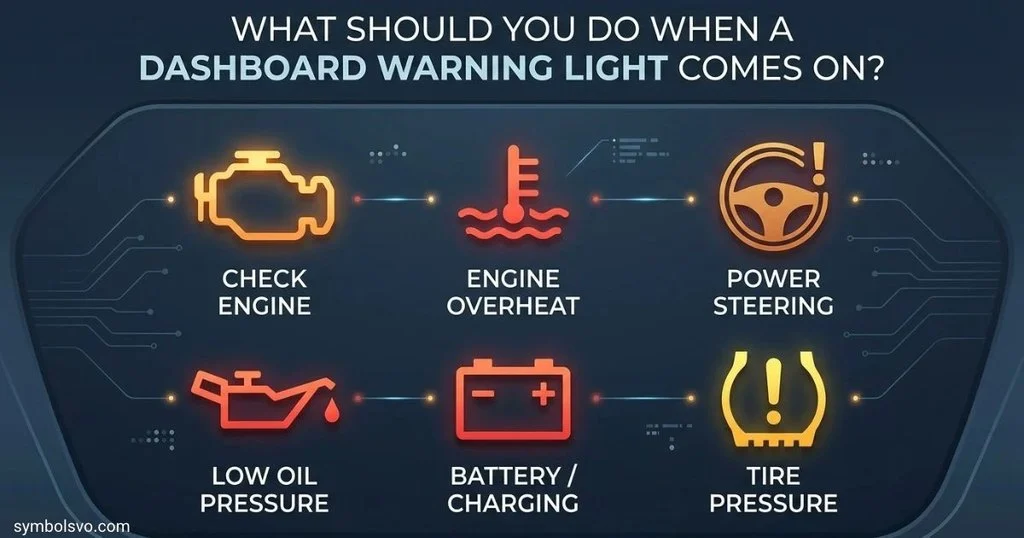
Seeing a warning light doesn’t always mean your car is about to break down. However, responding correctly can prevent further damage and help keep you safe.
Identify the Symbol and Read the Message
Start by checking the icon, color, and any accompanying message on the instrument cluster.
Ask yourself:
- Is the light red, amber, green, blue, or another color?
- Is it flashing or steady?
- Did it appear when starting the car or while driving?
- Are there unusual noises, smells, vibrations, or changes in performance?
The answers help you understand the situation, but they don’t replace the manufacturer’s instructions.
Decide Whether to Stop Driving
Some warnings require you to stop safely as soon as possible. Others allow you to arrange a prompt inspection if the vehicle remains safe to operate.
Stop safely and switch off the engine when instructed, especially if you see an oil pressure or overheating warning.
Also stop if the brakes behave abnormally, steering becomes difficult, or the vehicle develops serious mechanical symptoms. If you can’t safely continue, contact roadside assistance.
Check Only What You Can Check Safely
Once parked in a safe location, you may be able to perform simple checks.
- Check the engine oil level using the procedure in the owner’s manual.
- Inspect tire pressures with a suitable gauge.
- Look for visible fluid leaks without touching hot components.
- Confirm that the parking brake is released when appropriate.
- Read the dashboard message and follow its instructions.
Never open a hot coolant reservoir, reach into moving engine components, or attempt to handle high-voltage electrical parts.
Arrange a Diagnostic Check
If a warning remains on, returns repeatedly, or indicates a system fault, arrange an inspection.
A mechanic may use a diagnostic scanner to retrieve diagnostic trouble codes (DTCs). These codes provide useful clues about the affected system, but they don’t always identify the failed component.
For example, an oxygen sensor-related code doesn’t automatically prove that the sensor itself is defective. Wiring, exhaust leaks, or other engine problems may produce related symptoms.
A proper diagnosis combines fault codes with testing and inspection.
Can You Drive With a Dashboard Warning Light On?
The answer depends on the warning, the vehicle, and how the car behaves. Color provides a useful clue, but the specific symbol and manufacturer’s instructions matter more.
| Warning or condition | General guidance |
| Red oil pressure warning | Stop safely and switch off the engine |
| Engine overheating warning | Stop safely and shut off the engine |
| Red brake warning with abnormal braking | Stop safely; don’t continue driving |
| Flashing check engine light | Reduce risk and stop safely when necessary; urgent inspection is needed |
| Steady check engine light with normal operation | Arrange prompt diagnosis and follow the owner’s manual |
| Amber ABS warning with normal braking | Arrange inspection; the anti-lock function may be unavailable |
| Low tire pressure warning | Check pressure promptly; stop if a tire appears damaged or handling changes |
| Green turn signal indicator | Normal operation when signaling |
| Maintenance reminder | Follow the service schedule unless another warning indicates urgency |
These are general guidelines rather than permission to drive with a particular fault. If the manual tells you to stop, follow that instruction.
Which Dashboard Warning Lights Are Most Serious?
The most urgent warnings are those that indicate a risk to engine operation, braking, steering, or another essential safety system.
Pay particular attention to:
- Oil pressure warning: Continued operation can cause severe engine damage.
- Engine overheating warning: Excessive heat can damage major engine components.
- Brake-system warning: A fault may reduce braking performance.
- Steering-system warning: Steering assistance may be reduced or lost.
- High-voltage system warning: Certain faults require the vehicle to stop and receive specialized attention.
An unfamiliar warning can also be serious. When you can’t identify it, consult the manual and avoid guessing.
Why Do Dashboard Warning Lights Come On?
Dashboard warning lights illuminate when a vehicle detects a condition that needs attention. Some problems develop gradually, while others appear suddenly because a component has failed.
Understanding the common causes can help you explain the problem to a mechanic and avoid unnecessary guesswork.
Mechanical Problems
Mechanical faults affect the engine, transmission, brakes, cooling system, or other moving parts.
Examples include:
- Low engine oil pressure
- Coolant leaks and overheating
- Worn brake pads
- Transmission overheating
- Damaged belts or failing pumps
Regular maintenance can reduce some of these risks, but it can’t prevent every mechanical failure.
Electrical Problems
Modern vehicles depend on electrical power for starting, engine management, lighting, sensors, and safety systems.
A charging-system warning may result from an alternator fault, damaged wiring, or a loose connection. Battery problems can also affect some electronic systems.
If several unrelated warning lights appear together, an electrical or charging-system problem is one possible explanation. However, the combination alone doesn’t prove the cause.
Sensor and Electronic Control Faults
Vehicles use sensors to monitor engine operation, wheel speed, tire pressure, temperature, and other conditions.
A faulty sensor can trigger a warning even when the related mechanical component appears normal.
Examples include:
- Oxygen sensor faults
- ABS wheel-speed sensor problems
- Tire pressure monitoring system faults
- Coolant temperature sensor problems
- Engine control system faults
A diagnostic scan can help narrow down the issue. Further testing is often necessary to confirm the cause.
Maintenance Needs and Normal Operation
Not every dashboard indicator signals a malfunction.
Some lights illuminate briefly when you switch on the ignition. This startup check allows you to see whether the indicators are functioning.
Other messages remind you to change the oil, replace a filter, refill washer fluid, or schedule routine servicing.
The important distinction is between a normal status indicator, a maintenance reminder, and an active fault warning.
How to Identify an Unfamiliar Dashboard Symbol
If a symbol doesn’t look familiar, don’t guess based on its shape alone. Several indicators look similar but communicate different conditions.
Check Your Vehicle’s Owner’s Manual
The owner’s manual is usually the best starting point because it identifies the symbols used in your specific vehicle.
Look for the warning lights, instrument cluster, or dashboard indicators section. The manual should explain the symbol’s meaning and recommended response.
If your vehicle displays a written message, check that too.
Search by Car Make, Model, and Year
When looking for additional information, include the vehicle’s exact make, model, and model year.
For example, searching for a dashboard warning on a 2024 Toyota Corolla is more useful than searching only for a Toyota dashboard symbol.
Also specify whether the vehicle has a gasoline engine, diesel engine, hybrid system, or electric powertrain. These differences can affect the symbols displayed.
Use official manufacturer information whenever possible.
Use a Diagnostic Scanner When Appropriate
An OBD-II scanner can retrieve engine and emissions-related trouble codes on supported vehicles. More advanced equipment may be required to access ABS, airbag, transmission, hybrid, or other system codes.
A scanner is a diagnostic tool, not a universal repair solution.
It may identify a system or circuit that needs attention, but a mechanic may need to inspect wiring, test components, or perform additional measurements before recommending repairs.
How to Reset Car Dashboard Warning Lights
You shouldn’t reset a warning light simply because you want it to disappear. First determine why it appeared.
When Do Dashboard Warning Lights Turn Off Automatically?
Some indicators switch off when the underlying condition ends.
For example, a turn signal indicator stops flashing when the signal is canceled. A tire pressure warning may disappear after you correct the pressure and the monitoring system confirms the change.
Other warnings remain illuminated until the fault is repaired or the system completes its required checks.
A light going out doesn’t always mean the underlying issue has been resolved.
Can You Reset a Warning Light Without Fixing the Problem?
Some diagnostic tools can clear stored fault codes, but clearing a code doesn’t repair a failed component.
If the fault remains, the warning may return. Clearing codes can also erase useful diagnostic information that helps a mechanic investigate the problem.
Never use a reset as a substitute for addressing a critical warning.
How Do You Reset a Maintenance Reminder?
The procedure varies by vehicle. Some models let you reset a service reminder through the dashboard menu, while others require a particular sequence of controls or a compatible diagnostic tool.
Follow the instructions for your exact model and reset the reminder only after completing the required maintenance.
A service reminder reset is different from clearing an active engine, brake, or safety-system fault.
How to Prevent Dashboard Warning Lights and Vehicle Problems
You can’t prevent every warning light from appearing. However, regular maintenance can help you catch certain problems before they become more serious.
Follow these practical habits:
- Check engine oil: Follow the manufacturer’s recommended inspection and service schedule.
- Monitor tire pressure: Check pressure with a gauge and use the recommended values listed on the vehicle label.
- Inspect visible fluid levels: Check only the fluids and reservoirs covered by your owner’s manual.
- Maintain the battery: Have the battery and charging system tested when starting problems or electrical warnings occur.
- Pay attention to changes: Unusual noises, vibrations, smells, or reduced performance deserve attention.
- Follow scheduled maintenance: Replace filters and service components according to the manufacturer’s requirements.
- Respond to warnings promptly: Don’t ignore a light simply because the vehicle still seems to run normally.
The National Highway Traffic Safety Administration provides additional vehicle maintenance and tire safety information through its official website.
Do Car Dashboard Symbols Differ by Make and Model?
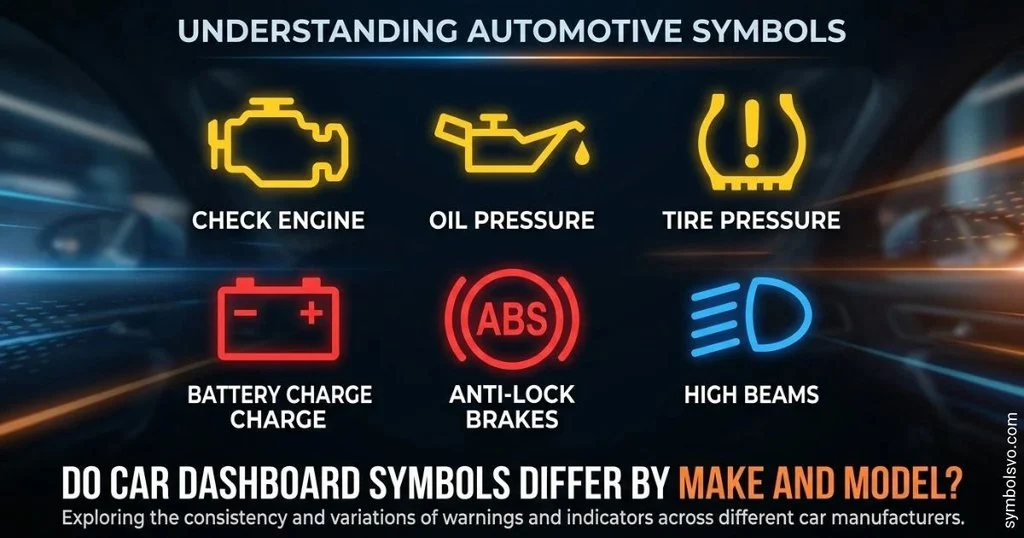
Yes. Although many manufacturers use familiar symbols, their colors, wording, and operating instructions can differ.
A dashboard symbol may also behave differently depending on the vehicle’s equipment and model year.
For example:
- A conventional gasoline car won’t necessarily have diesel particulate filter or AdBlue indicators.
- A diesel vehicle may display glow plug and emissions-system warnings.
- A hybrid vehicle may show electric-drive and high-voltage battery indicators.
- An electric vehicle may display charging, battery temperature, and electric powertrain warnings.
- Vehicles with advanced driver assistance may include additional collision avoidance, lane assistance, or sensor status indicators.
Even when two cars display similar icons, the correct response may differ.
For accurate information, consult your owner’s manual or the manufacturer’s official documentation. For unresolved safety-related warnings, ask a qualified technician.
Frequently Asked Questions About Car Dashboard Symbols
What do car dashboard symbols mean?
Car dashboard symbols communicate vehicle status, active features, maintenance needs, and potential faults. Their meanings depend on the icon, its color, the vehicle, and any accompanying message.
What is the most serious car dashboard warning light?
Oil pressure, engine overheating, and serious brake-system warnings are among the most urgent. They can indicate conditions that threaten engine operation or driving safety. Follow the specific warning’s instructions and stop safely when required.
What is the most common dashboard warning light?
There’s no single dashboard warning light that’s most common across all vehicles. The frequency depends on the vehicle’s age, design, maintenance, and operating conditions. The check engine light and tire pressure warning are familiar examples.
Can I drive with a yellow or amber dashboard light?
Sometimes. An amber light may indicate a fault that allows cautious travel to a repair facility. However, some warnings require prompt attention or stopping, especially when the vehicle behaves abnormally. Check your owner’s manual before deciding to continue.
Why is my check engine light flashing?
A flashing check engine light can indicate an active engine misfire that may damage the catalytic converter. Avoid heavy acceleration and stop safely when necessary. Arrange an urgent diagnostic inspection, especially if the engine shakes or loses power.
Why is my battery light on while driving?
The battery light often indicates that the charging system isn’t working correctly. Possible causes include an alternator fault, damaged drive belt, or electrical connection problem. Arrange a safe stop and follow the manufacturer’s instructions rather than assuming the battery alone is defective.
What does the oil warning light mean?
An oil pressure warning means the engine may not be receiving adequate oil pressure. Stop safely and switch off the engine. Check the oil level only when safe, and seek assistance if the warning remains on or the cause is unclear.
What does it mean when the brake and ABS lights come on together?
Both lights illuminating may indicate a braking-system fault beyond the anti-lock braking function. If braking feels abnormal, stop safely and don’t continue driving. Even if the pedal feels normal, seek prompt professional guidance.
What does the tire pressure warning light mean?
It usually indicates that one or more tires have low pressure. Check all tires with a pressure gauge and inflate them to the vehicle manufacturer’s recommended values. If the warning flashes before remaining on, the TPMS itself may have a fault.
Why does a dashboard warning light come on and then disappear?
Some warnings appear temporarily because of changing operating conditions or intermittent faults. A light may also switch off after a condition is corrected. If the warning returns repeatedly, investigate it rather than assuming the issue has disappeared permanently.
How do I find the meaning of an unfamiliar dashboard symbol?
Check your owner’s manual first. You can also consult official manufacturer documentation using your car’s make, model, and year. If the symbol remains unclear or relates to a safety-critical system, ask a qualified mechanic.
Can I reset car dashboard warning lights myself?
Some maintenance reminders can be reset using the vehicle’s menu or a manufacturer-approved procedure. Active fault warnings should be diagnosed before you attempt to clear them. Resetting a light doesn’t repair the underlying problem.
When should I call roadside assistance?
Call roadside assistance when a critical warning makes the vehicle unsafe to drive, the engine overheats, oil pressure drops, braking or steering becomes unreliable, or the vehicle breaks down. If you’re unsure whether continuing is safe, stop in a safe place and seek professional guidance.
Final Thoughts on Car Dashboard Symbols and Meanings
Learning car dashboard symbols and meanings gives you a better understanding of your vehicle and helps you respond more confidently when a warning appears.
Remember three essential points:
- Identify the symbol: Check its shape, color, flashing behavior, and any dashboard message.
- Assess the urgency: Some indicators show normal operation, while others require immediate action.
- Follow the correct instructions: Your owner’s manual and the vehicle’s specific warning determine the safest response.
Don’t ignore a warning just because your car still seems to run normally. A timely inspection can prevent further damage and help keep you safe on the road.
The most useful habit is simple: learn the important symbols before you need them. When an unfamiliar light appears, you’ll know where to look and how to make a safer decision.

I’m Daniel Brooks, a content creator and symbol enthusiast dedicated to researching the fascinating world of signs and symbols. I enjoy discovering the hidden meanings behind famous icons, emojis, historical emblems, and cultural symbols. Through my writing, I aim to provide trustworthy, well-researched, and reader-friendly information that helps people learn something new with every visit.
Books:
- The Complete Guide to World Symbols
- The Power of Universal Signs
 Nathan Holloway
 Mason Ellington