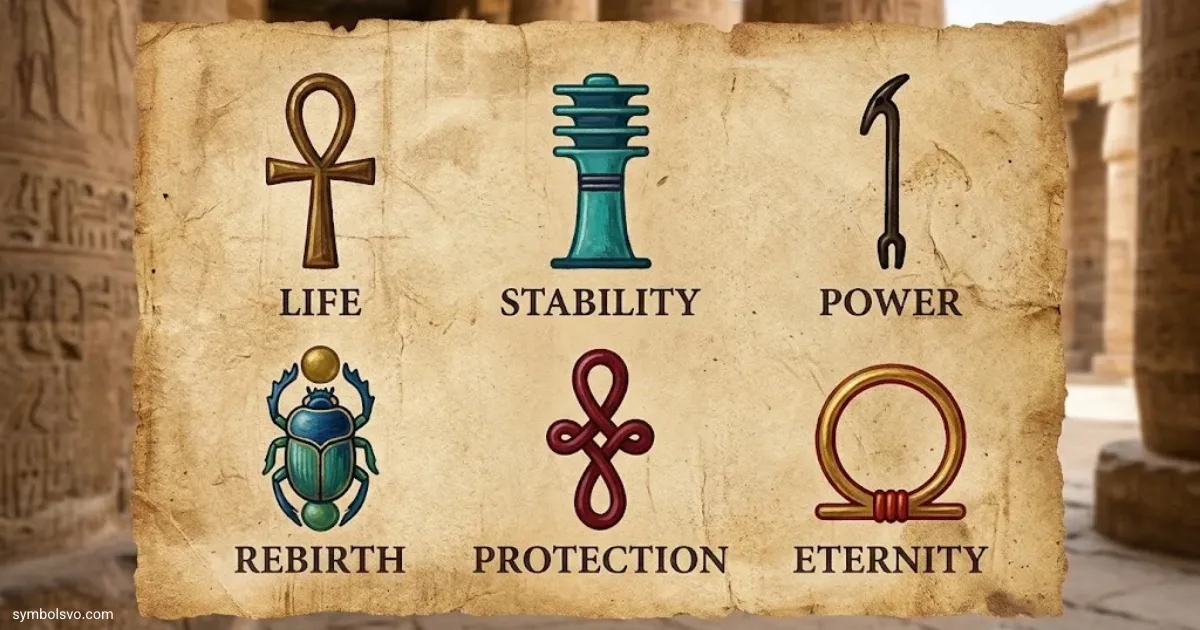
Ancient Egyptian writing is filled with fascinating images of birds, eyes, plants, animals, and everyday objects. These hieroglyphics symbols appear on temple walls, royal monuments, tombs, coffins, and ancient manuscripts. Each sign had a purpose, and many carried meanings that reached beyond their appearance.
However, Egyptian hieroglyphs weren’t simply pictures used to tell stories. Some signs represented sounds, others stood for complete words, and additional signs helped clarify meaning. Ancient Egyptians combined these elements to record names, religious beliefs, royal achievements, and important information about their world.
Understanding Egyptian hieroglyphs and their meanings requires looking at both the writing system and the culture that shaped it. The ankh, Eye of Horus, scarab beetle, and djed pillar are among the best-known examples. Yet each symbol has its own history, and some familiar interpretations need a little context.
This guide explores famous ancient Egyptian symbols, explains how hieroglyphic writing worked, and examines the role of these signs in religion, government, and daily life. You’ll also learn how scholars decipher inscriptions and why these remarkable signs still capture attention today.
What Are Egyptian Hieroglyphics?
Egyptian hieroglyphics formed the best-known writing system of ancient Egypt. The signs often resemble real objects, including people, animals, plants, tools, and parts of the human body. Scribes arranged them into carefully composed inscriptions that could communicate sounds, words, and ideas.
The word hieroglyph comes from Greek terms commonly translated as “sacred carving.” The ancient Egyptians referred to their writing as medu-netjer, meaning “words of the god.” This name reflects the close connection between writing, religion, and divine knowledge in Egyptian culture.
Although monumental inscriptions made hieroglyphs famous, Egyptians used their writing in several settings. They carved formal texts into stone, painted signs inside tombs, and wrote religious manuscripts on papyrus. Other scripts handled much of the faster, everyday work of administration.
When Did Ancient Egyptians Begin Using Hieroglyphs?
Egyptian writing emerged near the end of the fourth millennium BCE. Archaeological finds from sites such as Abydos show that early writing was already developing before Egypt’s dynastic state became firmly established.
Hieroglyphs remained in use for more than three thousand years. Their appearance and functions changed over time, reflecting shifts in language, religious practice, and artistic traditions.
The latest securely dated hieroglyphic inscription was carved at Philae on August 24, 394 CE. By the end of antiquity, knowledge of how to read the script had largely disappeared. Scholars eventually recovered that knowledge during the nineteenth century, with the Rosetta Stone playing a crucial role.
What Were Egyptian Hieroglyphics Used For?
Ancient Egyptians used hieroglyphs for much more than decorating temples. Their writing recorded religious beliefs, political authority, personal names, and events considered important enough to preserve.
Common uses included:
- Religious inscriptions: Texts dedicated to gods and goddesses.
- Royal monuments: Names, titles, achievements, and statements of kingship.
- Funerary texts: Prayers, protective formulas, and writings associated with the afterlife.
- Temple decoration: Captions, ritual scenes, and records of offerings.
- Administrative records: Labels, official documents, and other forms of written communication.
- Personal inscriptions: Names and titles appearing on statues, objects, and burial equipment.
Formal hieroglyphs often appeared where visual presentation mattered. Meanwhile, scribes frequently used cursive scripts for documents that required faster writing.
How the Ancient Egyptian Hieroglyphic Writing System Worked
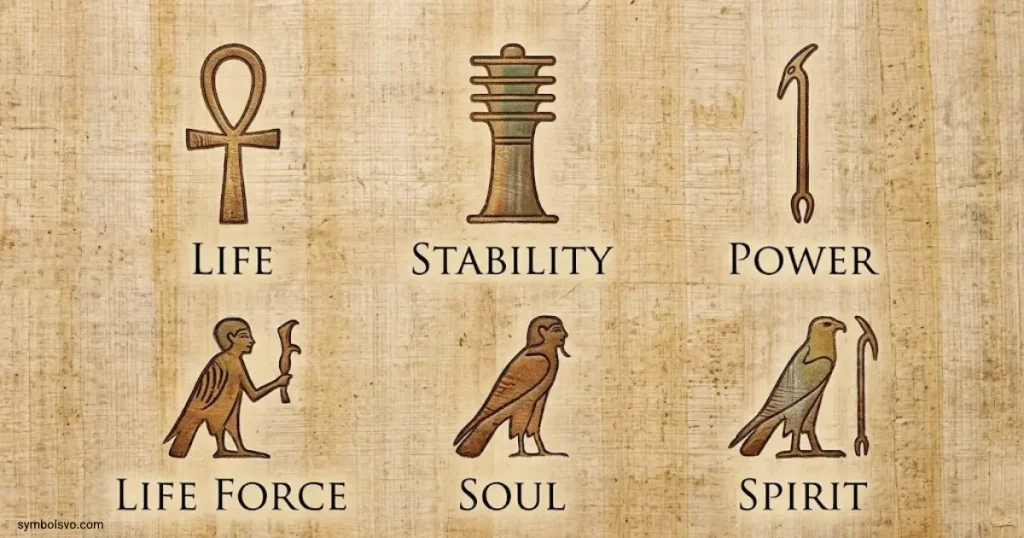
One of the biggest misconceptions about hieroglyphs is that every picture represented the object it showed. In reality, the ancient Egyptian writing system combined several kinds of signs.
A bird, for example, could represent a particular sound rather than the word “bird.” Another sign could represent a complete word, while a third could clarify the general category of the word being written.
Egyptologists commonly group these functions into phonograms, logograms, and determinatives. Understanding them makes Egyptian inscriptions much easier to interpret.
Phonograms: Hieroglyphs That Represent Sounds
Phonograms represent the sounds of the ancient Egyptian language. Depending on the sign, a phonogram could represent one, two, or three consonants.
These categories are commonly called uniliteral, biliteral, and triliteral signs.
| Type of phonogram | Function | Simple explanation |
| Uniliteral | Represents one consonant | Similar to a single consonant sign |
| Biliteral | Represents two consonants | One sign carries a two-consonant value |
| Triliteral | Represents three consonants | One sign carries a three-consonant value |
Egyptian writing generally recorded consonants rather than vowels in the way modern English spelling does. Scholars therefore use a system called transliteration to represent Egyptian words in Latin characters.
This explains why Egyptian hieroglyphs aren’t a direct English alphabet. Their sound system and spelling conventions developed around the ancient Egyptian language.
Logograms: Hieroglyphs That Represent Words
Logograms represent complete words or concepts. A sign showing a house, for example, could represent the Egyptian word for “house” rather than merely the sounds associated with the picture.
Some signs could work as both logograms and phonograms. Their function depended on how scribes used them in a particular word or inscription.
This flexibility made hieroglyphic writing more complex than a simple picture-based system.
Determinatives: Signs That Clarify Meaning
Determinatives helped readers understand a word’s meaning or category. They generally appeared after the phonetic spelling and did not contribute a sound to the word itself.
For example, a sign depicting a person could help identify a word related to a human being. Another sign might indicate that a word referred to a place, an action, or a concept associated with death.
These signs were especially useful because Egyptian writing generally omitted vowels. Different words could therefore have similar consonant patterns, making determinatives valuable clues.
Why Hieroglyphs Weren’t Just Picture Symbols
The Egyptian writing system worked through combinations of signs rather than one picture for every idea. A single word could include phonetic signs, a logogram, and a determinative.
This combination allowed scribes to express names, actions, abstract concepts, and complicated religious ideas. It also explains why a modern observer cannot reliably translate an inscription by guessing what each picture represents.
For accurate interpretation, the signs must be examined within their linguistic and historical context. The University College London guide to Egyptian hieroglyphic writing explains these different functions in detail.
Famous Hieroglyphics Symbols and Their Meanings
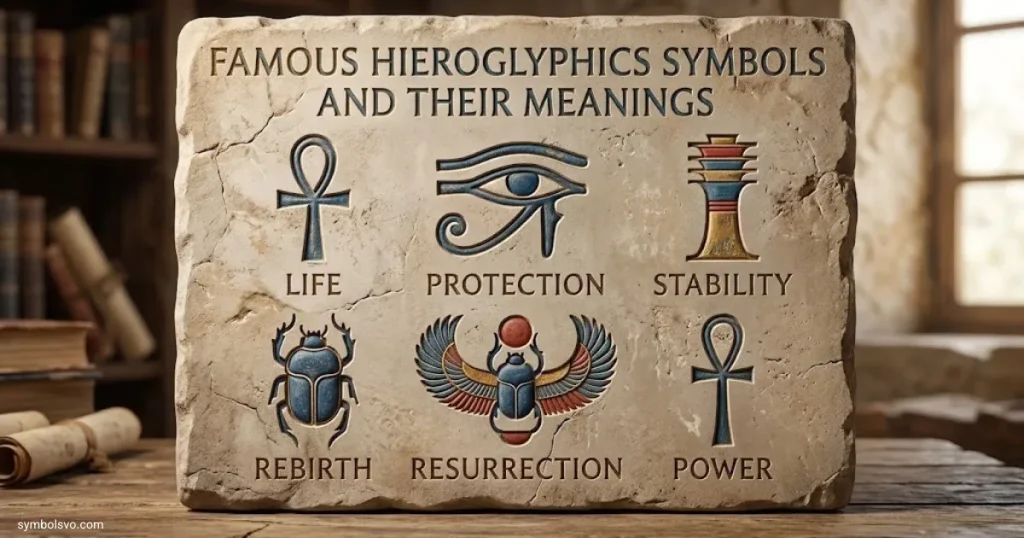
Many ancient Egyptian symbols and meanings have become familiar around the world. Some originated as elements of the writing system, while others became important religious emblems, royal insignia, or protective objects.
The distinction matters. The ankh is a recognizable sign associated with life, whereas the crook and flail are royal implements that also carry symbolic meaning. Both belong in a discussion of Egyptian symbolism, but they did not serve identical purposes.
Ankh: The Egyptian Symbol of Life
The ankh symbol features a cross-like shape with an oval loop at the top. It is one of the most recognizable images associated with ancient Egypt.
The ankh represents life and often appears in scenes involving gods, kings, and religious ceremonies. Egyptian deities frequently hold the sign, sometimes extending it toward a ruler as a symbol of life-giving power.
Its association with life also made it meaningful in funerary art. Ancient Egyptians placed great importance on existence beyond death, and the ankh fitted naturally into imagery about continued life and divine protection.
The ankh is commonly called the “key of life” or “Egyptian cross” today. These popular names help people recognize its shape, although they do not capture every aspect of its ancient meaning.
Common associations of the ankh include:
- Life and continued existence
- Divine power and life-giving energy
- Royal and religious imagery
- Eternal life in appropriate funerary contexts
Today, the ankh appears in jewelry, tattoos, artwork, and fashion. Its modern uses may reflect ancient Egyptian history, personal identity, or contemporary spiritual beliefs. Those modern interpretations should be distinguished from what archaeological evidence tells us about its ancient use.
Eye of Horus: Protection and Restoration
The Eye of Horus is a stylized eye with distinctive markings beneath and beside it. It is also associated with the Egyptian term wedjat, commonly connected with wholeness and restoration.
In Egyptian mythology, Horus suffered an injury to his eye during his conflict with Seth. The eye was subsequently restored in the mythological tradition, making it an important symbol of healing and renewed wholeness.
Ancient Egyptians used the Eye of Horus on protective amulets and funerary objects. These objects reflected the belief that symbolic protection could help preserve a person’s well-being in life and beyond death.
Its major associations include:
- Protection against harm
- Healing and restoration
- Wholeness and well-being
- Protection in funerary contexts
The Eye of Horus is often described as a universal symbol of good luck today. However, its documented ancient meaning is more closely connected with protection, restoration, and religious belief than with a guarantee of favorable events.
Eye of Ra: Solar Power and Divine Authority
The Eye of Ra is associated with Ra, the Egyptian sun god. It represents the sun’s divine power and could express both protection and destructive force.
In Egyptian mythology, the Eye of Ra sometimes acts as an independent divine power. Certain stories portray it as a force that protects the solar deity’s authority and punishes those who threaten the established order.
The Eye of Ra therefore has a different emphasis from the Eye of Horus, even though their imagery and associations sometimes overlap.
| Feature | Eye of Horus | Eye of Ra |
| Main association | Restoration and protection | Solar power and divine authority |
| Mythological connection | Horus and his restored eye | Ra and the power of his divine eye |
| Common interpretation | Wholeness and healing | Protection, power, and sometimes destructive force |
| Ancient use | Amulets and funerary imagery | Religious and solar imagery |
The two eyes should not be treated as interchangeable labels. Their meanings depend on the myths, images, and historical settings in which they appear.
Scarab Beetle: Transformation and Rebirth
The scarab symbol draws on the behavior of the dung beetle, which rolls balls of dung across the ground. Ancient Egyptians associated the beetle with renewal and the sun’s daily journey across the sky.
The deity Khepri, linked with the rising sun and renewal, was often represented as a scarab or as a human figure with a scarab head.
Scarab-shaped objects served several purposes. Some functioned as seals, while others served as amulets or appeared in funerary settings. Their importance extended beyond decoration because they connected daily observations of nature with religious ideas about transformation.
The scarab is commonly associated with:
- Rebirth and renewal
- Transformation
- Solar cycles
- Protection in certain funerary contexts
Its symbolism was especially suitable for objects connected with death and continued existence. The beetle’s emergence from the ground provided a powerful natural image for renewal.
Djed Pillar: Stability and Endurance
The djed pillar resembles a column topped with several horizontal bars. It is associated with stability, endurance, and the god Osiris.
Egyptian religious tradition connected the djed with the backbone of Osiris. This association helped link the symbol with the restoration of the god and ideas about enduring life beyond death.
The djed appeared in amulets, religious art, and funerary settings. Its form also became part of broader Egyptian visual language, making it recognizable in many objects and inscriptions.
Its key associations include:
- Stability and endurance
- Osiris and religious renewal
- Funerary protection
- Continued existence
The djed is sometimes described simply as a symbol of strength. That description captures part of its meaning, but its association with Osiris and religious restoration provides important historical context.
Tyet or Tjet: The Knot of Isis
The tyet symbol, also spelled tjet or tyet, resembles a looped knot with downward-curving arms. It is commonly known as the knot of Isis.
Its association with Isis connects it with protection and the goddess’s role in Egyptian religious traditions. The symbol appeared on amulets and funerary objects, where it formed part of a wider system of protective imagery.
The tyet is often compared with the ankh because both have a looped upper section. Their shapes may look related, but their meanings and religious associations differ.
The tyet is especially associated with:
- Isis and divine protection
- Funerary amulets
- Religious renewal
- Protective symbolism
Some explanations connect it with the blood of Isis. This association belongs to particular Egyptian funerary traditions and should not be taken as the sole meaning of every tyet image.
Shen Ring: Protection and the Idea of Encirclement
The shen ring takes the form of a loop of rope, often shown as a closed circle. Its shape suggests something surrounded or enclosed.
In Egyptian art, the shen ring could express protection and the idea of encircling something within a secure boundary. It appeared in royal and religious imagery, including representations involving gods and kings.
The shen ring is also related visually to the cartouche, the elongated enclosure used around certain royal names. However, the terms describe different forms and uses rather than two identical symbols.
Its main associations include:
- Protection and enclosure
- Royal imagery
- Continuity and completeness in some contexts
- Sacred and monumental decoration
The familiar modern idea of infinity can be a useful visual comparison, but it should not replace the symbol’s documented Egyptian associations.
Was Scepter: Power and Authority
The was scepter is a long staff with a distinctive animal-shaped top and a forked base. It appears in the hands of Egyptian gods and, in some contexts, rulers.
The scepter represented power, authority, and dominion. Its presence in a scene could help communicate the status of a deity or ruler without requiring a long written explanation.
Unlike a phonetic hieroglyph, the was scepter is primarily discussed as an emblem of authority in Egyptian art and religious symbolism.
It commonly represents:
- Divine power
- Royal authority
- Dominion
- Religious status
The was scepter demonstrates how Egyptian visual culture used objects to express abstract ideas. Its meaning came from the object’s established role in religious and royal imagery.
Sesen: The Egyptian Lotus Flower
The sesen, commonly associated with the Egyptian lotus, appears in floral forms used throughout ancient Egyptian art. Lotus imagery had strong connections with creation, renewal, and the natural world.
The opening of a flower could be associated with the emergence of the sun and the renewal of life. In some creation traditions, lotus imagery played a role in describing how the world or the sun came into existence.
Lotus flowers appeared in temple decoration, paintings, reliefs, and objects used in daily life. Their visual appeal made them suitable for artistic decoration, while their religious associations gave them additional significance.
Common associations include:
- Creation and renewal
- Solar imagery
- The natural world
- Religious and artistic decoration
The exact meaning depends on the scene. A lotus in a decorative composition may not carry the same significance as one shown in a religious narrative.
Crook and Flail: Kingship and Royal Authority
The crook and flail are two royal implements often depicted crossed over a ruler’s chest. They are strongly associated with Egyptian kingship and with the god Osiris.
The crook resembles a shepherd’s staff. The flail is a handled implement with suspended strands. Together, they became recognizable emblems of royal authority.
Their use in royal imagery helped present the ruler as a figure responsible for maintaining order and exercising legitimate power. Their association with Osiris also linked kingship with religious traditions surrounding death and renewal.
The crook and flail commonly represent:
- Kingship and royal authority
- Power and legitimacy
- Religious symbolism
- Osiris and royal imagery
They are not ordinary letters of the Egyptian hieroglyphic alphabet. Instead, they are ceremonial objects whose symbolic meanings developed through their use in religious and royal contexts.
Egyptian Symbols Associated With Life, Protection, and Rebirth
Different Egyptian symbols and their meanings often overlap because Egyptian religion connected life, protection, renewal, and the afterlife. Still, each symbol has its own history and should not be reduced to a single modern keyword.
The following table summarizes some widely recognized associations.
| Theme | Related symbol | Common historical association |
| Life | Ankh | Life and continued existence |
| Protection | Eye of Horus | Restoration and protective power |
| Solar renewal | Scarab beetle | Khepri and the rising sun |
| Stability | Djed pillar | Osiris and endurance |
| Protection associated with Isis | Tyet | Divine and funerary protection |
| Royal power | Crook and flail | Kingship and authority |
| Divine authority | Was scepter | Power and dominion |
| Creation and renewal | Lotus flower | Solar and creation imagery |
| Enclosure and protection | Shen ring | Protective encirclement |
These associations are useful starting points, not rigid rules. The same image may appear in different contexts, and the surrounding inscription can change how scholars interpret it.
Egyptian Symbols of Life and the Afterlife
Ancient Egyptian beliefs about life did not end at physical death. Many funerary traditions focused on preserving the deceased, protecting the body, and supporting continued existence.
The ankh is strongly associated with life, while the djed pillar and scarab often appear in contexts connected with renewal. Funerary amulets, inscriptions, and religious texts formed part of a wider effort to protect the deceased and support the journey into the afterlife.
Egyptian Symbols of Protection
Protective imagery appeared on amulets, coffins, tomb walls, and other objects. The Eye of Horus and tyet are particularly well-known examples.
These objects reflect ancient religious beliefs. Their presence does not establish that they possessed supernatural effects in a modern scientific sense; rather, it shows how Egyptians understood protection through their religious worldview.
Egyptian Symbols of Kingship and Power
Royal symbols communicated authority, legitimacy, and a ruler’s connection with divine order. The crook and flail, was scepter, and cartouche are important examples.
A cartouche enclosed a royal name within an elongated oval. This enclosure helped distinguish the ruler’s name in formal inscriptions and became one of the most recognizable features of Egyptian monumental writing.
Egyptian Hieroglyphs That Represent Letters and Sounds
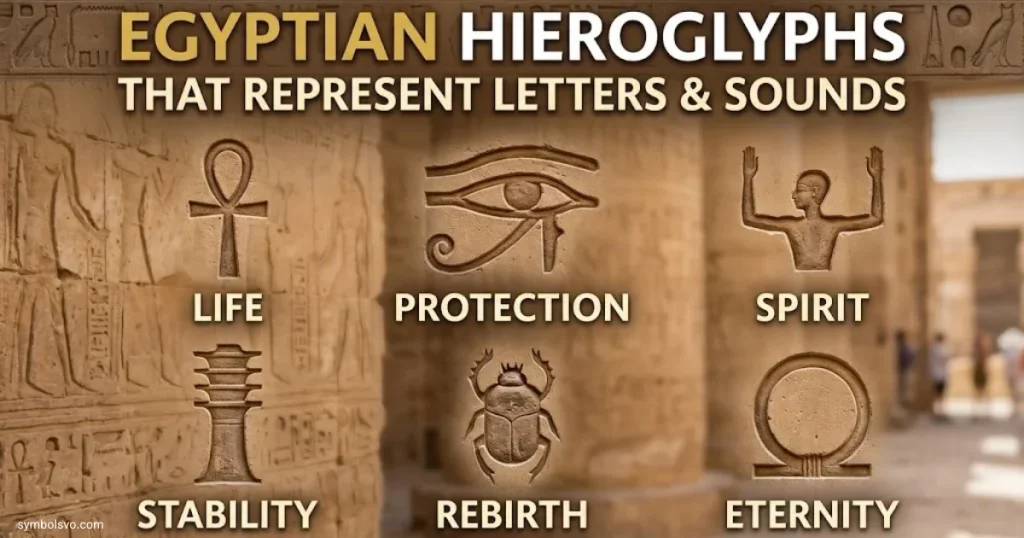
The phrase Egyptian hieroglyphic alphabet often appears in modern searches, but it can be misleading. Ancient Egyptian writing did not use an alphabet identical to the modern English alphabet.
Instead, Egyptian scribes used a group of signs representing individual consonants, alongside signs representing combinations of consonants and complete words. The language also used determinatives to clarify meaning.
What Is the Egyptian Hieroglyphic Alphabet?
Egyptologists often teach a set of 24 common uniliteral signs when introducing Middle Egyptian. These signs represent single consonants and provide a useful starting point for learning how hieroglyphs work.
However, the number 24 does not represent the total number of Egyptian signs. It refers to a conventional set of common one-consonant signs, not every sign in the writing system.
Ancient Egyptian also changed over time. Sign inventories, spelling practices, and language forms varied across different historical periods.
How Hieroglyphs Represent Sounds
Some hieroglyphs represent one consonant, while others represent two or three. Scribes could combine these signs to spell words, sometimes adding a phonetic complement or a determinative.
The system generally did not write vowels in the same way English does. Modern Egyptologists therefore use transliteration conventions to represent Egyptian words and distinguish sounds for scholarly discussion.
This matters when someone tries to write an English name in hieroglyphs. A modern name may be approximated phonetically, but the result is not automatically a historically authentic Egyptian word.
Can You Write Your Name in Egyptian Hieroglyphs?
Yes, a modern name can often be represented approximately using phonetic hieroglyphic signs. However, the result depends on how the name is pronounced and how its sounds can be represented in the ancient system.
A few points are worth remembering:
- Egyptian signs do not correspond one-to-one with every English letter.
- Vowels require special consideration because ancient Egyptian spelling generally emphasized consonants.
- A phonetic rendering of a modern name is not the same as translating that name’s meaning.
- Online name generators may simplify the system or use inconsistent sign values.
For an educational project, use a reliable sign list or Egyptological reference rather than assuming a decorative image is an accurate translation.
Egyptian Hieroglyphic Numbers and Counting Symbols
Ancient Egyptians used a decimal number system. Their numeral signs represented powers of ten, and scribes combined repeated signs to express larger quantities.
This system differed from the modern Hindu-Arabic numerals used in everyday arithmetic today. Egyptian notation was primarily additive: a number could be represented by repeating the signs for its component values.
Common Egyptian Numeral Values
| Numerical value | How the system represented it |
| 1 | A single-stroke sign |
| 10 | A heel-bone-shaped sign |
| 100 | A coil of rope |
| 1,000 | A lotus plant |
| 10,000 | A pointing finger |
| 100,000 | A tadpole or frog-shaped sign |
| 1,000,000 | A figure with raised arms |
These descriptions identify the traditional forms used in introductory explanations of Egyptian numerals. Actual inscriptions should be checked against reliable sign charts because drawings and typographic reproductions may vary.
How Ancient Egyptians Wrote Larger Numbers
To write a number, scribes repeated the sign for each required power of ten. For example, the number 23 could be represented by two ten signs and three one signs.
Similarly, a number such as 342 could be expressed using three hundred signs, four ten signs, and two one signs.
This additive approach made it possible to record quantities in administrative documents, accounts, and other written records. Egyptian mathematics also included methods for working with fractions, measurement, and practical calculations.
Numeral signs were part of the broader writing tradition, but their purpose differed from that of religious emblems such as the ankh or Eye of Horus.
How to Read Egyptian Hieroglyphics
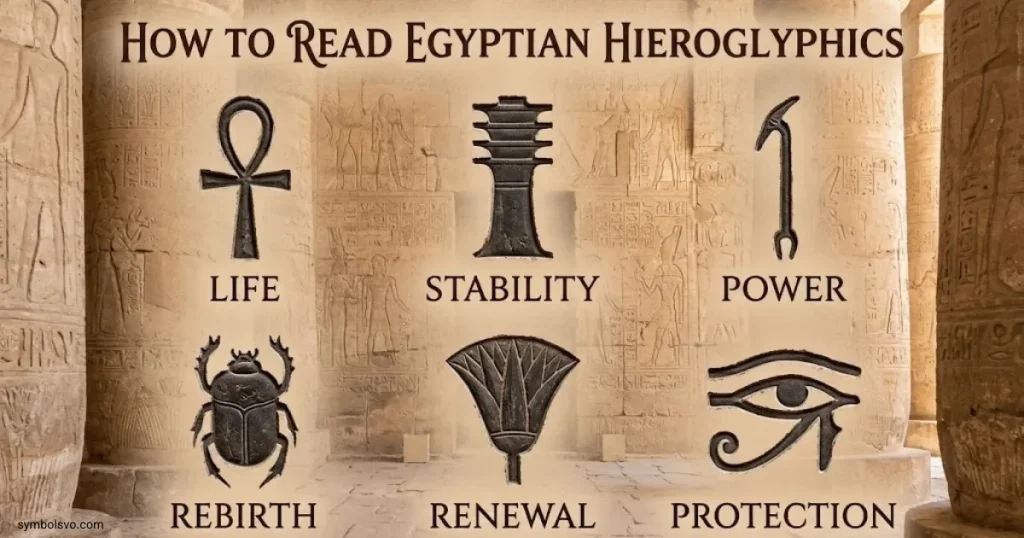
Reading Egyptian hieroglyphics requires more than recognizing individual pictures. You need to identify the writing direction, understand how signs function, and examine the surrounding text.
An inscription may combine phonetic signs, word signs, and determinatives. Its arrangement may also reflect artistic choices or the importance of particular names and figures.
Identify the Direction of Writing
Egyptian hieroglyphs could be written horizontally or vertically. Horizontal inscriptions might run from right to left or from left to right, while vertical inscriptions were arranged in columns.
The direction in which human and animal figures face often provides a useful clue. In many inscriptions, readers begin on the side toward which the figures face.
However, this visual clue must be checked against the full layout. Decorative compositions and the arrangement of signs can affect how a passage should be read.
Recognize Different Types of Signs
Start by identifying whether a sign appears to represent a sound, a word, or a semantic category. This distinction prevents the common mistake of translating every image literally.
For example, an animal sign may represent a consonant rather than an animal mentioned in the text. A determinative may indicate that a word concerns a person, place, or action without contributing a spoken sound.
Reliable reading therefore combines sign identification with knowledge of ancient Egyptian grammar and vocabulary.
Understand Cartouches and Royal Names
A cartouche is an elongated enclosure around certain royal names. It is especially useful when studying inscriptions because it helps identify a ruler’s name within a longer passage.
The Rosetta Stone contains royal names that helped scholars compare hieroglyphic signs with their Greek equivalents. These comparisons contributed to the eventual decipherment of the writing system.
Cartouches remain useful to students today, but identifying a name is only one step toward understanding a full inscription.
Why Accurate Translation Requires Historical Context
A group of hieroglyphs cannot always be translated by assigning a modern English word to every sign. Scholars consider the sign values, grammatical structure, historical period, and surrounding text.
For serious study, useful resources include:
- Egyptian sign lists and scholarly dictionaries
- Museum descriptions of documented inscriptions
- Introductory guides to Middle Egyptian grammar
- Published translations with explanations of uncertain readings
- Archaeological records identifying the object and its date
This approach produces a much more reliable interpretation than guessing from the visual appearance alone.
Where Ancient Egyptians Used Hieroglyphic Symbols
Hieroglyphs appeared across a wide range of objects and settings. Their placement often tells scholars something about the purpose of the writing and the people who commissioned it.
Temples and Religious Monuments
Temples contain many formal inscriptions, including royal dedications, religious scenes, and texts associated with offerings to gods. Hieroglyphs could identify deities, name rulers, and record actions considered important to religious life.
Obelisks and monumental walls also carried inscriptions that linked rulers with divine authority. The scale and careful design of these texts made writing part of the monument’s visual impact.
Tombs, Coffins, and Funerary Objects
Tombs and burial objects preserve a large amount of evidence about Egyptian religious beliefs. Inscriptions could include prayers, names, titles, and texts intended to support the deceased in the afterlife.
Funerary amulets also carried symbols associated with protection and renewal. Their meaning depended on the object, its placement, and the traditions connected with its use.
Canopic jars, coffins, sarcophagi, and other burial equipment provide important evidence for understanding these practices. However, not every decorated object carried the same religious message.
Papyrus and Other Writing Surfaces
Hieroglyphs were not limited to stone. Egyptians also wrote on papyrus and used a range of other materials, including pottery fragments and wooden objects.
Papyrus was made from the papyrus plant, which grew along the Nile. Scribes could apply ink to its surface, creating documents that were easier to transport than large stone inscriptions.
Formal hieroglyphic writing appeared in manuscripts, although cursive scripts were often more practical for lengthy documents.
Everyday Administration and Recordkeeping
Egyptian writing supported administration, accounting, and the management of resources. Records could concern goods, labor, taxes, property, and official activities.
Hieroglyphs were one part of this broader written culture. Hieratic and Demotic scripts handled many practical tasks, particularly when speed and efficient use of writing materials mattered.
The ability to preserve written records helped Egyptian institutions manage complex activities across generations.
Egyptian Gods and Their Associated Symbols
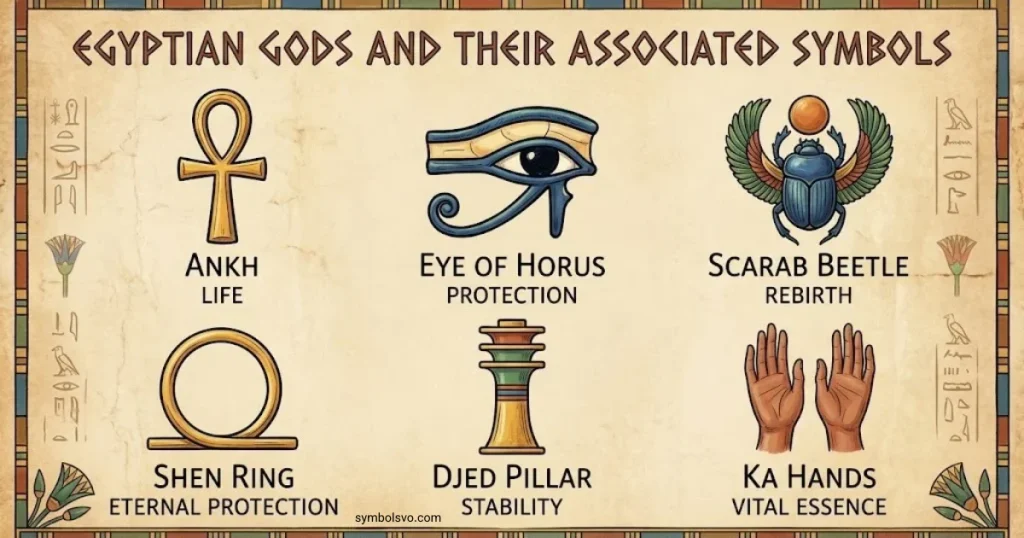
Egyptian mythology includes a wide range of gods and goddesses, each with different roles and visual attributes. Some deities had strong associations with particular symbols, animals, or objects.
These relationships helped artists communicate identity and religious meaning. However, Egyptian deities could take several forms, and their associations changed across periods and locations.
| Deity | Main association | Recognizable imagery |
| Horus | Sky and kingship | Falcon imagery and the Eye of Horus |
| Ra | Sun and creation | Solar disk and the Eye of Ra |
| Osiris | Afterlife and renewal | Djed pillar, crook, and flail |
| Isis | Protection and motherhood | Tyet and throne imagery |
| Khepri | Sunrise and renewal | Scarab beetle |
| Anubis | Mummification and funerary rites | Jackal imagery |
| Thoth | Writing and knowledge | Ibis or baboon imagery |
| Nekhbet | Royal protection | Vulture imagery |
Why Egyptian Gods Had More Than One Symbol
A deity’s identity could be expressed through animals, crowns, tools, gestures, and written names. These attributes helped viewers recognize a god within a religious scene.
For example, the scarab associated with Khepri expressed solar renewal, while the djed pillar connected with Osiris conveyed stability and religious restoration. The symbols served different purposes even when both related to renewal.
Egyptian mythology also developed over many centuries. Local traditions, royal policies, and changing religious practices influenced how deities were understood and depicted.
The Rosetta Stone and the Decipherment of Hieroglyphs
For centuries, scholars could see Egyptian hieroglyphs on monuments without knowing how to read them accurately. The breakthrough came through careful comparison of inscriptions, languages, and repeated groups of signs.
The Rosetta Stone became the most famous object associated with this process. It provided a crucial link between hieroglyphic writing and a language scholars could already read.
What Is the Rosetta Stone?
The Rosetta Stone is a granodiorite slab inscribed with a decree issued in 196 BCE during the reign of Ptolemy V. The decree appears in three versions:
- Hieroglyphic script
- Demotic script
- Ancient Greek
The versions convey the same general decree, although they are not perfectly identical in every detail. Because scholars could read ancient Greek, they gained a valuable reference for interpreting the Egyptian texts.
French forces discovered the stone near Rashid, known in English as Rosetta, in 1799 during the French campaign in Egypt. British forces later took possession of it, and it became part of the British Museum’s collection.
How Jean-François Champollion Deciphered Hieroglyphs
The decipherment did not result from one discovery alone. Scholars including Thomas Young made important contributions by comparing repeated signs and investigating royal names.
Jean-François Champollion built on earlier work and used his knowledge of Coptic, a later form of the Egyptian language, to interpret the writing system. In 1822, he announced a major breakthrough in understanding hieroglyphs.
Royal cartouches helped researchers identify names in the inscriptions. Comparing those names with Greek forms revealed that hieroglyphs could represent sounds as well as words and concepts.
Why the Rosetta Stone Changed Egyptology
The decipherment opened the door to a much fuller understanding of Egyptian history. Scholars could begin reading royal records, religious texts, administrative documents, and funerary writings rather than relying only on images and archaeological interpretation.
The stone was not a complete dictionary of Egyptian writing. Instead, it provided a key that researchers combined with other inscriptions, language evidence, and historical knowledge.
Its importance lies in helping scholars recover access to a written tradition that had remained unread for many centuries.
Egyptian Symbols in Modern Culture
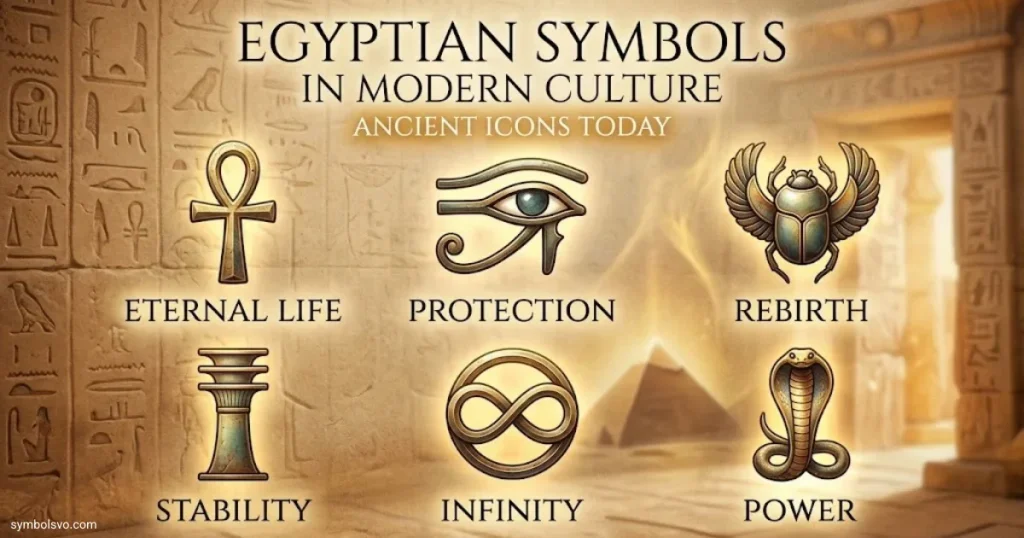
Ancient Egyptian symbols continue to appear in jewelry, fashion, tattoos, decorative art, and popular media. Their distinctive shapes make them recognizable, even to people who have never studied Egyptian history.
However, modern use does not always match ancient meaning. A design may draw inspiration from Egyptian religion while also reflecting contemporary fashion, personal identity, or modern spiritual beliefs.
Egyptian Symbols in Jewelry and Tattoos
The ankh, Eye of Horus, and scarab are common choices in modern jewelry and tattoo designs. Some people choose them because of their historical associations, while others appreciate their visual style.
Before selecting a symbol, it helps to understand its documented history. The Eye of Horus, for example, has associations with restoration and protection, while the ankh is strongly connected with life.
A modern design may express a personal meaning, but that interpretation should not be presented as the only historically correct one.
Egyptian Symbols in Art, Fashion, and Design
Egyptian motifs appear in clothing, accessories, architecture, graphic design, and decorative objects. Designers may borrow the forms of lotus flowers, cartouches, scarabs, and monumental inscriptions.
These uses demonstrate the lasting influence of ancient Egyptian visual culture. They also show why historical context matters when interpreting symbols outside their original settings.
Ancient Symbols and Modern Interpretations
Some modern spiritual movements use Egyptian imagery in ways that differ from ancient religious practices. These interpretations can be meaningful to contemporary communities, but they should be distinguished from archaeological evidence.
The Eye of Providence, for example, is a separate symbol with its own history. Its visual resemblance to an eye motif does not establish that it originated from the Eye of Horus.
Understanding these distinctions helps readers appreciate modern symbolism without confusing different traditions.
Egyptian Hieroglyphics vs. Hieratic and Demotic Writing
Ancient Egyptians used more than one script. Hieroglyphic writing was the most visually recognizable, but scribes also developed cursive forms that suited faster writing.
The differences between these scripts reveal how Egyptian writing adapted to different settings.
| Script | Appearance | Common uses |
| Hieroglyphic | Detailed signs arranged in rows or columns | Monuments, temples, formal inscriptions, and some manuscripts |
| Hieratic | Cursive forms derived from hieroglyphs | Religious texts, letters, accounts, and administrative documents |
| Demotic | Highly cursive Egyptian script | Administrative, legal, literary, and everyday documents in later periods |
Hieroglyphic Writing
Hieroglyphs were well suited to formal inscriptions and carefully arranged visual compositions. Their signs could be carved or painted with considerable detail.
They also appeared in religious manuscripts and other texts, so their use was not restricted to stone monuments.
Hieratic Script
Hieratic was a cursive script that allowed scribes to write more efficiently. Its signs developed from hieroglyphic forms but became simplified through repeated use.
Scribes used hieratic for a wide range of documents, including literary works, religious writings, letters, and administrative records.
Demotic Script
Demotic developed as another cursive Egyptian script and became prominent in later periods. It was widely used for practical writing, including legal and administrative documents.
Demotic appears on the Rosetta Stone alongside hieroglyphic writing and ancient Greek. Its presence helped scholars investigate the relationship between different forms of Egyptian writing.
Frequently Asked Questions About Hieroglyphics Symbols
What Do Hieroglyphics Symbols Mean?
Hieroglyphics symbols can represent sounds, complete words, objects, or categories of meaning. Their function depends on how scribes used them in a particular word or inscription.
Some well-known signs also have religious or cultural associations. The ankh, for example, is strongly associated with life, while the Eye of Horus is connected with restoration and protection.
What Are the Most Famous Egyptian Hieroglyphics Symbols?
Among the best-known Egyptian symbols are the ankh, Eye of Horus, Eye of Ra, scarab beetle, djed pillar, tyet, shen ring, and was scepter.
The crook and flail and lotus flower are also important in Egyptian visual culture. However, not all these objects functioned as ordinary writing signs; some are primarily religious or royal emblems.
Is the Ankh a Hieroglyph or a Religious Symbol?
The ankh is a recognizable Egyptian sign associated with life. It can appear within written and visual contexts and also serves as a religious symbol in Egyptian art.
Its meaning depends on how and where it appears. In modern culture, the ankh is commonly called the key of life.
What Is the Difference Between the Eye of Horus and the Eye of Ra?
The Eye of Horus is commonly associated with restoration, well-being, and protection. The Eye of Ra represents the sun god’s divine power and can express both protective and destructive force.
Their imagery overlaps in some contexts, but they have distinct mythological associations. They should not automatically be treated as interchangeable symbols.
Do Egyptian Hieroglyphs Represent Letters?
Some hieroglyphs represent single consonants, much like individual letters. Others represent two or three consonants, while additional signs represent whole words or clarify meaning.
For that reason, hieroglyphic writing is not simply an alphabet. It combines different types of signs to represent the ancient Egyptian language.
How Many Hieroglyphic Symbols Are There?
The total depends on the period and how scholars count signs. Middle Egyptian is often introduced through a core inventory of roughly 750 signs, while the conventional set of 24 uniliteral signs represents only one part of the system.
Later periods introduced additional signs and new uses for existing ones. A single number therefore cannot describe every hieroglyph used throughout Egyptian history.
Can Hieroglyphs Be Translated Into English?
Yes. Egyptologists translate Egyptian texts by identifying sign values, grammar, vocabulary, and historical context.
Writing a modern English name in hieroglyphs is a different task. That usually involves an approximate phonetic rendering rather than translating the name’s meaning into ancient Egyptian.
Which Egyptian Symbol Represents Eternal Life?
The ankh is the best-known Egyptian symbol associated with life and continued existence. It frequently appears in religious scenes and funerary imagery.
Other symbols, including the scarab and djed pillar, also appear in contexts connected with renewal and the afterlife. Their meanings are related but not identical.
What Is the Rosetta Stone, and Why Is It Important?
The Rosetta Stone is a decree dated to 196 BCE and written in hieroglyphic, Demotic, and ancient Greek. Because scholars could read Greek, they used it to help interpret the Egyptian scripts.
The stone played a crucial role in the decipherment of hieroglyphs, particularly through the work of Jean-François Champollion and earlier researchers.
Are Egyptian Hieroglyphs Still Used Today?
Hieroglyphs are no longer used as an ordinary living writing system, but scholars, museums, educators, and artists continue to study and reproduce them.
Modern researchers use inscriptions to investigate Egyptian language, religion, politics, and daily life. Their work continues to improve our understanding of ancient Egyptian civilization.
Conclusion: Understanding the Meaning Behind Egyptian Hieroglyphs
Hieroglyphics symbols reveal how ancient Egyptians expressed language, religious beliefs, royal authority, and ideas about life and death. Some signs represented sounds or words, while others clarified meaning or served as powerful religious and cultural emblems.
The ankh, Eye of Horus, scarab, djed pillar, and other familiar symbols offer a useful introduction to Egyptian history. Yet their meanings become clearer when you examine their original settings rather than relying only on modern interpretations.
The writing system itself is equally fascinating. Phonograms, logograms, and determinatives worked together to form a flexible way of recording the Egyptian language. The Rosetta Stone later helped scholars recover that system and unlock thousands of years of written evidence.
By studying authentic inscriptions, archaeological objects, and reliable historical sources, you can move beyond recognizing the pictures. You can begin to understand the language, beliefs, and culture that gave these remarkable signs their meaning.

I’m Daniel Brooks, a content creator and symbol enthusiast dedicated to researching the fascinating world of signs and symbols. I enjoy discovering the hidden meanings behind famous icons, emojis, historical emblems, and cultural symbols. Through my writing, I aim to provide trustworthy, well-researched, and reader-friendly information that helps people learn something new with every visit.
Books:
- The Complete Guide to World Symbols
- The Power of Universal Signs
 Nathan Holloway
 Mason Ellington