Dreidel symbols may look like simple Hebrew letters, but each one carries a meaning connected to Hanukkah, Jewish traditions, and a beloved holiday game. From Nun and Gimel to Hey and Shin, these symbols help explain why the dreidel has remained an important part of Jewish cultural life.
A traditional dreidel has four sides, each marked with a Hebrew letter. Together, the letters form a phrase that recalls the Hanukkah miracle. They also tell players what to do during the game, making each spin part of a familiar holiday tradition.
However, the story goes beyond the letters themselves. The dreidel has roots in European spinning-top games, a special version exists in Israel, and later Jewish interpretations have given the toy additional spiritual meaning.
In this guide, you’ll discover what each dreidel symbol means, how the four Hebrew letters work, why Israeli dreidels use a different letter, and how this small spinning top became a lasting symbol of Hanukkah.
What Is a Dreidel?
A dreidel is a four-sided spinning top used in a traditional Jewish game, especially during Hanukkah, the Jewish Festival of Lights. Each side displays a Hebrew letter that determines what happens when the top stops spinning.
The game is popular among families and children during the holiday. Players usually use small tokens, candies, or chocolate coins as game pieces. The letters provide the instructions, while the spinning top adds an element of chance and excitement.
The word dreidel comes from Yiddish and is related to German words associated with turning or spinning. In Hebrew, the toy is called a sivivon or sevivon, a word associated with spinning around.
Although the dreidel is best known as a Hanukkah toy, it also represents the way a simple everyday object can carry cultural meaning across generations.
What Do Dreidel Symbols Represent?
The four letters on a traditional dreidel are:
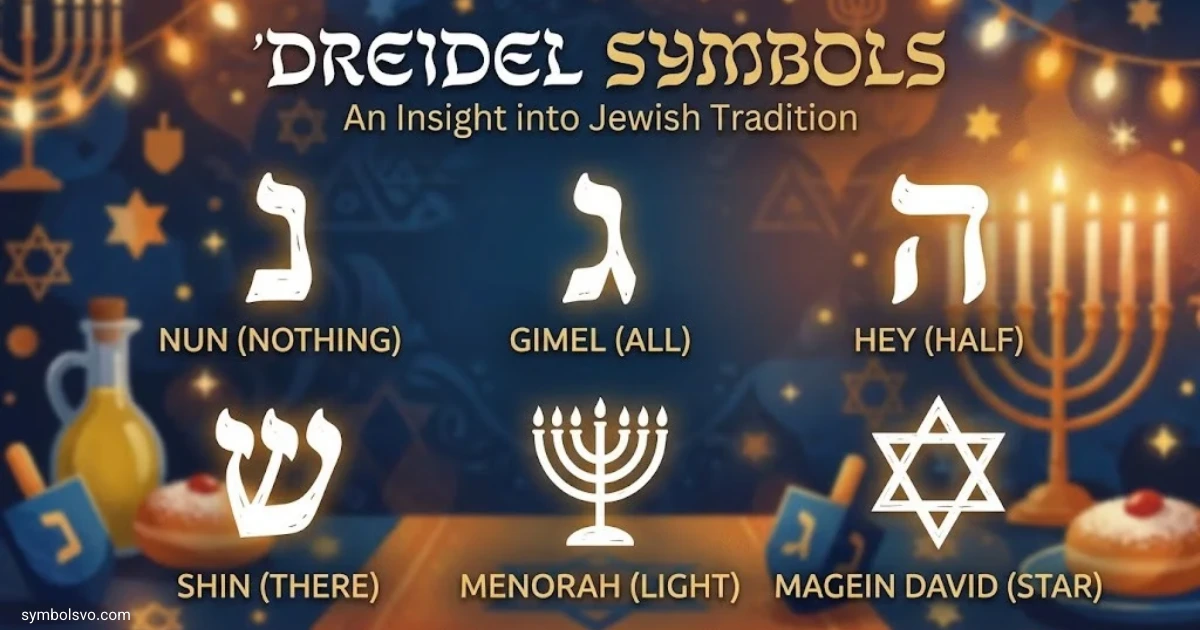
- Nun (נ): Represents Nes, meaning “miracle,” in the traditional Hanukkah phrase.
- Gimel (ג): Represents Gadol, meaning “great.”
- Hey (ה): Represents Haya, meaning “happened” or “was.”
- Shin (ש): Represents Sham, meaning “there.”
Together, these letters form the phrase Nes Gadol Haya Sham, commonly translated as “A great miracle happened there.”
Each letter also has a separate function in the game. Nun means a player does nothing, Gimel means the player takes the entire pot, Hey means the player takes half, and Shin usually means the player adds a piece.
The key distinction: The letters’ meanings in the Hebrew phrase differ from their instructions in the game. Understanding both helps explain the dreidel’s cultural significance.
The Four Dreidel Symbols and Their Meanings
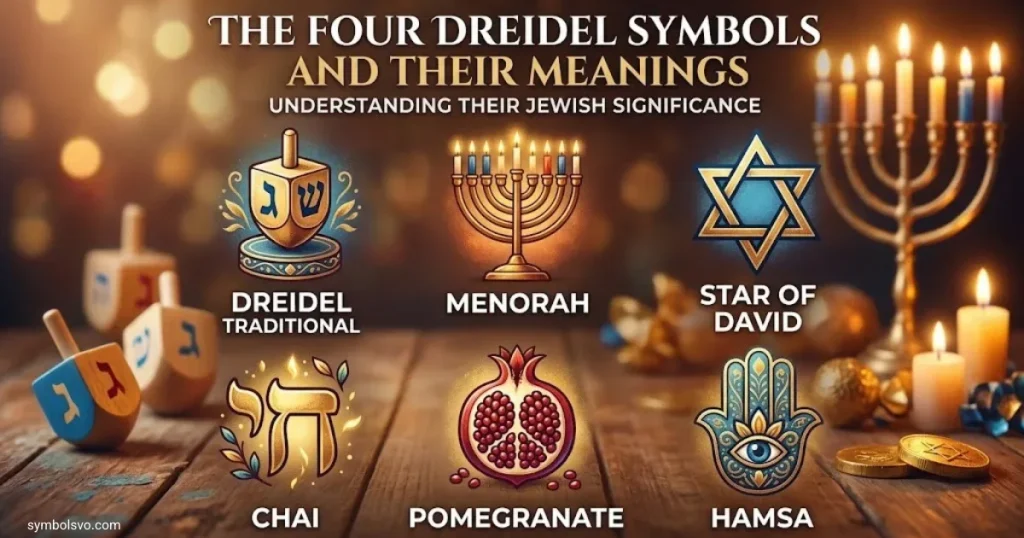
The four dreidel symbols have two main purposes: they represent the words of a traditional Hebrew phrase and determine the outcome of each turn. Learning the letters makes the game easier to understand and reveals why the dreidel holds a special place in Hanukkah celebrations.
Nun (נ): The Symbol for Doing Nothing
Nun (נ) is the first letter in the traditional phrase Nes Gadol Haya Sham. It represents Nes, the Hebrew word for “miracle.”
During the dreidel game, Nun means the player does nothing. The player neither takes pieces from the pot nor adds any. The turn simply passes to the next person.
Although this result might seem disappointing, it gives everyone a chance to stay in the game without changing the pot. A player who lands on Nun can still win everything on a later spin.
Nun also contributes to the larger meaning of the dreidel. As the opening letter of the traditional phrase, it begins the message about the miracle associated with Hanukkah.
Remember: Nun means “miracle” in the phrase and “do nothing” in the game.
Gimel (ג): The Symbol for Taking Everything
Gimel (ג) represents Gadol, which means “great” in Hebrew. It is also the most rewarding result in the standard dreidel game.
When a player spins Gimel, they take every game piece in the center pot. Depending on the number of players and how many pieces remain, this can change the direction of the game in an instant.
For example, imagine that the pot contains eight chocolate coins. If your dreidel lands on Gimel, you collect all eight coins under the usual rules.
Gimel is a useful reminder that each spin brings a new possibility. A player who has collected very few pieces can suddenly take the lead with one lucky turn.
Its symbolic role also matters. The word Gadol describes the greatness of the miracle remembered during Hanukkah, connecting the game’s most dramatic result with the traditional phrase.
Remember: Gimel means “great” in the phrase and “take everything” in the game.
Hey (ה): The Symbol for Taking Half
Hey (ה) stands for Haya, a Hebrew word commonly translated as “happened” or “was” in the traditional phrase.
In the game, Hey means the player takes half the pieces from the pot. This outcome offers a reward without clearing the entire center.
Suppose the pot contains ten tokens. A player who spins Hey takes five. If the pot contains an odd number, players should agree beforehand on how to divide it. Many versions of the game round up, allowing a player to take half plus one.
Hey creates a middle ground between Gimel and Nun. The player gains something, but other pieces remain available for the next turn.
The letter also completes an important part of the Hanukkah phrase. Together, Nun, Gimel, and Hey begin the message about a great miracle that happened.
Remember: Hey means “happened” in the phrase and “take half” in the game.
Shin (ש): The Symbol for Adding to the Pot
Shin (ש) is the fourth letter on many traditional dreidels used outside Israel. It represents Sham, meaning “there.”
When a player spins Shin, they usually add one game piece to the center pot. That piece becomes available for another player to collect later.
For example, if four coins remain in the pot, a player who spins Shin adds one coin. The pot now contains five coins, giving future players a larger possible reward.
This rule can help the game continue after several players have collected pieces. Some households also require everyone to contribute when the pot becomes empty or nearly empty.
Shin completes the phrase Nes Gadol Haya Sham, or “A great miracle happened there.” In this context, “there” refers to the Land of Israel, where the Hanukkah events took place.
Remember: Shin means “there” in the phrase and “add one piece” in the game.
Dreidel Symbols at a Glance
The following table brings the four letters together, making it easier to remember their meanings.
| Hebrew symbol | Letter name | Meaning in the phrase | Dreidel game rule |
| נ | Nun | Nes — miracle | Do nothing |
| ג | Gimel | Gadol — great | Take the entire pot |
| ה | Hey | Haya — happened or was | Take half the pot |
| ש | Shin | Sham — there | Add one piece |
These are the standard letters found on many dreidels outside Israel. Israeli dreidels commonly replace Shin with Pey (פ), which changes the final word of the phrase from “there” to “here.”
What Does “Nes Gadol Haya Sham” Mean?
The phrase Nes Gadol Haya Sham is one of the best-known explanations of dreidel symbolism. Its four words correspond to the first letters on a traditional dreidel.
The phrase translates as “A great miracle happened there.” It recalls the events celebrated during Hanukkah and connects the spinning top to the Jewish story of religious perseverance and the rededication of the Temple in Jerusalem.
Here is a closer look at each word:
| Hebrew word | Transliteration | English meaning |
| נס | Nes | Miracle |
| גדול | Gadol | Great |
| היה | Haya | Happened or was |
| שם | Sham | There |
The first letters of these words form Nun, Gimel, Hey, and Shin. This connection gives the familiar game a memorable message that children and adults can recognize.
How the Phrase Connects to Hanukkah
Hanukkah commemorates the Jewish rededication of the Second Temple in Jerusalem after the Maccabean revolt against Seleucid rule in the second century BCE.
Jewish tradition also associates the holiday with a miracle involving a small supply of consecrated oil. According to the familiar account, the oil burned for eight days while a new supply was prepared.
The dreidel’s phrase recalls the miracle and the holiday’s broader story. However, the historical origins of the game are more complicated than the familiar explanation suggests.
The Hebrew phrase is best understood as a traditional symbolic interpretation of the letters. Historical research indicates that the game developed from older European spinning-top games whose letters originally represented instructions for playing.
You can read more about the holiday’s history through My Jewish Learning’s guide to Hanukkah symbols.
Why Do Israeli Dreidels Have Pey Instead of Shin?
One of the most interesting details about dreidel symbols is that the final letter changes depending on where the dreidel is used. Many dreidels outside Israel feature Shin, while Israeli dreidels commonly display Pey.
This difference changes the final word of the traditional Hebrew phrase.
- Outside Israel: Nun, Gimel, Hey, Shin — Nes Gadol Haya Sham.
- In Israel: Nun, Gimel, Hey, Pey — Nes Gadol Haya Po.
The Hebrew word Po (פה) means “here.” As a result, the Israeli phrase translates as “A great miracle happened here.”
What Does Pey (פ) Mean on an Israeli Dreidel?
Pey (פ) represents Po, meaning “here.” It replaces Shin in the traditional phrase to reflect the geographical perspective of people living in Israel.
The difference is small, but the meaning is memorable. A Jewish family outside Israel can refer to the miracle as something that happened “there,” while an Israeli family can describe it as something that happened “here.”
Importantly, Pey doesn’t change the basic rules of the game. In the standard Israeli version, landing on Pey still means adding a piece to the pot.
| Feature | Traditional version outside Israel | Common Israeli version |
| Fourth letter | Shin (ש) | Pey (פ) |
| Final word | Sham | Po |
| Translation | There | Here |
| Full phrase | Nes Gadol Haya Sham | Nes Gadol Haya Po |
| Game instruction | Add one piece | Add one piece |
This distinction makes the dreidel a useful example of how language and geography influence cultural traditions. The same holiday story can be expressed through a slightly different phrase without changing the game’s basic structure.
For further reading, see the National Library of Israel’s article on the origin of the dreidel.
The History and Origin of Dreidel Symbols
The history of the dreidel reveals a fascinating difference between a game’s original purpose and the meaning people later attached to it. Although the dreidel is now strongly associated with Hanukkah, historians generally connect its development to older European spinning-top games.
Did the Dreidel Originate in Ancient Jewish History?
The popular story says Jewish children used spinning tops to disguise their Torah study when authorities approached during a period of persecution under Greek rule. According to this account, the children would put away their religious texts and pretend to play.
This story has become a familiar part of Jewish traditions surrounding Hanukkah. It highlights the importance of preserving religious learning and cultural identity during difficult times.
However, historians have found no convincing evidence that establishes this story as the dreidel’s actual origin. The documented history points toward European games that existed long before the dreidel became a Hanukkah custom.
The distinction matters because a meaningful cultural story doesn’t necessarily provide a complete historical record. The Torah-study legend helps explain the dreidel’s place in Jewish memory, but it shouldn’t be presented as a proven account of its invention.
The Connection Between Dreidels and European Spinning-Top Games
The dreidel resembles the European teetotum, a spinning top used in games of chance. Players spun the top and followed the instruction associated with the letter or symbol facing upward.
In German-speaking regions, similar games used letters associated with four outcomes:
- Nichts — nothing.
- Ganz — everything.
- Halb — half.
- Stell ein — put in.
These words closely match the traditional dreidel game’s instructions. Over time, the game adapted to Jewish communities in Europe, where Hebrew letters took the place of the earlier markings.
The National Library of Israel describes this development in its article, A Great Miracle Happened Where? The Origin of the Dreidel.
How the Hebrew Letters Acquired Their Religious Meaning
The original game instructions help explain why the letters correspond to the outcomes used today. Nun means nothing, Gimel means everything, Hey means half, and Shin means putting a piece into the pot.
Later, the same letters became associated with the phrase Nes Gadol Haya Sham. That interpretation connected an existing game to the Hanukkah story and gave the letters a religious and cultural meaning.
This development illustrates how traditions can evolve. A game borrowed from another culture became a recognizable part of Jewish holiday celebrations through a combination of familiar gameplay and a new interpretation.
Key historical fact: The dreidel’s association with Hanukkah is well established as a tradition, but its exact early history remains less certain than the familiar holiday story suggests.
The Deeper Symbolism of Dreidel Letters
Beyond the standard Hebrew phrase, some Jewish teachings connect the dreidel to broader ideas about spiritual life, Jewish history, and redemption. These interpretations add depth to the toy’s cultural significance, but they don’t all carry the same historical status.
It’s useful to distinguish the familiar meaning of the four letters from later mystical explanations.
Dreidel Symbols and the Hanukkah Miracle
The most widely recognized interpretation connects the letters with the miracle remembered during Hanukkah. The phrase Nes Gadol Haya Sham serves as a compact reminder of the holiday’s story.
For many families, the dreidel helps introduce children to the holiday’s history in a playful way. Children learn the Hebrew letters, repeat the phrase, and connect the game with the broader celebration.
The dreidel therefore works on two levels. Its letters determine the outcome of each turn, while their traditional interpretation recalls a meaningful event in Jewish history.
Dreidel Symbols and Jewish Resilience
The traditional story about children hiding Torah study gives the dreidel another layer of meaning. In this account, the spinning top represents the determination to preserve Jewish learning despite restrictions.
Although the story’s historical accuracy remains uncertain, its cultural message is clear. It connects the game with Jewish heritage, religious education, and the passing of traditions from one generation to another.
Families can share this story while explaining that historians have not confirmed it as the game’s origin. Doing so preserves the story’s cultural importance without confusing legend with documented history.
Gematria: The Numerical Value of Dreidel Letters
Gematria is a traditional Jewish interpretive method that assigns numerical values to Hebrew letters. Some later interpretations use these values to connect the dreidel with religious concepts.
The numerical values of the four letters on a traditional dreidel are:
| Hebrew letter | Name | Numerical value |
| נ | Nun | 50 |
| ג | Gimel | 3 |
| ה | Hey | 5 |
| ש | Shin | 300 |
| Total | 358 |
The total is 358. In Hebrew, the word Mashiach (משיח), meaning “Messiah,” also has a numerical value of 358.
This numerical connection has inspired interpretations linking the dreidel with Jewish mysticism, redemption, and hope for the future.
However, gematria is an interpretive tradition, not evidence that the dreidel was originally designed to encode this message. The connection is best presented as an additional religious interpretation rather than the primary meaning of the letters.
The Four Kingdoms Interpretation
Another later interpretation connects the four dreidel letters with kingdoms or figures associated with Jewish history. In certain explanations, the letters represent Babylon, Persia, Greece, and Rome.
These associations appear in religious commentary that interprets the dreidel as a reminder of historical oppression and Jewish survival. Some versions connect the letters with figures such as Nebuchadnezzar and Haman or with symbolic names associated with Greece and Rome.
This interpretation differs from the standard Hanukkah phrase. It should therefore be introduced as an alternative religious explanation, not as the literal translation of Nun, Gimel, Hey, and Shin.
The distinction keeps the article accurate while acknowledging that Jewish traditions can contain several layers of interpretation.
How to Play the Dreidel Game
Understanding the symbols becomes easier when you see how they work in practice. The dreidel game is simple enough for beginners, yet each spin can change who holds the most game pieces.
You only need a dreidel, a few players, and small objects to use as tokens.
What You Need to Play Dreidel
Gather these basic items before starting:
- One four-sided dreidel.
- Two or more players.
- Small, identical game pieces, such as candies, buttons, or chocolate coins.
- A flat surface where the dreidel can spin freely.
Chocolate coins, often called Hanukkah gelt, are a popular choice. You can also use ordinary tokens to keep the game simple.
Basic Dreidel Game Rules
Follow these steps to play a standard version of the game.
- Give every player the same number of pieces. Around 10 to 15 pieces per player is a common starting point.
- Create the pot. Each player contributes one piece to the center.
- Take turns spinning. Each player spins the dreidel once and checks which letter faces upward.
- Follow the letter’s instruction. The result determines whether the player takes pieces, receives nothing, or adds a piece.
- Replenish the pot when needed. Many versions require every player to contribute another piece when the pot becomes empty or nearly empty.
- Continue until the agreed endpoint. Players may stop after a set time or continue until one person collects all the pieces.
Household rules can vary. Agree on how to divide an odd-numbered pot and what happens when a player runs out of pieces before the game begins.
What Happens When a Dreidel Lands on Each Letter?
| Letter | What the player does | Example |
| Nun | Takes nothing | The player leaves the pot unchanged. |
| Gimel | Takes everything | The player collects all six tokens. |
| Hey | Takes half | The player takes three tokens from a pot of six. |
| Shin | Adds one token | The player adds one token to the pot. |
In Israel, Pey usually replaces Shin, but its game instruction remains the same.
The game’s appeal comes from its simplicity. You don’t need extensive preparation or special equipment, and new players can learn the rules in just a few turns.
Dreidel Traditions and Their Cultural Significance
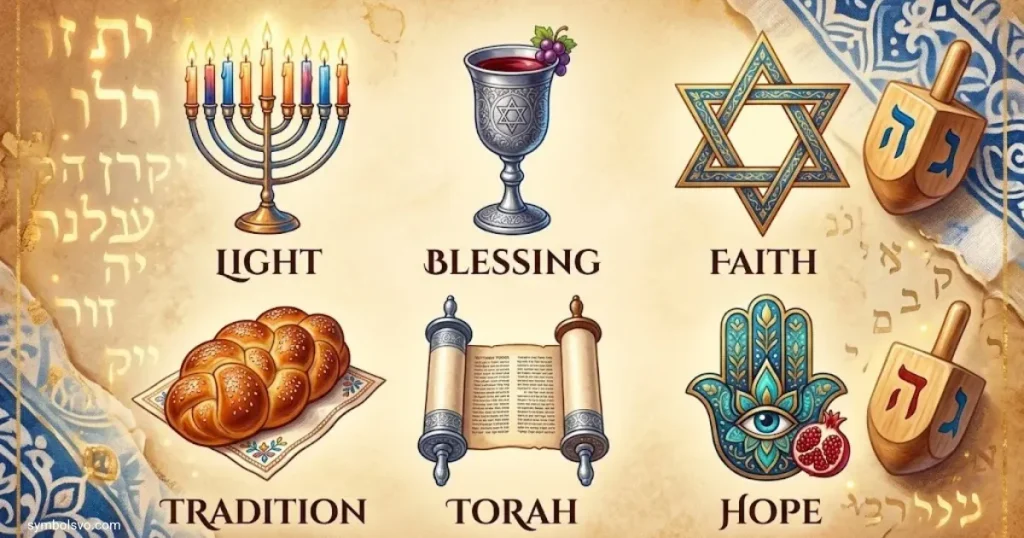
The dreidel has become more than a game piece. For many families, it represents Hanukkah traditions, shared memories, and a simple way to introduce children to Jewish history and Hebrew letters.
Why Do Jewish People Play Dreidel During Hanukkah?
Families often play dreidel during Hanukkah gatherings because the game combines fun with cultural learning. Children can recognize the Hebrew letters, practice remembering their names, and learn the traditional phrase associated with the holiday.
The game also creates opportunities for generations to spend time together. Grandparents may teach children the rules, while adults share stories about how they played growing up.
Dreidel isn’t a required religious ritual. Rather, it’s a popular custom that has become closely associated with the holiday through generations of family and community celebrations.
How Dreidels Differ Around the World
The most recognizable regional difference is the final letter. Many dreidels outside Israel display Shin, while Israeli versions commonly use Pey.
Other differences include the material, artwork, size, and decorative style. Some dreidels feature simple lettering, while others display colorful patterns, holiday designs, or elaborate craftsmanship.
These variations show how a familiar tradition can adapt to different communities while keeping its central meaning.
What Are Dreidels Made Of?
Modern dreidels come in many materials, depending on their purpose and design.
- Wood: A traditional-looking option with a simple, natural finish.
- Plastic: Lightweight and practical for everyday family games.
- Metal: Often used for durable or decorative designs.
- Silver: Common in ornamental or collectible dreidels.
- Glass and ceramic: Materials sometimes used for artistic display pieces.
The material doesn’t determine the meaning of the letters. Whether a dreidel is wooden, plastic, or silver, its Hebrew symbols carry the same conventional meanings when the standard letters appear.
Dreidel vs. Grogger: What’s the Difference?
A dreidel and a grogger are both associated with Jewish holiday traditions, but they serve different purposes.
A dreidel is a spinning top used during Hanukkah. A grogger is a noisemaker traditionally used during Purim, a holiday associated with the story told in the Book of Esther.
| Feature | Dreidel | Grogger |
| Associated holiday | Hanukkah | Purim |
| Main purpose | A spinning game | Making noise |
| Typical design | Four-sided spinning top | Handheld or rotating noisemaker |
| Main association | Hebrew letters and the Hanukkah miracle | Purim customs and the story of Esther |
The main difference is straightforward: a dreidel determines a player’s turn through its letters, while a grogger produces sound as part of a holiday custom.
Frequently Asked Questions About Dreidel Symbols
What Do the Four Letters on a Dreidel Stand For?
On a traditional dreidel outside Israel, Nun, Gimel, Hey, and Shin represent the first letters of Nes Gadol Haya Sham, meaning “A great miracle happened there.” The letters also tell players what to do during the game.
What Does Gimel Mean on a Dreidel?
Gimel (ג) represents Gadol, meaning “great,” in the traditional Hebrew phrase. During the game, Gimel means the player takes every piece in the center pot.
What Does Shin Mean on a Dreidel?
Shin (ש) represents Sham, meaning “there.” In the standard game, a player who spins Shin adds one piece to the pot.
Why Do Israeli Dreidels Have Pey Instead of Shin?
Israeli dreidels commonly use Pey (פ) to represent Po, meaning “here.” This creates the phrase Nes Gadol Haya Po, translated as “A great miracle happened here.”
What Does Sivivon Mean in Hebrew?
Sivivon, also spelled sevivon, is the Hebrew word for a spinning top. It refers to the toy used in the traditional Hanukkah game.
How Many Sides Does a Dreidel Have?
A traditional dreidel has four sides, each marked with a Hebrew letter. The letters are Nun, Gimel, Hey, and Shin outside Israel, while Israeli versions commonly substitute Pey for Shin.
Is the Story About Hiding Torah Study Historically Proven?
No reliable historical evidence establishes the popular story as the actual origin of the dreidel. The story remains a familiar Hanukkah tradition, while historical research connects the game’s development to older European spinning-top games.
What Is the Spiritual Meaning of a Dreidel?
The best-known symbolic meaning comes from the phrase Nes Gadol Haya Sham, which recalls the Hanukkah miracle. Later Jewish interpretations also connect the letters with ideas such as redemption, Jewish resilience, and gematria.
These additional interpretations should be distinguished from the traditional phrase and the letters’ original game instructions.
What Is the Difference Between Dreidel Letters in Israel and Outside Israel?
The main difference is the fourth letter. Many dreidels outside Israel use Shin for Sham, meaning “there,” while Israeli dreidels commonly use Pey for Po, meaning “here.” The other three letters and the basic game rules remain the same.
Conclusion:
Dreidel symbols combine a simple game with a rich cultural tradition. The four Hebrew letters—Nun, Gimel, Hey, and Shin—determine each player’s move while forming the familiar phrase Nes Gadol Haya Sham, or “A great miracle happened there.”
In Israel, the letter Pey commonly replaces Shin to create the phrase “A great miracle happened here.” This small change highlights the connection between language, geography, and Jewish identity.
The dreidel’s history also shows how traditions evolve. Although the popular story about children hiding Torah study remains meaningful, historical research connects the game’s development to older European spinning tops.
Today, families continue to play dreidel during Hanukkah, teaching children Hebrew letters and sharing holiday memories. Whether made of wood, plastic, or silver, the spinning top remains a familiar reminder of Jewish heritage, Hanukkah traditions, and the enduring significance of cultural symbols.

I’m Daniel Brooks, a content creator and symbol enthusiast dedicated to researching the fascinating world of signs and symbols. I enjoy discovering the hidden meanings behind famous icons, emojis, historical emblems, and cultural symbols. Through my writing, I aim to provide trustworthy, well-researched, and reader-friendly information that helps people learn something new with every visit.
Books:
- The Complete Guide to World Symbols
- The Power of Universal Signs
 Nathan Holloway
 Mason Ellington