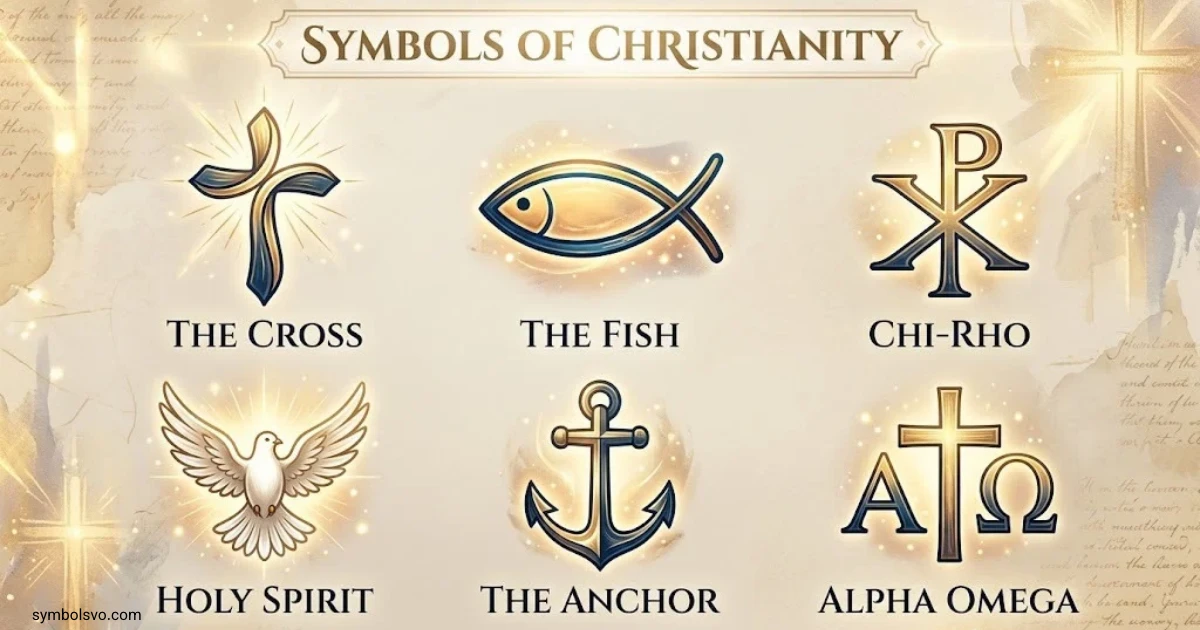
Christianity has a rich history filled with meaningful signs, images, and emblems that help believers understand their faith. From the cross and the fish to the dove and the Lamb of God, symbols of Christianity represent important beliefs about Jesus Christ, salvation, hope, love, peace, and eternal life.
Some Christian symbols and meanings come directly from the Bible, while others developed through centuries of Christian art, worship, and tradition. Churches often display these symbols in stained-glass windows, paintings, architecture, jewelry, and religious ceremonies.
Understanding Christian religious symbols and their meanings can help you explore the Bible, recognize Christian artwork, and learn how different denominations express their beliefs. This guide explains 25 important Christian symbols, their biblical connections, historical origins, and spiritual meanings.
What Are Christian Symbols?
Christian symbols are images, objects, letters, or signs that represent ideas central to the Christian faith. They can communicate religious teachings, remind believers of biblical events, or express spiritual concepts that are difficult to explain through words alone.
For example, the cross represents Jesus Christ’s crucifixion and the Christian belief in salvation. A dove often represents the Holy Spirit and peace, while a fish is associated with Jesus and the early Christian community.
Christian symbolism appears throughout Scripture and church history. Some symbols have clear biblical foundations, while others gained additional meanings through Christian traditions and artwork.
It is also important to distinguish between Christian symbols in the Bible and symbols that became popular later. The Bible mentions images such as the lamb, vine, bread, wine, dove, and anchor. Other familiar designs, including particular cross styles and Christograms, developed or became widespread during later periods.
25 Important Symbols of Christianity and Their Meanings
The following table provides a quick overview of common Christian symbols and meanings.
| Christian Symbol | Meaning | Biblical Connection |
| Cross | Sacrifice, redemption, and salvation | 1 Corinthians 1:18 |
| Crucifix | Jesus Christ’s suffering and death | John 19:17–30 |
| Ichthys (Fish) | Jesus Christ and Christian faith | Matthew 4:19 |
| Dove | Holy Spirit and peace | Matthew 3:16 |
| Lamb of God | Jesus’ sacrifice and victory | John 1:29 |
| Chi-Rho | Christ’s name and identity | Colossians 1:15–20 |
| Alpha and Omega | God’s eternity and sovereignty | Revelation 22:13 |
| Anchor | Hope and spiritual stability | Hebrews 6:19 |
| Bread and Wine | Communion and remembrance of Jesus | Luke 22:19–20 |
| Crown of Thorns | Jesus’ suffering and kingship | John 19:2 |
| Star of Bethlehem | Jesus’ birth and guidance | Matthew 2:1–10 |
| Rainbow | God’s covenant and faithfulness | Genesis 9:12–17 |
| Good Shepherd | Jesus’ care and guidance | John 10:11 |
| Palm Branch | Victory and Jesus’ entry into Jerusalem | John 12:12–13 |
| Water | Baptism, cleansing, and new life | John 3:5 |
| Sacred Heart | Christ’s love and compassion | John 19:34 |
| IHS | A traditional monogram for Jesus | Christian tradition |
| Flame | Holy Spirit and Pentecost | Acts 2:1–4 |
| Butterfly | Resurrection and transformation | Traditional Christian art |
| Lily | Purity, hope, and resurrection | Matthew 6:28–29 |
| Ship | The Church and the journey of faith | Traditional Christian art |
| Pelican | Self-sacrifice and Christ’s love | Traditional Christian art |
| Keys | Authority and the kingdom of heaven | Matthew 16:19 |
| Triquetra | The Holy Trinity in some traditions | Christian tradition |
| Lion of Judah | Christ’s kingship and victory | Revelation 5:5 |
Meanings may vary by denomination, historical period, and artistic context. Not every symbol in the table appears in the Bible as a specifically Christian emblem.
The Cross: The Most Recognized Christian Symbol
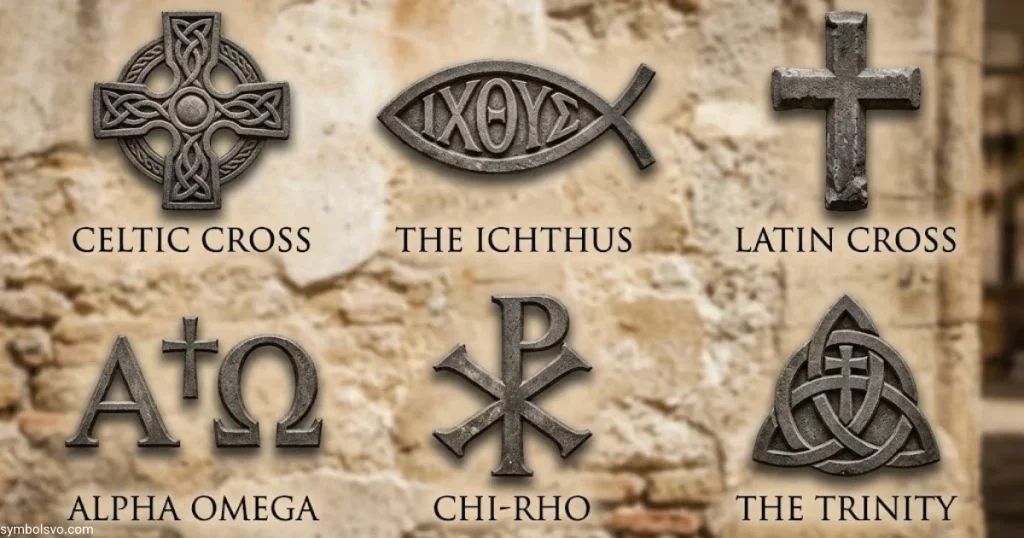
The Christian cross is widely recognized as the central symbol of Christianity. It reminds Christians of Jesus Christ’s crucifixion and the belief that his death and resurrection bring forgiveness, reconciliation, and salvation.
In 1 Corinthians 1:18, Paul describes the message of the cross as the power of God for those who are being saved. For Christians, the cross therefore represents more than suffering. It also points toward hope, redemption, and victory over death.
Several types of Christian crosses have developed throughout history. Their shapes and uses can differ across Christian traditions.
Latin Cross
The Latin cross has a long vertical line crossed by a shorter horizontal line above its midpoint. It is one of the most familiar Christian designs.
It represents Jesus’ crucifixion and the Christian message of salvation. Many Protestant churches and other Christian communities use a plain cross to emphasize the resurrection as well as Christ’s sacrifice.
Crucifix
A crucifix is a cross that includes a representation of Jesus’ body. It is particularly associated with Roman Catholicism, although it also appears in some other Christian traditions.
The crucifix emphasizes Christ’s suffering and his sacrificial death. A plain cross and a crucifix communicate closely related beliefs, but their visual emphasis differs.
Greek Cross
The Greek cross has four arms of approximately equal length. It appears in Byzantine and Eastern Christian art, church decoration, and architectural designs.
Its balanced shape makes it a distinctive example of Christian religious imagery.
Orthodox Cross
The Eastern Orthodox cross commonly features three horizontal bars. The upper bar represents the inscription associated with Jesus’ crucifixion, while the lower slanted bar is traditionally interpreted in relation to the two men crucified beside Jesus.
Specific explanations and artistic details vary across Orthodox traditions.
Celtic Cross
The Celtic cross combines a Christian cross with a circular ring around the intersection. It is associated with Celtic Christian art and is often seen in Ireland, Scotland, and other regions influenced by Celtic traditions.
Its meaning depends on context, but it commonly represents Christian faith and heritage.
Jerusalem Cross
The Jerusalem cross features a large central cross surrounded by four smaller crosses. It is associated with Jerusalem and the historical Christian tradition of pilgrimage to the Holy Land.
The five crosses are sometimes interpreted in connection with Christ’s wounds or the spread of Christianity, although explanations vary.
Other Christian Cross Designs
Other designs include St. Andrew’s Cross, the Maltese Cross, the papal cross, and the cross and crown. Each has a particular historical or denominational association.
When studying types of Christian crosses, remember that a cross’s meaning may depend on where it appears, who uses it, and how it is decorated.
Early Christian Symbols and Christograms
Before the cross became the dominant visual emblem of Christianity, early Christians used a variety of images and letter combinations to express their beliefs.
These early Christian symbols appeared on objects, tombs, rings, and other forms of religious art. They helped communicate ideas about Christ, resurrection, baptism, and eternal life. Historical accounts describe symbols such as the fish, anchor, dove, and Chi-Rho among early Christian imagery. Christianity Today discusses how these symbols developed over time.
Ichthys: The Christian Fish Symbol
The Ichthys, commonly called the Christian fish or Jesus fish, is formed from two curved lines that create the outline of a fish.
The Greek word ichthys means “fish.” Early Christians also associated its letters with a Greek phrase meaning “Jesus Christ, Son of God, Savior.” The fish became an important Christian sign during the early centuries of the Church. Loyola Press explains its connection with Jesus’ identity.
The fish also recalls biblical stories involving fishermen, Jesus’ disciples, and miraculous meals. It is still used on car decals, jewelry, clothing, and church materials.
The popular claim that Christians always used the fish as a secret recognition sign should be treated cautiously. The symbol’s early Christian significance is well established, but some details of the familiar secret-password story are less certain.
Chi-Rho
The Chi-Rho symbol combines two Greek letters: chi (Χ) and rho (Ρ). These are the first two letters of the Greek word Christos, meaning Christ.
The symbol became especially prominent during the reign of Roman Emperor Constantine in the fourth century. It later appeared in Christian manuscripts, coins, and religious artwork.
The Chi-Rho represents Jesus Christ and his central place in Christian belief. It is one of the best-known examples of a Christogram, which is a monogram or combination of letters used to represent Christ.
Alpha and Omega
Alpha and Omega are the first and last letters of the Greek alphabet. In Revelation 22:13, the speaker declares, “I am the Alpha and the Omega, the First and the Last, the Beginning and the End.”
The phrase communicates God’s eternal nature and sovereignty. In Christian art, the letters may appear beside a cross, around a depiction of Christ, or within a church decoration.
IHS: The Holy Name of Jesus
IHS is a traditional Christian monogram associated with the name of Jesus. It developed from the first letters of the name in Greek and later became familiar in Western Christian art and devotion.
You may find IHS on church altars, vestments, stained glass, and religious objects. It serves as a visual reminder of Jesus and his importance in Christian worship.
INRI
INRI represents the Latin phrase Iesus Nazarenus, Rex Iudaeorum, meaning “Jesus of Nazareth, King of the Jews.”
According to John 19:19–22, this title was placed on the inscription above Jesus during the crucifixion. It frequently appears on crucifixes and other Christian artwork.
Staurogram or Tau-Rho
The staurogram, also called the Tau-Rho, combines the Greek letters tau (Τ) and rho (Ρ). It appears in some early Christian manuscripts as an abbreviation connected with words for the cross and crucifixion.
It is an important example of how early Christians used written forms to communicate religious meaning.
Symbols of God, Jesus, and the Holy Trinity
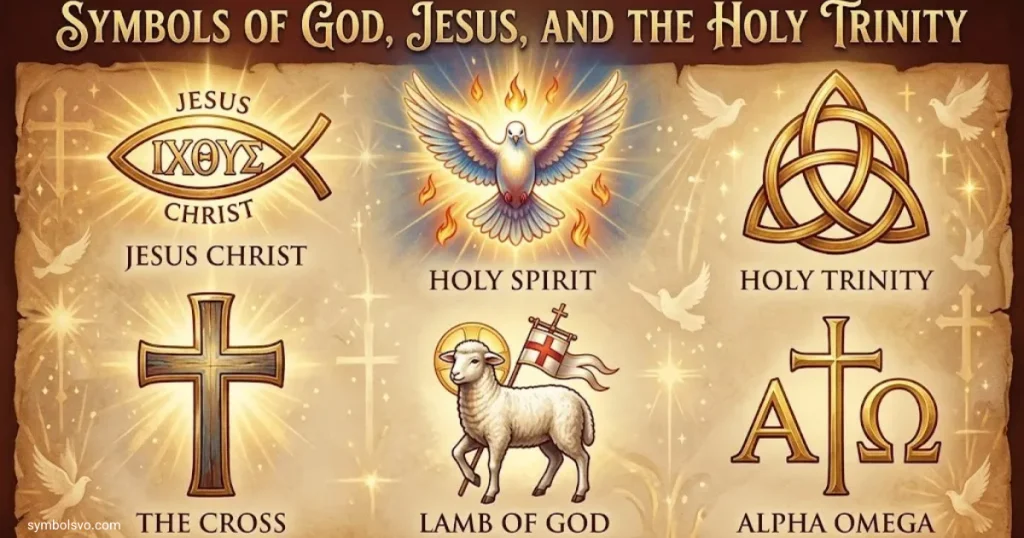
Many Christian symbols focus on the identity of Jesus, the character of God, or the Christian doctrine of the Trinity.
The Trinity teaches that God is one God in three persons: the Father, the Son, and the Holy Spirit. Christian art uses several visual designs to help explain this belief, although no symbol completely captures the doctrine.
Dove: Symbol of the Holy Spirit
The dove symbol is strongly associated with the Holy Spirit. In Matthew 3:16, the Spirit of God descends like a dove when Jesus is baptized.
Because of this biblical scene, artists often portray a white dove in paintings of the baptism of Jesus and other religious works. The dove can also represent peace, purity, and divine presence.
Its meaning depends on context. In the story of Noah, a dove brings an olive leaf, signaling that the floodwaters are receding (Genesis 8:11). This contributes to its wider associations with peace and renewal.
Lamb of God
The Lamb of God is one of the most important symbols of Jesus Christ. In John 1:29, John the Baptist identifies Jesus as the Lamb of God who takes away the sin of the world.
The lamb recalls the biblical tradition of sacrifice and expresses the Christian belief that Jesus gave his life for humanity. In Revelation, the Lamb also appears as victorious and worthy of honor.
Christian art sometimes depicts a lamb carrying a banner to represent Christ’s victory over death.
Good Shepherd
Jesus describes himself as the good shepherd in John 10:11. The Good Shepherd symbol shows Christ caring for, guiding, and protecting his followers.
Artwork may portray Jesus carrying a sheep or standing among a flock. The image reflects the relationship between a shepherd and the sheep in his care.
It communicates love, guidance, responsibility, and the Christian belief that Jesus knows and cares for his people.
Sacred Heart
The Sacred Heart of Jesus is particularly important in Roman Catholic devotion. It commonly appears as a heart surrounded by rays of light and sometimes a crown of thorns or a cross.
The symbol represents Christ’s love, mercy, and willingness to suffer for humanity. Its imagery draws on Christian reflection about Jesus’ compassion and the events of his crucifixion.
Crown of Thorns
The Crown of Thorns recalls the crown placed on Jesus’ head before his crucifixion, as described in John 19:2.
It represents humiliation, suffering, and the sacrifice associated with Jesus’ death. At the same time, the crown can remind Christians that Jesus’ kingship differs from worldly ideas of power.
Vine
In John 15:1, Jesus describes himself as the true vine and his followers as branches. The vine symbol represents spiritual connection, growth, and dependence on Christ.
The image reminds believers that a fruitful spiritual life depends on maintaining a relationship with Jesus.
Symbols of the Holy Trinity
There are several symbols of the Holy Trinity, including interlocking circles, triangular designs, and the triquetra.
- Triquetra: Three connected loops that can represent the unity of the Father, Son, and Holy Spirit.
- Triangle: Three sides may be used to illustrate the three persons of the Trinity and the unity of God.
- Three interlocking circles: A design sometimes used to communicate unity and the relationship among the three persons.
- Shamrock: A three-leaf plant traditionally used in Christian teaching about the Trinity, especially in Irish Christian heritage.
These designs are traditional teaching aids rather than literal descriptions of God. Their use varies across denominations and communities.
Christian Symbols of Hope, Faith, Salvation, and Eternal Life
Christian symbols frequently express hope, renewal, and confidence in God’s promises. Some are drawn directly from Scripture, while others became familiar through religious art.
Anchor
The anchor symbol represents hope and stability. Hebrews 6:19 describes hope as an anchor for the soul, making the connection especially meaningful in Christian interpretation.
Anchors also appeared in early Christian art. Their shape could suggest a cross, and their practical purpose made them a natural image for steadfastness during difficult times.
Bread and Wine
Bread and wine are central to the Christian Eucharist, also known as Holy Communion or the Lord’s Supper.
In Luke 22:19–20, Jesus shares bread and a cup with his disciples and connects them with remembrance of him and the new covenant. Christian communities commemorate this event during worship.
The interpretation of Communion differs among denominations. Nevertheless, bread and wine remain widely recognized symbols of Jesus’ last meal with his disciples and his sacrifice.
Star of Bethlehem
The Star of Bethlehem is associated with the story of Jesus’ birth in Matthew 2:1–10. The Gospel describes wise men who follow a star as they travel to find the child Jesus.
In Christian artwork and Christmas decorations, the star represents guidance, hope, and the revelation of Christ. It is commonly placed at the top of Christmas trees or incorporated into Nativity scenes.
Rainbow
The rainbow is a biblical symbol of God’s covenant with Noah after the flood. In Genesis 9:12–17, God gives the rainbow as a sign of the covenant.
Within this biblical context, the rainbow represents God’s promise and faithfulness. Its meaning in modern culture can differ from its traditional biblical interpretation, so context matters.
Water
Water carries several meanings throughout the Bible. It can represent cleansing, life, renewal, and judgment.
Christian baptism uses water as a sign of initiation into the Christian community. Different denominations understand the sacrament in different ways, but water remains central to the ceremony.
Water also appears in stories about Noah’s flood, the Israelites crossing the sea, and Jesus meeting the Samaritan woman in John 4.
Butterfly
The butterfly symbol is often used in Christian art to represent transformation and resurrection. Its life cycle provides a visual analogy for change and new life.
Although the butterfly is not established in Scripture as a specific Christian emblem, its traditional meaning makes it popular in Easter decorations, religious crafts, and memorial artwork.
Lily
Lilies are associated with purity, hope, and new life in some Christian traditions. They are especially common in Easter arrangements and church decorations.
Matthew 6:28–29 mentions lilies in Jesus’ teaching about God’s care for creation. The passage is not specifically about Easter lilies, but the flower’s beauty has encouraged later Christian interpretations involving trust and renewal.
Pelican
In historic Christian art, the pelican can symbolize self-sacrifice. Medieval depictions sometimes showed a mother pelican feeding her young from her own body.
The image became an analogy for Christ’s sacrificial love and the Eucharist. This symbolism comes from traditional stories about the bird rather than a biblical account of pelicans behaving this way. United Methodist Communications explains the use of this image in Christian symbolism.
Ship
The ship is a traditional Christian image for the Church and the journey of faith. It can represent a community traveling through the difficulties of life while trusting in God.
A ship’s mast and cross-like structure also allowed artists to connect the image with Christian themes. This interpretation is rooted in church tradition and historical art rather than a single Bible verse that directly defines the ship as a Christian symbol.
Keys
In Matthew 16:19, Jesus speaks to Peter about the keys of the kingdom of heaven. In Christian art, keys are therefore associated with authority and the passage’s teaching about Peter.
Two crossed keys are especially associated with the papacy and the Vatican. Their interpretation depends on the religious and historical setting in which they appear.
Christian Animal Symbols and Their Meanings
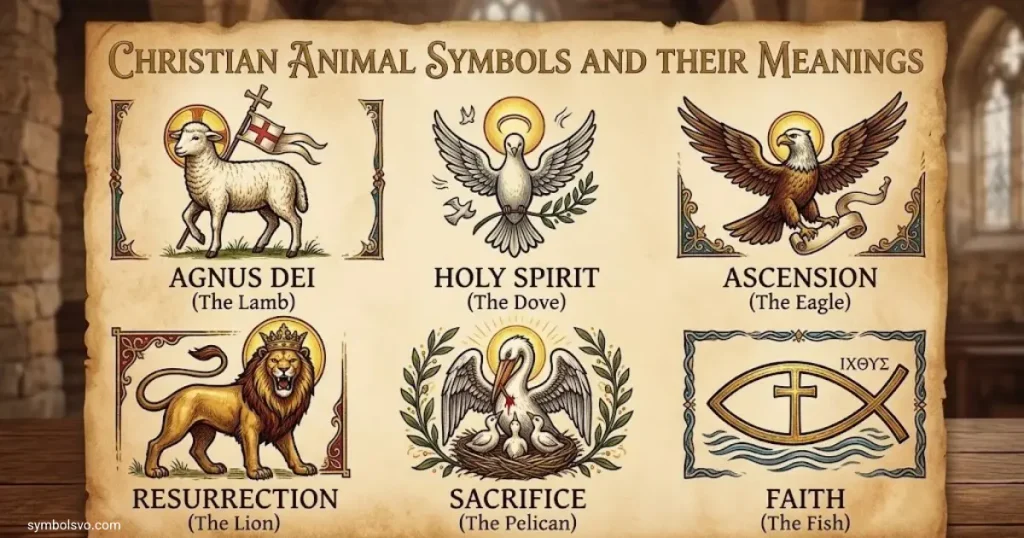
Animals appear throughout Scripture and Christian art. They can represent virtues, spiritual dangers, people, or aspects of God’s relationship with humanity.
These Christian animal symbols do not all have a single fixed meaning. A particular animal may represent different things in different passages.
Lamb and Sheep
Lambs and sheep are among the most familiar biblical animals. A lamb can represent Jesus as the Lamb of God, while sheep often symbolize believers who need guidance and care.
The image of Jesus as the Good Shepherd connects these meanings by presenting Christ as the one who protects and leads his followers.
Eagle
The eagle can represent strength, renewal, and spiritual elevation in Christian interpretation. Isaiah 40:31 compares those who hope in the Lord to eagles that rise on wings.
The eagle is also traditionally associated with John the Evangelist in Christian art.
Lion
The lion can symbolize courage, authority, and kingship. Revelation 5:5 refers to Jesus as the Lion of the crews of Judah.
However, lions can also represent danger or hostile power in other biblical passages. Their meaning depends on the surrounding text.
Ox
The ox is traditionally associated with Luke the Evangelist in Christian iconography. The image is connected with interpretations of the biblical vision of four living creatures.
In other contexts, the ox may represent service, strength, or sacrifice.
Serpent
The serpent is a complex biblical symbol. In Genesis 3, it is associated with temptation and disobedience. Other biblical passages use serpent imagery in different ways.
For this reason, the serpent should not automatically be treated as a positive Christian symbol. Its meaning depends on the passage and the artistic context.
Peacock
In some historic Christian artwork, the peacock symbolizes immortality or eternal life. This association developed through older cultural beliefs about the bird and its feathers.
It is best understood as a traditional artistic symbol rather than a direct biblical teaching.
Christian Number Symbolism in the Bible
Numbers sometimes carry symbolic significance in Scripture. Understanding their use can help readers recognize patterns in biblical narratives and religious artwork.
However, Christian number symbolism should be interpreted carefully. A number does not automatically carry the same meaning in every passage, and not every number has a hidden spiritual message.
| Number | Common Biblical Association | Example |
| One | Unity and the oneness of God | Deuteronomy 6:4 |
| Two | Witness, partnership, or agreement in certain contexts | Deuteronomy 19:15 |
| Three | Important biblical patterns, including the resurrection on the third day | 1 Corinthians 15:4 |
| Four | The earth or the four directions in some symbolic passages | Revelation 7:1 |
| Seven | Completeness or fulfillment in many biblical contexts | Genesis 2:2–3 |
| Ten | The Ten Commandments | Exodus 20 |
| Twelve | The crews of Israel and the twelve apostles | Matthew 10:2–4 |
| Forty | A period of testing, preparation, or transition in several narratives | Matthew 4:2 |
| 666 | The number of the beast in Revelation | Revelation 13:18 |
The Meaning of Three
The number three appears in important Christian teachings and narratives. Christians connect it with the resurrection of Jesus on the third day and, in another context, with the doctrine of the Trinity.
These are related but distinct uses. The number itself does not prove the doctrine of the Trinity; the doctrine is based on the broader Christian understanding of God.
The Meaning of Seven
Seven often appears in biblical passages involving completion or fulfillment. The creation account in Genesis includes six days of work followed by a seventh day of rest.
The number also appears repeatedly in Revelation, including its seven churches and seven seals. These uses contribute to its symbolic importance in biblical literature.
The Meaning of Twelve
Twelve is associated with the twelve crews of Israel and the twelve apostles. In Revelation, the number also appears in descriptions of the New Jerusalem.
These repeated patterns connect the number with God’s people and the organization of biblical communities.
The Meaning of Forty
Forty appears in stories involving preparation, testing, or major transitions. Moses spends forty days on Mount Sinai, the Israelites experience forty years in the wilderness, and Jesus fasts for forty days.
These examples show how a number can become associated with a recurring theme without functioning as a universal code.
Christian Symbols Found in the Bible
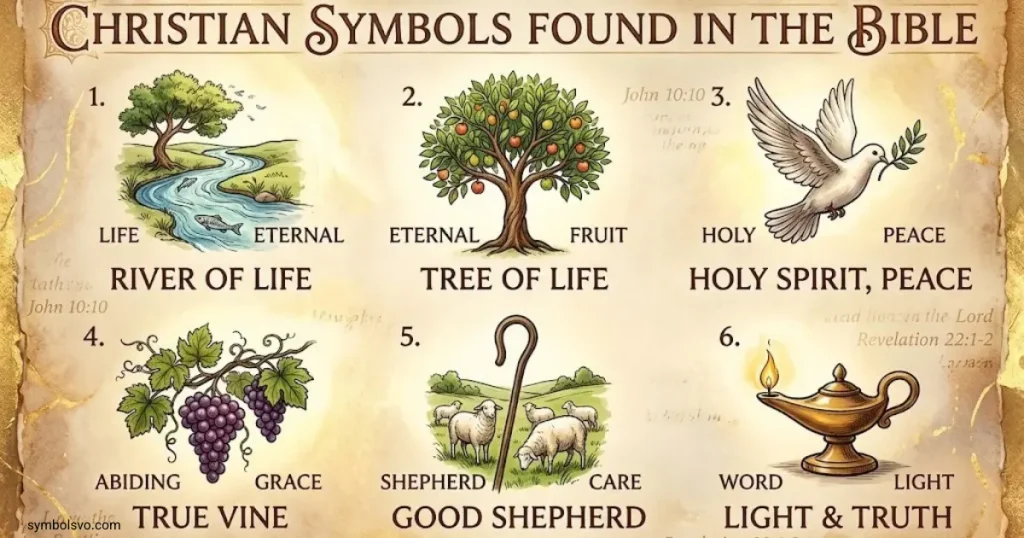
The Bible includes many images that later became important in Christian teaching, worship, and art. Recognizing their original context helps explain their significance.
Symbols in the Old Testament
- Rainbow: God’s covenant with Noah after the flood (Genesis 9:12–17).
- Tree of life: A symbol of life and access to the garden in Genesis 2–3.
- Passover lamb: Associated with the Israelites’ deliverance from Egypt in Exodus 12.
- Serpent: Appears in the account of temptation in Genesis 3 and in other biblical passages.
- Water: Appears in creation, the flood, the Exodus, and many other narratives.
Christians may interpret some Old Testament images in relation to Jesus and the New Testament. Such interpretations are part of Christian theology and should be distinguished from the original setting of the passages.
Symbols in the New Testament
- Dove: Associated with the Holy Spirit at Jesus’ baptism (Matthew 3:16).
- Lamb of God: Identifies Jesus with the lamb imagery used in Scripture (John 1:29).
- Bread and wine: Connected with the Last Supper (Luke 22:19–20).
- Vine: Represents Jesus and the relationship between him and his followers (John 15:1–5).
- Keys: Appear in Jesus’ teaching to Peter (Matthew 16:19).
- Alpha and Omega: Express God’s eternal nature in Revelation 22:13.
Revelation also uses symbols such as the Lamb, scrolls, lampstands, seals, and the beast. These images belong to the book’s complex vision literature, so their meaning should be considered within the wider passage.
Christian Symbols in Churches and Worship
Christian symbols are not limited to books and paintings. They appear in church buildings, worship services, religious ceremonies, and seasonal celebrations.
Baptism
Water is used in baptism as a sign of Christian initiation. Depending on the denomination, baptism may be understood in relation to forgiveness, new birth, covenant, faith, or membership in the Christian community.
Some churches also use a shell, a dove, or a cross in baptismal artwork.
Eucharist and Holy Communion
Bread and wine, or bread and grape juice in some communities, are used in Communion services. The ceremony recalls Jesus’ Last Supper with his disciples.
Christian traditions differ in their understanding of Christ’s presence in Communion. The symbols remain important, but their theological explanations are not identical.
Easter
Easter celebrates the resurrection of Jesus. Common Christian symbols of resurrection include the empty tomb, the cross, the butterfly, lilies, and the rising sun.
The empty tomb has a direct connection with the Gospel accounts. The butterfly, lilies, and rising sun are later or broader symbolic associations that help communicate new life and hope.
Palm Sunday
Palm branches recall Jesus’ entry into Jerusalem, when people welcomed him with branches and expressions of praise (John 12:12–13).
Many churches distribute palm branches during Palm Sunday services. In some traditions, these branches are later kept or used to prepare ashes for Ash Wednesday.
Stained Glass and Church Architecture
Stained-glass windows often show biblical stories, saints, and Christian symbols. Historically, such artwork helped communicate religious narratives to people who could not easily access written texts.
Churches may also use crosses, candles, altars, and symbolic architectural designs to express their beliefs. The exact forms vary across denominations and historical periods.
Christian Symbols Across Different Denominations
Christian denominations share many central beliefs, but they do not always use symbols in the same way.
Catholic Christianity makes extensive use of crucifixes, saints’ images, the Sacred Heart, and symbols connected with the sacraments.
Eastern Orthodox Christianity is known for icons, traditional depictions of Christ and the saints, and distinctive cross designs. Icons are treated as sacred images with a specific role in worship and devotion.
Protestant Christianity includes a wide range of traditions. Many Protestant churches emphasize the plain cross, the Bible, baptism, and Communion. Some use stained glass and religious artwork, while others prefer simpler worship spaces.
These descriptions are general rather than universal. Individual churches within each tradition may have different practices.
Lesser-Known Christian Symbols
Beyond the familiar cross and fish, many other images appear in Christian art and tradition.
Fleur-de-Lis
The fleur-de-lis is a stylized lily-shaped design. In some Christian artwork, it is associated with Mary, purity, or religious royalty.
It also appears in secular heraldry, so it is not exclusively Christian.
Three Nails
Three nails can represent the nails associated with Jesus’ crucifixion. In religious art, they serve as reminders of Christ’s suffering and sacrifice.
Their use is more traditional than biblical: the Gospels describe the crucifixion but do not establish a standard emblem of three nails.
Cross and Crown
The cross and crown combines the Christian cross with a crown. Depending on the tradition, it can represent victory through faith, Christ’s kingship, or the hope of eternal reward.
The symbol appears in several Christian communities, though its interpretation varies.
Flame of Pentecost
A flame represents the coming of the Holy Spirit at Pentecost in Acts 2:1–4. The passage describes what appeared to be tongues of fire resting on the disciples.
The flame is therefore associated with the Holy Spirit, spiritual renewal, and the beginning of the Church’s mission.
Chrismons
Chrismons are Christian symbols, often made as white and gold ornaments for Christmas trees. The term combines the ideas of Christ and monogram.
Common designs include the Chi-Rho, the cross, Alpha and Omega, and other symbols associated with Jesus. Some churches use Chrismons to teach biblical stories and Christian beliefs. United Methodist Communications provides examples of these designs.
Why Are Christian Symbols Important?
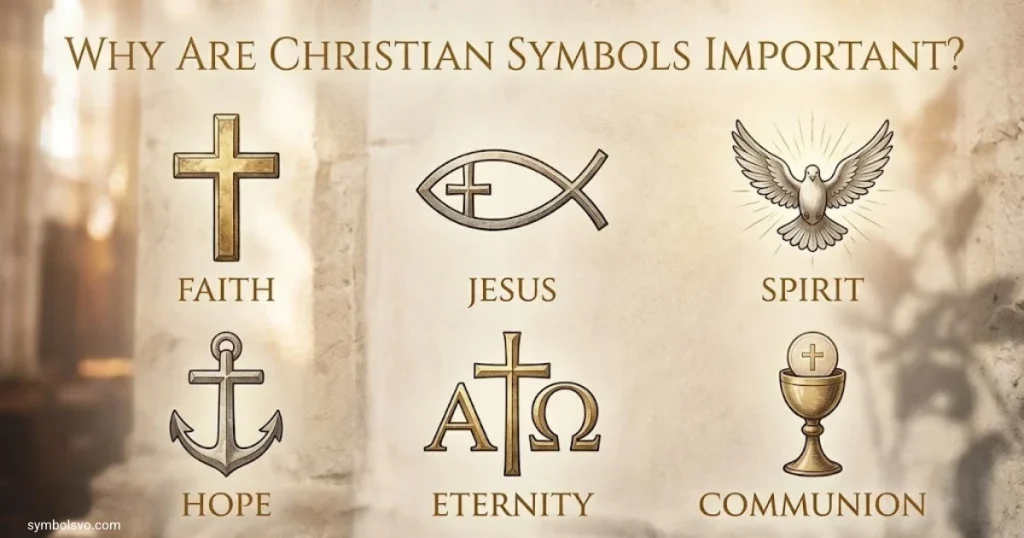
Christian symbols help believers express their faith in visual and memorable ways. Their importance goes beyond decoration.
- They communicate beliefs: The cross, lamb, and dove represent major Christian teachings.
- They connect Scripture with daily life: Familiar images remind believers of biblical stories and promises.
- They preserve history: Early Christian symbols provide clues about how believers expressed their faith in different periods.
- They support worship: Churches use symbols in sacraments, services, architecture, and religious art.
- They encourage reflection: A symbol can prompt someone to think about forgiveness, hope, sacrifice, or spiritual growth.
- They express community: Shared signs can communicate religious identity and belonging.
Still, a symbol is not the same as the belief it represents. Its meaning depends on Scripture, tradition, and the context in which it is used.
Frequently Asked Questions About Symbols of Christianity
What is the main symbol of Christianity?
The cross is the most widely recognized symbol of Christianity. It represents Jesus Christ’s crucifixion and the Christian belief in salvation through his death and resurrection.
What was the earliest Christian symbol?
The fish, or Ichthys, is among the earliest well-documented Christian symbols. Other early images included the dove, anchor, shepherd, and Christograms. The evidence does not support reducing the entire history of early Christian symbolism to one single symbol.
What is the difference between a cross and a crucifix?
A cross is a Christian symbol formed by intersecting lines. A crucifix includes a representation of Jesus’ body on the cross. Both relate to Jesus’ crucifixion, but they differ in visual emphasis and use.
What does the Christian fish symbol mean?
The fish, known as Ichthys, is associated with Jesus Christ and the Christian confession that he is the Son of God and Savior. Its Greek name also connects it with an early Christian phrase about Jesus’ identity.
What are the symbols of the Holy Trinity?
Common traditional representations include the triquetra, triangle, three interlocking circles, and shamrock. These designs are visual teaching aids for the Christian belief in one God in three persons.
What does the dove symbolize in Christianity?
The dove commonly represents the Holy Spirit because of the account of Jesus’ baptism in Matthew 3:16. It can also symbolize peace and renewal in other biblical and Christian contexts.
What does Alpha and Omega mean?
Alpha and Omega are the first and last letters of the Greek alphabet. In Revelation 22:13, they express God’s eternal nature and sovereignty as the beginning and the end.
What are the main Christian symbols of resurrection?
The empty tomb is directly connected with the Gospel accounts of Jesus’ resurrection. The cross, butterfly, lily, and rising sun are also used in Christian tradition to communicate resurrection, hope, and new life.
Do all Christian denominations use the same symbols?
No. Many Christian traditions share symbols such as the cross, dove, and bread and wine, but their artwork and worship practices differ. Catholic, Orthodox, and Protestant communities may use different designs or emphasize different meanings.
Are all Christian symbols mentioned in the Bible?
No. Some symbols are directly connected with biblical passages, while others developed through church history, religious art, and devotional traditions. The butterfly, Chrismons, and certain cross designs are examples of symbols whose familiar forms developed outside the biblical text.
Conclusion
The symbols of Christianity communicate some of the faith’s most important themes, including Jesus Christ’s sacrifice, the resurrection, the Holy Spirit, salvation, hope, and eternal life.
The cross remains the most recognizable Christian emblem, while the fish, dove, Lamb of God, Chi-Rho, Alpha and Omega, anchor, and other images offer additional ways to understand Christian beliefs. Some symbols come directly from Scripture, and others developed through centuries of church tradition and artistic expression.
Learning about Christian religious symbols and their meanings makes it easier to recognize them in churches, religious artwork, and everyday life. Most importantly, understanding their historical and biblical contexts helps explain not only what these symbols look like but also why they matter to Christians around the world.

I’m Daniel Brooks, a content creator and symbol enthusiast dedicated to researching the fascinating world of signs and symbols. I enjoy discovering the hidden meanings behind famous icons, emojis, historical emblems, and cultural symbols. Through my writing, I aim to provide trustworthy, well-researched, and reader-friendly information that helps people learn something new with every visit.
Books:
- The Complete Guide to World Symbols
- The Power of Universal Signs
 Nathan Holloway
 Mason Ellington