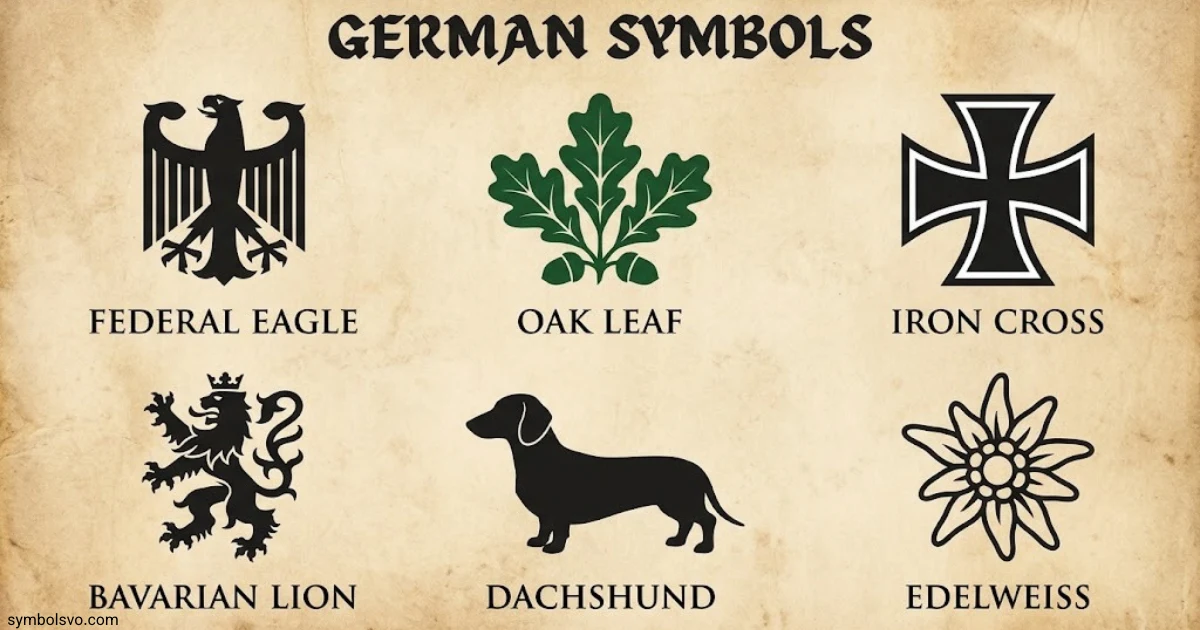
German symbols tell fascinating stories about a country’s national identity, regional traditions, artistic achievements, and changing history. Some represent democracy and unity, while others reflect centuries of craftsmanship, folklore, architecture, and everyday life.
From the black, red, and gold German flag to the Federal Eagle, Brandenburg Gate, and Black Forest cuckoo clock, each symbol offers a different glimpse into Germany’s past and present. However, not every familiar German image has official national status. Some belong to particular regions, historical periods, or cultural traditions.
This guide explores the most important German symbols and meanings, including official national emblems, famous landmarks, traditional cultural icons, ancient Germanic imagery, and symbols used in modern society. You’ll also discover how to distinguish German symbols from broader Germanic traditions and understand their historical context.
What Are German Symbols?
German symbols are images, objects, colors, buildings, and traditions associated with Germany and its people. They help communicate historical events, shared values, regional identities, and cultural achievements.
Some symbols have a formal connection to the German state. The federal flag, national anthem, and Federal Eagle are important examples. Others, such as the pretzel, cuckoo clock, and traditional Christmas market, represent cultural practices or regional heritage.
The distinction matters because Germany has a rich and varied history. Its present-day identity developed through different kingdoms, principalities, religious movements, political systems, and regional traditions.
German vs. Germanic Symbols
The terms German symbols and Germanic symbols are related, but they don’t mean the same thing.
- German symbols relate to modern Germany, its government, national history, and cultural traditions.
- Germanic symbols relate to the broader historical and linguistic traditions of Germanic peoples across Europe.
- Norse symbols belong primarily to the historical cultures and mythology of Scandinavia, although they share connections with wider Germanic traditions.
- Regional German symbols represent places such as Bavaria, Saxony, and the Black Forest rather than the entire country.
For example, the German flag represents the modern federal republic. By contrast, the runic alphabet belongs to an earlier historical writing tradition used by various Germanic-speaking communities.
German Symbols and Their Meanings
The following table summarizes some of the most recognizable symbols of Germany, including their origins and cultural associations.
| German symbol | Meaning or association | Historical or cultural context |
| German flag 🇩🇪 | National identity, unity, and democratic traditions | Federal Republic of Germany |
| Federal Eagle (Bundesadler) | Federal authority and state identity | German heraldry |
| Deutschlandlied | National identity, unity, justice, and freedom | German national anthem |
| Brandenburg Gate | Unity and political change | Berlin’s history |
| Berlin Wall | Division, resistance, and reunification | Cold War history |
| Oak tree and oak leaves | Strength and endurance in European symbolism | Heraldry and cultural imagery |
| Iron Cross | Military history | Prussian and German military traditions |
| Cuckoo clock | Regional craftsmanship | Black Forest |
| Lederhosen and dirndl | Regional dress and folk traditions | Bavaria and Alpine regions |
| Christmas tree | Seasonal celebration | German-speaking European traditions |
| Pretzel | Baking heritage and regional food culture | Particularly associated with southern Germany |
| Fachwerk house | Traditional timber-framed architecture | Historic German towns |
| German castles | Medieval history and romantic architecture | Regional architectural heritage |
| Fraktur typeface | Historical printing and typography | German publishing traditions |
| Bauhaus design | Modernism and functional design | Twentieth-century German art and architecture |
These examples show why German symbols and their meanings deserve more than a simple list. A national emblem, a regional food, and a historic monument can all represent Germany, but they do so in different ways.
Official German National Symbols
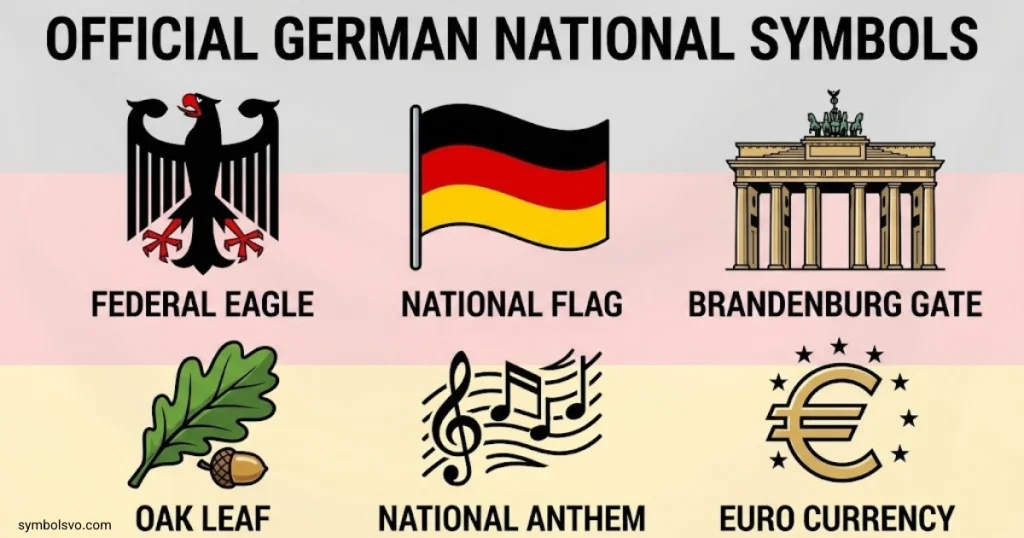
Official symbols represent the German state and its constitutional identity. They appear in government buildings, public ceremonies, official documents, and national celebrations.
According to the German Bundestag’s overview of state symbols, Germany’s federal flag, national colors, national anthem, and Federal Eagle all play important roles in national representation. The federal flag is the national symbol explicitly established in Article 22 of the Basic Law.
The German Flag: Black, Red, and Gold
Symbol: 🇩🇪
The German national flag features three horizontal stripes: black at the top, red in the middle, and gold at the bottom. These colors have a long history in German political movements.
Their modern national significance grew during the nineteenth century, when supporters of German unity and civil liberties adopted black, red, and gold. The colors appeared prominently during the Hambach Festival of 1832 and the revolutions of 1848–1849.
Germany later adopted different national colors during the imperial period. In 1919, the Weimar Republic restored black, red, and gold. The Federal Republic of Germany adopted them again in 1949, and the reunified country retained the tricolor in 1990.
Today, the black-red-gold flag represents Germany’s democratic state and its history of pursuing national unity.
One common misconception concerns the meaning of each individual color. People often assign black to hardship, red to courage, and gold to prosperity. These interpretations circulate widely, but they aren’t an official, universally established explanation of the flag.
The Federal Eagle (Bundesadler)
The Federal Eagle, known in German as the Bundesadler, is one of the country’s most recognizable official emblems. It depicts a black eagle and appears in official state settings, including the German parliament.
Eagles have a long history in European heraldry. Different rulers, kingdoms, and political institutions used eagle imagery to represent authority and sovereignty.
However, the modern Federal Eagle shouldn’t be confused with every historical German eagle. The Holy Roman Empire, Prussia, and other German states used different designs with distinct political meanings.
The Bundesadler represents the present-day federal state. Its historical predecessors reflect earlier political systems.
The German Federal Coat of Arms
Germany’s federal coat of arms features a black eagle on a gold shield. This emblem is closely connected to the Federal Eagle and the country’s official heraldic identity.
A coat of arms differs from a flag because it uses a heraldic design displayed on a shield. Governments, cities, states, and historically established families may have their own coats of arms.
Germany’s sixteen federal states also have individual emblems. Bavaria’s blue-and-white lozenges, for example, have a distinct regional identity and history.
These differences make German heraldry especially interesting. Similar visual elements can appear across several emblems without giving them identical meanings.
The German National Anthem: Deutschlandlied
Germany’s national anthem is based on the third stanza of Das Lied der Deutschen, commonly called the Deutschlandlied.
August Heinrich Hoffmann von Fallersleben wrote the song’s words in 1841, using a melody composed by Joseph Haydn. The song originally expressed aspirations for national unity and freedom during a period when Germany consisted of numerous separate states.
The third stanza begins with the ideas of unity, justice, and freedom. These themes align with the democratic identity of modern Germany.
The song became the national anthem during the Weimar Republic in 1922. Its political history later became complicated by the Nazi regime’s use of the first stanza in nationalist propaganda. Since 1952, the third stanza has served as the anthem of the Federal Republic of Germany.
Day of German Unity
The Day of German Unity, or Tag der Deutschen Einheit, is celebrated on October 3 each year.
This national holiday commemorates German reunification in 1990, when the former German Democratic Republic joined the Federal Republic of Germany. The event ended decades of division between East and West Germany.
The date carries particular significance because the fall of the Berlin Wall occurred earlier, on November 9, 1989. Reunification followed through political negotiations and legal agreements rather than immediately after the Wall opened.
Today, October 3 represents national unity, democratic change, and the peaceful restoration of a single German state.
Famous German Landmarks and Their Symbolic Meanings
Germany’s historic buildings and monuments preserve memories of political change, cultural achievements, and regional development. Several have become powerful German historical symbols recognized around the world.
Brandenburg Gate
The Brandenburg Gate is one of Berlin’s most famous landmarks. Built in the late eighteenth century, it originally served as a monumental entrance to the city.
Its meaning changed considerably over time. The gate became associated with Prussian power, later stood near the dividing line of Cold War Berlin, and eventually emerged as a symbol of reunification.
When Germany reunited in 1990, the Brandenburg Gate became a powerful setting for public celebrations. Today, visitors often associate it with freedom, unity, and Berlin’s role in modern German history.
Berlin Wall
The Berlin Wall once divided East and West Berlin. East German authorities began building the barrier in 1961, restricting movement between the two sides.
For decades, the Wall represented the Cold War’s political division. Families and communities found themselves separated, while the border became a powerful symbol of restricted freedom.
The Wall opened on November 9, 1989, following growing public pressure and political upheaval in East Germany. Its opening helped pave the way for reunification the following year.
Today, surviving sections, memorial sites, and painted stretches of the Wall preserve the memory of division and peaceful resistance. They also remind visitors that political freedom can change the course of a nation’s history.
Reichstag Building
The Reichstag Building houses Germany’s federal parliament, the Bundestag. Its history reflects the country’s changing political systems, from the German Empire through the Weimar Republic, dictatorship, division, and reunification.
The building’s modern glass dome attracts visitors and offers views across Berlin. Its transparent design is commonly associated with public access and government accountability.
Although the Reichstag is an important political landmark, it isn’t itself an official national emblem. Its significance comes from its role in German parliamentary history and democratic government.
Neuschwanstein Castle
Neuschwanstein Castle stands in Bavaria and is famous for its dramatic towers, mountain setting, and romantic architectural style.
King Ludwig II of Bavaria commissioned the castle in the nineteenth century. Its design drew inspiration from medieval architecture and romantic artistic ideas rather than serving as a typical medieval fortress.
The castle has become an internationally recognized image of Germany. Its fairy-tale appearance attracts visitors interested in architecture, Bavarian history, and European royal heritage.
Neuschwanstein represents a popular image of Germany, but it isn’t an official national symbol. Its association with fairy tales largely reflects its appearance and modern cultural reputation.
Cologne Cathedral and Fachwerk Houses
Germany’s architectural heritage includes monumental Gothic cathedrals and traditional timber-framed buildings.
Cologne Cathedral is a major example of Gothic architecture. Its long construction history and religious importance connect it to the development of medieval European art and architecture.
Meanwhile, Fachwerk houses feature visible timber frames with infill panels. Many historic German towns preserve examples of this building style, although timber framing also appears in other European countries.
These structures symbolize different aspects of German heritage. Cathedrals reflect religious institutions and monumental craftsmanship, while Fachwerk houses reveal local building traditions and everyday life.
Traditional German Cultural Symbols
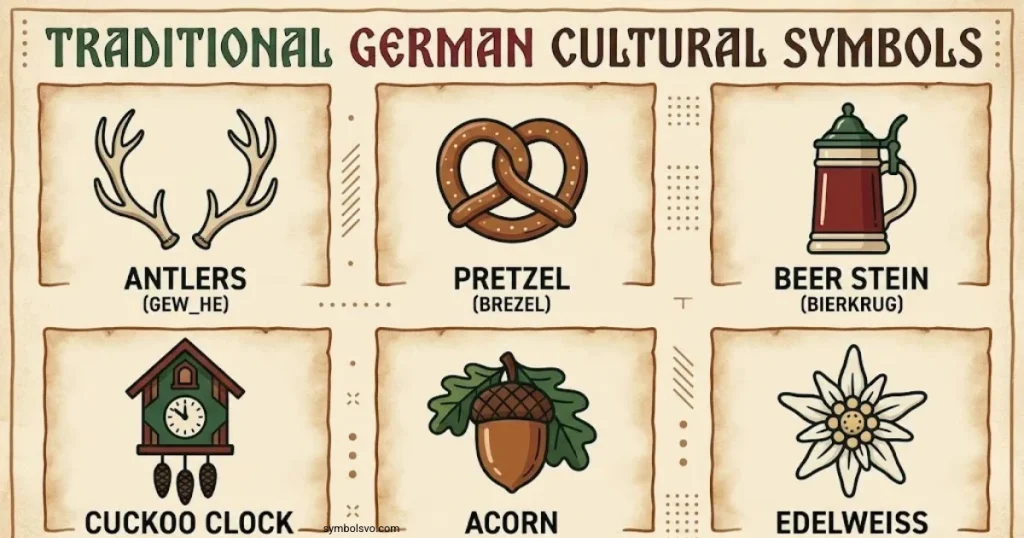
Some of the most recognizable German cultural symbols aren’t government emblems or monuments. They’re familiar objects and traditions that have developed through regional craftsmanship, celebrations, and everyday customs.
Black Forest Cuckoo Clock
The cuckoo clock is closely associated with the Black Forest region of southwestern Germany. Traditional versions feature wooden cases, carved decorations, and a small cuckoo that appears when the clock strikes.
The craft developed into a regional specialty, with makers creating different designs and mechanical features. Some clocks depict forest scenes, traditional houses, or figures performing small movements.
Cuckoo clocks symbolize regional craftsmanship and the preservation of traditional skills. They also show how a local product can become an internationally recognized cultural icon.
Oak Tree and Oak Leaves
The oak tree appears throughout European art, literature, and heraldry. Its long life and sturdy wood have made it a common symbol of strength, endurance, and stability.
Oak leaves also appear in historical military decorations, official imagery, and decorative designs. Their precise meaning depends on the particular emblem and its historical setting.
In German cultural imagery, oak motifs can evoke resilience and heritage. However, the oak isn’t Germany’s official national tree, and its symbolism isn’t exclusive to Germany.
German Christmas Tree
The Christmas tree is one of the best-known symbols associated with German-speaking Christmas traditions.
Evergreen trees became part of Christmas celebrations in German-speaking regions during the early modern period. Families gradually developed customs involving decorations, lights, ornaments, and gifts.
Today, Christmas trees appear in homes, town squares, churches, and public celebrations around the world. Their association with Germany reflects the historical influence of German-speaking European traditions, although Christmas customs have developed across many countries.
Advent Calendar, Advent Wreath, and Christmas Markets
These German Christmas symbols reflect the importance of seasonal celebration in many German communities.
- Advent calendar: Marks the days leading up to Christmas, often with small doors or compartments.
- Advent wreath: Typically features evergreen branches and four candles, with a candle associated with each Sunday of Advent.
- Christmas market: Brings together seasonal decorations, handmade crafts, food, and public festivities.
These traditions combine religious history with family customs and modern public celebrations. Their exact forms vary by region and household.
Beer Steins and Oktoberfest
Beer steins and traditional beer vessels are strongly associated with German brewing culture. Some feature decorative lids, ceramic designs, or regional motifs.
Oktoberfest, held in Munich, is a major Bavarian festival that attracts visitors from around the world. Traditional clothing, music, food, and beer tents contribute to its distinctive atmosphere.
However, Oktoberfest represents one regional tradition rather than all of Germany. The country’s cultural life includes many other festivals, local customs, and food traditions.
German Regional Symbols and Traditions
Germany’s regional identities are an essential part of its cultural heritage. The country’s sixteen federal states maintain distinct traditions, local emblems, and historical associations.
Bavarian Symbols
Bavaria is associated with blue-and-white lozenges, traditional Alpine clothing, regional festivals, and distinctive cuisine.
The blue-and-white diamond pattern appears in Bavarian heraldry and represents a recognizable regional identity. It’s particularly visible on flags, souvenirs, and official regional imagery.
Traditional clothing also contributes to Bavaria’s public image:
- Lederhosen: Leather breeches traditionally associated with men’s regional dress.
- Dirndl: A dress with a fitted bodice, blouse, skirt, and apron.
- Traditional hats: Regional headwear that may feature feathers, decorative cords, or other ornaments.
These garments have changed over time and are often worn at festivals, weddings, and cultural events. They’re not everyday clothing for every Bavarian.
Black Forest Regional Heritage
The Black Forest, or Schwarzwald, is a mountainous and forested region in southwestern Germany.
It’s associated with cuckoo clocks, woodcarving, traditional architecture, hiking, and regional food specialties. The forest also features prominently in German fairy-tale imagery and Romantic-era literature.
Its cultural identity comes from a combination of landscape, craftsmanship, tourism, and local traditions. These associations make the Black Forest one of the most recognizable regional symbols connected with Germany.
German State and Municipal Coats of Arms
Germany’s federal states and municipalities use their own heraldic emblems to represent local history and civic identity.
These designs may feature eagles, lions, crowns, shields, crosses, or other historical motifs. Each emblem has a particular origin, so its meaning should be checked individually.
Regional heraldry helps preserve the history of former kingdoms, duchies, principalities, and free cities. It also explains why several German symbols look similar without representing the same institution.
German Food Symbols and Culinary Heritage
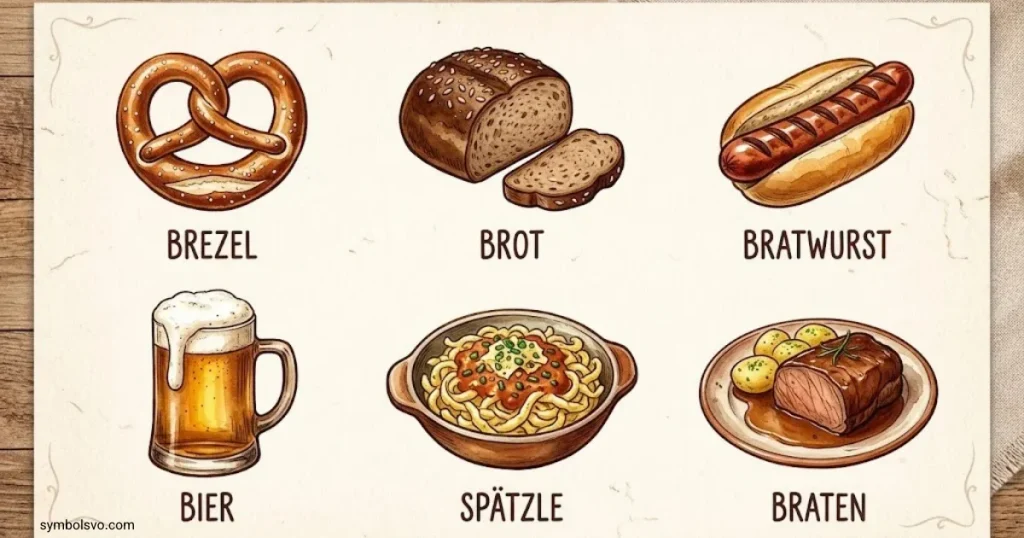
Food can serve as a powerful cultural marker. Germany’s regional dishes, baking traditions, and festive recipes often connect families with local history.
Pretzels and Bratwurst
The German pretzel is especially associated with southern Germany, including Bavaria and Baden-Württemberg. Its distinctive twisted shape makes it instantly recognizable in bakeries, beer gardens, and festival settings.
Bratwurst represents another important part of German food culture. The name refers to a category of sausages rather than one standardized recipe. Ingredients, seasoning, and preparation methods vary across regions.
Both foods appear at markets and public celebrations. Their popularity makes them recognizable symbols of German culture, although neither has official national-emblem status.
German Bread Culture
Germany has a particularly diverse bread tradition, with regional differences in grain, texture, shape, and baking methods. Rye breads, mixed-grain loaves, sourdough varieties, and rolls all feature in everyday meals.
Bread also reflects the importance of local bakeries and skilled food production. Germany’s documented German Bread Culture has been included in the country’s inventory of intangible cultural heritage.
This tradition shows that cultural symbols don’t always take the form of flags or monuments. Sometimes, they emerge from everyday routines passed between generations.
Black Forest Cake, Stollen, and Lebkuchen
Several German desserts carry strong regional or seasonal associations.
- Black Forest cake: A layered cake associated with the Black Forest region and made in well-known versions with chocolate, cherries, cream, and cherry spirit.
- Stollen: A rich fruit bread commonly associated with Christmas baking.
- Lebkuchen: A family of spiced baked goods strongly connected with German Christmas markets.
These foods represent regional recipes, festive gatherings, and baking traditions. Their exact ingredients and preparation methods vary, so it’s worth distinguishing a familiar commercial version from a particular regional recipe.
Ancient Germanic Symbols and Their Meanings
Ancient Germanic symbols require careful historical interpretation. Some come from archaeological finds or written inscriptions, while others became popular through later literature, modern spirituality, or political movements.
Germanic Runes and the Elder Futhark
The Elder Futhark is an early runic writing system associated with Germanic languages. It contains 24 characters and appears in inscriptions from the early centuries of the Common Era.
Runes primarily served as written characters. People carved them into objects such as stones, metalwork, and personal items. Some inscriptions identify people or commemorate events, while others remain difficult to interpret.
Modern designs often assign spiritual meanings to individual runes. These interpretations may draw on later traditions rather than direct evidence from the earliest inscriptions.
It’s important to remember that runes belong to a broader historical world. They aren’t simply an ancient German alphabet, nor do they all have one universal symbolic meaning.
Fehu Rune (ᚠ)
The Fehu rune is associated with a historical word for cattle or movable wealth. In early Germanic societies, livestock could represent an important store of economic value.
That background explains why modern interpretations often connect Fehu with wealth, resources, or prosperity. However, modern spiritual meanings shouldn’t be treated as exact translations of every historical inscription.
Othala Rune (ᛟ)
The Othala rune is associated with inherited property or an ancestral estate in historical Germanic linguistic contexts.
Today, its meaning depends heavily on where and how it appears. Some people encounter it in historical studies or decorative designs, while extremist groups have appropriated certain versions for political messaging.
That history matters. A character’s ancient origin doesn’t erase later associations, and a modern design shouldn’t automatically be described as harmless or historically authentic without examining its context.
Sun Wheels, Valknut, and Mjölnir
Ancient European artwork includes circular solar motifs and other geometric designs. Their meanings vary according to the object, period, and archaeological context.
Two other widely recognized symbols are the Valknut and Mjölnir, Thor’s hammer from Norse mythology.
- Valknut: A group of interlocking triangles found in some archaeological and artistic contexts associated with Norse culture. Its precise historical meaning remains debated.
- Mjölnir: The hammer associated with Thor, a major figure in Norse mythology.
- Solar motifs: Circular or radial designs that may appear in different ancient European traditions.
These images can be relevant to the wider history of Germanic peoples. However, Norse mythological symbols aren’t automatically official or uniquely German symbols.
German Symbols in Politics and Military History
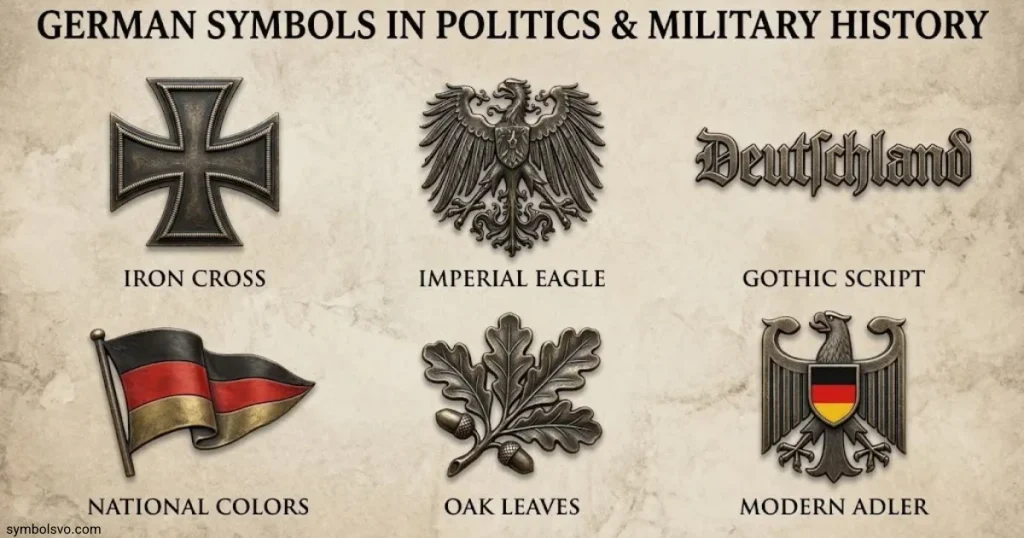
Germany’s political history has given several symbols meanings that changed across different periods. Understanding these changes helps explain why a design may represent military service in one context and carry more sensitive associations in another.
Iron Cross Meaning and History
The Iron Cross originated as a Prussian military decoration in the early nineteenth century. It later appeared in different forms during subsequent periods of German military history.
Its meaning depends on the specific design, date, and use. A historical medal, a museum artifact, and a modern emblem shouldn’t be assumed to carry identical associations.
The Iron Cross is therefore best understood as a symbol of military history rather than a general emblem representing every aspect of German culture.
Prussian Eagles and Military Heraldry
Prussia used eagle imagery in state and military heraldry. These historical designs reflect the power and identity of a former German kingdom.
Modern Germany’s Federal Eagle belongs to a different constitutional context. Although the designs share an eagle motif, the historical institutions and political meanings differ.
Comparing the emblems helps explain how German historical symbols can evolve without losing every connection to their past.
Nazi-Era Appropriation and Historical Misuse
The Nazi regime used political symbols to promote dictatorship, racial ideology, and persecution. It also appropriated historical imagery and presented selected symbols as evidence of an invented national past.
This period complicates the interpretation of some German and Germanic imagery. Certain runes and other historical motifs have since been adopted by extremist groups.
Historical context helps prevent two common mistakes:
- Treating every ancient Germanic symbol as extremist.
- Assuming a symbol has no modern political associations simply because it existed in ancient times.
When researching German symbols in history, examine the specific design, the period in which it appeared, and the group using it. Museums and established historical sources can help separate documented origins from later political claims.
German Symbols in Religion, Folklore, and Literature
Religious traditions, fairy tales, and literature contribute to Germany’s cultural identity. Their symbols often represent ideas and stories rather than formal national institutions.
Christian Cross and the Protestant Reformation
The Christian cross is an important religious symbol in Germany’s history. Christianity shaped religious art, architecture, education, music, and public life across many German-speaking regions.
The Protestant Reformation began in the early sixteenth century and became closely associated with Martin Luther. His challenge to established church practices helped transform Christianity across Europe.
Germany’s religious heritage includes Protestant, Catholic, Jewish, Muslim, and other communities. No single religious symbol represents every German citizen or the country’s entire contemporary society.
Brothers Grimm and German Fairy Tales
Jacob and Wilhelm Grimm became famous for collecting and publishing folk tales. Their work helped preserve stories that circulated through oral traditions and later influenced children’s literature worldwide.
Familiar stories include:
- Hansel and Gretel, featuring a forest journey and a dangerous house.
- Snow White, known for its magical mirror and enchanted narrative.
- Rapunzel, associated with a tower and long hair.
- Cinderella, a story with versions found across many cultures.
These tales helped popularize images of dark forests, castles, witches, wolves, and magical objects. However, not every story originated exclusively in Germany, and the Brothers Grimm’s published versions reflect their own editorial work.
Forests in German Folklore and Romanticism
Forests play a recurring role in German literature, folklore, and Romantic-era art. They can represent nature, solitude, mystery, danger, or a place where ordinary rules seem to disappear.
The Black Forest is particularly recognizable in popular cultural imagery. Yet its literary associations shouldn’t be mistaken for a single fixed meaning shared by every German community.
Music, Literature, and Bauhaus Design
Germany’s artistic heritage includes composers such as Johann Sebastian Bach, Ludwig van Beethoven, and Johannes Brahms. Writers such as Johann Wolfgang von Goethe and Friedrich Schiller also shaped European literary history.
These figures aren’t literal national emblems. Instead, their work contributes to the country’s cultural reputation and intellectual history.
The Bauhaus movement provides a different example. Founded in 1919, the influential school helped shape modern architecture, design, and applied art. Its sites in Weimar, Dessau, and Bernau are recognized by UNESCO for their importance to modernist architecture and design.
Bauhaus design is often associated with functional forms, clear geometry, and an emphasis on the relationship between form and use. Its influence extends far beyond Germany.
German Alphabet Symbols and Decorative Characters
Some searches for German symbols actually concern letters, typography, or decorative characters. These belong to German writing and visual design rather than the country’s official symbolism.
German Letters: Ä, Ö, Ü, and ß
Modern German uses the Latin alphabet, with three additional vowel characters and a special letter.
| Character | Name | Basic explanation |
| Ä ä | A with umlaut | A German vowel character |
| Ö ö | O with umlaut | A German vowel character |
| Ü ü | U with umlaut | A German vowel character |
| ß | Eszett or sharp S | Represents a particular s sound in German spelling |
These characters matter because they can change a word’s spelling and pronunciation. They’re useful when writing German names, place names, and everyday expressions correctly.
Fraktur and German Blackletter Typography
Fraktur is a historical blackletter typeface associated with German printing traditions. Related typefaces appeared in books, newspapers, and other printed materials over several centuries.
Blackletter isn’t a separate German alphabet. It represents a style of lettering used to display the Latin script.
Today, Fraktur may appear in historical documents, museum displays, traditional designs, or decorative branding. Its historical associations depend on the specific context.
German Symbols to Copy and Paste
The following characters may be useful for text, captions, or decorative designs.
| Symbol or character | Description |
| 🇩🇪 | German flag emoji |
| Ä ä | A with umlaut |
| Ö ö | O with umlaut |
| Ü ü | U with umlaut |
| ß | Eszett |
| ᚠ | Fehu rune |
| ᛟ | Othala rune |
| ✠ | Cross-like decorative character |
| ⚜ | Fleur-de-lis |
| ❖ | Decorative diamond |
| ✦ | Decorative star |
Important: Not every decorative character in this table has a historical connection to Germany. The fleur-de-lis, for example, appears in several European heraldic traditions. Runes also have their own historical and modern associations.
Use a character because you understand its meaning, not simply because it looks traditional.
German Symbols for Tattoos and Family Heritage
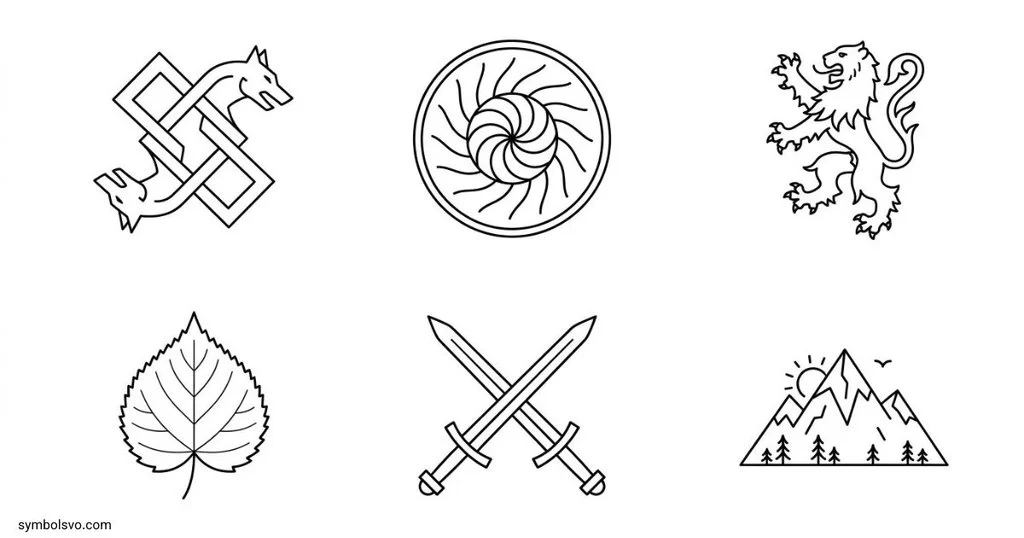
People interested in German ancestry sometimes choose symbols that reflect a family connection, regional background, or personal interpretation of German history. Researching a design first can help avoid incorrect meanings.
German Eagle and Oak Leaf Tattoos
An eagle tattoo may draw inspiration from German heraldry, but its meaning depends on the exact design. A modern Federal Eagle, a Prussian eagle, and a generic eagle illustration aren’t interchangeable.
Oak leaf tattoos offer a more general nature-inspired design. Oak leaves often suggest strength or endurance in European imagery, although the interpretation remains personal unless the design comes from a specific historical emblem.
German Family Crests and Heraldic Shields
A German family crest is often used loosely to describe a shield or heraldic design associated with ancestry. Historically, coats of arms identified particular people, families, institutions, or territories.
A surname alone doesn’t prove that a particular coat of arms belongs to every person who shares that name. Before treating a design as an ancestral emblem, verify its documented history through reputable heraldic records.
Regional coats of arms may also be suitable for representing a documented connection to a particular part of Germany.
Runic Tattoos and Historical Context
Runic designs can appeal to people interested in ancient writing and Germanic history. However, historical accuracy and modern associations both matter.
Before interpreting a rune as a symbol of family heritage, check its original linguistic context and the ways different groups have used it over time. Some runes have been appropriated by extremist movements, so the exact design matters.
A landscape, historic building, regional emblem, or verified family coat of arms may communicate a personal connection more clearly than a rune with disputed meanings.
German Symbols in Modern Society
Modern Germany combines historical traditions with contemporary democratic values, cultural diversity, and technological innovation. Its symbols continue to evolve as people interpret the past through present-day experiences.
National Identity and Democratic Values
The German flag and Federal Eagle remain important symbols of the federal state. They appear at official ceremonies, public institutions, and national events.
The national flag also appears at sporting competitions and civic celebrations. Its black, red, and gold colors connect contemporary Germany with earlier movements for unity and political freedom.
Historical memorials serve another purpose. They preserve the memory of dictatorship, persecution, division, and the struggle to establish democratic institutions.
Engineering, Automobiles, and Innovation
Germany is internationally associated with engineering, automobile manufacturing, industrial design, and technical research.
Automobile brands such as BMW, Mercedes-Benz, and Volkswagen contribute to this reputation. However, German engineering and automobile logos are cultural associations rather than official national symbols.
The same distinction applies to the Autobahn. Germany’s highway network represents modern transportation infrastructure and features prominently in international perceptions of German motoring.
Bauhaus design provides a useful link between history and modern innovation. Its influence on architecture, furniture, and visual communication shows how a cultural movement can shape everyday objects long after its original period.
Cultural Diversity and Changing Interpretations
German identity isn’t limited to traditional clothing, regional food, historic buildings, or familiar national colors. Contemporary Germany includes people with diverse family histories, languages, religious traditions, and cultural experiences.
As a result, German symbols in modern society can carry different meanings for different communities. A historical monument might represent national pride to one person and painful memories to another.
Understanding these differences creates a more complete picture of German cultural identity. Symbols become more meaningful when their historical background and present-day significance are considered together.
Frequently Asked Questions About German Symbols
What Are the Most Famous German Symbols?
Some of the most recognizable symbols include:
- The German flag, with its black, red, and gold stripes.
- The Federal Eagle, or Bundesadler.
- The Deutschlandlied, Germany’s national anthem.
- Brandenburg Gate and the Berlin Wall.
- Neuschwanstein Castle.
- The Black Forest cuckoo clock.
- Traditional Christmas markets and Bavarian regional clothing.
These examples include both official national symbols and cultural icons.
What Is the Main National Symbol of Germany?
Germany doesn’t have just one symbol that represents every aspect of the country. The German federal flag is explicitly established in Article 22 of the Basic Law, while the Federal Eagle serves as an important official emblem.
The national anthem also represents the Federal Republic of Germany at official ceremonies and international events.

Gesetze im Internet
+1
What Do the Black, Red, and Gold Colors Mean?
The black-red-gold flag is historically connected to movements for German unity and civil liberties. These colors became prominent during the nineteenth century and were adopted by the Weimar Republic and the modern Federal Republic.
Although people sometimes assign separate meanings to each color, the historically established association is with the broader movement for unity and freedom.
What Does the German Eagle Symbolize?
The German eagle symbol represents federal state identity and authority. Its modern form belongs to Germany’s official heraldic tradition.
Eagles also appeared in earlier German political systems, including the Holy Roman Empire and Prussia. Their designs and meanings varied across different periods.
What Does the Brandenburg Gate Represent?
The Brandenburg Gate represents several stages of German history, including Prussian rule, Cold War division, and reunification.
Today, it’s widely recognized as a landmark associated with Berlin, freedom, and German unity.
Are German and Germanic Symbols the Same?
No. German symbols relate to modern Germany, its national institutions, regional cultures, and history. Germanic symbols relate to broader historical traditions among Germanic-speaking peoples across Europe.
Runes and Norse mythological imagery belong to that wider historical context. They shouldn’t automatically be treated as symbols of modern Germany.
What Are Traditional German Cultural Symbols?
Recognizable traditional German symbols include cuckoo clocks, Christmas trees, Advent wreaths, pretzels, regional folk costumes, and historic timber-framed houses.
Their meanings depend on regional traditions and historical context. Most are cultural icons rather than official national emblems.
What Does the Iron Cross Mean in German History?
The Iron Cross began as a Prussian military decoration and later appeared in different forms during German military history.
Its meaning depends on the design, period, and use. Historical context is especially important when distinguishing museum artifacts from modern political imagery.
What German Symbols Are Suitable for Tattoos?
People interested in German heritage may consider documented regional coats of arms, historic architecture, oak leaves, landscapes, or designs inspired by traditional craftsmanship.
Before choosing a historical emblem or rune, verify its origins and modern associations. A symbol’s appearance alone doesn’t establish its meaning or connection to a particular family.
Where Can I Find German Symbols to Copy and Paste?
You can copy the German flag emoji 🇩🇪 and German letters such as Ä, Ö, Ü, and ß from the tables in this article.
Decorative characters and runes are also available in Unicode. However, some characters have meanings or political associations beyond their appearance, so research unfamiliar symbols before using them.
Conclusion:
German symbols offer a window into the country’s national history, cultural traditions, regional identities, and modern society. The black, red, and gold flag represents the historical pursuit of unity and freedom, while the Federal Eagle serves as an official emblem of the German state.
Other symbols tell different stories. Brandenburg Gate and the Berlin Wall preserve memories of division and reunification. The Black Forest cuckoo clock represents regional craftsmanship, while Christmas markets, pretzels, and traditional folk costumes reflect particular cultural practices.
Ancient Germanic symbols require additional care because their historical origins don’t always match their modern interpretations. Runes, military emblems, and mythological designs can carry different meanings across periods and communities.
Ultimately, the most useful way to understand German symbols and their meanings is to examine where each symbol originated, how people used it, and what it represents today. That approach reveals a richer picture of Germany than any single flag, landmark, or cultural icon could provide.

I’m Nathan Holloway, a passionate researcher and writer with a deep interest in symbols, signs, and their hidden meanings. I enjoy exploring how symbols have influenced different civilizations, religions, and modern communication. Through my work, I aim to make complex historical and cultural concepts easy to understand for readers of all backgrounds. Every article I write is carefully researched to provide reliable and engaging information.
Books:
- Beyond the Symbol
- The Secret Meanings of Everyday Signs
Author 2: Grace Whitmore
Description:
My name is Grace Whitmore, and I love discovering the stories behind the world’s most fascinating symbols. I spend my time researching ancient civilizations, mythology, spiritual traditions, and modern iconography to uncover the meanings people often overlook. I believe that every symbol has a history worth telling, and I enjoy sharing that knowledge in a simple and reader-friendly way.
Books:
- Echoes of Ancient Symbols
- The Symbolic World
 Mason Ellington
 Daniel Brooks