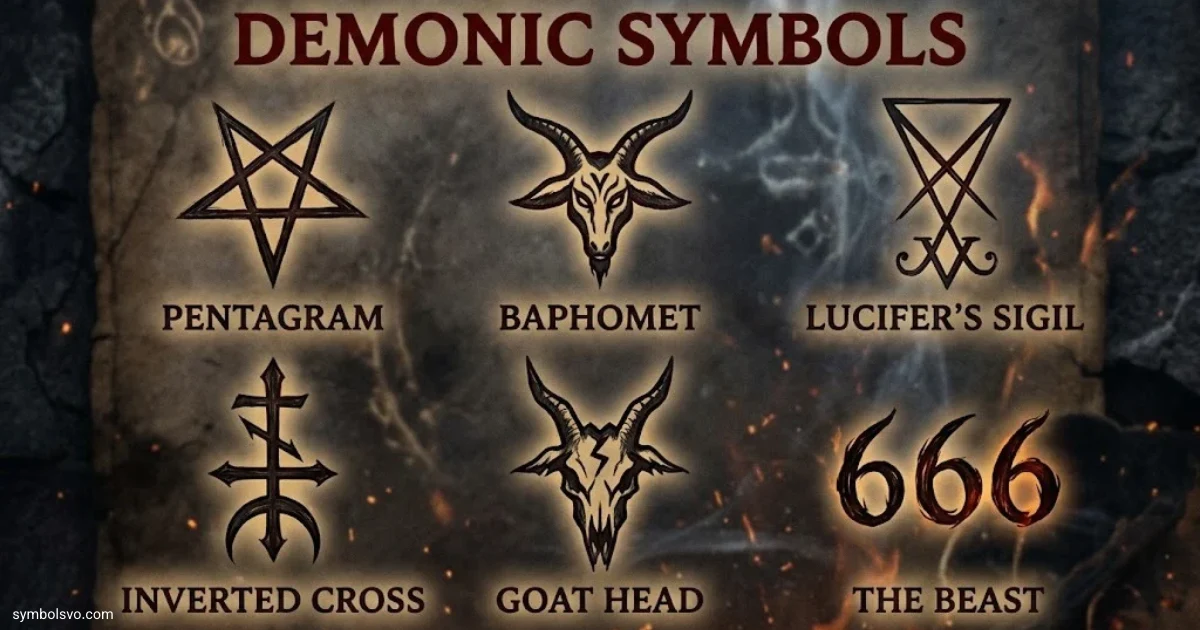
Demonic symbols have fascinated people for centuries. They appear in religious texts, ancient folklore, medieval manuscripts, occult artwork, horror movies, and modern graphic design. Some represent supernatural evil, while others have acquired darker meanings through later interpretations.
However, demonic symbols and their meanings aren’t always as straightforward as they seem. A pentagram might represent spiritual protection in one tradition and Satanic imagery in another. A serpent can symbolize temptation, wisdom, healing, or transformation, depending on the culture.
Understanding these differences helps you separate historical facts from popular myths. This guide explores well-known demonic symbols, their origins, religious associations, and modern uses while explaining which interpretations historians can actually support.
What Are Demonic Symbols?
Demonic symbols are images, signs, numbers, or emblems associated with demons, Satan, harmful supernatural beings, or ideas about spiritual evil within particular cultural and religious traditions.
People encounter these symbols in many settings. Ancient communities used images and protective objects to express beliefs about supernatural forces. Medieval writers recorded magical diagrams in manuscripts. Modern artists use similar imagery to communicate fear, mystery, rebellion, or other themes.
The meaning of a symbol depends on its historical and cultural context. An image associated with evil in one religious tradition might represent protection or wisdom in another.
For example, Christian interpretations of the serpent often emphasize temptation because of its role in the biblical story of Adam and Eve. Other traditions associate serpents with renewal, healing, or knowledge.
It’s also important to distinguish demonic symbolism, Satanic imagery, and occult symbolism:
- Demonic symbolism concerns images associated with demons or demonic forces.
- Satanic symbolism refers to imagery connected with Satan, Satanism, or related cultural representations.
- Occult symbolism includes signs used in various esoteric, magical, or hidden-knowledge traditions.
- Religious symbolism encompasses images representing beliefs, sacred stories, spiritual identities, and religious practices.
These categories sometimes overlap, but they aren’t interchangeable.
List of Demonic Symbols and Their Meanings
The following table summarizes several recognizable symbols associated with demons, Satan, and occult traditions. Their meanings vary, so the descriptions distinguish established associations from broader interpretations.
| Symbol | Common association | Important context |
| Sigil of Baphomet | Modern Satanic imagery | Associated with the Church of Satan |
| Inverted pentagram | Occult and Satanic imagery | Interpretation depends on context |
| Pentagram | Spirituality and magical traditions | Has both protective and religious uses |
| Number 666 | The Beast in Revelation | Also carries modern cultural meanings |
| Leviathan Cross | Modern occult imagery | Historical claims require careful verification |
| Inverted cross | Saint Peter and anti-Christian imagery | Has different meanings in different settings |
| Goetic seals | Historical demonological literature | Appear in particular magical manuscripts |
| Goat-headed figure | Baphomet and horned imagery | Not every horned figure represents a demon |
| Serpent | Temptation, wisdom, and renewal | Meaning varies widely across cultures |
| Devil’s pitchfork | Popular depictions of the Devil | Especially common in Western folklore and cartoons |
| Hexagram | Religious and esoteric symbolism | Has important meanings beyond demonology |
| Horned figures | Mythology and occult art | Can represent gods, animals, or supernatural beings |
This list provides a starting point rather than a universal classification. Historical research matters because modern artwork often combines symbols that originally developed in separate traditions.
Important Demonic Symbols and Their Meanings
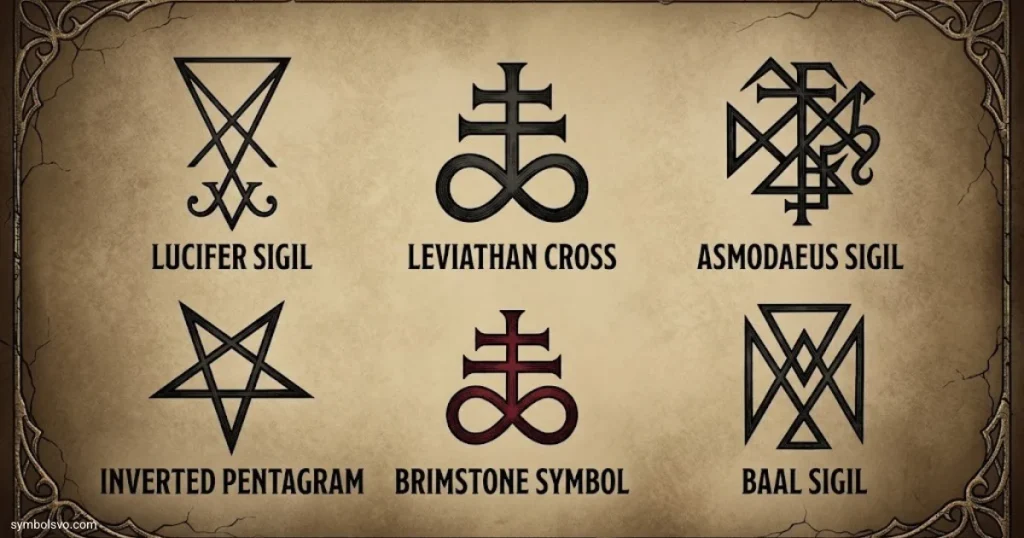
Sigil of Baphomet
The Sigil of Baphomet is one of the most recognizable emblems in modern Satanic imagery. Its design features a goat’s head within an inverted pentagram, often surrounded by Hebrew lettering.
The emblem’s current association with organized Satanism developed during the twentieth century. The Church of Satan adopted it as its official insignia in 1966, when Anton LaVey founded the organization. The group subsequently helped popularize the design through its publications and public identity.
The symbol draws on several layers of earlier imagery. Goats, inverted stars, and the figure of Baphomet each have their own histories. Combining these elements created an emblem that communicates a specific modern identity.
Common associations include:
- Modern Satanism and the Church of Satan
- Rebellion against conventional religious expectations
- Goat-headed imagery and occult art
- Contemporary depictions of the supernatural
One important distinction deserves attention: the Sigil of Baphomet is not a universal emblem for every Satanist or every occult tradition. Its meaning depends on the group or person using it.
Inverted Pentagram
An inverted pentagram is a five-pointed star positioned with one point facing downward and two points facing upward. Its interpretation depends on the tradition, accompanying imagery, and historical period.
The five-pointed star appeared in ancient cultures long before its modern association with Satanism. Later European occult writers assigned different spiritual and philosophical meanings to its orientation.
During the nineteenth century, occult authors helped popularize interpretations of inverted stars that later influenced modern Satanic imagery. In particular, the association between an inverted pentagram and a goat’s head became influential in Western occult art.
Today, the symbol frequently appears in horror fiction, metal artwork, fantasy illustrations, and modern Satanic emblems.
However, an inverted pentagram does not have one universal meaning. Its presence alone doesn’t establish a person’s beliefs or prove that an image represents a demon.
Pentagram and Pentacle
The pentagram is a five-pointed star drawn with five connected lines. A pentacle often refers to a pentagram enclosed within a circle, although historical usage varies.
Both symbols appear in different religious, philosophical, and magical traditions. Their meanings have changed across centuries, which makes it misleading to classify them as exclusively evil.
In some historical magical traditions, pentagrams served as protective signs. In other settings, people associated them with the elements, spiritual order, or philosophical ideas about the human relationship with the universe.
Modern popular culture often presents pentagrams as occult symbols or Satanic symbols, particularly when the star appears inverted or alongside other recognizable imagery.
Yet context matters more than shape alone.
| Feature | Pentagram | Pentacle |
| Basic appearance | Five-pointed star | Often a five-pointed star inside a circle |
| Historical use | Religious, philosophical, and magical contexts | Frequently associated with magical or protective objects |
| Modern interpretations | Spirituality, occultism, and Satanic imagery | Spiritual practice, protection, and occult imagery |
| Does it always represent evil? | No | No |
Number 666: The Number of the Beast
The number 666 is among the most recognizable symbols associated with the Devil in Western culture. Its principal biblical source is Revelation 13:18, which calls it the number of the Beast.
The Book of Revelation uses vivid imagery to describe conflict, political power, faithfulness, and opposition to God. Its references to the Beast have inspired centuries of theological interpretation and artistic representation.
Scholars have proposed several explanations for the number. One influential interpretation connects 666 with the name Nero Caesar through a numerical system in which letters carry numerical values. However, researchers continue to debate the evidence and other possible interpretations. A 2025 study in the Journal of Theological Studies examined alternative proposals involving the Roman imperial family.
An additional detail makes the subject even more interesting: some ancient biblical manuscripts record 616 instead of 666. This variant appears in early textual evidence and has its own history of interpretation.
Today, 666 appears in horror movies, music, literature, and internet culture. It often functions as shorthand for evil, danger, rebellion, or something supposedly forbidden.
Nevertheless, the number’s cultural reputation should not replace an understanding of its biblical and historical background.
Leviathan Cross
The Leviathan Cross is commonly presented as a double-cross design with an infinity-like loop beneath the crossbars. Modern occult and Satanic imagery sometimes associates it with sulfur and alchemical symbolism.
Its contemporary appearance has made it recognizable in graphic design, alternative fashion, and fictional depictions of occult traditions. However, claims about its exact ancient origins are not always supported by reliable historical evidence.
The name Leviathan has a much older background. In biblical literature, Leviathan appears as a formidable sea creature, and later interpretations have connected it with chaos or destructive power.
The modern emblem should not automatically be treated as an ancient symbol used unchanged across thousands of years. The history of the name and the history of a particular graphic design are separate questions.
Inverted Cross
The inverted cross has more than one recognized interpretation. In Christian tradition, it is associated with Saint Peter, who according to later Christian accounts requested crucifixion upside down because he considered himself unworthy of dying in the same manner as Jesus.
For that reason, an inverted cross has historically appeared in Christian contexts without expressing opposition to Christianity.
Modern horror movies and provocative artwork often use the same shape to suggest Satanism, desecration, or anti-Christian themes. This popular association has become widespread enough that many people assume it is the symbol’s original meaning.
That assumption overlooks its religious history.
When interpreting an inverted cross, consider the surrounding imagery, the creator’s stated intention, and the setting in which it appears. A symbol’s orientation alone cannot establish its meaning.
Goetic Seals and Demon Sigils
Demon sigils are symbols associated with named supernatural beings in certain magical and demonological traditions. Historical texts sometimes call these designs seals and connect them with particular spirits.
One important source is the Ars Goetia, the first section of a compilation known as the Lesser Key of Solomon. The text circulated in early modern manuscript traditions and describes spirits alongside names, ranks, and associated seals.
These diagrams are important to historians because they reveal how some authors organized supernatural beliefs and magical knowledge. They are historical evidence of a tradition’s ideas, not proof that the beings described in those texts exist.
Not every symbol described online as an ancient demon sigil has a documented historical origin. Some modern illustrations combine authentic manuscript designs with newly created artwork.
When researching a seal, check whether it appears in a traceable manuscript or credible historical study rather than relying on an unattributed image.
Goat-Headed Figures and Baphomet
Goat-headed figures occupy an important place in modern occult art. The best-known example is Baphomet, a figure that has acquired several interpretations throughout its history.
The French occult writer Éliphas Lévi published a famous image of Baphomet in the nineteenth century. The illustration combined human and animal features with symbolic elements that Lévi interpreted through his own philosophical and esoteric framework.
Later depictions increasingly connected Baphomet with Satanic imagery. The goat’s head eventually became part of the Sigil of Baphomet used by the Church of Satan.
However, Baphomet’s history is more complicated than the simple claim that the figure has always represented the Devil. The name and image developed through different historical contexts.
Goat imagery also appears in mythology, pastoral life, and depictions of supernatural beings. Horns alone do not make a figure demonic.
Serpent Symbolism
The serpent is one of the most versatile figures in mythological symbolism. Its meanings include temptation, danger, renewal, healing, wisdom, and transformation.
In the biblical story of Adam and Eve, the serpent tempts Eve to eat the forbidden fruit. This narrative strongly influenced later Western associations between serpents, deception, and evil.
Other traditions tell different stories. Serpents may represent renewal because they shed their skin. Snake imagery also appears in ancient healing traditions, where it can signify restoration or medical knowledge.
These differences show why the serpent should not automatically appear on a list of demonic symbols without explanation.
Its meaning depends on the story, religion, and cultural setting in which it appears. The same animal can communicate danger in one narrative and healing in another.
Devil’s Trident and Pitchfork
The Devil’s pitchfork is a familiar feature of Western cartoons, Halloween decorations, and popular depictions of the underworld. Artists often pair it with horns, a tail, and a red body to create an instantly recognizable character.
Although the image is widely associated with the Devil, it should not be confused with a single, universally recognized ancient demonic emblem.
The trident also has its own independent history. In Greek and Roman mythology, Poseidon and Neptune carry tridents as attributes of divine power associated with the sea. That older association does not make every trident a symbol of evil.
Popular art often blends different visual traditions to create memorable characters. Understanding the difference between a mythological attribute and a modern cartoon convention helps avoid inaccurate historical claims.
Hexagram
A hexagram is a six-pointed star formed by two overlapping triangles. It appears in religious, cultural, artistic, and esoteric settings.
The symbol has a particularly important association with Jewish identity and the Star of David. It has also appeared in other historical contexts, including decorative designs and certain magical traditions.
Because some occult artwork incorporates the hexagram, people occasionally classify it as a demonic symbol. That interpretation is too broad to be historically reliable.
A hexagram’s meaning depends on its use, surrounding imagery, and cultural setting. In particular, its use in Jewish religious and cultural life should not be confused with its occasional appearance in occult illustrations.
Horned Figures in Mythology and Occult Art
Horned figures appear in numerous mythological and religious traditions. Depending on the context, horns can signify strength, fertility, wilderness, animal identity, or supernatural authority.
In some European Christian art, artists used horned features to portray demons or the Devil. Those images influenced later illustrations, stage costumes, horror films, and fantasy characters.
However, horned figures are not all interchangeable. A mythological deity, an animal-headed guardian, a fictional monster, and a figure explicitly described as a demon represent different subjects.
The key is to identify the original figure before assigning meaning to its appearance. This prevents demonic imagery from becoming an inaccurate label for every horned creature in mythology.
Ancient Demonic Symbols and Their Origins
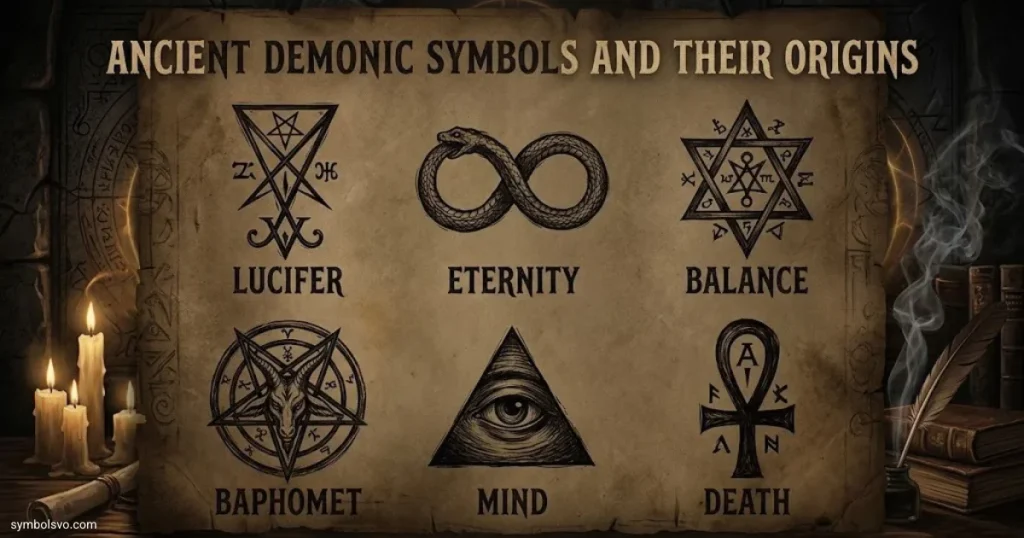
The history of ancient demonic symbols begins with a wide range of beliefs about harmful spirits, supernatural dangers, and unseen forces. Ancient communities did not share one universal concept of demons, so their symbols reflected different religious systems and local concerns.
Some images represented dangerous beings. Others showed protective deities, guardians, or objects believed to defend people against misfortune.
Demonic and Protective Imagery in Mesopotamia
Ancient Mesopotamia, which included civilizations such as Sumer and Babylonia, had rich traditions concerning supernatural beings. Written texts describe figures associated with illness, danger, protection, and the boundaries between human and divine worlds.
One important example is Pazuzu, a supernatural figure often associated with harmful winds. Although modern audiences may recognize Pazuzu from horror fiction, ancient Mesopotamian people also used images of the figure in protective contexts.
This apparent contradiction is important. A frightening supernatural being could itself serve a protective purpose in a particular religious tradition.
Ancient Mesopotamian objects and inscriptions therefore provide valuable evidence for understanding historical demon symbols. They also show why modern labels such as “evil symbol” may oversimplify older beliefs.
Ancient Egyptian Symbols and Supernatural Beings
Ancient Egyptian religion included gods, protective figures, underworld beings, and supernatural threats. Religious images often served specific purposes connected with death, renewal, divine authority, and protection.
Some creatures that appear frightening to modern viewers had positive or protective associations in their original setting. Others represented dangerous forces that religious texts sought to control or overcome.
Egyptian symbols should therefore be interpreted through Egyptian religious beliefs rather than automatically classified as demonic according to later European traditions.
Greek and Roman Mythology
Greek and Roman traditions included underworld figures, monsters, divine messengers, and beings that could threaten human safety. Cerberus, for example, guarded the entrance to the underworld in Greek mythology.
A creature associated with the underworld was not necessarily evil in the same sense as Satan in Christian theology. Its role depended on the myth and the responsibilities assigned to it.
Later artwork sometimes blended classical mythology with Christian ideas about demons. Modern fantasy continued this process, combining gods, monsters, and occult imagery into new fictional designs.
How Ancient Symbols Changed Over Time
Symbols rarely retain exactly the same meaning across centuries. Religious contact, political change, artistic reinterpretation, and popular storytelling can all influence their significance.
A figure once associated with protection may later appear as a frightening monster. An ordinary geometric design may acquire religious meaning through repeated use. A historical image may become a modern emblem almost entirely different from its original context.
When researching the origins of demonic symbols, ask three questions:
- What did the original culture call the figure or symbol?
- What purpose did it serve in its earliest documented setting?
- How did later religious traditions or popular culture reinterpret it?
These questions help separate documented history from modern speculation.
Demonic Symbols in Medieval Demonology and Grimoires
Medieval European demonology developed within a religious environment strongly influenced by Christian teachings about Satan, demons, temptation, and spiritual conflict.
Religious writers described demons in theological texts, sermons, stories, and artistic works. Some manuscripts also recorded magical practices, diagrams, and names associated with supernatural beings.
A grimoire is a text associated with magical knowledge or practices. Historical grimoires vary widely in their contents, authorship, and origins. Some include astrological diagrams, ritual instructions, spirit names, or symbols believed by their authors to have special significance.
The Lesser Key of Solomon, particularly its Ars Goetia section, is an important example of early modern demonological literature. Its spirit descriptions and associated seals show how some historical writers organized their ideas about supernatural beings.
However, the presence of a symbol in a grimoire does not establish that it originated in antiquity. A manuscript may preserve older material, reinterpret earlier traditions, or introduce designs from its own period.
Why Historical Context Matters
When studying medieval demonology symbols, researchers examine the manuscript itself, its date, language, illustrations, and relationship to other texts.
A reliable historical account should distinguish among:
- Symbols found in surviving historical manuscripts.
- Later copies or adaptations of earlier designs.
- Modern illustrations inspired by historical texts.
- Unverified images described online as ancient symbols.
This approach prevents fictional or recently invented artwork from being presented as an authentic artifact.
Satanic Symbols vs. Demonic Symbols vs. Occult Symbols
The terms Satanic, demonic, and occult often appear together online. However, they describe different categories of imagery.
| Category | Definition | Example or context |
| Demonic symbols | Images associated with demons in a particular tradition | Seals appearing in historical demonological texts |
| Satanic symbols | Images connected with Satan or Satanism | Sigil of Baphomet in modern Satanism |
| Occult symbols | Images used in esoteric or magical traditions | Symbols found in historical grimoires |
| Religious symbols | Images expressing religious beliefs or identity | The Star of David in Jewish tradition |
| Protective symbols | Images believed to guard against harm | Amulets in some ancient cultures |
These categories can overlap. A particular emblem might appear in a magical manuscript, receive a Satanic interpretation later, and then become a familiar image in horror movies.
That doesn’t mean every symbol in any one category belongs to all the others.
Is Every Occult Symbol Satanic?
No. The word occult broadly refers to hidden knowledge or esoteric traditions. Historically, occult practices have included a variety of philosophical, astrological, magical, and spiritual systems.
Some modern Satanic imagery uses occult symbols, but many occult traditions are not Satanic. Likewise, a geometric star or an old manuscript diagram does not automatically indicate belief in demons.
The most reliable interpretation comes from the symbol’s documented use rather than assumptions based on its appearance.
Demonic Symbols Across Religions and Cultures
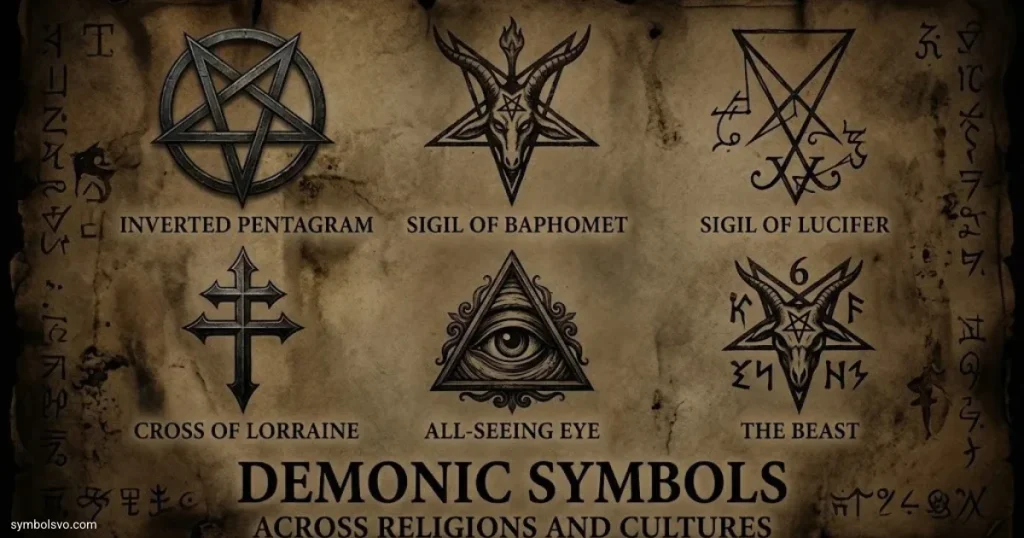
Religious traditions have developed different ways of understanding evil, harmful spirits, and supernatural beings. These differences matter when interpreting religious symbols and their meanings.
Demonic Imagery in Christianity
Christian traditions discuss Satan, demons, temptation, and spiritual opposition in different biblical passages and later theological writings.
The Book of Revelation provides the context for the number 666 and the Beast. Later Christian art developed visual conventions for portraying the Devil, including horns, monstrous features, and scenes of temptation.
These images shaped much of the Western world’s modern understanding of demonic imagery. However, not every feature in medieval or modern depictions comes directly from the Bible.
Islamic Beliefs About Iblis, Shaytan, and Jinn
Islamic teachings distinguish among Iblis, Shaytan, and jinn. The Quran discusses Iblis in connection with his refusal to obey God’s command concerning Adam. The term jinn refers to beings with their own place in Islamic theology.
These concepts do not map perfectly onto every category in European Christian demonology. Treating them as identical can erase important theological differences.
Similarly, the Kaaba, Islamic calligraphy, and Islamic geometric patterns are not inherently demonic symbols. They have their own religious, artistic, and cultural significance.
The crescent and star also have varied historical uses and associations with particular Muslim communities and national flags. They should not be labeled Satanic simply because they are unfamiliar to someone viewing them.
Modern Satanism
Modern Satanism includes different movements with distinct philosophies and practices. The Church of Satan, founded by Anton LaVey in 1966, is associated with the Sigil of Baphomet.
Its use of Satanic imagery should be understood within the organization’s own history and stated worldview. Other movements may interpret Satan or related symbols differently.
This distinction is important because popular culture often portrays Satanism as one uniform belief system. Historical and contemporary reality is more varied.
Symbols Believed to Protect Against Evil Spirits
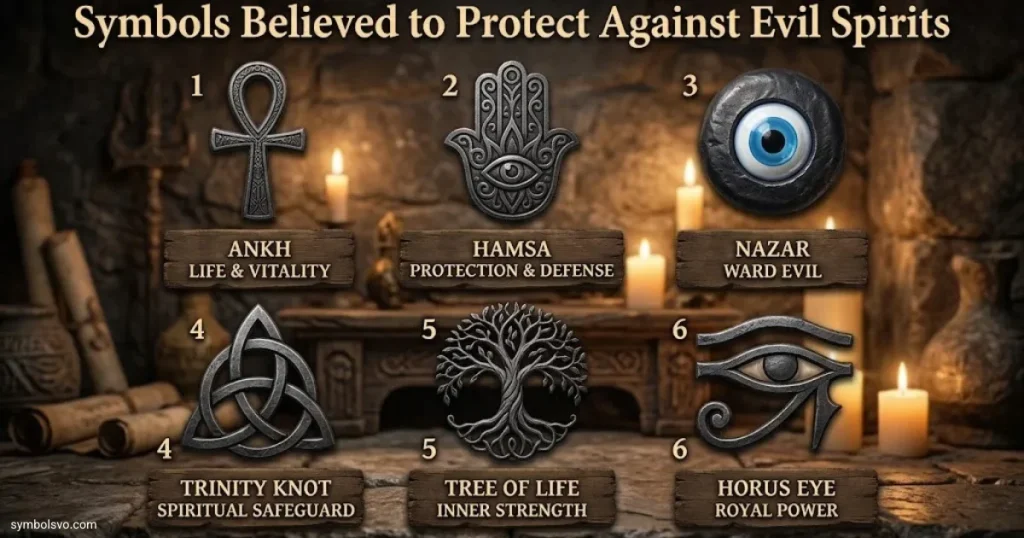
Not every symbol connected with supernatural beings represents danger. Across many cultures, people have used protective symbols against evil spirits to express hope for safety, health, and spiritual security.
Protective objects can include amulets, inscriptions, ritual images, and designs placed on buildings or personal belongings. Their purposes differ by culture and period.
For example, some ancient Mesopotamian objects depicted supernatural figures within protective contexts. Other cultures used written prayers, sacred names, or symbolic designs to express protection from misfortune.
These objects reveal what people believed and how they responded to perceived threats. They do not, by themselves, prove that supernatural dangers existed or that the objects had measurable protective powers.
When studying protective symbolism, consider the culture that produced the object, the purpose described in historical sources, and the evidence supporting its interpretation.
Demonic Symbols in Tattoos, Gothic Art, and Popular Culture
Modern artists frequently borrow demonic symbols, occult imagery, and supernatural figures to communicate ideas about fear, independence, mystery, and rebellion.
However, a symbol’s artistic meaning may differ from its historical or religious significance. Understanding this difference helps readers interpret modern designs more accurately.
Demonic Symbols Tattoos and Their Meanings
People choose demon-inspired or occult-themed tattoos for different personal and artistic reasons. Some appreciate the visual style, while others are interested in mythology, gothic art, religious history, or fictional characters.
Common designs include:
- Inverted pentagrams: Often associated with modern Satanic imagery.
- Sigil of Baphomet: Recognizable through its association with the Church of Satan.
- Serpents: Can represent transformation, danger, wisdom, or renewal.
- Horned figures: May draw on mythology, fantasy, or modern occult art.
- Number 666: Often references Revelation or popular depictions of the Beast.
These interpretations aren’t universal. Someone might select a design for its visual qualities without subscribing to the beliefs associated with it.
Before interpreting a tattoo, consider the precise design, the wearer’s explanation, and the symbol’s documented history. A single image rarely reveals someone’s beliefs or intentions.
Demonic Symbols in Horror Movies and Video Games
Horror creators use supernatural imagery to communicate danger quickly. A strange seal, an inverted star, or an unfamiliar inscription can suggest a mysterious threat before the audience knows anything about the story.
Filmmakers and game designers often modify historical symbols or invent fictional ones. They may combine elements from several traditions to create a recognizable visual language.
This approach works because audiences already associate certain shapes and images with supernatural danger. Yet the resulting fictional meaning may have little connection to the symbol’s actual history.
When researching demonic symbols in popular culture, distinguish between a design’s role in a fictional story and its documented meaning outside that story.
Gothic Art, Music, and Literature
Gothic artwork often explores darkness, mortality, mystery, fear, and the supernatural. Artists may use skulls, shadows, serpents, monsters, or religious imagery to develop these themes.
Heavy metal artwork, fantasy novels, comic books, and album covers also use demonic imagery. In these settings, symbols can communicate a mood, establish a fictional world, or challenge conventional expectations.
The image itself doesn’t necessarily tell you what the creator believes. Artistic expression and religious commitment are different things.
How to Identify a Demonic Symbol Correctly
A symbol’s appearance can offer clues, but reliable identification requires more than visual recognition. Many designs have multiple interpretations, and some internet descriptions repeat unsupported claims about their origins.
Use the following approach when researching an unfamiliar image.
- Identify its exact appearance. Note its shapes, inscriptions, orientation, and surrounding elements.
- Find its historical context. Look for the earliest reliable records of the design.
- Check its cultural background. Determine which religious, artistic, or philosophical tradition used it.
- Compare credible sources. Consult museum collections, scholarly books, historical manuscripts, and academic publications.
- Look for alternative interpretations. Check whether the symbol has protective, religious, or non-demonic associations.
- Separate evidence from belief. Explain what historical records establish and what particular traditions believe.
For example, an inverted cross might appear in a Christian artwork associated with Saint Peter or in a horror film intended to suggest evil. The shape alone cannot tell you which interpretation applies.
The same principle applies to pentagrams, serpents, and horned figures. Context is essential to accurate symbol identification.
Common Misconceptions About Demonic Symbols
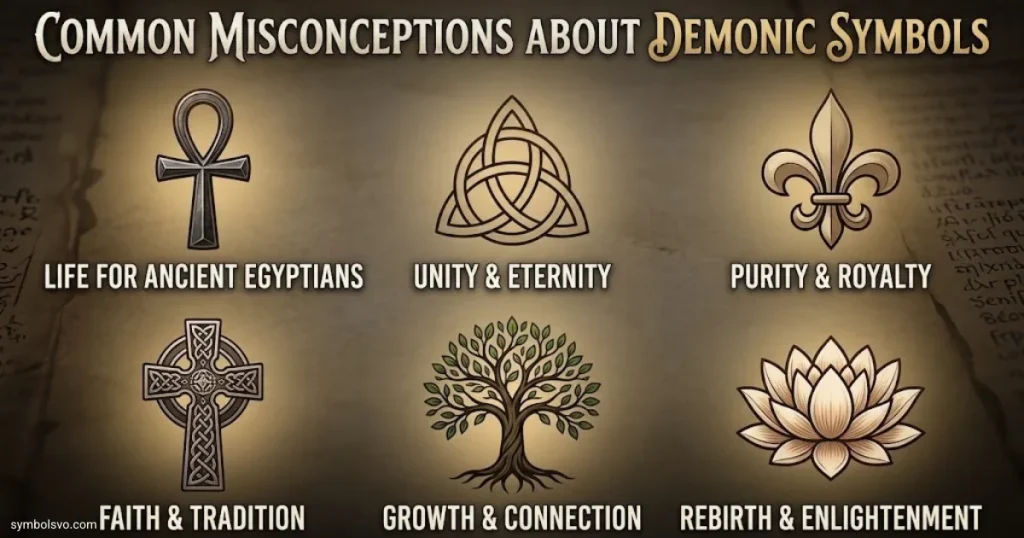
Are All Pentagrams Satanic Symbols?
No. The pentagram has appeared in different historical, religious, philosophical, and magical settings. Some modern Satanic imagery uses an inverted pentagram, but the five-pointed star is not exclusively Satanic.
Are All Occult Symbols Connected to Demons?
No. Occult symbolism covers many esoteric traditions and historical practices. Some symbols relate to astrology, philosophical ideas, magical literature, or protective beliefs rather than demons.
Does 666 Always Mean Satanism?
No. The number’s best-known historical source is Revelation 13:18, where it identifies the number of the Beast. Modern culture frequently associates it with Satan, but its biblical interpretation has generated substantial scholarly debate. Some researchers have proposed a connection with Nero Caesar, while other interpretations remain under discussion.
Is Every Horned Figure a Demon?
No. Horned figures appear in mythology, religious art, and depictions of animals and supernatural beings. Their meanings vary considerably. Researchers must identify the specific figure and tradition before describing it as demonic.
Do Demonic Symbols Have the Same Meaning in Every Culture?
No. Symbolic meanings develop through cultural traditions, religious teachings, historical events, and artistic reinterpretation. An image considered dangerous in one setting might represent protection, wisdom, or authority in another.
Can a Symbol’s Meaning Change Over Time?
Yes. Symbols can acquire new meanings as they move between cultures and historical periods. Later artists, religious writers, and popular media may reinterpret an older design in ways that differ from its original use.
Frequently Asked Questions About Demonic Symbols
What are demonic symbols?
Demonic symbols are signs, images, numbers, or emblems associated with demons, Satan, or supernatural evil in particular traditions. Their meanings depend on historical context, cultural beliefs, and how people use them.
What are some common demonic symbols?
Frequently discussed examples include the Sigil of Baphomet, inverted pentagram, number 666, certain demonological seals, and horned figures. However, symbols such as the pentagram, serpent, and inverted cross also have meanings outside demonic imagery.
What is the most recognizable Satanic symbol?
The Sigil of Baphomet is one of the most recognizable symbols associated with modern Satanism, particularly the Church of Satan. Other Satanic movements and cultural depictions may use different imagery.
What does the inverted pentagram mean?
The inverted pentagram is a five-pointed star with one point facing downward. It appears in modern Satanic imagery and some occult traditions. Its interpretation depends on the design’s historical and cultural context.
What does the Sigil of Baphomet represent?
The Sigil of Baphomet is a modern emblem associated with the Church of Satan. It combines a goat’s head, an inverted pentagram, and surrounding lettering. Its present-day meaning reflects its development within modern Satanic imagery.
What does the number 666 symbolize?
In Revelation 13:18, 666 is identified as the number of the Beast. Later religious interpretation, literature, music, and film connected it with the Devil and evil. Scholars continue to examine its original historical meaning.
What is the difference between demonic and Satanic symbols?
Demonic symbols relate to demons or demonic beings within particular traditions. Satanic symbols relate to Satan, Satanism, or imagery associated with them. The categories overlap, but they are not identical.
Are all pentagrams evil?
No. Pentagrams have appeared in several historical and religious traditions, including contexts involving protection and spiritual symbolism. Their meaning depends on orientation, accompanying imagery, and cultural use.
What is the historical meaning of the inverted cross?
The inverted cross is associated with Saint Peter in Christian tradition. Modern horror and anti-Christian artwork sometimes use it differently, so its meaning depends on the context.
What are demon sigils?
Demon sigils are symbols associated with named spirits in certain historical magical texts. Some appear in demonological manuscripts, including the Ars Goetia. Their presence documents historical beliefs rather than establishing supernatural claims as fact.
Were ancient symbols used to protect people from evil spirits?
Yes. Some ancient cultures used amulets, inscriptions, and ritual objects intended to protect against harmful supernatural forces. These practices provide evidence of historical beliefs, although they do not establish that the objects had supernatural effects.
Why do horror movies use demonic symbols?
Horror movies use these symbols to create mystery, tension, and a sense of supernatural danger. Filmmakers may adapt historical imagery or invent new designs to fit their fictional worlds.
What should you know before choosing a demonic symbol tattoo?
Research the symbol’s documented history, cultural associations, and modern interpretations. Some designs have religious significance or carry meanings that differ from their popular portrayal. Understanding that background helps prevent mistaken assumptions.
Final Thoughts on Demonic Symbols and Their Meanings
Demonic symbols are best understood through their history rather than appearance alone. Some have documented connections with Satanic movements or demonological literature, while others gained darker associations through religious reinterpretation, popular culture, or modern artwork.
The Sigil of Baphomet, inverted pentagram, and number 666 have recognizable places in modern discussions of demonic and Satanic imagery. Meanwhile, the pentagram, serpent, hexagram, and inverted cross have broader histories that deserve careful explanation.
The most important lesson is simple: a symbol’s meaning depends on who used it, when they used it, and what it represented in that setting. By examining reliable historical evidence and respecting cultural differences, you can distinguish documented meanings from myths and misconceptions.
That approach makes the study of demonic symbolism, occult signs and symbols, and historical religious imagery far more informative than a list of frightening-looking designs.

Mason Ellington is a creative and dedicated Content Writer and Symbols Expert with a passion for words, communication, and symbolic meanings. He specializes in crafting engaging, informative, and well-structured content while exploring the deeper meanings and interpretations behind symbols. With a creative mindset and attention to detail, Mason transforms ideas into meaningful content that informs, inspires, and connects with readers. His expertise combines powerful storytelling, clear communication, and a deep understanding of symbolism.
 Nathan Holloway
 Daniel Brooks