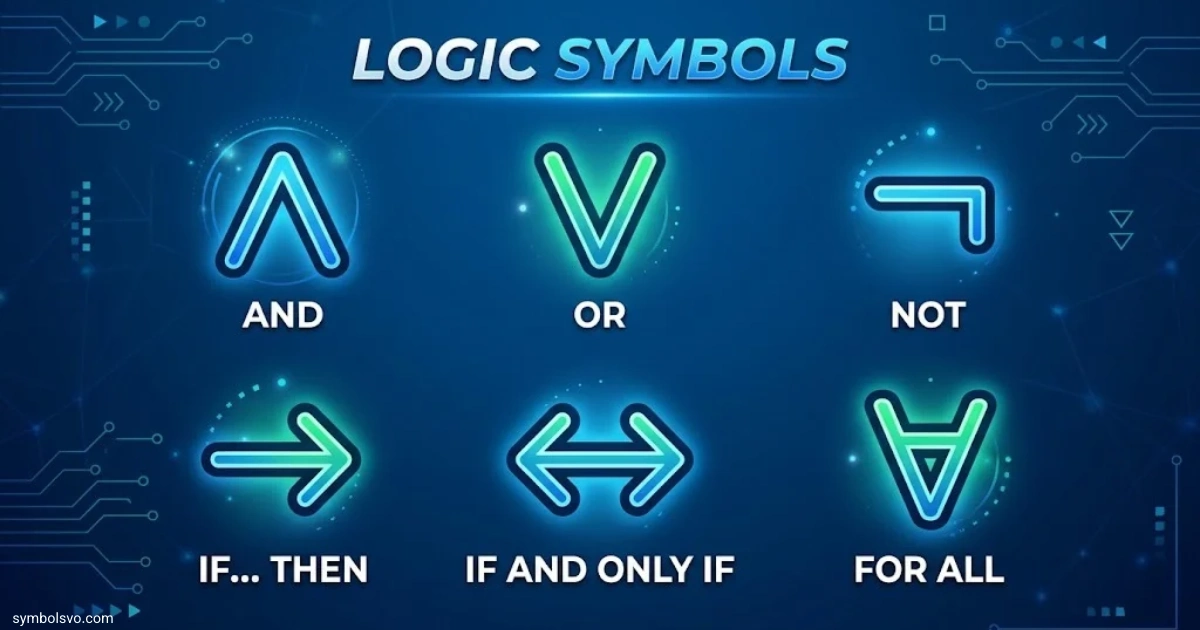
Logic symbols help you express ideas, evaluate statements, and understand how conclusions follow from premises. You’ll find them in mathematics, philosophy, computer science, formal proofs, and digital electronics.
This guide covers the most important logic symbols and meanings, from basic operators such as NOT, AND, and OR to advanced notation involving quantifiers, logical equivalence, and formal derivation. You’ll also find examples, truth tables, programming equivalents, and a copy-and-paste reference.
Whether you’re learning symbolic logic for the first time or reviewing mathematical notation, this reference will help you understand what each symbol means and how to use it correctly.
What Are Logic Symbols?
Logic symbols are special characters used to represent logical operations, relationships, and statements. They make complex reasoning easier to express without repeating lengthy sentences.
Consider the statement, “It is raining and the road is wet.” In symbolic logic, you can represent it as:
P ∧ Q
Here, P means “It is raining,” while Q means “The road is wet.” The symbol ∧ connects the two propositions using the logical operation AND.
This notation makes the statement shorter while preserving its logical structure.
What Is a Logical Proposition?
A proposition is a statement that can be classified as true or false under a given interpretation. For example, “Seven is a prime number” is true, while “Seven is an even number” is false.
Logic commonly represents propositions with letters such as P, Q, and R.
These letters are called propositional variables. You can combine them with logical connectives to form compound propositions.
Examples include:
- ¬P — P is not true.
- P ∧ Q — Both P and Q are true.
- P ∨ Q — At least one of P and Q is true.
- P → Q — If P is true, Q is true.
- P ↔ Q — P and Q have the same truth value.
What Are Logical Operators and Connectives?
Logical operators, also called logical connectives in propositional logic, combine or modify propositions according to defined truth conditions.
Negation operates on one proposition. Conjunction, disjunction, implication, and biconditional connect two propositions.
These operators form the foundation of propositional logic, which studies how the truth of compound statements depends on their parts.
Why Do Mathematicians Use Symbolic Logic?
Symbolic notation makes arguments easier to analyze. It also reduces ambiguity when ordinary language allows multiple interpretations.
For example, the sentence “If I study, I pass” can be represented as P → Q. Once the propositions are defined, a truth table can show precisely when the conditional is true or false.
Formal logic also helps mathematicians distinguish a statement’s truth from the validity of an argument. These concepts are related, but they are not interchangeable.
For an authoritative introduction to classical logic, see the Stanford Encyclopedia of Philosophy’s overview of classical logic.
Basic Logic Symbols and Their Meanings
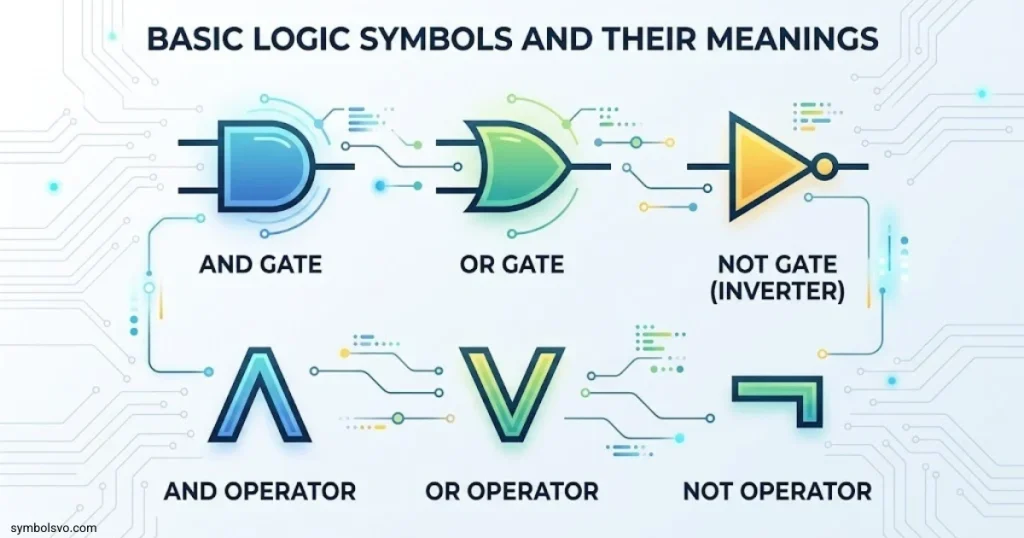
Basic logic symbols appear in introductory mathematics, discrete mathematics, computer science, and formal reasoning. Learning their truth conditions is more useful than memorizing their names alone.
Negation Symbol (¬): NOT
The negation symbol ¬ means NOT. It reverses the truth value of a proposition.
If P is true, ¬P is false. If P is false, ¬P is true.
Example:
- P: The door is open.
- ¬P: The door is not open.
Negation changes the truth value without introducing another proposition.
In some programming languages, the exclamation mark ! performs a similar operation. However, mathematical notation and programming syntax are different systems.
Conjunction Symbol (∧): AND
The conjunction symbol ∧ means AND. A conjunction is true only when both connected propositions are true.
Suppose P means “The computer is switched on” and Q means “The monitor is connected.” The expression P ∧ Q is true only when both conditions hold.
If either proposition is false, the entire conjunction is false.
Remember: AND requires both conditions to be satisfied.
Disjunction Symbol (∨): Inclusive OR
The disjunction symbol ∨ represents inclusive OR. It means that at least one of the connected propositions must be true.
For example, P ∨ Q is true when P is true, Q is true, or both are true.
This differs from the everyday use of “or,” which sometimes suggests that only one option can apply.
In classical propositional logic, the symbol ∨ normally represents inclusive OR unless the system explicitly defines another interpretation.
Exclusive OR Symbol (⊕): XOR
The exclusive OR symbol ⊕ means XOR. It is true when exactly one of two propositions is true.
For example, suppose a system activates a warning when either of two conditions occurs, but not when both occur. The relationship can be modeled as P ⊕ Q.
The truth conditions are straightforward:
- P true, Q false: true.
- P false, Q true: true.
- Both true: false.
- Both false: false.
XOR is common in Boolean algebra, digital circuits, and computer science.
Implication Symbol (→): If–Then
The implication symbol → represents a conditional statement. The expression P → Q reads “If P, then Q.”
P is the antecedent, while Q is the consequent.
In classical material implication, the expression is false only when P is true and Q is false. In every other truth-value combination, the conditional is true.
Consider this example:
“If a number is divisible by four, it is even.”
Let P mean “The number is divisible by four” and Q mean “The number is even.” The conditional is P → Q.
This relationship does not claim that every even number must be divisible by four. That would reverse the direction of the implication.
Biconditional Symbol (↔): If and Only If
The biconditional symbol ↔ means “if and only if,” often abbreviated as “iff.”
The expression P ↔ Q is true when P and Q share the same truth value. Both must be true or both must be false.
For example, “An integer is even if and only if it is divisible by two” expresses a two-way relationship.
A biconditional can be understood as two implications:
(P → Q) ∧ (Q → P)
This means P implies Q, and Q also implies P.
Truth and Falsity Symbols (⊤ and ⊥)
The symbols ⊤ and ⊥ can represent logical truth and falsity, respectively.
In classical logic, ⊤ is a truth constant and ⊥ is a falsity constant. They differ from ordinary propositions because their truth values are fixed by the system.
For example, P ∨ ¬P is always true in classical logic. Meanwhile, P ∧ ¬P is always false.
These examples illustrate a tautology and a contradiction.
Logic Symbols and Truth Tables
A truth table shows the result of a logical expression for every possible combination of input truth values. It is one of the most practical tools for learning logical operators.
For two propositions, P and Q, there are four possible combinations. Each proposition can be true or false.
NOT Truth Table
| P | ¬P |
| True | False |
| False | True |
Negation has only one input. Its output always takes the opposite truth value.
AND Truth Table
| P | Q | P ∧ Q |
| True | True | True |
| True | False | False |
| False | True | False |
| False | False | False |
The conjunction is true only in the first row because both propositions must be true.
OR Truth Table
| P | Q | P ∨ Q |
| True | True | True |
| True | False | True |
| False | True | True |
| False | False | False |
Inclusive OR is false only when both propositions are false.
XOR Truth Table
| P | Q | P ⊕ Q |
| True | True | False |
| True | False | True |
| False | True | True |
| False | False | False |
XOR differs from inclusive OR in the first row. When both inputs are true, inclusive OR returns true, while XOR returns false.
Implication Truth Table
| P | Q | P → Q |
| True | True | True |
| True | False | False |
| False | True | True |
| False | False | True |
The last two rows often confuse beginners. In classical material implication, a false antecedent makes the conditional true regardless of the consequent’s truth value.
This convention defines the conditional’s truth conditions. It does not necessarily describe how people use “if” in everyday conversation.
Biconditional Truth Table
| P | Q | P ↔ Q |
| True | True | True |
| True | False | False |
| False | True | False |
| False | False | True |
A biconditional is true whenever the two propositions match.
How to Read a Compound Logic Expression
Consider the expression:
¬P ∨ Q
Read it as “NOT P OR Q.”
To evaluate it, first determine the truth value of P and apply negation. Then combine the result with Q using inclusive OR.
For example, if P is true and Q is false, then ¬P is false. The final expression is False ∨ False, which is false.
Parentheses can change how you interpret more complicated expressions. Always identify the main connective and evaluate the components according to the expression’s structure.
Mathematical Logic Symbols and Their Meanings
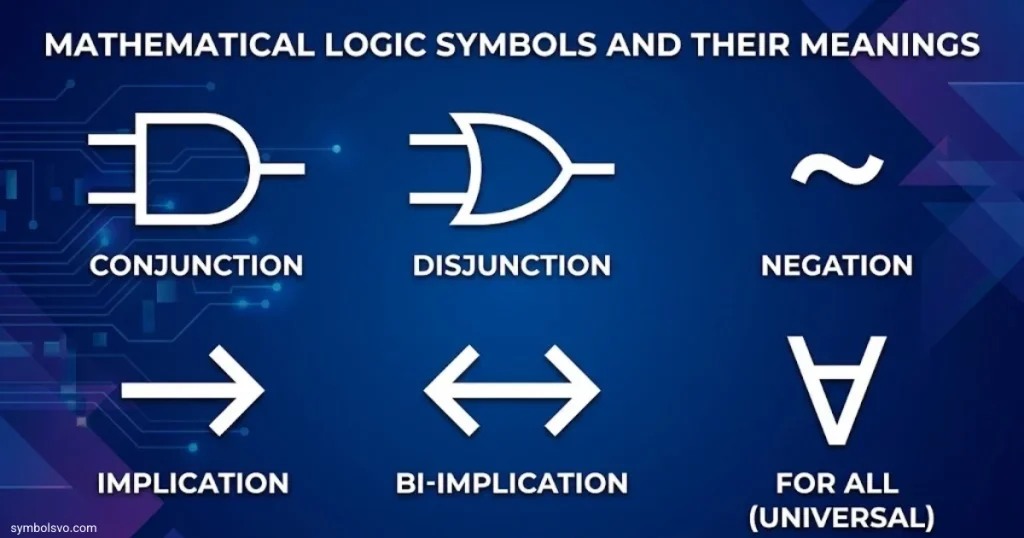
Mathematical logic includes symbols that express relationships between propositions, mathematical objects, and formal arguments. Some look similar but serve different purposes.
Logical Equivalence Symbol (≡)
The symbol ≡ often represents logical equivalence. Two formulas are logically equivalent when they have the same truth value under every relevant truth assignment.
For example:
P ∧ Q ≡ Q ∧ P
This expresses the commutative law of conjunction. Reversing the order of P and Q does not change the result.
In some textbooks, logical equivalence is written using ↔ or another notation. Always follow the convention established by the text or proof system.
Implication and Related Symbols (→ and ⇒)
The symbol → commonly represents material implication within an object language. It forms a compound proposition from P and Q.
The symbol ⇒ is often used to express implication in informal mathematical writing or to indicate a metalinguistic relationship. However, its meaning varies by author and context.
For instance, a textbook might write P ⇒ Q as shorthand for “P implies Q.” Another might use it to describe a consequence of a preceding calculation.
The surrounding definitions determine the intended meaning.
Biconditional and Equivalence Symbols (↔ and ⇔)
The symbol ↔ commonly expresses a biconditional inside a logical formula.
The symbol ⇔ is often used in mathematics to indicate equivalence between statements or steps. Some authors use it interchangeably with ↔, while others reserve it for statements about formulas.
Do not assume these conventions are universal. Check how a textbook defines its notation.
Equality and Inequality Symbols (= and ≠)
The equality symbol = states that two expressions have the same value or denote the same object under the relevant interpretation.
For example:
3 + 2 = 5
The inequality symbol ≠ means that two values are not equal.
Logical equivalence differs from ordinary equality. Equality concerns values or objects, while logical equivalence concerns the truth conditions of formulas or statements.
Therefore (∴) and Because (∵)
The symbol ∴ means “therefore.” Writers use it to introduce a conclusion drawn from preceding statements.
The symbol ∵ means “because.” It introduces a reason or explanation.
For example:
- All squares have four sides.
- This shape is a square.
- ∴ This shape has four sides.
These symbols help summarize an argument, but they do not prove that its reasoning is valid by themselves. The premises must actually support the conclusion.
Semantic Entailment (⊨) and Syntactic Derivation (⊢)
The symbols ⊨ and ⊢ are especially important in formal logic.
Semantic entailment, represented by ⊨, concerns truth across interpretations or models. If Γ ⊨ P, then P is true in every relevant model where all statements in Γ are true.
Syntactic derivation, represented by ⊢, concerns formal proof rules. If Γ ⊢ P, then a proof system permits a derivation of P from the premises in Γ.
In short:
- ⊨ focuses on truth under interpretations.
- ⊢ focuses on what can be derived using formal rules.
Quantifier Symbols in Predicate Logic
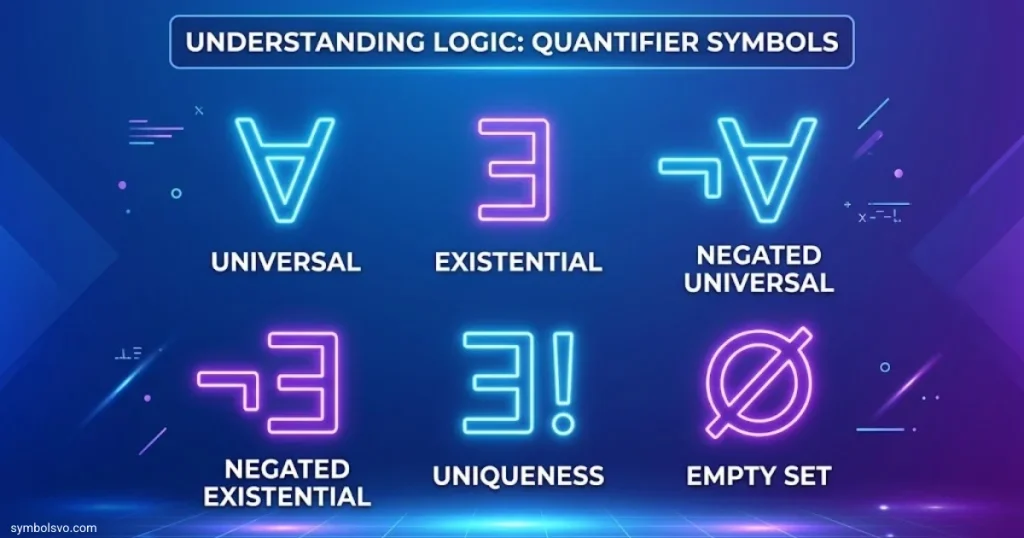
Propositional logic treats complete statements as units. Predicate logic goes further by representing objects, properties, variables, and relationships.
Quantifiers specify how broadly a predicate applies within a domain of discourse.
Universal Quantifier (∀): For All
The universal quantifier ∀ means “for all” or “for every.”
Consider:
∀x P(x)
This reads “For every x, P(x) is true.”
Suppose P(x) means “x is greater than zero” and the domain contains only positive integers. The statement is true because every member of that domain satisfies the predicate.
Change the domain to all integers, however, and the statement becomes false because zero and negative integers do not satisfy the predicate.
The domain matters. A quantified expression cannot be interpreted correctly without knowing which objects its variables represent.
Existential Quantifier (∃): There Exists
The existential quantifier ∃ means “there exists at least one.”
For example:
∃x P(x)
This reads “There is at least one x for which P(x) is true.”
If P(x) means “x is an even integer,” the statement is true over the integers because many integers satisfy the predicate.
An existential statement does not claim that every member of the domain satisfies the property. It requires only one qualifying member.
Negated Existential Quantifier (∄)
The symbol ∄ expresses that no object in the relevant domain satisfies a predicate.
For example:
∄x P(x)
This means that no x satisfies P(x).
It is equivalent to:
¬∃x P(x)
The second form makes the negation explicit. Both express the absence of any qualifying object under the intended interpretation.
How to Read Quantified Expressions
Follow these steps when interpreting predicate notation:
- Identify the quantifier.
- Determine the variable it binds.
- Identify the predicate applied to that variable.
- Establish the domain of discourse.
- Translate the complete expression into plain English.
For example, ∀x P(x) means every object in the domain satisfies P. By contrast, ∃x P(x) means at least one object satisfies P.
Negation of Universal and Existential Statements
Negating a quantifier changes the statement’s meaning in a predictable way.
| Original statement | Equivalent negation | Plain-English meaning |
| ∀x P(x) | ¬∀x P(x) ≡ ∃x ¬P(x) | At least one object does not satisfy P |
| ∃x P(x) | ¬∃x P(x) ≡ ∀x ¬P(x) | No object satisfies P |
These relationships are examples of De Morgan’s laws for quantifiers.
For instance, the negation of “Every student passed” is not “Every student failed.” It is “At least one student did not pass.”
That distinction matters when translating ordinary statements into formal logic.
Logic Symbols in Mathematics and Formal Proofs
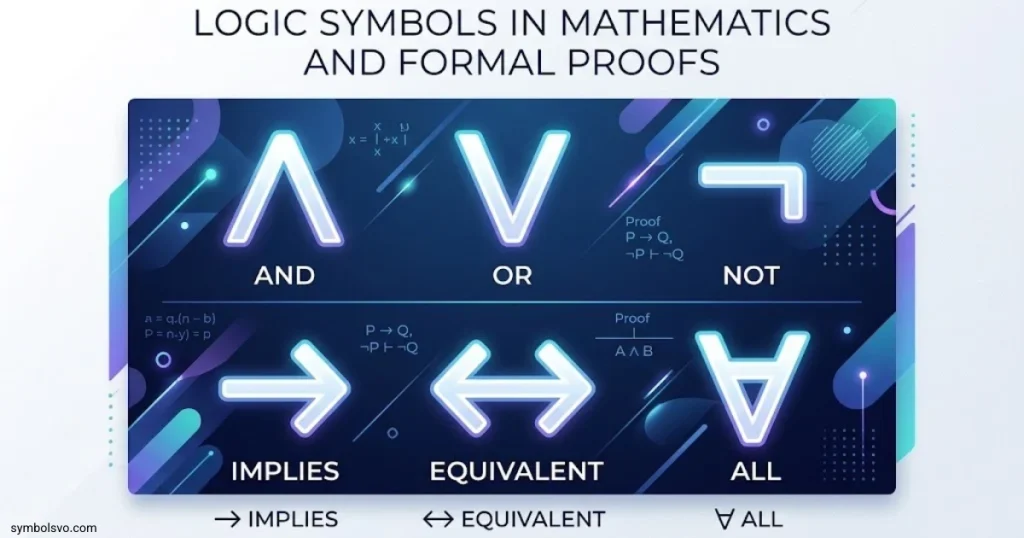
Mathematical proofs use logical notation to connect assumptions with conclusions. The goal is to show that a conclusion follows from accepted premises, definitions, or previously established results.
Propositional Logic and Predicate Logic
Propositional logic studies relationships between propositions using connectives such as ¬, ∧, ∨, and →.
Predicate logic adds variables, predicates, and quantifiers such as ∀ and ∃.
Compare these examples:
- Propositional logic: P → Q
- Predicate logic: ∀x (P(x) → Q(x))
The first relates two propositions. The second states that every object in the domain satisfying P also satisfies Q.
Premises, Conclusions, and Logical Inference
A logical argument contains premises and a conclusion. The premises provide the information from which the conclusion is derived.
Consider this argument:
- If a number is divisible by four, it is even.
- The number 12 is divisible by four.
- Therefore, 12 is even.
Its logical structure is:
P → Q
P
∴ Q
This inference pattern is called modus ponens. It is a standard valid rule of inference in classical logic.
The example shows why logical notation is useful: it separates the argument’s structure from the specific subject matter.
Tautologies, Contradictions, and Contingencies
Logical expressions fall into three common categories according to their truth conditions.
| Type | Definition | Example |
| Tautology | True under every truth assignment | P ∨ ¬P |
| Contradiction | False under every truth assignment | P ∧ ¬P |
| Contingency | True under some assignments and false under others | P ∧ Q |
A tautology is always true in classical propositional logic. A contradiction is always false. A contingency depends on the truth values assigned to its propositions.
Truth tables provide a systematic way to identify these categories.
Logical Equivalence and De Morgan’s Laws
Logical equivalence laws let you rewrite expressions without changing their truth conditions.
De Morgan’s laws are especially useful:
¬(P ∧ Q) ≡ ¬P ∨ ¬Q
¬(P ∨ Q) ≡ ¬P ∧ ¬Q
The first says that NOT (P AND Q) is equivalent to NOT P OR NOT Q. The second says that NOT (P OR Q) is equivalent to NOT P AND NOT Q.
These rules are useful when simplifying Boolean expressions, constructing proofs, and checking logical conditions.
Validity and Logical Consistency
An argument is valid when its conclusion must be true whenever all its premises are true under the relevant logical interpretation.
Validity does not mean that every premise is actually true. It means the argument’s structure preserves truth from premises to conclusion.
Logical consistency concerns whether a set of statements can all be true together under a relevant interpretation or formal system.
These concepts answer different questions. Validity evaluates an argument, while consistency evaluates a collection of statements or assumptions.
Logic Symbols in Computer Science and Programming
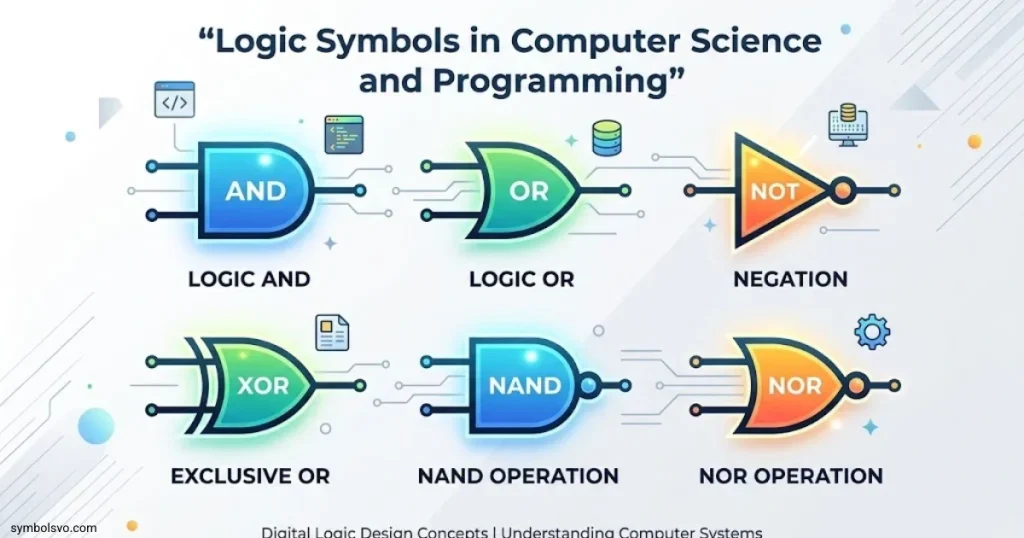
Logic plays a major role in programming because software frequently evaluates conditions and makes decisions based on Boolean values.
However, mathematical logic symbols and programming operators are not always interchangeable. A mathematical expression such as P ∧ Q may need different syntax in a programming language.
Logical NOT, AND, and OR Operators
Most mainstream programming languages provide operations corresponding to NOT, AND, and OR.
- NOT reverses a Boolean value.
- AND evaluates whether the required conditions are satisfied together.
- OR evaluates whether at least one condition is satisfied.
These operations commonly appear in conditional statements, validation rules, and control flow.
Programming Operators in Python
Python uses the keywords not, and, and or for logical operations.
is_logged_in = True
has_permission = False
print(not is_logged_in) # False
print(is_logged_in and has_permission) # False
print(is_logged_in or has_permission) # True
The example demonstrates how logical expressions return Boolean results when their operands are Boolean values.
Python also supports comparison operators such as ==, !=, <, and >. These compare values rather than directly representing the standard mathematical connectives.
Logical Operators in C-Style Languages
Languages such as C, C++, and Java commonly use !, &&, and || for logical NOT, AND, and OR.
int is_ready = 1;
int has_permission = 0;
if (is_ready && !has_permission) {
/* The condition is true. */
}
Here, && combines two conditions and ! negates the second. Exact behavior and type rules depend on the programming language.
XOR and Bitwise Operators
The caret symbol ^ represents bitwise XOR in languages such as C, C++, and Python. In Python, it operates on integer bits rather than serving as the general-purpose Boolean XOR keyword.
For example, Python provides:
print(True ^ False) # True
print(True ^ True) # False
Although these examples produce the expected XOR results for Boolean operands, ^ is still the bitwise XOR operator in Python.
When reading source code, distinguish logical operations from bitwise operations. Their behavior can differ when operands contain integers or other data types.
Boolean Expressions and Conditional Statements
A Boolean expression evaluates to a truth value or a language-specific Boolean result. Programs use these expressions to control which instructions execute.
For example, an application might check whether a user has entered valid information before allowing a form submission.
has_name = True
has_email = True
if has_name and has_email:
print(“The form is ready to submit.”)
The program executes the message only when both conditions are true.
Logic Symbols Used in Digital Electronics
Digital electronics uses Boolean operations to process binary signals. These operations are implemented through electronic components called logic gates.
A gate receives one or more inputs and produces an output according to its logical function.
Mathematical connectives describe the underlying logic. Circuit diagrams use graphical symbols that represent the physical gate functions.
AND Gate Symbol and Function
An AND gate outputs 1 only when all its inputs are 1.
For two binary inputs, its truth table matches the logical conjunction P ∧ Q.
OR Gate Symbol and Function
An OR gate outputs 1 when at least one input is 1. Its behavior matches inclusive disjunction, represented by P ∨ Q.
NOT Gate Symbol and Function
A NOT gate has one input and produces the opposite binary value.
An input of 1 produces an output of 0. An input of 0 produces an output of 1.
XOR and XNOR Gates
An XOR gate outputs 1 when its two inputs differ. An XNOR gate outputs 1 when its inputs match.
These operations are useful in digital circuits that compare bits or perform arithmetic functions.
NAND and NOR Gates
NAND means NOT AND. Its output is the negation of the AND operation.
NOR means NOT OR. Its output is the negation of the OR operation.
Both are important in digital circuit design because combinations of these gates can implement many other Boolean functions.
Logic Gate Truth Tables
| A | B | AND | OR | XOR | NAND | NOR | XNOR |
| 0 | 0 | 0 | 0 | 0 | 1 | 1 | 1 |
| 0 | 1 | 0 | 1 | 1 | 1 | 0 | 0 |
| 1 | 0 | 0 | 1 | 1 | 1 | 0 | 0 |
| 1 | 1 | 1 | 1 | 0 | 0 | 0 | 1 |
A value of 1 represents a high or true logical state in this simplified model. A value of 0 represents a low or false state.
Actual electrical voltage levels depend on the circuit technology and its specifications.
Common Logic Symbols Compared
Several logic symbols look similar or describe related concepts. Understanding their differences prevents errors in mathematics and programming.
OR (∨) vs. XOR (⊕)
The OR symbol ∨ allows both propositions to be true. XOR, represented by ⊕, requires exactly one proposition to be true.
| P | Q | P ∨ Q | P ⊕ Q |
| True | True | True | False |
| True | False | True | True |
| False | True | True | True |
| False | False | False | False |
The difference appears when both propositions are true.
Implication (→) vs. Biconditional (↔)
An implication P → Q is false only when P is true and Q is false.
A biconditional P ↔ Q is true only when P and Q share the same truth value.
The implication expresses a one-way condition. The biconditional expresses a two-way relationship.
Equality (=) vs. Logical Equivalence (≡)
Equality concerns values or objects. Logical equivalence concerns whether two formulas have matching truth conditions.
For example, 2 + 3 = 5 is an arithmetic equality. Meanwhile, P ∧ Q ≡ Q ∧ P expresses a logical equivalence under the usual classical interpretation.
The notation ≡ has other uses in mathematics, so its intended meaning must come from context.
Implication (→) vs. Metalogical Notation (⇒)
The symbol → commonly appears inside a logical formula. The symbol ⇒ may be used to express implication in ordinary mathematical writing or to describe a relationship between formulas.
Different authors adopt different conventions. Read the definitions before deciding whether these symbols are interchangeable in a particular text.
Semantic Entailment (⊨) vs. Syntactic Derivation (⊢)
The difference is between truth under interpretations and derivation under formal rules.
- Γ ⊨ P means P follows semantically from Γ.
- Γ ⊢ P means P can be derived from Γ in a specified proof system.
The two notions are related, but they are not defined in the same way. Formal systems are often studied to determine whether their derivations correctly capture semantic consequences.
How to Read and Use Logic Symbols
You don’t need to memorize every symbol at once. Start with a small set of connectives and learn how they combine propositions.
Use the following method when interpreting a logical expression.
- Identify the propositions. Determine what P, Q, or other variables represent.
- Recognize the connectives. Identify negation, conjunction, disjunction, implication, or another operator.
- Check the parentheses. They show which parts of the expression belong together.
- Follow the notation’s precedence rules. If precedence is unclear, use parentheses instead of guessing.
- Translate the expression into plain English. This checks whether you understand the relationship.
- Evaluate the truth values. Use a truth table when the result is not immediately obvious.
For example, consider ¬P ∨ Q. First, negate P. Then combine the result with Q using inclusive OR.
If P is false and Q is false, then ¬P is true. The complete expression is therefore true because at least one side of the disjunction is true.
This step-by-step approach becomes especially useful when expressions contain several operators.
Common Mistakes When Using Logic Symbols
Even simple notation can become confusing when readers overlook a symbol’s exact meaning.
Confusing Inclusive OR with XOR
The symbol ∨ normally includes the case where both propositions are true. The symbol ⊕ excludes that case.
Check the truth table whenever a problem uses OR and the intended meaning is unclear.
Misreading an Implication
In classical material implication, P → Q does not mean that P and Q must both be true.
It means the conditional is false only when P is true and Q is false. This is a formal truth condition, not a complete account of every everyday use of “if.”
Treating Equality and Logical Equivalence as Identical
The symbols = and ≡ serve different purposes in standard logical notation.
Equality identifies the same value or object. Logical equivalence concerns formulas with matching truth conditions. The exact notation can vary across mathematical subjects.
Confusing ⊨ with ⊢
Semantic entailment asks whether a conclusion follows across the relevant interpretations. Syntactic derivation asks whether a proof system can derive that conclusion.
Knowing which relationship a symbol expresses helps you read formal proofs correctly.
Ignoring Quantifier Scope and Parentheses
Compare these expressions:
∀x (P(x) → Q(x))
(∀x P(x)) → Q(x)
They are not generally equivalent. In the first expression, the quantifier applies to the entire conditional. In the second, the quantifier applies only to P(x), leaving the meaning and binding of Q dependent on the surrounding context.
Parentheses and quantifier scope are essential to correct interpretation.
Using Mathematical Notation Directly in Programming Code
A formula such as P ∧ Q may be valid mathematical notation, but it is not standard Python syntax for logical AND.
Use the operators required by the programming language. Check the documentation when working with unfamiliar languages or data types.
Frequently Asked Questions About Logic Symbols
What Are the Most Common Logic Symbols?
The most common introductory symbols include ¬ for NOT, ∧ for AND, ∨ for inclusive OR, → for implication, and ↔ for biconditional. Predicate logic also uses ∀ for “for all” and ∃ for “there exists.”
What Does the NOT Symbol (¬) Mean?
The symbol ¬ represents logical negation. It reverses a proposition’s truth value. If P is true, ¬P is false, and vice versa.
What Do ∧ and ∨ Mean in Logic?
The symbol ∧ means AND and is true only when both propositions are true. The symbol ∨ means inclusive OR and is true when at least one proposition is true.
What Is the Difference Between OR and XOR?
Inclusive OR (∨) is true when one or both propositions are true. XOR (⊕) is true when exactly one proposition is true. Their truth tables differ when both propositions are true.
What Does the Implication Symbol (→) Mean?
The symbol → represents a conditional statement that reads “If P, then Q.” In classical material implication, it is false only when P is true and Q is false.
What Do ∀ and ∃ Mean?
The universal quantifier ∀ means “for all.” The existential quantifier ∃ means “there exists at least one.” Both depend on the domain of discourse and the predicate being evaluated.
What Is the Difference Between ⊨ and ⊢?
The symbol ⊨ represents semantic entailment, which concerns truth across relevant interpretations. The symbol ⊢ represents syntactic derivation, which concerns proof using formal rules.
Can I Copy and Paste Logic Symbols?
Yes. You can copy these Unicode characters into compatible documents, notes, and applications:
¬ ∧ ∨ ⊕ → ↔ ∀ ∃ ∄ ⊤ ⊥ ≡ ⊨ ⊢ ∴ ∵
Some fonts and applications may display certain mathematical characters differently.
How Are Logic Symbols Used in Programming?
Programming languages use logical operators to evaluate conditions, combine Boolean expressions, and control program flow. Python commonly uses not, and, and or, while C-style languages commonly use !, &&, and ||.
How Can I Memorize Basic Logic Symbols?
Start by learning each symbol alongside its meaning and truth conditions. Practice with short expressions, build truth tables, and translate formulas into ordinary language. Comparing AND, OR, and XOR is especially helpful because their differences become clear through examples.
Final Thoughts on Logic Symbols
Logic symbols provide a compact way to express mathematical statements, analyze arguments, and evaluate conditions. Once you understand the basic connectives, more advanced ideas such as quantifiers, logical equivalence, and formal derivation become easier to follow.
Keep the reference chart nearby while practicing. Focus on what each symbol does rather than memorizing its name alone. With regular practice, you’ll become more confident reading logical expressions in mathematics, computer science, and formal reasoning.

I’m Daniel Brooks, a content creator and symbol enthusiast dedicated to researching the fascinating world of signs and symbols. I enjoy discovering the hidden meanings behind famous icons, emojis, historical emblems, and cultural symbols. Through my writing, I aim to provide trustworthy, well-researched, and reader-friendly information that helps people learn something new with every visit.
Books:
- The Complete Guide to World Symbols
- The Power of Universal Signs
 Nathan Holloway
 Mason Ellington