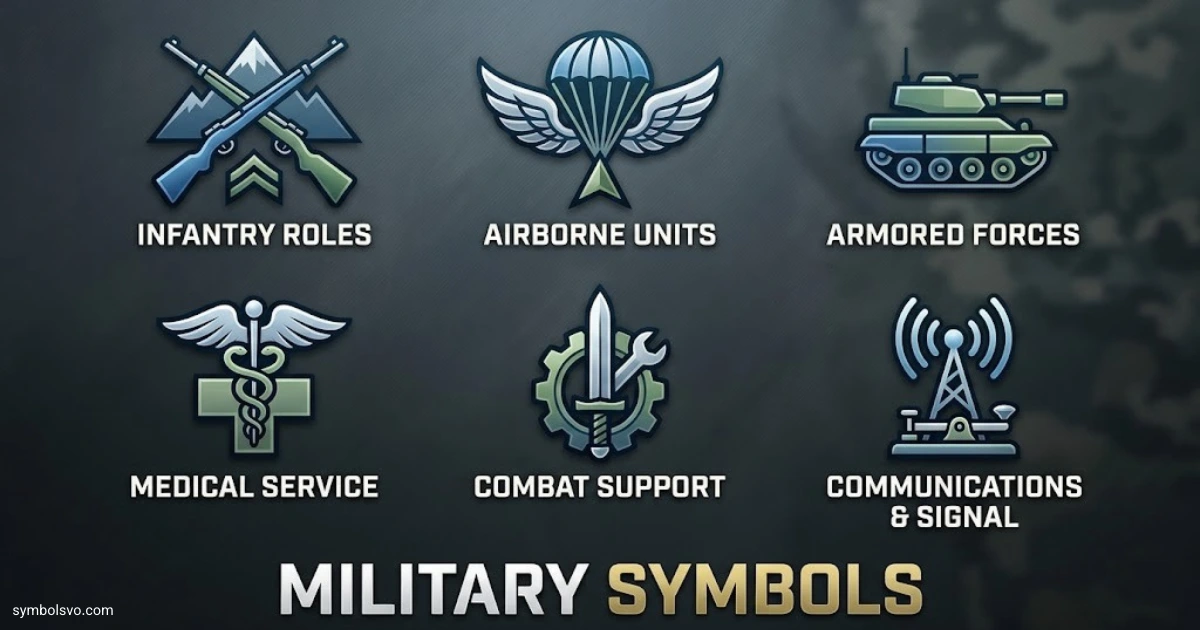
Military symbols help people represent military units, vehicles, equipment, positions, and operations through simple visual marks. You may see them on tactical maps, military diagrams, training materials, history projects, and strategy games. Their meanings often depend on the military organization, symbol system, and situation in which they appear.
If you are looking for military symbols to copy and paste, this guide includes useful text characters, symbol examples, and information about NATO, US, German, Ukrainian, and Roman military symbols. It also explains how military graphics work, how symbols are used in map reading, and how you can create or draw your own military-style graphics.
Some military symbols are standardized within formal systems, while others are historical illustrations or modern decorative designs. Understanding this difference helps you choose the right symbol for your project, presentation, map, or social media post without confusing a decorative character with an official military marking.
Military Symbols And Their Meanings
Military symbols are visual marks used to communicate information about armed forces, units, equipment, activities, and locations. In formal military systems, a symbol’s meaning comes from an established standard rather than its appearance alone.
Here are some common categories and examples:
| Symbol or marking | Common meaning or use |
| ★ | Star; often used decoratively or in rank-related designs |
| ★★★ | Three-star arrangement; may represent senior rank in a specific system |
| ⊕ | Circle with a cross; meaning depends on the map or symbol convention |
| ➤ | Directional arrow; useful for illustrating movement |
| → | Direction or movement from one point to another |
| ⊗ | Cross inside a circle; may have specialized meanings in technical diagrams |
| 🪖 | Military helmet emoji |
| 🎖️ | Military medal emoji |
| 🚩 | Flag; can represent a marker or signal in a general illustration |
These examples are useful for text, educational materials, and decorative designs, but they are not a substitute for an official tactical symbol library.
Main Categories Of Military Symbols
- Unit symbols: Identify military formations, units, and organizational elements.
- Equipment symbols: Represent vehicles, weapons systems, and other equipment in formal diagrams.
- Control measure symbols: Show boundaries, routes, areas, and other operational information.
- Historical military markings: Represent insignia, standards, shields, and emblems associated with past armies.
- Decorative military symbols: Include stars, medals, flags, and helmet characters used in personal profiles or designs.
The same shape can mean different things in different systems. A star, for example, may be decorative, represent rank in a particular insignia system, or form part of a standardized graphic. Always check the relevant legend or reference guide before interpreting it.
Military Symbols Copy And Paste
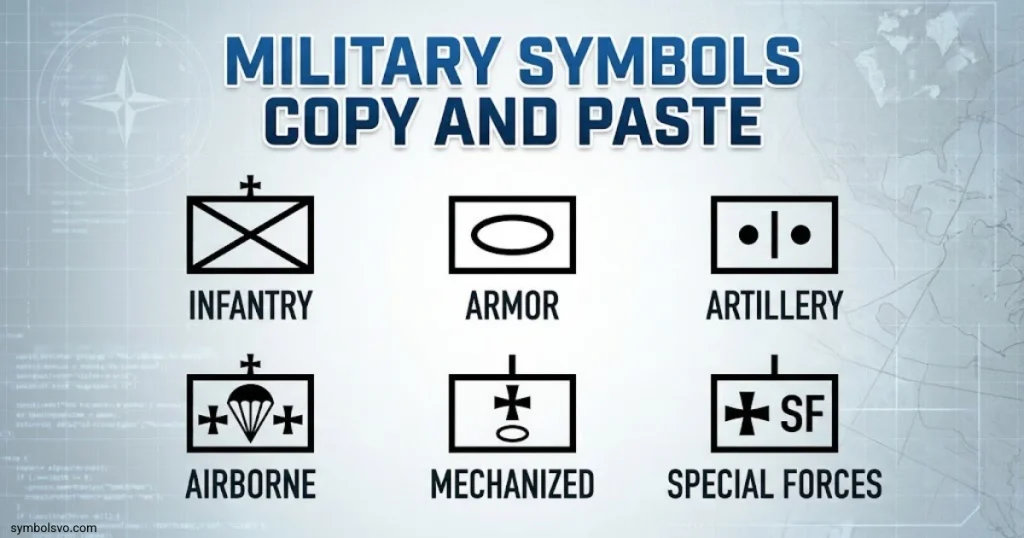
If you need military-themed characters for a username, message, profile, school project, or graphic, the following symbols are easy to copy. Select a character and use your device’s normal copy-and-paste shortcuts.
Military-Themed Symbols
🪖
Helmet
Copy
🎖️
Military medal
Copy
★
Star
Copy
☆
Outline star
Copy
➤
Arrow marker
Copy
🚩
Flag
Copy
These are general-purpose Unicode characters and emoji, not a complete collection of official military map symbols.
More Military-Style Text Characters
Select Copy to use a character in your own text.
★ ☆ ✦ ✧
Stars and decorative marks
Copy
→ ← ↑ ↓ ↗ ↘
Directional arrows
Copy
○ ● ◉ ◎
Circle markers
Copy
□ ■ ▣ ▢
Square markers
Copy
◆ ◇ ▲ △ ▼
Geometric markers
Copy
✚ ✖ ⊕ ⊗
Cross and circle combinations
Copy
Geometric characters can help you build simple diagrams, but they do not automatically acquire military meanings. For an accurate map, use symbols from the relevant military standard.
Military Emoji And Unicode Characters
Unicode assigns code points to text characters and emoji. For example:
| Character | Unicode code point | Official Unicode/CLDR name |
| 🪖 | U+1FA96 | Military helmet |
| 🎖 | U+1F396 | Military medal |
| ★ | U+2605 | BLACK STAR |
| ☆ | U+2606 | WHITE STAR |
The star characters are Unicode text symbols, whereas the helmet and medal are emoji. Their appearance may change across devices and applications. You can use them in compatible messaging apps, documents, and social media platforms, but they are not standardized tactical graphics.
Military Symbols And Graphics
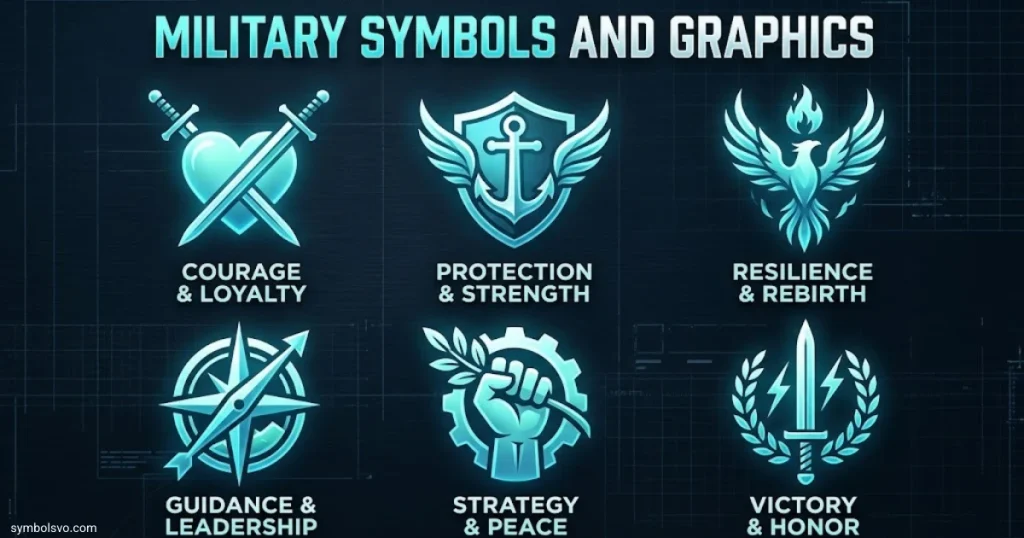
Military symbols and graphics cover a much wider range than individual text characters. They include standardized icons, organizational markings, equipment illustrations, map overlays, and diagrams used to communicate information visually.
A formal military graphic can combine several parts:
- Frame: The outer shape that helps identify a symbol’s category or affiliation under a particular standard.
- Icon: The central graphic representing a unit, equipment type, or other entity.
- Modifiers: Additional marks that provide more specific information.
- Text and numbers: Labels, identifiers, or other details associated with the symbol.
- Color and line style: Visual properties that may communicate affiliation, status, or other information under the applicable convention.
These components are especially useful in digital mapping systems and command-and-control displays. NATO’s APP-06 standard provides a structured approach to military symbology, including symbols used in electronic systems and hand-drawn applications.
Common Types Of Military Graphics
| Graphic type | What it represents |
| Unit graphics | Military organizations and formations |
| Equipment graphics | Vehicles and equipment categories |
| Boundary lines | Areas or limits defined by a map convention |
| Directional arrows | Movement, orientation, or a depicted route |
| Installation graphics | Facilities and other military locations |
| Historical insignia | National, regimental, or unit-associated designs |
A decorative tank illustration and an official tank symbol may look completely different because they serve different purposes. The illustration is meant to be recognizable, while the standardized graphic is designed to convey a defined category of information.
For presentations, infographics, and educational posters, decorative graphics can work well. For operational maps or professional military training, use the applicable standard and its accompanying reference material.
Military Symbols In Map Reading
Military map symbols help readers understand the information shown on a map without relying entirely on written descriptions. Depending on the map and its legend, symbols may identify units, installations, boundaries, equipment, or movement-related information.
How To Read Military Map Symbols
- Check the legend. Identify the symbol system and version used by the map.
- Examine the frame and icon. In standardized symbology, the overall shape and internal graphic can carry different pieces of information.
- Read associated labels. Letters, numbers, and short codes may identify a unit or provide additional context.
- Check colors and line styles. Their meaning depends on the applicable standard and map convention.
- Read the surrounding information. A symbol should be interpreted alongside the map title, date, scale, and legend.
Examples Of Map Markings
| Marking | General use in an illustrative map |
| ★ | A star marker or a symbol component |
| → | A depicted direction or route |
| – – – – | A dashed line used to show a defined boundary or route |
| ▲ | A triangular location marker |
| ○ | A circular location marker |
These examples are generic drawing elements, not a verified set of official military map symbols. Formal systems use specific shapes, frames, icons, and modifiers that must be read according to their documentation.
Military maps can also use symbols for air, land, maritime, space, and other operational categories. NATO APP-06 covers multiple categories of military symbology rather than just land units.
For historical maps, the symbols may follow older national conventions instead. Never assume that a modern NATO graphic and a historical map marking have identical meanings.
NATO Military Symbols
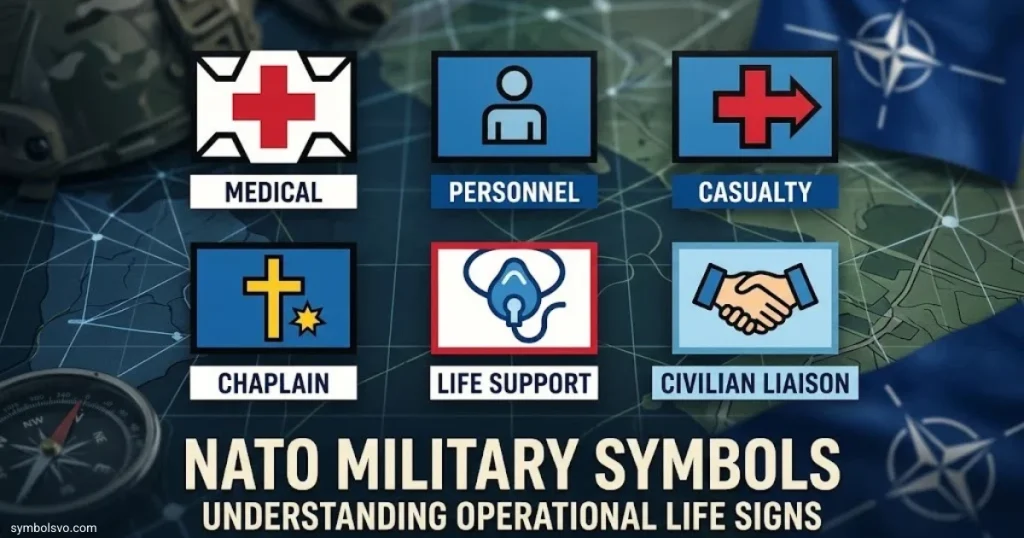
NATO military symbols are standardized graphics designed to support a shared understanding of military information among participating forces. The NATO Joint Military Symbology publication, APP-06, describes a structured set of symbols for electronic displays and manual applications.
What NATO Symbols Represent
The NATO symbology system includes several broad categories:
- Land units, individuals, and organizations.
- Military equipment and installations.
- Air-related entities.
- Maritime and subsurface entities.
- Space-related entities.
- Control measures and operational graphics.
- Stability activities and civil-support activities.
The system uses reusable components to create more specific graphics. Depending on the symbol, a frame, internal icon, modifiers, colors, and text can work together to communicate information.
NATO Military Symbol Standards
APP-06 is the key reference for NATO joint military symbology. Different editions can contain different symbols or changes, so a reference should be checked for its version and intended use.
The US military also maintains its own symbology standard, MIL-STD-2525. It is closely related to NATO symbology, but the two should not automatically be treated as identical in every edition or application.
If you need NATO symbols for an accurate map, training resource, or professional document, use the applicable edition of APP-06 rather than assembling a symbol set from unrelated Unicode characters.
US Military Symbols
US military symbols are used to represent units, equipment, installations, and operational information in military maps, digital displays, and planning documents. The US military’s MIL-STD-2525 standard provides a structured symbology system, with symbol construction and modifiers that help communicate information consistently.
Common US Military Symbol Categories
| Category | Purpose |
| Unit symbols | Represent military organizations and formations |
| Equipment symbols | Identify equipment categories |
| Installation symbols | Represent facilities and military sites |
| Control measures | Depict boundaries, routes, and defined areas |
| Status and affiliation indicators | Add context to a symbol under the applicable standard |
The exact appearance of a symbol depends on its category, version, and the information being represented. A formal symbol may contain several components instead of one standalone character.
Where To Find US Military Symbols
The Map.Army Symbol Gallery provides a browser-based way to explore a military symbol library based on MIL-STD-2525C. Its documentation explains that the library does not include every symbol found in later US or NATO standards.
For accurate work, check the standard edition required by your organization or project. If you only need a general military-themed design, simple Unicode characters may be sufficient, but they should not be presented as official US military graphics.
US Military Symbols And Graphics
US military symbols and graphics include the visual components used to represent military organizations, equipment, locations, and operational information. They are commonly used in planning diagrams, mapping applications, training materials, and presentations.
A graphic may combine an icon with a frame, modifiers, and identifying text. These components allow a standardized symbol to communicate more information than a simple illustration.
Examples Of US Military Graphic Uses
- Unit organization diagrams: Show relationships between different organizational elements.
- Equipment illustrations: Help readers recognize broad equipment categories.
- Map overlays: Add standardized symbols and lines to a map.
- Training presentations: Explain military terminology and symbol conventions.
- Historical displays: Compare symbols and insignia from different periods.
For professional diagrams, use the appropriate MIL-STD-2525 symbol library. For a general presentation, you can also use editable vector illustrations, shapes, and text labels.
Keep in mind that US military graphics can change between standard editions. If a symbol must be interpreted correctly, identify the source and edition rather than relying only on its visual appearance.
Army Military Symbols And Graphics
Army military symbols and graphics focus on land forces, their organization, equipment, and activities. They can appear in paper maps, digital planning tools, training diagrams, historical documents, and educational resources.
Army symbology is not limited to a single country’s system. The US Army, NATO forces, and other national armies may use related concepts while following different standards or national conventions.
Common Army Symbol Categories
| Symbol category | Typical purpose |
| Infantry-related symbols | Represent infantry units or formations in a formal system |
| Armored-unit symbols | Identify armored or mechanized formations |
| Artillery-related symbols | Represent artillery organizations or equipment |
| Engineer-related symbols | Identify engineering units or activities |
| Logistics symbols | Represent supply, transport, and support organizations |
| Medical symbols | Identify medical services or facilities according to the relevant convention |
These are categories, not a claim that each has one universal Unicode character. Official graphics should be taken from the appropriate national or international symbol standard.
Army Symbols For Documents And Presentations
For a school project or a general presentation, use clearly labeled illustrations and keep their meanings consistent throughout the document. If you include official military symbology, cite the reference standard and distinguish it from decorative artwork.
For example, a simple star can mark an important point on a presentation slide, while an official army unit symbol communicates a more specific meaning defined by its standard. The two should not be confused.
German Military Symbols
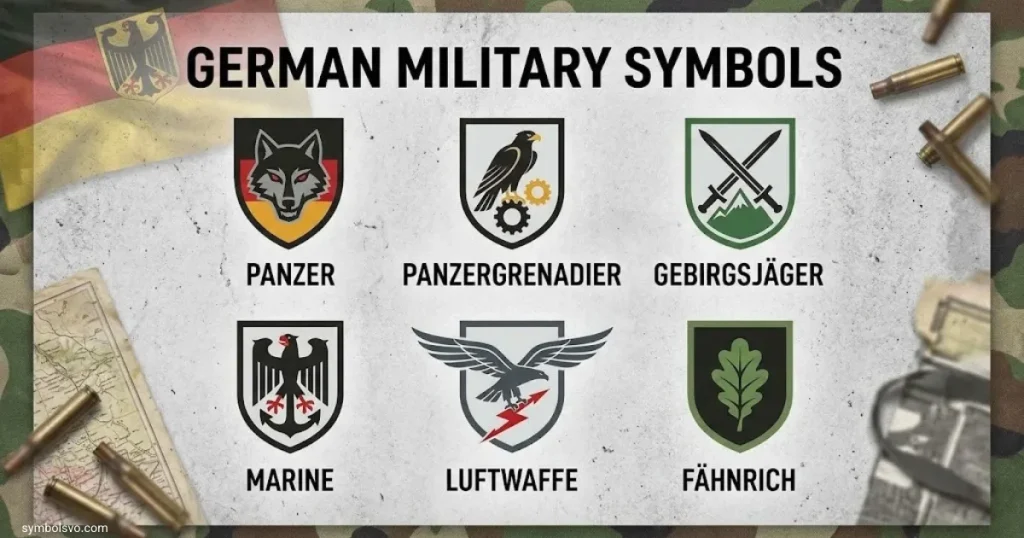
German military symbols vary by historical period, organization, and purpose. A symbol used by the modern German armed forces may differ significantly from an insignia used by the German Empire, the Weimar Republic, or Germany during the Second World War.
Types Of German Military Symbols
- Modern Bundeswehr symbols: Used in contemporary German military contexts, with applicable organizational and NATO-related conventions.
- Historical insignia: Includes unit badges, rank markings, flags, and other designs from earlier periods.
- Regimental and unit emblems: Designs associated with particular formations or military organizations.
- Map symbols: Graphics used in formal mapping or operational contexts according to a relevant standard.
German Military Symbols And Their Context
Historical military markings should always be identified by period and organization. A national emblem, a unit badge, a rank insignia, and a tactical map symbol are different types of visual information.
For historical research, use museum collections, archival documents, and reliable military-history references. For current German or NATO-related map graphics, use the applicable standardized symbol library.
There is no single Unicode character that represents all German military symbols. Some emblems may be available as images or vector graphics rather than copyable text characters. If you need a specific insignia, search by its verified name and historical period.
Ukrainian Military Symbols
Ukrainian military symbols include national and military emblems, unit insignia, rank markings, flags, and symbols used in formal military documentation. Their appearance and meaning depend on the organization and historical context.
Common Categories Of Ukrainian Military Symbols
- National symbols: The Ukrainian flag and national emblems used in official contexts.
- Military unit insignia: Distinctive badges associated with particular units or formations.
- Rank insignia: Markings used to identify military rank under the relevant system.
- Historical military symbols: Emblems and flags associated with earlier Ukrainian military organizations.
- Tactical graphics: Standardized military symbols used in maps and operational displays.
The Ukrainian flag is commonly represented with the national colors of blue and yellow. The emoji 🇺🇦 can be used in messages and profiles where flag emoji are supported, but it is not a tactical unit symbol.
Copy And Paste Ukrainian Flag
🇺🇦
Ukraine flag emoji
Unicode regional indicator sequence for the Ukrainian flag.
Copy
For an official Ukrainian military badge or unit emblem, use a reliable reference image instead of substituting a generic star, shield, or flag. Tactical symbols and national insignia serve different purposes, and neither should be assumed to have a universal meaning outside its intended system.
Roman Military Symbols
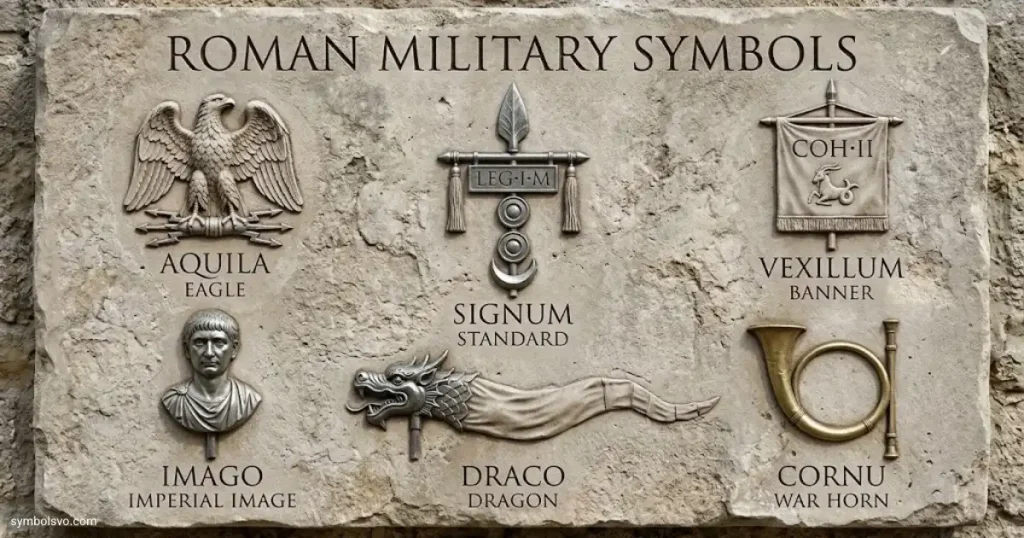
Roman military symbols belong to the ancient world and differ from modern NATO and US tactical graphics. They were used on standards, shields, armor, coins, inscriptions, and other objects associated with Roman military life.
Common Roman Military Symbols And Markings
The eagle standard was a highly significant emblem associated with a Roman legion. It represented the unit and its honor rather than functioning as a modern map symbol.
A vexillum was a military standard consisting of a cloth panel attached to a crossbar and carried on a pole. Its specific design and use could vary.
Roman shields could feature painted patterns, figures, and other markings. Their designs varied across periods and military units, so one pattern should not be treated as universal.
Roman Symbols For Copy And Paste
There is no universal Unicode character for the Roman legionary eagle standard or every Roman military emblem. You can, however, use classical Latin letters and simple decorative characters to create a Roman-inspired text design.
SPQR
Famous Roman abbreviation
Copy
🏛️
Classical architecture emoji
Copy
★
Decorative star
Copy
⚔
Crossed swords symbol
Copy
♜
Chess rook; sometimes used decoratively
Copy
SPQR stands for Senatus Populusque Romanus, meaning “The Senate and People of Rome.” It was a well-known expression of Roman civic identity. The other characters above are general Unicode or emoji symbols, not verified reproductions of ancient Roman military insignia.
For historical accuracy, use a museum image, archaeological reference, or scholarly source when depicting an aquila, vexillum, or legionary shield.
Military Symbols Generator
A military symbols generator is a tool that creates military-style graphics or builds standardized symbols from selectable components. The best option depends on whether you need an official map symbol, an editable diagram, or a decorative design.
Types Of Military Symbol Generators
| Tool type | Best use |
| Standardized symbol editor | Creating symbols from a defined military library |
| Map-symbol generator | Adding military graphics to a map |
| Vector graphics editor | Drawing custom icons and emblems |
| Diagram software | Building unit organization charts and labeled graphics |
| Presentation software | Creating military-themed diagrams for slides |
For standardized military symbology, the Map.Army Symbol Gallery is a useful starting point. It documents a MIL-STD-2525C-based symbol library and explains some of its limitations.
How To Create A Military Symbol
- Choose the relevant symbol standard or decide that you need a decorative graphic.
- Select the category that matches your intended use.
- Add the appropriate icon and any required modifiers.
- Include labels or identifiers only when needed.
- Export the result in a suitable format, such as SVG or PNG, if the tool supports it.
- Verify the symbol against the relevant reference before using it in formal documentation.
Do not assume that a generator produces official symbols simply because it uses military-style frames and icons. Check which standard and version it supports, especially when working with NATO or US military graphics.
Draw Military Symbols
You can draw military symbols by hand or create them digitally. The best approach depends on whether you want a simple military-themed illustration or an accurate symbol from an established standard.
How To Draw Simple Military-Style Symbols
Step 1: Choose the symbol type. Decide whether you need a star, flag, helmet, vehicle illustration, or a formal tactical graphic.
Step 2: Sketch the basic shape. Start with simple geometric forms, such as circles, squares, triangles, or lines.
Step 3: Add the main icon. Place the recognizable element inside the shape if your chosen design requires one.
Step 4: Add labels if needed. Use short text labels to identify the symbol in a presentation or educational diagram.
Step 5: Keep the design consistent. Use similar line weights, spacing, and sizes across a collection of symbols.
Step 6: Check the meaning. If the design is intended to represent an official military unit or function, compare it with the appropriate standard rather than relying on visual similarity.
Simple Symbols You Can Draw
| Symbol | Drawing idea |
| ★ | Draw a five-pointed star |
| ☆ | Draw an outlined five-pointed star |
| → | Draw a horizontal line with an arrowhead |
| ○ | Draw a simple circle |
| □ | Draw a square |
| ▲ | Draw an upward-pointing triangle |
These characters work well for basic diagrams, educational activities, and decorative projects. They should not be treated as official military symbols without supporting documentation.
Digital Tools For Drawing Military Graphics
Vector graphics editors are useful when you need scalable symbols that remain sharp at different sizes. Presentation software works well for simple diagrams, while a standardized symbol editor is preferable for formal military symbology.
If you plan to reuse a symbol across several documents, save a clean master version and keep its label or source information with the file.
Military Symbols PowerPoint
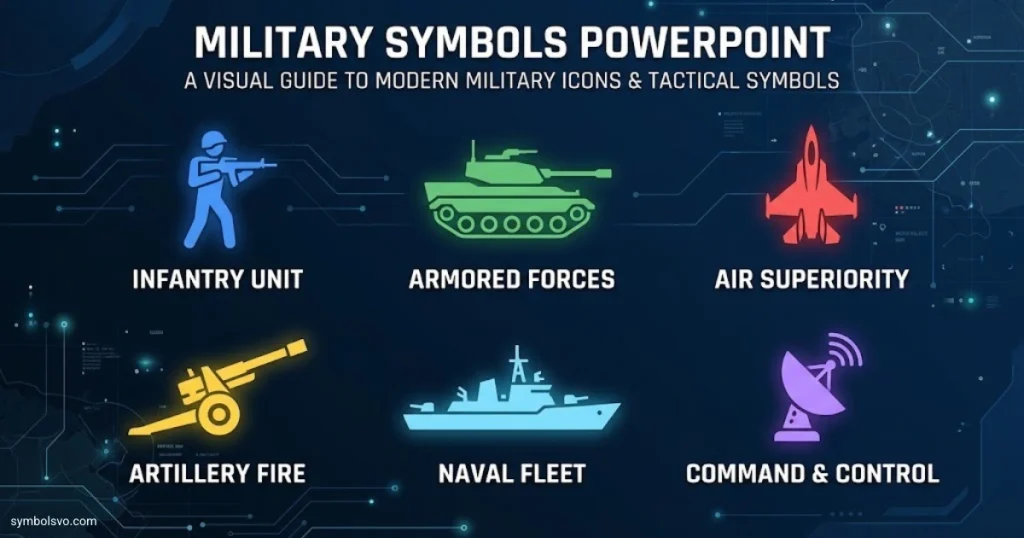
Military symbols in PowerPoint can help you explain military history, show organizational relationships, create educational diagrams, or present information through clear visual elements.
PowerPoint supports shapes, text boxes, pictures, and other visual elements that can be combined to build custom graphics. You can also insert supported SVG files when you need vector artwork that can scale cleanly.
How To Add Military Symbols In PowerPoint
- Open your PowerPoint presentation and select the slide where the symbol will appear.
- Choose Insert → Shapes to create basic geometric designs.
- Use Insert → Pictures to add an existing military symbol image.
- Add a text box to explain the symbol’s meaning.
- Align the objects and group them if they form one graphic.
- Save the presentation and check that the symbol remains readable at normal slide size.
The exact menu names may vary slightly by PowerPoint version.
Best Symbol Formats For PowerPoint
| Format | Main advantage | Limitation |
| SVG | Scalable vector artwork | Editing depends on the file and software version |
| PNG | Simple image insertion with transparent backgrounds | Can look blurry when enlarged too much |
| JPG | Suitable for photographs and complex images | Does not support transparency |
| Unicode text | Easy to type, copy, and recolor | Appearance and meaning can vary by font or platform |
For formal military presentations, use graphics from the relevant standard and include a legend when readers may not recognize the symbols. For general educational slides, labeled illustrations can be easier to understand than highly technical graphics.
Tips For A Clear Military Symbols Slide
- Use one consistent visual style throughout the presentation.
- Make symbols large enough to recognize on a projected screen.
- Add labels instead of expecting the audience to guess each meaning.
- Avoid combining unrelated historical and modern symbol systems without explanation.
- Keep decorative icons separate from official tactical graphics.
If you distribute the PowerPoint to others, check the licensing and permitted use of any external images or symbol libraries.
Frequently Asked Questions About Military Symbols
What Are The Most Common Military Symbols?
Common military symbols include unit graphics, equipment icons, flags, rank insignia, and standardized map markings. Stars, arrows, and military-themed emoji are also popular for decorative designs, but they do not automatically represent official military information.
Are NATO And US Military Symbols The Same?
No. NATO APP-06 and US MIL-STD-2525 are related military symbology standards, but they are not identical in every version or application. Check the relevant standard when accuracy matters.
Can I Copy And Paste Official Military Symbols?
You can copy and paste Unicode characters, emoji, and text symbols easily. However, many official military graphics are complex images or standardized components rather than single text characters. Use a compatible symbol library when you need an accurate tactical graphic.
Where Can I Find Military Symbols For Maps?
Start with the official reference for the applicable military symbol standard. The Map.Army Symbol Gallery is one option for exploring a MIL-STD-2525C-based library. Always check whether its supported version matches your requirements.
Can I Use Military Symbols In PowerPoint And Social Media?
Yes. Unicode characters and emoji can be used in many presentations, messages, and social media posts. You can also insert suitable PNG or SVG graphics. Display and editing support depend on the application, font, and device, so check the final result before sharing it.
Conclusion
Military symbols provide a visual way to communicate information about armed forces, equipment, historical traditions, and map features. Learning the differences between formal military symbology, national insignia, and decorative characters helps you choose the right graphics for your needs.
For quick projects, copy-and-paste characters such as ★, ➤, 🪖, and 🎖️ offer convenient options. For NATO, US, or other national military symbols, use a reliable reference that identifies the relevant standard and explains the symbol’s intended meaning.
The best military symbol is one that serves your purpose and is easy to understand. Use decorative symbols for personal designs and presentations, and rely on verified military references when creating maps, educational resources, or formal documents.

I’m Daniel Brooks, a content creator and symbol enthusiast dedicated to researching the fascinating world of signs and symbols. I enjoy discovering the hidden meanings behind famous icons, emojis, historical emblems, and cultural symbols. Through my writing, I aim to provide trustworthy, well-researched, and reader-friendly information that helps people learn something new with every visit.
Books:
- The Complete Guide to World Symbols
- The Power of Universal Signs
 Nathan Holloway
 Mason Ellington