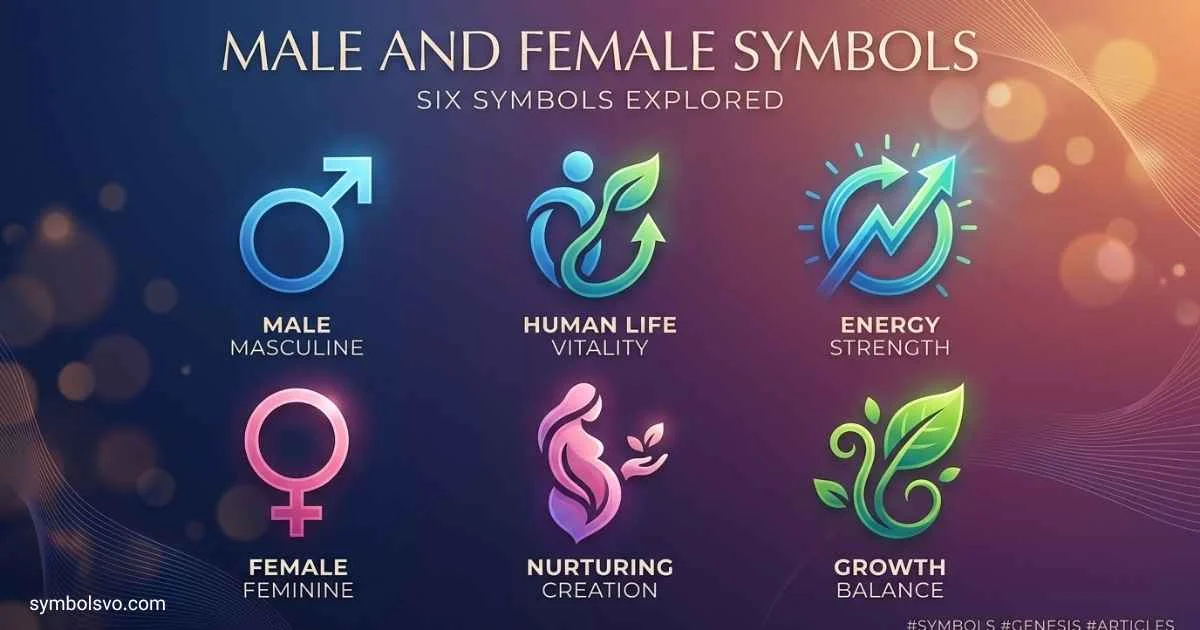
Have you ever seen the ♂ and ♀ symbols and wondered what they really mean? These familiar signs appear everywhere, from biology textbooks and public signs to social media profiles and everyday digital communication. I’ll help you understand their meanings without confusing terminology or unnecessary details.
The male and female symbols have fascinating historical origins and important meanings in science, culture, and modern communication. If you want to identify, understand, or copy these symbols, you’ll find the essential information you need right here.
In this guide, you’ll discover what each symbol represents, how they differ, where they are commonly used, and how to copy and paste them on your device. I’ll also explain their Unicode characters and help you avoid common misunderstandings so you can use these symbols confidently.
What Are the Male and Female Symbols?
The male and female symbols are graphic signs commonly used to represent male and female sex or gender. They are widely recognized because their shapes are simple and easy to reproduce.
The two standard symbols are:
- ♂ — Male symbol: A circle with an arrow pointing diagonally upward and to the right.
- ♀ — Female symbol: A circle with a small cross extending downward.
These characters appear in biology, medicine, astrology, educational materials, public signage, and online communication. Their exact meaning depends on the setting. In a biological chart, they may refer to sex, while in a social or cultural context, they may represent gender identity or traditional gender categories.
The symbols are useful for labeling information in a compact space. However, they do not represent every gender identity or biological variation, so more specific labels may be appropriate in contexts where accuracy and inclusion matter.
Male and Female Symbols Meaning
The male symbol ♂ and female symbol ♀ have traditional associations with masculinity and femininity. They are also commonly used to indicate male and female categories in scientific, medical, and educational settings.
| Symbol | Common name | Traditional association | Unicode |
| ♂ | Male sign | Male sex, masculinity | U+2642 |
| ♀ | Female sign | Female sex, femininity | U+2640 |
The male symbol ♂ has an arrow extending from a circle. Its design is traditionally associated with Mars, the Roman god of war. This connection helped link the sign with masculine symbolism.
The female symbol ♀ has a cross below a circle. It is traditionally associated with Venus, the Roman goddess of love and beauty. This association helped connect the sign with feminine symbolism.
These traditional meanings are not universal rules. Modern people may use the symbols in different ways, and their meanings can change depending on culture, community, and purpose.
Gender Symbol
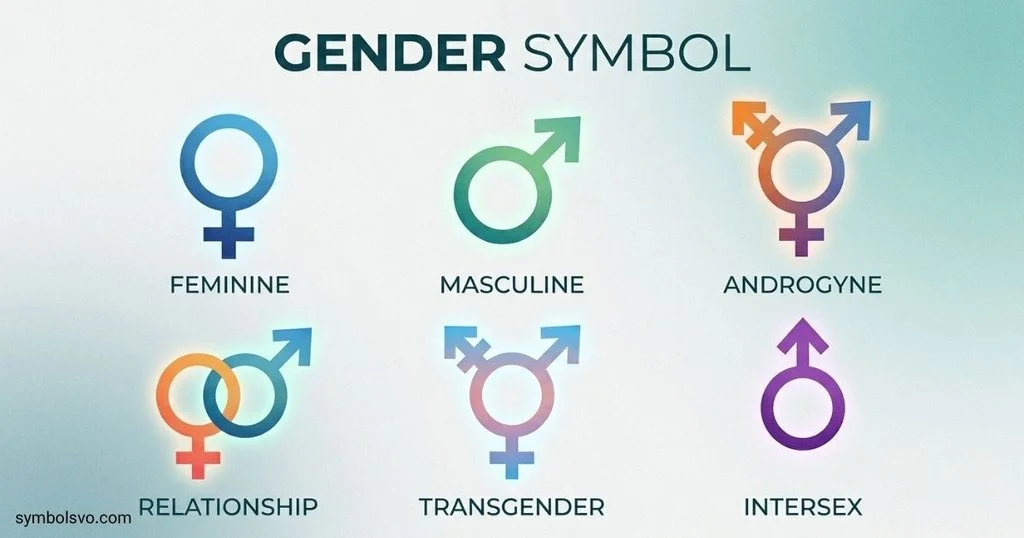
A gender symbol is a visual character used to communicate information about sex, gender, or gender-related concepts. The male and female symbols are two of the most familiar examples, but they are not the only symbols used in this area.
Common examples include:
- ♂ — Traditionally represents male.
- ♀ — Traditionally represents female.
- ⚧ — Transgender symbol, often represented as a combination of gender-related elements.
- ⚥ — A symbol associated with hermaphroditism or intersex-related concepts in some technical and historical contexts; usage varies.
The last two symbols should not be treated as interchangeable. In particular, ⚧ is commonly used to represent transgender identities, while ⚥ has different historical and technical uses. Terminology and symbol preferences can vary among individuals and organizations.
For forms, research, or public information, use labels that fit the purpose instead of relying on symbols alone. A symbol can save space, but a clear text label often communicates more accurately.
Male and Female Symbols Origin
The familiar male and female symbols have historical roots in astronomy and astrology. They were used as planetary signs long before becoming common labels in biology and everyday design.
The male sign ♂ is associated with Mars, while the female sign ♀ is associated with Venus. Their traditional planetary associations later became linked with ideas about masculine and feminine qualities.
The symbols became especially useful in scientific writing because a single character could identify a category without taking up much space. They were adopted in biological classification, medical illustrations, and other technical contexts.
Their modern appearance may seem simple, but the meanings attached to them developed over time. It is more accurate to describe their history as a gradual transition from planetary symbols to sex-related notation than to assign their entire origin to one person or a single ancient event.
Where Do Male and Female Symbols Come From?
The male and female symbols are commonly traced through European astrological and astronomical traditions. Their connection to Mars and Venus explains why their shapes are often discussed alongside Roman mythology.
Mars was associated with war, strength, and military power. Venus was associated with love, beauty, and attraction. These traditional associations contributed to the later interpretation of the symbols as male and female signs.
The shapes are also sometimes explained through older visual ideas: the male symbol’s arrow is associated with a spear, while the female symbol’s circle and cross are often compared to a hand mirror. These are familiar explanations of their design, but they should not be treated as complete proof of every stage in the symbols’ early development.
Today, the signs are used internationally. Their recognizable shapes make them practical for charts, labels, diagrams, and digital text, although some modern applications use more inclusive symbols or written descriptions.
Male and Female Symbols X and Y
The letters X and Y are associated with sex chromosomes in human genetics. They are not the same as the male and female symbols, but people often encounter them together in biology lessons and scientific diagrams.
In the common human chromosome patterns:
- XX is typically associated with female development.
- XY is typically associated with male development.
These are common patterns, not a complete description of every person’s biology. Variations in chromosomes, hormones, genes, and development exist, so XX and XY should not be used as universal labels for all individuals.
Here is a simple comparison:
| Character or pattern | What it represents |
| ♂ | A traditional male sign |
| ♀ | A traditional female sign |
| X | A chromosome name |
| Y | A chromosome name |
| XX | A common human chromosome pattern |
| XY | A common human chromosome pattern |
The symbols ♂ and ♀ are visual signs, while X and Y are letters used to name chromosomes. In a genetics chart, the letters provide information about chromosomes; in a general diagram, the gender symbols may provide a quick category label.
Male and Female Symbols Combined
Male and female symbols can be combined in different designs to represent relationships, sex categories, balance, or gender-related concepts. There is no single combined design that means the same thing in every context.
Here are some ways the symbols may appear together:
- ♂ ♀ — The two symbols displayed side by side to show male and female categories.
- ♀♂ — An adjacent arrangement used in some graphics or informal designs.
- ⚥ — A separate Unicode character with historical and technical associations; it should not automatically be treated as a universal symbol for gender equality.
- ⚧ — A transgender symbol used in many contemporary contexts.
For decorative designs, the symbols can be placed next to each other, overlapped, or incorporated into a larger graphic. Such combinations can suggest connection or inclusion, but the meaning depends on the design and the audience.
If you are creating a sign, chart, or educational resource, add a label when the intended meaning might be unclear. For an inclusive design, consider using an established symbol appropriate to your subject rather than inventing a combination and assuming everyone will understand it.
Yin Yang Male Female Symbols
The yin-yang symbol ☯ comes from Chinese philosophical traditions and represents complementary forces, often described through yin and yang. It is not originally a male-and-female symbol, although some modern designs combine it with the male ♂ and female ♀ signs.
In some contemporary artwork, yin is associated with feminine qualities and yang with masculine qualities. These associations are simplified interpretations of a much broader concept. Yin and yang are not simply synonyms for women and men; they describe interdependent aspects of change and balance.
A design combining ☯, ♂, and ♀ may be used to express harmony, duality, or the relationship between contrasting qualities. The message depends on the creator’s intention.
You can copy the main characters here:
- ☯ — Yin-yang symbol.
- ♂ — Male symbol.
- ♀ — Female symbol.
Use these combinations thoughtfully, especially in educational or cultural content. The yin-yang symbol has a specific cultural and philosophical background, so it should not be presented as if it were originally created to represent modern gender categories.
Egyptian Male and Female Symbols
Ancient Egyptian art and writing included many ways to communicate ideas about men, women, gods, fertility, and family relationships. However, there is no single ancient Egyptian character that functions as a direct equivalent of the modern male symbol ♂ or female symbol ♀ in every context.
Egyptian hieroglyphs included signs for people, body parts, actions, and concepts. Images of men and women also appeared in tomb paintings, statues, reliefs, and other artwork. Their clothing, poses, titles, and surrounding inscriptions helped identify the people represented.
Some Egyptian deities were associated with fertility, creation, protection, or motherhood. For example, Isis is often connected with motherhood and protection, while Osiris is associated with kingship, death, and regeneration. These associations are more complex than a simple male-versus-female division.
If you want an Egyptian-inspired male and female design, you can use historically informed illustrations of people or deities. Avoid labeling an unrelated hieroglyph as an official Egyptian male or female symbol unless its meaning is supported by a reliable Egyptological source.
Male and Female Symbols Copy Paste
You can copy the male and female symbols directly from the table below. Select the character you need and paste it into a document, text message, website, profile, or supported design application.
| Symbol | Name | Unicode |
| ♂ | Male sign | U+2642 |
| ♀ | Female sign | U+2640 |
| ⚥ | Historical or technical sex-related sign | U+26A5 |
| ⚧ | Transgender symbol | U+26A7 |
| ☯ | Yin-yang symbol | U+262F |
The symbols in this table have different meanings, so choose the one that matches your purpose. The yin-yang symbol, for example, represents a philosophical concept rather than a standard female or male category.
How To Copy And Paste The Symbols
- Find the character you want in the table.
- Select the symbol with your mouse or touch screen.
- Copy it using your device’s copy command.
- Open the destination and paste it.
If a symbol appears as an empty box, question mark, or unexpected character, the application or font may not support its display correctly. Try a different font or use a clear written label. Copying a Unicode character also does not guarantee that every platform will display it in exactly the same style.
Male and Female Symbols Emoji
The male sign ♂ and female sign ♀ are Unicode symbols, but they are not standard colorful emoji in the way that many faces and objects are. Depending on the device and application, they may appear as plain monochrome characters or receive different visual styling.
Here are related characters you may want to copy:
- ♂ — Male sign.
- ♀ — Female sign.
- ⚧ — Transgender symbol.
- ⚥ — Sex-related sign with historical and technical uses.
- 🧑 — Person emoji.
- 👨 — Man emoji.
- 👩 — Woman emoji.
The last three are human emoji, not alternate spellings of the male and female signs. They may be more suitable when you want to represent a person rather than label a category.
Emoji designs can differ between platforms, and some characters may render differently in older software. If your message must be clear to everyone, use the symbol with a short text label.
Male and Female Symbols Images
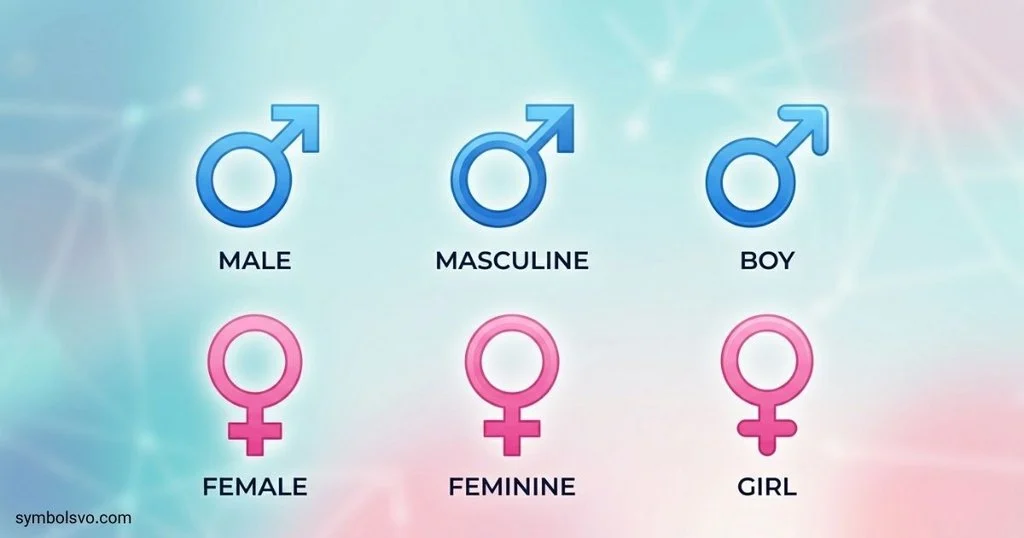
Images of male and female symbols are useful when you need more control over color, size, shape, and placement than a text character provides. You can find them in diagrams, classroom materials, public signs, presentations, infographics, and website graphics.
Common image styles include:
- Classic symbols: The familiar ♂ and ♀ shapes in black or another solid color.
- Colored symbols: Blue, pink, or other colors chosen for a specific design.
- Outlined symbols: Thin lines that work well in minimalist layouts.
- Combined designs: Male and female signs placed together to show two categories or a relationship.
- Accessible signage: Symbols paired with text to make the meaning clearer.
Color choices such as blue for male and pink for female are common in some designs, but they are conventions rather than rules. Color alone should not carry important information if viewers may have difficulty distinguishing it.
For professional use, choose images with clear edges and sufficient contrast. Check the image license before using artwork commercially, and consider scalable vector graphics when you need a symbol that remains sharp at different sizes.
Female Symbol Picture
The female symbol ♀ is one of the simplest graphic signs to reproduce. It consists of a circle with a short vertical line extending down to a crossbar.
The character is useful when you need a compact female-related label in a chart, diagram, or graphic. You can also use it as a starting point for a custom icon, provided the final design remains clear and appropriate to its context.
Here are several ways to use the female symbol:
- Plain text: ♀
- With a label: ♀ Female
- In a comparison: ♂ Male | ♀ Female
- In a chart: Place the symbol beside the category it identifies.
- In a design: Use the symbol as a small visual element alongside explanatory text.
If you need a female symbol picture rather than a text character, a vector image gives you more control over stroke thickness and color. A text character is quicker to copy, while an image is often better for a carefully designed poster or sign.
Clip Art Male and Female Symbols
Clip art provides ready-made images of male and female signs. These images may include simple black icons, colorful illustrations, silhouettes, people, or combined symbols.
Clip art can be useful for school assignments, presentations, health information, infographics, and signs. The best choice depends on the audience and the message you want to communicate.
When selecting clip art, consider these points:
- Clarity: The symbols should be recognizable at the size you plan to use.
- Style: Match the icon to the design of the document or presentation.
- Contrast: Make sure the symbol stands out from its background.
- Accuracy: Avoid artwork that changes the symbol into something confusing.
- Licensing: Check whether the image is free to use, requires attribution, or has commercial restrictions.
For a basic document, the Unicode characters ♂ and ♀ may be enough. For a large poster or printed sign, a vector icon can offer more consistent sizing and placement.
Bathroom Male and Female Symbols
Male and female symbols are often used on bathroom doors to identify facilities traditionally designated for men and women. They are especially useful when a sign needs to be understood quickly from a distance.
A bathroom sign might use:
- ♂ to identify a men’s restroom.
- ♀ to identify a women’s restroom.
- Men / Women as written labels.
- A person icon or accessibility symbol to communicate additional information where appropriate.
A symbol alone may not be clear to every visitor. Adding words can improve understanding, especially for children, visitors who are unfamiliar with the signs, and people who interpret symbols differently.
Facilities should also consider accessibility and local rules when designing restroom signage. A male or female symbol does not, by itself, communicate whether a restroom is wheelchair accessible, family-friendly, or gender-neutral.
For inclusive facilities, signs may use a neutral person icon, a toilet icon, or a clear label such as “All-Gender Restroom.” The most useful sign is the one that accurately describes the facility and helps visitors find the right space.
Family Tree Male and Female Symbols
Family trees often use male and female symbols to show people and relationships across generations. In a traditional family diagram, a square may represent a male and a circle may represent a female. These shapes are especially common in pedigree charts and family-history materials.
The symbols are not completely uniform across every family-tree system. Some genealogy programs use photographs, initials, person icons, or other shapes instead.
A simple family-tree example may look like this:
- ♂ Parent: A person shown with a traditional male symbol.
- ♀ Parent: A person shown with a traditional female symbol.
- Lines between people: Connections that indicate partnerships or parent-child relationships, according to the diagram’s key.
- Generational rows: Different levels of the family tree, often arranged from older generations to younger ones.
For a family history project, it is helpful to include a legend explaining the symbols and lines. This prevents confusion when the tree includes adopted relatives, stepfamilies, unknown information, or relationships that do not fit a traditional diagram.
A family tree should reflect the family information accurately. If the chart is intended for a broad audience, names and relationship labels may be clearer and more respectful than relying only on gender symbols.
Pedigree Male and Female Symbols
A pedigree is a diagram used to show biological relationships across generations. In genetics and medical studies, it can help researchers understand how a trait or condition appears in a family.
Traditional pedigree notation commonly uses:
- □ Square: Male.
- ○ Circle: Female.
- ◇ Diamond: Sex unspecified or not specified in some pedigree conventions.
- Horizontal line: A relationship or mating connection, according to the chart’s notation.
- Vertical line: A connection to offspring.
These are common conventions, but the exact meaning of a symbol should always be checked against the chart’s legend. Pedigree diagrams can include additional marks for affected individuals, carriers, deceased relatives, twins, or other details.
In genetic counseling and research, pedigree symbols help organize information, but they do not establish a diagnosis on their own. A trained professional interprets the chart alongside family history, clinical information, and relevant testing.
Pedigree Chart Male and Female Symbols
A pedigree chart uses symbols and connecting lines to show family relationships in a structured way. It may cover several generations and track a particular inherited trait or medical condition.
A simplified example is:
| Pedigree symbol | Common meaning |
| □ | Male |
| ○ | Female |
| ◇ | Sex unspecified in some systems |
| ■ | Male individual marked as affected in some charts |
| ● | Female individual marked as affected in some charts |
| ◐ or a shaded symbol | May indicate a carrier or another defined status, depending on the chart key |
The filled symbols in the table are examples of common conventions. Their meaning depends on the specific pedigree system and the trait being studied, so always read the legend.
A well-designed pedigree chart should include a key, clear generation labels, and consistent lines. Use standard notation if the chart is for genetics or healthcare, because improvised symbols can make it harder for others to interpret the information correctly.
For a general family tree, simpler icons may be sufficient. For a scientific pedigree, consistency matters more than decoration.
Pokémon Go Pokédex Male and Female Symbols
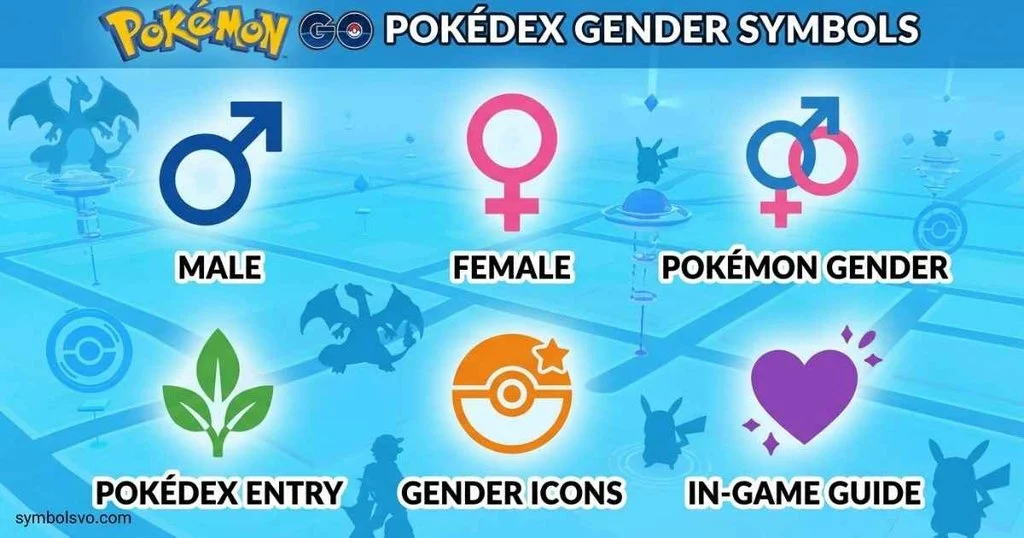
In Pokémon GO and other Pokémon games, the male and female signs ♂ and ♀ may appear beside a Pokémon’s name or details to show its sex, when the species has sex differences represented in the game.
The symbols can help players identify which version of a Pokémon they have. Some Pokémon have visible differences between male and female forms, while others look almost identical regardless of sex. Not every Pokémon species has a male and female form; some species are genderless or have other specific characteristics.
The signs are useful when checking a Pokédex entry, comparing Pokémon, or organizing a collection. For example, a player may use the symbols in notes to record a particular Pokémon’s sex or to remember which form they still need.
Keep in mind that game details can differ by species and game version. The presence of ♂ or ♀ is a game label, not a guarantee that the Pokémon will have a different appearance or special ability. Consult the individual Pokédex entry when you need species-specific information.
Frequently Asked Questions
What Is The Male Symbol And The Female Symbol?
The male symbol is ♂, and the female symbol is ♀. They are commonly used to represent male and female categories in biology, medicine, signage, and other types of information.
How Do I Copy And Paste Male And Female Symbols?
Select ♂ or ♀ from this article, copy the character, and paste it into your document, message, website, or profile. If it displays incorrectly, try a font or application that supports the character.
What Are The Unicode Codes For Male And Female Symbols?
The male sign ♂ has the Unicode code point U+2642, and the female sign ♀ has the code point U+2640. These code points identify the characters independently of how a particular font styles them.
Are Male And Female Symbols The Same As X And Y Chromosomes?
No. The symbols ♂ and ♀ are visual signs, while X and Y are chromosome names. XX and XY are common human chromosome patterns, but they do not describe every form of biological sex development.
Can Male And Female Symbols Represent Every Gender Identity?
No. The traditional symbols represent male and female categories, but they do not cover every gender identity or biological variation. Use more specific symbols or written labels when the context calls for inclusive or precise information.
Conclusion
Male and female symbols are simple, recognizable characters with a long history in astronomy, astrology, science, and everyday communication. The male sign ♂ and female sign ♀ remain useful for labels, charts, bathroom signs, family trees, and digital text, while their meanings depend on the setting.
You can copy and paste the symbols directly, use Unicode information to identify them, or choose images and clip art for more detailed designs. Related signs such as ⚧ and ⚥ have different uses, so it is worth checking their meanings before adding them to a chart or graphic.
The best symbol is the one that communicates your intended message clearly. For personal projects, simple characters may be enough. For scientific charts, public signs, or inclusive materials, pair symbols with clear labels and follow the conventions that suit your audience.

I’m Daniel Brooks, a content creator and symbol enthusiast dedicated to researching the fascinating world of signs and symbols. I enjoy discovering the hidden meanings behind famous icons, emojis, historical emblems, and cultural symbols. Through my writing, I aim to provide trustworthy, well-researched, and reader-friendly information that helps people learn something new with every visit.
Books:
- The Complete Guide to World Symbols
- The Power of Universal Signs
 Nathan Holloway
 Mason Ellington