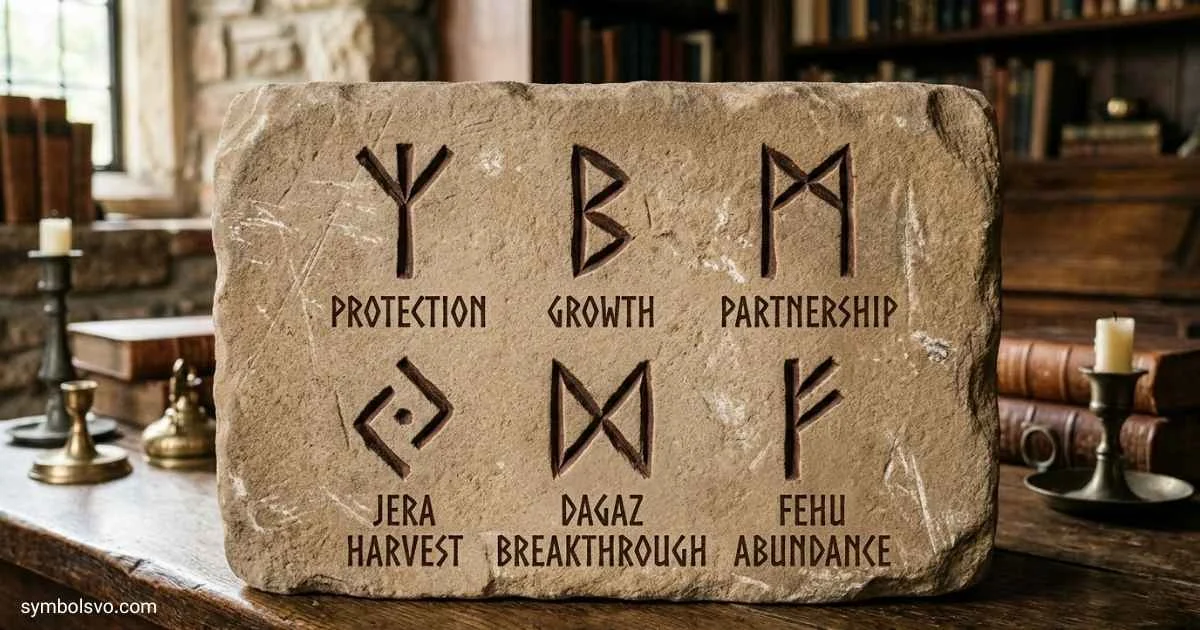
Rune symbols have fascinated people for centuries, carrying connections to ancient writing, Norse history, and Germanic cultures. I find these mysterious characters especially interesting because each rune has its own history, shape, and linguistic significance.
But what do rune symbols actually mean, and why have they remained so fascinating throughout history? If you want to explore ancient runes, understand their meanings, and discover the stories behind these remarkable symbols, you’re in the right place.
In this guide, I’ll help you explore the most recognized rune symbols, their historical origins, and their traditional associations. You’ll also learn about the Elder Futhark alphabet, how runes were used in the past, and the difference between historical evidence and modern interpretations.
Rune Symbols and Meanings
Runes are characters from historical writing systems used by Germanic peoples. The word rune is associated with a Germanic word for a secret or mystery, which has helped shape their modern spiritual image. Historically, however, runes were primarily letters used to write languages.
The Elder Futhark is one of the best-known rune systems. It contains 24 characters and was used during the early centuries of the Common Era. Later systems, including the Younger Futhark, developed different forms and numbers of characters.
Here are some familiar Elder Futhark runes and their common modern associations.
| Rune | Name | Letter or sound | Common modern association |
| ᚠ | Fehu | F | Wealth, resources, prosperity |
| ᚢ | Uruz | U | Strength, vitality, endurance |
| ᚦ | Thurisaz | Th | Challenges, defense, caution |
| ᚨ | Ansuz | A | Communication, wisdom, inspiration |
| ᚱ | Raidho | R | Travel, movement, a journey |
| ᚲ | Kenaz | K | Knowledge, creativity, illumination |
| ᚷ | Gebo | G | Gifts, exchange, partnership |
| ᚹ | Wunjo | W | Joy, harmony, satisfaction |
| ᚾ | Naudiz | N | Need, patience, resilience |
| ᛁ | Isa | I | Stillness, focus, restraint |
| ᛃ | Jera | J or Y | Harvest, cycles, results over time |
| ᛉ | Algiz | Z or a related sound | Protection in many modern interpretations |
| ᛊ | Sowilo | S | Sun, energy, success |
| ᛏ | Tiwaz | T | Justice, courage, duty |
| ᛒ | Berkano | B | Growth, renewal, nurturing |
| ᛗ | Mannaz | M | Humanity, identity, community |
| ᛚ | Laguz | L | Water, intuition, flow |
| ᛞ | Dagaz | D | Daylight, change, awakening |
| ᛟ | Othala | O | Inheritance, ancestry, heritage |
These associations are common in modern rune guides, divination, and spiritual practices. They should not be treated as a single, universally accepted dictionary of ancient meanings. Historical runes could represent sounds, names, words, or inscriptions without carrying a separate spiritual meaning every time they appeared.
Norse Rune Symbols and Meanings

Norse rune symbols are closely connected with the languages and cultures of ancient Scandinavia. The word Norse generally refers to the historical people, language, and cultural traditions of the region.
Two rune systems are especially relevant when studying Norse history:
- Elder Futhark: A 24-character system used in earlier Germanic inscriptions.
- Younger Futhark: A 16-character system that became prominent during the Viking Age.
The Younger Futhark is particularly important for understanding Viking-Age Scandinavia. It has fewer characters than the Elder Futhark, so individual runes could represent more than one sound.
Some popular Norse rune interpretations include:
- ᚠ Fehu: Associated with movable wealth and resources.
- ᚱ Raidho: Often interpreted in modern practice as a journey or movement.
- ᚷ Gebo: Commonly associated with gifts and reciprocal relationships.
- ᛏ Tiwaz: Connected by its name with the god Týr and often associated today with courage and justice.
- ᛟ Othala: Often linked with inheritance, family heritage, and ancestral land in modern interpretations.
Norse mythology and historical runic writing overlap, but they are not the same thing. A rune’s name, its use in an inscription, and its modern spiritual interpretation are three different types of information.
If you are choosing a Norse rune for a personal design, research the relevant historical system instead of assuming every modern meaning reflects Viking-Age beliefs.
Viking Rune Symbols and Meanings
Viking rune symbols are often used in tattoos, jewelry, game designs, and Norse-inspired artwork. The most historically relevant writing system for the Viking Age is Younger Futhark, although modern designs frequently use Elder Futhark characters because its 24 runes are widely presented in contemporary rune charts.
Here are several runes and symbols associated with Viking-inspired designs.
| Symbol | Name or identification | Common association |
| ᚠ | Fehu, Elder Futhark | Wealth and resources |
| ᚱ | Raidho, Elder Futhark | Journey and movement |
| ᛏ | Tiwaz, Elder Futhark | Courage and justice |
| ᛉ | Algiz, Elder Futhark | Protection in modern interpretations |
| ᛟ | Othala, Elder Futhark | Heritage and ancestry |
| ᚦ | Thurisaz, Elder Futhark | A thorn; also interpreted in modern practice through ideas of challenge or defense |
What about the Valknut? The Valknut is a recognizable motif formed from three interlocking triangles. It appears in some archaeological contexts associated with the Norse world, but it is not a rune or a letter in the Futhark alphabets. Its precise historical meaning remains uncertain.
What about Thor’s hammer? Mjölnir, Thor’s hammer, is another well-known Norse symbol. Archaeological examples include hammer-shaped pendants. It is a mythological object and symbol, not a rune.
These distinctions matter if you want historically informed Viking artwork. Combining runes with Mjölnir or other Norse motifs can create a striking design, but each element has its own history.
Nordic Rune Symbols and Meanings
The word Nordic refers broadly to the Nordic region and its cultures. In popular searches, Nordic rune symbols often mean runes associated with Scandinavia, Norse heritage, and Viking-inspired aesthetics.
The following characters belong to the Elder Futhark, a historical Germanic runic alphabet. They are often included in modern Nordic-themed designs.
- ᚠ Fehu: Wealth and resources in modern interpretations.
- ᚢ Uruz: Strength and vitality.
- ᚨ Ansuz: Communication and wisdom.
- ᚷ Gebo: Gifts and mutual exchange.
- ᛊ Sowilo: The sun and energy.
- ᛒ Berkano: Growth and renewal.
- ᛚ Laguz: Water and flow.
- ᛞ Dagaz: Daylight and transformation.
For a more historically accurate Nordic design, identify the period and region you want to represent. Scandinavian inscriptions from the Viking Age generally used Younger Futhark, while many modern reference charts display Elder Futhark.
You may also see several runes arranged in a row or combined into a single design. A row of runes can represent a written word or inscription. A combined design is sometimes called a bind rune, although the purpose and historical context of individual examples vary.
Celtic Rune Symbols
Celtic rune symbols are popular in searches for ancient spiritual designs, tattoos, and Celtic-inspired artwork. However, there is an important historical distinction: runes belong to Germanic writing traditions, while Celtic languages historically used other writing systems.
One important Celtic writing system is Ogham. It is often shown as a series of lines or strokes arranged along a central stem. Ogham is not a runic alphabet, even though people sometimes confuse the two because both are associated with ancient European cultures.
For example:
- Ogham: An early medieval writing system used mainly for inscriptions in Ireland and parts of Britain.
- Elder Futhark: An early Germanic runic alphabet containing 24 characters.
- Celtic knotwork: Decorative interlacing patterns associated with various Celtic artistic traditions; these are not letters or runes.
If you want a design that combines Celtic and Norse influences, you can bring together knotwork, Ogham-inspired elements, and historically identifiable runes as a modern artistic choice. Just avoid describing every ancient-looking symbol as a Celtic rune.
For a meaningful personal tattoo, it is worth checking whether you want a Celtic-language inscription, a Norse rune, or a decorative design inspired by both traditions.
Icelandic Rune Symbols and Meanings
Icelandic rune symbols can refer to more than one tradition. Historical runes were used in Iceland, while Icelandic magical manuscripts also preserved distinctive symbols known as galdrastafir, often translated as magical staves.
These two categories should not be confused.
Historical runes: Iceland used runic writing in historical periods, including forms related to the Younger Futhark tradition. Later Icelandic inscriptions and manuscripts reflect changing writing practices.
Icelandic magical staves: These are symbols found in Icelandic magical traditions, especially in manuscripts from later centuries. Their forms and purposes vary.
Two frequently discussed Icelandic symbols are:
- Vegvísir: A symbol associated in modern popular culture with guidance and finding one’s way. It is documented in a 19th-century Icelandic manuscript, so it should not automatically be described as a verified Viking-Age symbol.
- Ægishjálmur: Commonly called the Helm of Awe in modern discussions. It appears in Icelandic magical traditions and is often associated today with protection or strength.
Neither Vegvísir nor Ægishjálmur is a letter in the Elder Futhark or Younger Futhark alphabets.
Their modern meanings may be personally meaningful, but claims about their ancient origins should be checked carefully. If you want an Icelandic-inspired symbol for jewelry or a tattoo, decide whether you prefer historical runic writing or a magical-stave design.
Ancient Rune Symbols
Ancient rune symbols were used to write languages before the widespread adoption of the Latin alphabet in many Germanic-speaking regions. They appear on objects such as stones, metal items, combs, tools, and jewelry.
Some inscriptions record names, ownership, memorial messages, or other short texts. Others remain difficult to interpret because they are damaged, incomplete, or use unfamiliar language.
The three major runic systems often discussed are:
- Elder Futhark: The earliest widely recognized runic alphabet, with 24 characters.
- Younger Futhark: A 16-character system used in Scandinavia during the Viking Age.
- Anglo-Saxon Futhorc: An expanded runic system used in early medieval England and associated with Old English.
The names Futhark and Futhorc come from the sounds of the first characters in their respective alphabets.
Runes are sometimes described as ancient magical symbols because some historical and later traditions connected them with ritual or divination. However, the surviving evidence does not support the claim that every rune was always a magical sign.
Their first and most basic function was as writing. Modern rune readings and symbolic meanings should be understood as interpretations shaped by historical research, later traditions, and contemporary spiritual practice.
Rune Symbols and Meanings Chart
This chart provides a quick reference to all 24 Elder Futhark characters. The character names and approximate sound values are more firmly grounded in the historical writing system than the spiritual meanings often assigned to them today.
| Rune | Name | Approximate sound value | Common modern association |
| ᚠ | Fehu | F | Wealth |
| ᚢ | Uruz | U | Strength |
| ᚦ | Thurisaz | Th | Challenge or defense |
| ᚨ | Ansuz | A | Communication |
| ᚱ | Raidho | R | Journey |
| ᚲ | Kenaz | K | Knowledge or creativity |
| ᚷ | Gebo | G | Gifts or exchange |
| ᚹ | Wunjo | W | Joy |
| ᚺ | Hagalaz | H | Disruption or change |
| ᚾ | Naudiz | N | Need or endurance |
| ᛁ | Isa | I | Stillness |
| ᛃ | Jera | J or Y | Harvest or cycles |
| ᛇ | Eihwaz | Often reconstructed as a sound related to the yew name | Endurance or transition |
| ᛈ | Perthro | Uncertain | Mystery or chance |
| ᛉ | Algiz | Z or a related sound | Protection |
| ᛊ | Sowilo | S | Sun or energy |
| ᛏ | Tiwaz | T | Courage or justice |
| ᛒ | Berkano | B | Growth |
| ᛖ | Ehwaz | E | Movement or partnership |
| ᛗ | Mannaz | M | Humanity |
| ᛚ | Laguz | L | Water or flow |
| ᛜ | Ingwaz | Ng | Potential or fertility |
| ᛞ | Dagaz | D | Daylight or change |
| ᛟ | Othala | O | Heritage or inheritance |
The sound values are approximate because historical pronunciation and transliteration can be complex. Some rune names, especially Perthro, have uncertain or debated origins. Modern symbolic meanings are included as a reading aid, not as definitive translations of ancient inscriptions.
If you need a rune chart for academic work, prioritize a reputable historical reference. If you want one for personal reflection or creative writing, the modern associations can provide inspiration as long as you recognize their limits.
Rune Symbols Copy and Paste
If you want rune symbols for a profile, message, username, design, or digital artwork, you can copy the characters below.
Elder Futhark runes:
ᚠ ᚢ ᚦ ᚨ ᚱ ᚲ ᚷ ᚹ ᚺ ᚾ ᛁ ᛃ ᛇ ᛈ ᛉ ᛊ ᛏ ᛒ ᛖ ᛗ ᛚ ᛜ ᛞ ᛟ
Individual runes to copy:
- ᚠ — Fehu
- ᚢ — Uruz
- ᚦ — Thurisaz
- ᚨ — Ansuz
- ᚱ — Raidho
- ᚷ — Gebo
- ᛉ — Algiz
- ᛏ — Tiwaz
- ᛒ — Berkano
- ᛟ — Othala
Copy-and-paste examples:
- ᚠᚢᚱᚨ — A decorative sequence of runes, not a verified word.
- ᛉ ᛉ ᛉ — A repeated-rune design often used for a protective aesthetic.
- ᚠ • ᚷ • ᚹ — Runes separated by decorative dots.
- ᛏ | ᛊ | ᛒ — A simple vertical-divider design.
These examples are decorative arrangements. They should not be treated as historically accurate words or traditional magical formulas.
Most modern devices support many Unicode rune characters, but the exact appearance depends on the operating system, font, and app. If a character appears as a blank box, try another font or application. Copying a rune also does not automatically make it a translation of a name or phrase.
Rune Symbols for Good Luck
Many modern rune guides connect particular characters with luck, prosperity, opportunity, or positive change. These associations can be useful for personal reflection, but there is no single historical list of runes that guarantees good luck.
Here are several runes commonly chosen for this purpose.
- ᚠ Fehu: Often associated with wealth, resources, and financial well-being.
- ᚹ Wunjo: Commonly linked with joy, satisfaction, and harmony.
- ᛃ Jera: Associated in modern interpretations with harvests, cycles, and rewards that follow effort.
- ᚷ Gebo: Often connected with gifts, generosity, and balanced relationships.
- ᛊ Sowilo: Commonly associated with sunlight, energy, confidence, and success.
- ᛞ Dagaz: Often interpreted as a new day, a breakthrough, or a change in perspective.
You can use these symbols in a journal, vision board, artwork, or personal reminder. For example, someone working toward a financial goal might choose Fehu as a reminder to manage resources wisely. Someone focusing on relationships might select Gebo to represent mutual care and generosity.
The value comes from the meaning you assign to the symbol and the actions it encourages. A rune cannot guarantee wealth, luck, or success.
Protection Rune Symbols
Protection rune symbols are popular in jewelry, tattoos, personal artwork, and modern spiritual practice. Several runes are commonly associated with protection, boundaries, courage, or the ability to face difficult situations.
Algiz (ᛉ) is one of the most recognizable choices in modern rune guides. It is often interpreted as a symbol of protection, alertness, or a connection with something greater. These meanings are primarily modern interpretations rather than a complete description of how the rune functioned in every historical inscription.
Thurisaz (ᚦ) is another rune sometimes chosen for defensive or protective themes. Its name is associated with a thorn or a related concept, and modern interpretations often emphasize challenge, caution, or force. It can suggest the importance of recognizing risks rather than acting without thought.
Tiwaz (ᛏ) is frequently associated with courage, duty, and justice. For some people, these ideas represent protection through integrity and standing up for others.
When choosing a protection rune, consider the quality you want the design to represent. You might choose Algiz as a personal reminder to stay aware, or Tiwaz to represent courage when facing a difficult decision.
A symbol can have cultural, spiritual, or personal importance, but it does not provide a proven physical barrier against danger. Practical safety measures remain essential.
Rune Symbols for Protection
If your main goal is to find a symbol for a tattoo, pendant, or personal design, it helps to compare the common modern interpretations rather than treating every protection symbol as identical.
| Rune | Common modern interpretation | Design idea |
| ᛉ Algiz | Protection and awareness | Use a single rune in a small pendant or minimalist design. |
| ᚦ Thurisaz | Boundaries, caution, or defense | Pair the rune with a simple border in a graphic design. |
| ᛏ Tiwaz | Courage, justice, and duty | Use it as a personal reminder of integrity. |
| ᛊ Sowilo | Energy and resilience | Incorporate it into a sun-inspired composition. |
These are modern interpretive associations, not universal ancient definitions. The same character may have different meanings in historical, linguistic, and contemporary spiritual contexts.
Before using a rune permanently, especially in a tattoo, check its shape and cultural background. Some runic characters and rune-inspired symbols have also been appropriated by extremist groups. Their meanings can therefore depend on the surrounding design and context. Research the full design instead of judging it by a single character alone.
Magic Rune Symbols
Magic rune symbols can refer to runes used in modern divination, symbolic rituals, or spiritual practices. They can also refer more broadly to historical beliefs about runes and the separate magical traditions recorded in later sources.
The Elder Futhark runes are often used in contemporary rune readings. A reader may draw a rune and reflect on its name or a modern association, such as patience, change, or communication. This is a contemporary interpretive practice, not a scientifically established method for predicting the future.
Some historical inscriptions suggest that runes could be used in ritual or protective contexts. However, it would be inaccurate to assume that all runes were magical or that every modern rune-reading method reproduces an ancient tradition.
It is also helpful to distinguish runes from Icelandic magical staves. Symbols such as Vegvísir and Ægishjálmur are associated with Icelandic magical traditions, but they are not letters in the Futhark alphabets.
If you want to use magical rune symbolism, consider the difference between history and personal belief. You can use a rune as a focus for meditation, journaling, or intention-setting without claiming that it has guaranteed supernatural effects.
For example, choosing Jera to reflect on patience can encourage you to think about steady effort and long-term results. Choosing Ansuz might prompt you to pay more attention to communication. These uses give the symbols a personal role while keeping expectations realistic.
How to Make Your Own Rune Symbols

Creating your own rune-inspired symbol can be a meaningful way to express a personal goal, value, or idea. You can design something simple for a notebook, digital profile, piece of art, or piece of jewelry.
Follow these steps to create a design.
1. Choose A Clear Intention
Start with one idea. It might be courage, learning, friendship, patience, or personal growth. A clear intention will help you choose suitable visual elements.
2. Research Relevant Runes
Look up the names, historical sounds, and background of any runes you want to use. If you prefer historical accuracy, choose a specific system, such as Elder Futhark or Younger Futhark, instead of mixing characters without understanding the difference.
3. Select One Or Two Characters
A single rune can create a clean and memorable design. If you combine multiple runes, understand that the result may not form a recognized word. Avoid presenting a newly created combination as an ancient symbol unless you have reliable evidence for that claim.
4. Sketch Several Versions
Draw the selected character on paper. Try changing the size, angle, spacing, or surrounding lines. Keep the original rune recognizable if you want to preserve its historical form.
5. Test The Design At Different Sizes
A design that looks clear on paper may become difficult to read when reduced to a small icon or pendant. Check the symbol at the size you plan to use.
6. Check The Cultural And Visual Context
Before publishing or permanently wearing the design, research its wider use. A symbol may have meanings you did not intend, particularly when combined with other runes or political and historical imagery.
7. Save A Clean Digital Version
Once you are happy with your sketch, recreate it using a drawing app or vector editor. If you want to type a standard rune character, use its Unicode version where available. If you create a custom drawing, remember that it is an original design rather than a standard Unicode character.
Your finished symbol does not need to look ancient to be meaningful. A thoughtful, clearly designed symbol can express your values while respecting the history of the writing systems that inspired it.
Frequently Asked Questions
What Is The Most Popular Rune Symbol?
Algiz (ᛉ) is one of the best-known runes in modern protection-themed designs. Fehu (ᚠ), associated with wealth in modern interpretations, and Othala (ᛟ), associated with heritage, are also widely discussed. Popularity varies by community and use.
Are Rune Symbols Viking Symbols?
Runes were used by Germanic peoples, including Scandinavians during the Viking Age. However, not every rune belongs specifically to the Viking period. Elder Futhark is earlier, while Younger Futhark is especially relevant to Viking-Age Scandinavia.
Can I Use Rune Symbols In My Username Or Bio?
Yes. You can copy and paste Unicode rune characters into many digital profiles, usernames, and messages. Their appearance depends on the platform and font, and some services may restrict certain characters in usernames.
What Is The Difference Between Runes And Icelandic Magical Staves?
Runes are characters from historical writing systems. Icelandic magical staves are separate symbols documented in Icelandic magical traditions. Vegvísir and Ægishjálmur are examples of magical staves, not Futhark letters.
Do Rune Symbols Have One Fixed Meaning?
No. A rune has a historical name and sound value within a particular writing system, but many spiritual meanings found online are modern interpretations. Context, historical evidence, and the tradition being followed all matter.
Conclusion
Rune symbols connect ancient writing systems with modern interests in Norse history, mythology, spirituality, and design. Learning about Elder Futhark, Younger Futhark, and related traditions helps you understand where the characters came from and how their uses changed over time.
You can use rune characters for copy-and-paste text, decorative artwork, jewelry, or personal reflection. Symbols such as Fehu, Algiz, and Tiwaz are often given modern associations with prosperity, protection, and courage, but these interpretations should not be confused with universal historical meanings.
The best approach is to choose symbols carefully, research their origins, and be clear about whether you are using a historical character or a modern interpretation. That way, your design can reflect your intentions while respecting the cultures and writing traditions behind it.

I’m Nathan Holloway, a passionate researcher and writer with a deep interest in symbols, signs, and their hidden meanings. I enjoy exploring how symbols have influenced different civilizations, religions, and modern communication. Through my work, I aim to make complex historical and cultural concepts easy to understand for readers of all backgrounds. Every article I write is carefully researched to provide reliable and engaging information.
Books:
- Beyond the Symbol
- The Secret Meanings of Everyday Signs
Author 2: Grace Whitmore
Description:
My name is Grace Whitmore, and I love discovering the stories behind the world’s most fascinating symbols. I spend my time researching ancient civilizations, mythology, spiritual traditions, and modern iconography to uncover the meanings people often overlook. I believe that every symbol has a history worth telling, and I enjoy sharing that knowledge in a simple and reader-friendly way.
Books:
- Echoes of Ancient Symbols
- The Symbolic World
 Mason Ellington
 Daniel Brooks