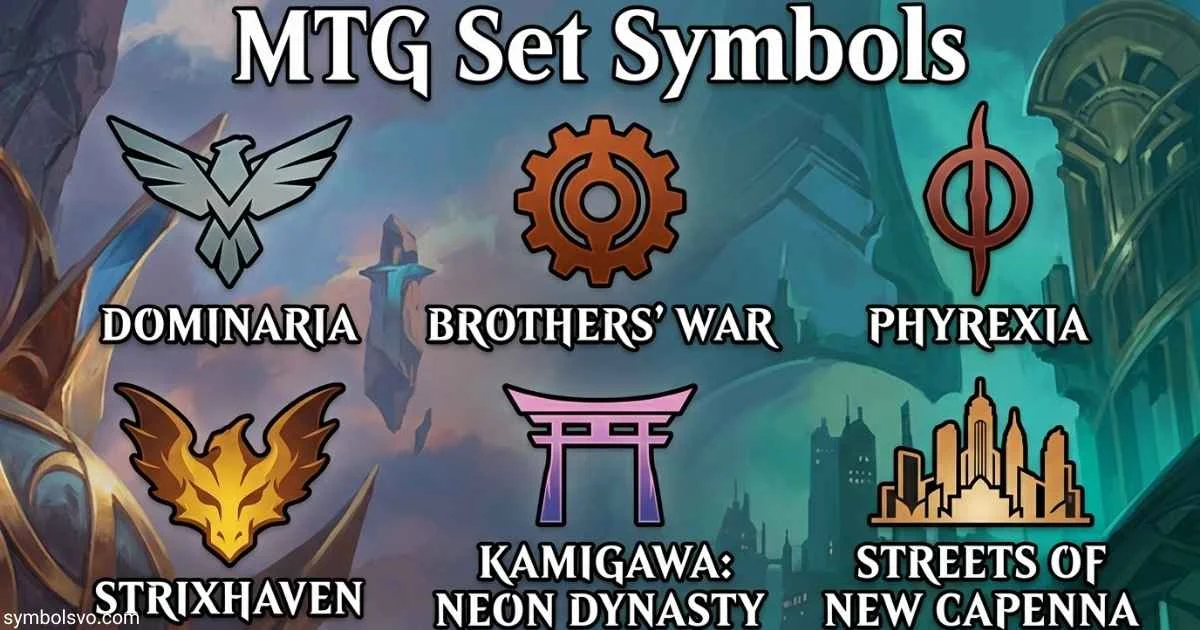
If you play Magic: The Gathering, you’ve probably noticed the small symbols printed on your cards. These little icons may look simple, but I find them fascinating because they can reveal which expansion a card belongs to and help you learn more about its history.
Want to know what those mysterious MTG set symbols actually mean? You can use them to identify card sets, distinguish editions, and better understand your collection.
In this guide, I’ll walk you through MTG set symbols, explain how to recognize them, and show you why they matter. Whether you’re a beginner or an experienced player, you’ll find it easier to identify the sets behind your favorite Magic cards.
MTG Set Symbols List
MTG set symbols are small graphics printed on Magic: The Gathering cards to show the expansion or product in which a card was released. Many symbols have a distinctive shape or theme that connects to the set’s story, setting, or visual identity.
Here are some common types of MTG releases you may encounter when building a set-symbol reference:
| Release type | What the symbol helps identify |
| Main expansion sets | Cards from a regular Magic expansion |
| Core sets | Cards from core-set releases |
| Masters sets | Special releases that reprint existing cards |
| Commander products | Cards associated with Commander-focused products |
| Draft and supplemental sets | Cards from additional play formats or special releases |
| Universes Beyond sets | Magic products featuring outside fictional worlds or franchises |
| Promotional products | Cards distributed through special events or promotions |
The exact symbol depends on the specific release. Some products have their own set code and symbol, while cards in certain products may use a related or shared release identity. For accurate identification, compare the icon with a trusted card database rather than relying on the artwork alone.
All MTG Set Symbols and Names
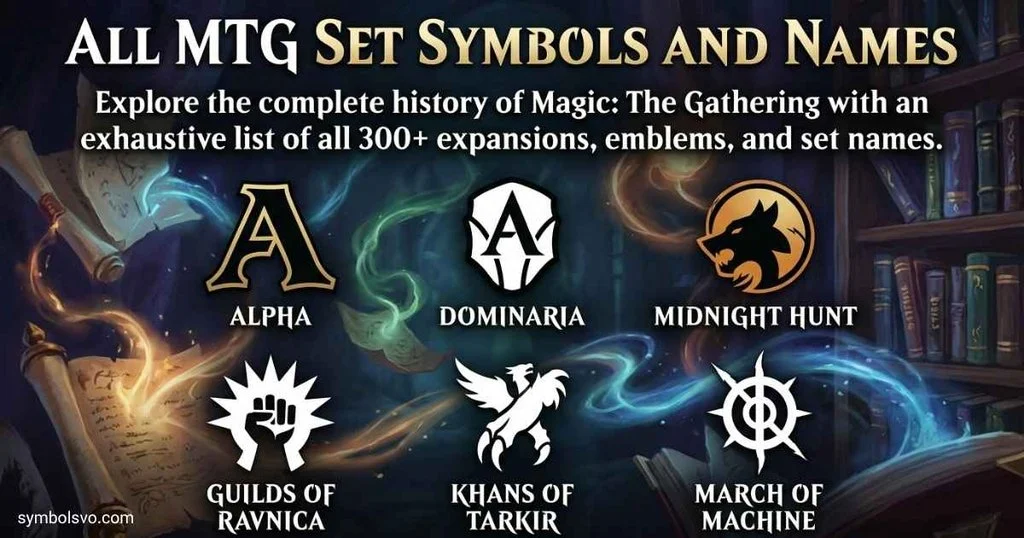
A complete reference needs both the symbol and the set name. A symbol by itself can be difficult to identify, especially when two designs use similar shapes, colors, or visual themes.
When recording set symbols, include these details whenever possible:
- Set symbol: The small icon printed on the card.
- Set name: The official name of the expansion or product.
- Set code: The short code used by card databases and collection tools.
- Release year: The year the set or product was released.
- Release type: For example, a standard expansion, supplemental set, or special crossover product.
The symbol’s color can sometimes provide a quick clue about rarity. In many modern Magic releases, the set symbol uses different colors for common, uncommon, rare, and mythic rare cards. However, older cards and special products can follow different conventions, so color alone is not a dependable way to identify a card’s set or rarity.
For a more reliable lookup, search the card’s name or collector number in a card database such as Scryfall or the official Magic card gallery. These sources can help confirm the set name and code associated with a particular printing.
MTG Set Symbols List With Pictures
Pictures make MTG set symbols easier to compare. Many icons are too small to identify comfortably on a card, and a visual reference lets collectors compare shapes side by side.
A useful picture-based list should display each symbol alongside its set name and release year. For example, the table below shows the information worth collecting for a visual reference.
| Symbol image | Set name | Year | Set code |
| Add the verified symbol image | Set’s official name | Release year | Official set code |
| Add the verified symbol image | Set’s official name | Release year | Official set code |
| Add the verified symbol image | Set’s official name | Release year | Official set code |
These rows are a template, not a verified gallery of individual symbols. For a complete picture list, use the official Magic card gallery or a card database that displays set icons with their associated releases.
When comparing images, look at the outer shape, internal design, and small distinguishing features. A symbol may look different when enlarged, compressed, or displayed against a dark background. If you are identifying a card from a photograph, check the printed set code and collector number as well.
MTG Set Symbols in Order
Players may want MTG set symbols in order to browse releases, organize binders, or identify a card’s place in Magic history. There are several ways to order a symbol list, and the best method depends on your purpose.
- Release order: Arrange sets from oldest to newest.
- Alphabetical order: Sort official set names from A to Z.
- Year order: Group releases by calendar year.
- Product order: Separate standard expansions, Commander products, Masters sets, and other releases.
- Set-code order: Sort by the short codes used in databases.
For most collectors, release order is the easiest starting point. It shows how the visual style of set symbols has changed over time and helps place a card within the broader release history.
Be careful when comparing a set’s original release date with the date of a reprint. A card may have appeared in several products, and each printing can have its own set identity. The symbol identifies the specific printing’s release, not necessarily the first set in which the card ever appeared.
All MTG Set Symbols in Order
A full chronological reference can include hundreds of sets and products, depending on whether it covers only major expansions or every supplemental, promotional, digital, and special release.
To keep the list useful, define what counts as a set before sorting the symbols. A list of major expansion sets will be shorter than a database covering every product that has received its own set code.
A practical master list can use this structure:
| Order | Set name | Set code | Release year | Symbol verified |
| 1 | Official set name | Code | Year | Yes/No |
| 2 | Official set name | Code | Year | Yes/No |
| 3 | Official set name | Code | Year | Yes/No |
Replace each sample row with a verified release record and its matching symbol image. This avoids presenting invented symbols or incorrect dates as factual information.
If you are making a personal collection checklist, you can also add a column for whether you own a card from each set. For trading, inventory management, or cataloging, keep the official set code alongside the symbol because it is easier to search and less ambiguous than an icon alone.
MTG Set Symbols Chronological Order
Chronological order places sets according to their release dates. This is helpful for understanding the history of Magic: The Gathering, following changes in card design, and identifying older printings.
The earliest Magic releases used different visual conventions from many modern sets. As the game expanded, set symbols became a familiar part of card identification. Later releases introduced a wider range of themes, supplemental products, and crossover settings, resulting in a much larger variety of icons.
A chronological list should use the release date of each specific set or product. Avoid sorting a reprint by the original debut date of a card included in it. For example, if a card first appeared in one expansion and later returned in a supplemental set, the later printing belongs at the later point in a list of releases.
For an accurate timeline, verify dates and set identities against a card database. This is especially useful for products released close together, products with different regional release dates, and sets that belong to the same broader storyline.
MTG Set Symbols by Year
Grouping symbols by year is a convenient way to browse Magic releases without scrolling through one very long list. It can also help collectors focus on the sets they played, missed, or want to complete.
A year-based directory might be organized like this:
- 1993–1999: Early Magic releases and the game’s first expansion eras.
- 2000–2009: Sets from the game’s continued expansion through the 2000s.
- 2010–2019: A broad range of modern-era expansions and supplemental products.
- 2020 onward: Recent releases, additional product types, and crossover sets.
These ranges are broad navigation groups rather than a complete year-by-year inventory. A proper list should place each set under its actual release year and distinguish major expansions from other products.
If you are creating a downloadable or printable reference, add the set code and a small symbol image beside each entry. That makes it easier to search digitally and recognize icons on physical cards.
MTG Set Symbols 2024
The 2024 section should include sets and products released during 2024, with each symbol matched to its official name and code. Do not include a set simply because its story, announcement, or preview appeared during that year; use its actual release information.
For each entry, record:
| Detail | What to include |
| Set name | The official release name |
| Symbol | A verified image of the set symbol |
| Set code | The code used in card databases |
| Release date | The set’s actual release date |
| Product category | Expansion, supplemental product, or another release type |
This structure is more reliable than a symbol-only gallery because it lets readers confirm the release even if the icon is hard to see. It also reduces confusion between a main expansion and a related product released in the same year.
To build the final 2024 list, consult a trusted card database and verify each release separately. The same year may include multiple products with different set codes and symbols.
MTG Set Symbols 2025
A 2025 set-symbol directory follows the same approach: list the products released in 2025 and match every symbol to its official set name and code.
The year is especially useful for collectors who want to organize recent cards or compare new releases with earlier sets. Still, avoid relying on memory or a cropped symbol image when a precise identification is needed. A visual resemblance is not enough to establish that two cards belong to the same set.
A useful 2025 reference should include:
- Official set and product names.
- Verified set-symbol images.
- Set codes.
- Release dates.
- Notes for special or crossover products where needed.
If the list is meant to cover every Magic product, state the scope clearly. A list containing only main expansions should not be described as every set symbol from 2025. Supplemental and promotional releases may need separate entries, depending on how the reference is defined.
MTG Set Symbols 2026
The 2026 section should be treated as a year-specific directory that may need updates as new releases arrive. A list created early in the year can become incomplete later, so include a clear “last updated” date when publishing it.
For each release, verify the official name, set code, symbol, and release date. Separate confirmed releases from announced or upcoming products, and do not label a symbol as final if only a provisional image is available.
A reliable 2026 checklist can use the following fields:
| Field | Purpose |
| Set name | Identifies the release |
| Symbol image | Helps readers recognize it visually |
| Set code | Supports precise database searches |
| Release date | Places it in the correct chronology |
| Status | Distinguishes released, announced, and upcoming products |
For the latest information, check official Magic announcements and a current card database. Because release plans can change, this section should be reviewed periodically instead of treated as a permanently complete list.
MTG Set Symbols Wiki
A wiki can be a useful starting point for browsing set names, release history, and related products. Community-maintained references may also include symbol images and information that is convenient for collectors.
However, a wiki entry should not be the only source used for a precise identification. Community pages can vary in coverage, and entries may be incomplete or updated at different times. Check important details against official product information or a maintained card database.
When using a wiki, look for these details:
- Whether the page identifies the exact product or set.
- Whether the symbol image matches the release being described.
- Whether the set code and release date are provided.
- Whether the entry distinguishes a main set from a related product.
- Whether the page cites reliable sources.
A wiki is most useful for discovery and navigation. For buying, selling, cataloging, or confirming a specific card printing, verify the result using the card’s set code and collector number.
MTG Set Symbols Printable
A printable MTG set-symbol chart can help players organize a collection, mark sets they have completed, or keep a quick-reference sheet beside their cards. A good print layout should make the icons clear without using too much ink or space.
For a useful printable sheet, include:
- A legible symbol image.
- The official set name.
- The set code.
- The release year.
- A checkbox or blank space for collection tracking, if needed.
Use a grid for the symbols and keep the labels large enough to read on paper. If you plan to print in black and white, check whether symbols remain distinguishable without their original colors. A color version can be useful for recognition, while a monochrome version may be more economical for everyday use.
Before printing, confirm that every image is high enough resolution for the chosen paper size. Tiny icons copied from compressed thumbnails may look blurry when enlarged. For personal reference, you can create a sheet from verified database images, but avoid presenting an incomplete selection as a complete list.
MTG Set Symbols List Printable
A printable list differs from a picture chart because it can prioritize names and tracking fields over large symbol images. This is useful for players who want a checklist rather than a purely visual reference.
A simple layout could look like this:
| Collectd | Set name | Year | Set code |
| ☐ | Official set name | Year | Code |
| ☐ | Official set name | Year | Code |
| ☐ | Official set name | Year | Code |
The sample rows above are placeholders, not actual set entries. Fill them using verified release records before printing or sharing the checklist.
For the most practical result, choose a page size that suits your collection. A one-page summary can cover major sets, while a multi-page checklist can include supplemental products and more detailed release information. Add a date to the document so readers know when its set list was last checked.
If you want to keep the list current, save an editable version as well as a PDF. You can then add new releases, correct errors, and regenerate the printable copy without rebuilding the entire chart.
Custom MTG Set Symbols
Custom MTG set symbols are original icons made for personal projects, fan sets, playtest cards, or custom-designed Magic-inspired cards. They can help give a project a consistent visual identity, much like an expansion symbol does for an official release.
A strong custom symbol is easy to recognize at small sizes. Simple silhouettes, balanced shapes, and clear negative space generally work better than intricate artwork with many tiny details.
When designing one, consider these practical points:
- Keep it simple: Avoid details that disappear when the symbol is reduced.
- Test several sizes: Preview it at the approximate size where it will appear on a card.
- Check contrast: Make sure the design remains visible against the card background.
- Use a consistent style: Match the symbol’s visual weight to the rest of your custom design.
- Label unofficial material clearly: Do not present a fan-made symbol as an official Wizards of the Coast release.
Custom symbols are useful for playtesting and creative projects, but they do not create an official Magic set identity. If you share custom cards publicly, explain that the symbols and cards are fan-made where that distinction could matter.
Avatar MTG Set Symbols
The Avatar: The Last Airbender crossover brought the world of the animated series into Magic: The Gathering. When looking for Avatar-related set symbols, confirm the exact product and card printing rather than assuming every Avatar-themed item shares one symbol.
A reliable reference should show the symbol beside the official product name and set code. That is particularly helpful when searching for cards featuring characters, nations, creatures, or other recognizable parts of the Avatar universe.
When organizing Avatar cards, consider keeping separate entries for different printings or related products. A card can appear in more than one release, and its symbol may vary depending on which printing you own.
For identification, check the symbol against a current card database and compare the card’s collector number. Artwork alone may suggest the franchise, but it does not always tell you the exact set.
TMNT MTG Set Symbols
The Teenage Mutant Ninja Turtles (TMNT) theme is another crossover topic that collectors may search for when browsing Magic set symbols. The most reliable way to identify a TMNT-related printing is to match its symbol with the official release name and set code.
If you are creating a TMNT-specific checklist, include the symbol image, card name, collector number, and printing information. This helps distinguish cards from different product types and avoids mixing official releases with custom fan-made cards.
The franchise’s recognizable characters and visual style may make the theme easy to spot, but they are not a substitute for checking the printing. A card’s set symbol is most useful when it is paired with the set code and other identifying details.
For an up-to-date reference, use the official Magic card gallery or a card database that supports filtering by set and franchise. Confirm the product’s release details before adding an entry to a dated symbol list.
Marvel MTG Set Symbols
Marvel-related Magic searches focus on crossover releases and the symbols associated with their cards. When cataloging these cards, verify the specific product name and code rather than assuming that every Marvel-related card uses the same set symbol.
A useful Marvel symbol reference should include a visual icon, official product name, set code, and release information. If the reference covers multiple products or releases, list them separately so readers can identify the exact printing they own.
For collectors, this detail can matter when comparing versions of the same card. Similar artwork or a shared character does not guarantee that two cards come from the same release.
Use a current, reliable card database to confirm the symbol and product identity. If a release is announced but has not yet appeared in the card database, label its details as announced or provisional instead of treating them as a verified released printing.
MTG Set Symbols Sword**
The phrase “MTG set symbols sword” may refer to a set symbol that resembles a sword, a weapon-themed icon, or a search for sword-related Magic cards. Since many set symbols are stylized and small, a sword-like shape can be difficult to identify from appearance alone.
To find the correct symbol, start with the card or product where you saw it. Check the set code, collector number, and official set name, then compare the icon with a verified database image. If you only have a cropped picture, compare its outline and internal details with several possible symbols before making a match.
Also distinguish between a set symbol and a card illustration. A sword shown in the artwork is not necessarily part of the set symbol. The set symbol is the small icon printed near the type line, and it identifies the release rather than the weapon or item depicted in the card’s art.
If you are creating a sword-themed custom symbol, use a clear silhouette that remains recognizable at small sizes and label it as custom rather than official.
FAQ
What Does An MTG Set Symbol Tell You?
An MTG set symbol identifies the set or product associated with a particular card printing. For accurate identification, check the symbol alongside the set code and collector number.
Where Can I Find A Complete MTG Set Symbols List?
Use the official Magic card gallery or a card database such as Scryfall to browse set names, symbols, and release information. The scope of a complete list depends on whether it includes only expansions or every supplemental product.
Do MTG Set Symbols Show Card Rarity?
On many cards, the set symbol’s color indicates rarity. However, conventions can vary by release and card treatment, so check the card’s rarity information rather than relying on color alone.
Can I Download Or Print An MTG Set Symbols Chart?
Yes. You can create a printable chart using verified symbol images, official set names, release years, and set codes. Check image quality and make sure the list clearly states which releases it covers.
Are Custom MTG Set Symbols Official?
No. Custom symbols made for fan projects, playtesting, or personal designs are unofficial unless they are part of an authorized release. Label custom cards clearly to avoid confusion with official Magic products.
Conclusion
MTG set symbols are useful visual clues for identifying card sets, sorting collections, and exploring Magic: The Gathering’s release history. Pairing each icon with its official set name and code makes a reference much easier to use.
A well-organized list can group symbols alphabetically, chronologically, or by release year. Picture charts and printable checklists can also help collectors track their cards and recognize unfamiliar symbols.
For the most reliable results, verify each entry against a current card database or official source. Keep newer releases updated, distinguish official symbols from custom designs, and check the exact printing before making a final identification.

Mason Ellington is a creative and dedicated Content Writer and Symbols Expert with a passion for words, communication, and symbolic meanings. He specializes in crafting engaging, informative, and well-structured content while exploring the deeper meanings and interpretations behind symbols. With a creative mindset and attention to detail, Mason transforms ideas into meaningful content that informs, inspires, and connects with readers. His expertise combines powerful storytelling, clear communication, and a deep understanding of symbolism.
 Nathan Holloway
 Daniel Brooks