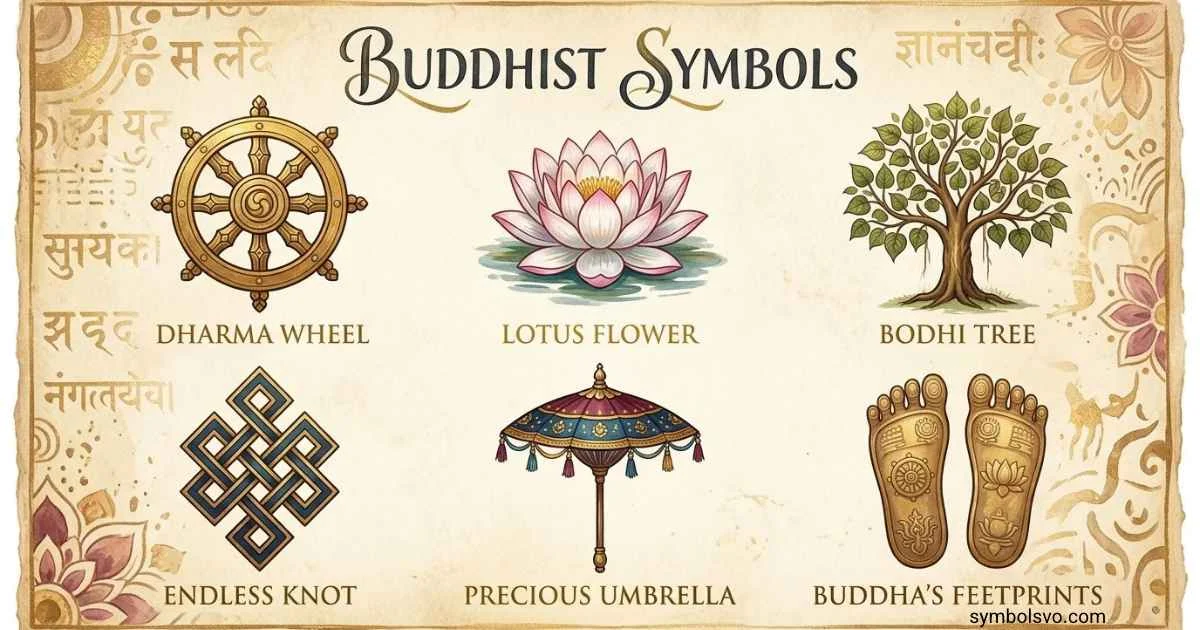
Buddhist symbols offer a visual way to understand some of the most important teachings of Buddhism. From the eight-spoked Dharma wheel to the graceful lotus flower, each symbol carries ideas about wisdom, compassion, freedom, and the journey toward enlightenment. These images appear in temples, monasteries, sacred paintings, meditation spaces, and Buddhist ceremonies around the world.
However, Buddhist symbols aren’t simply decorative designs. Many connect directly to the life of Siddhartha Gautama, the historical Buddha, or to teachings about suffering, karma, mindfulness, and liberation. Their meanings can also change depending on the Buddhist tradition, cultural setting, and way people use them.
The eight auspicious symbols, especially prominent in Tibetan Buddhism, form one of the best-known groups of Buddhist imagery. Other important symbols include the Bodhi Tree, Buddha footprints, the Three Jewels, the vajra, and the Wheel of Life.Whether you’re researching Buddhist philosophy, studying religious art, or learning about Buddhist symbols and meanings, understanding their history helps reveal the ideas behind these familiar images.
What Are Buddhist Symbols?
Buddhist symbols are visual signs, objects, gestures, and artistic representations that communicate Buddhist teachings and religious ideas. They help people understand concepts that can otherwise seem abstract, such as enlightenment, impermanence, compassion, and the causes of suffering.
Some symbols refer to events in the Buddha’s life. The Bodhi Tree, for example, recalls his awakening, while Buddha footprints represent his presence and spiritual path. Other symbols express broader teachings. The Dharma wheel represents the Buddha’s teaching, and the endless knot is commonly associated with interdependence.
Buddhist symbols appear in many forms, including:
- Sacred Buddhist icons: Buddha statues, bodhisattva images, and traditional emblems.
- Buddhist religious symbols: Dharma wheels, lotus flowers, stupas, and ritual objects.
- Buddhist meditation symbols: Images used as focal points for contemplation or visualization in certain practices.
- Buddhist cultural symbols: Designs found in temples, paintings, textiles, architecture, and ceremonial objects.
- Buddhist spiritual symbols: Images associated with wisdom, compassion, awakening, and liberation.
Buddhist symbolism developed over many centuries. Early Buddhist art sometimes represented the Buddha through footprints, a throne, a Bodhi Tree, or a Dharma wheel rather than depicting him in human form. Later Buddhist traditions developed rich visual languages featuring Buddhas, bodhisattvas, mandalas, and elaborate sacred imagery.
One important distinction is that not every Buddhist symbol has exactly the same meaning everywhere. Theravada, Mahayana, and Vajrayana traditions share many images, but they may interpret or use them differently.
What Are the Eight Auspicious Symbols in Buddhism?
The eight auspicious symbols are known in Sanskrit as the Ashtamangala. They form an important group of sacred images in Tibetan Buddhism and appear in many Himalayan Buddhist paintings, temples, ritual objects, and decorative arts.
These symbols express favorable qualities associated with Buddhist teachings and spiritual development. Depending on the tradition and context, they may represent wisdom, protection, freedom, abundance, purity, or the triumph of awakening over ignorance.
The traditional group includes:
| Buddhist symbol | Common meaning |
| Dharma Wheel | The Buddha’s teachings and the path to awakening |
| Conch Shell | The proclamation and spread of the Dharma |
| Golden Fish | Freedom and fearlessness |
| Lotus Flower | Purity and enlightenment |
| Parasol | Protection from suffering and harmful influences |
| Treasure Vase | Abundance and auspicious qualities |
| Victory Banner | Triumph over ignorance and obstacles |
| Endless Knot | Interdependence and interconnectedness |
These meanings provide a useful starting point, but each symbol has a richer history. Understanding its traditional context makes the symbolism more meaningful.
Dharma Wheel (Dharmachakra): The Symbol of Buddhist Teachings

The Dharma Wheel, or Dharmachakra, is one of the most recognizable Buddhist sacred symbols. Its circular shape represents the Buddha’s teachings, often called the Dharma, and the path that leads toward awakening.
The wheel is closely associated with the Buddha’s first sermon at Deer Park in Sarnath, near modern-day Varanasi in India. According to Buddhist tradition, he taught a group of five companions about the Four Noble Truths and the path to the end of suffering. This event is commonly described as the turning of the wheel of Dharma.
What do the eight spokes mean?
The eight spokes commonly represent the Noble Eightfold Path, a central teaching that guides ethical conduct, mental development, and wisdom.
| Path factor | Meaning |
| Right View | Understanding experience in light of Buddhist teachings |
| Right Intention | Developing intentions rooted in renunciation, goodwill, and harmlessness |
| Right Speech | Speaking truthfully and avoiding harmful speech |
| Right Action | Acting ethically and avoiding harm |
| Right Livelihood | Earning a living without causing harm |
| Right Effort | Cultivating helpful mental qualities and reducing harmful ones |
| Right Mindfulness | Developing clear awareness of body, feelings, mind, and experience |
| Right Concentration | Developing stable attention and meditative focus |
The Noble Eightfold Path isn’t simply a checklist to complete in order. Its elements support one another and work together as a practical approach to understanding and overcoming suffering.
The Dharma wheel appears in Buddhist temples, sculptures, flags, and paintings. In many settings, it reminds practitioners that Buddhist teachings are meant to guide how people think, speak, and act.
Key takeaway: The Dharma wheel represents the Buddha’s teachings in motion and the practical path toward liberation.
Conch Shell (Shankha): The Sound of the Dharma
The conch shell, known as Shankha in Sanskrit, represents the far-reaching sound of the Dharma. Its traditional meaning reflects the idea that the Buddha’s teachings can reach people across different places and circumstances.
The white, right-turning conch is a familiar form of this symbol in Tibetan Buddhist art. Its shape and sound give it a distinctive place among the eight auspicious symbols.
What does the Buddhist conch shell symbolize?
The conch is commonly associated with:
- The spread of Buddhist teachings: Its powerful sound represents the proclamation of the Dharma.
- Awakening from ignorance: The sound can symbolize a call to recognize reality more clearly.
- Clarity and purity: The white conch often conveys auspiciousness and the clarity of the teachings.
- Religious ceremonies: Conch shells may be used as ritual instruments in certain Buddhist traditions.
The conch’s meaning is more specific than a general promise of good fortune. Its central association is with the communication and influence of the Dharma.
In Buddhist paintings and temple decorations, the conch may appear beside the Dharma wheel, lotus, and other auspicious emblems. Together, these symbols express different qualities of the Buddhist path.
Golden Fish: Freedom and Fearlessness
The pair of golden fish represents freedom, fearlessness, and auspiciousness. In Tibetan Buddhist symbolism, the fish move freely through water, making them a fitting image for release from the constraints of suffering.
Water can also suggest the vast ocean of samsara, the continuing cycle of birth, death, and rebirth described in Buddhist teachings. The fish’s effortless movement through this environment provides a visual contrast to the difficulties beings experience while caught in that cycle.
What do the golden fish mean in Buddhism?
The paired fish are commonly associated with:
- Freedom: The ability to move without the restrictions that hold a person back.
- Fearlessness: Confidence in moving through life’s difficulties.
- Liberation: The possibility of becoming free from suffering and the causes that sustain it.
- Auspiciousness: Favorable qualities associated with well-being and spiritual progress.
These interpretations are especially familiar in Tibetan Buddhist art, where the two fish are often shown facing or following one another in a symmetrical arrangement.
The symbol shouldn’t be confused with a universal Buddhist rule about fish or wealth. Its significance comes from the meanings developed within Buddhist visual traditions.
Key takeaway: The golden fish illustrate freedom and fearlessness, particularly when understood alongside Buddhist teachings about suffering and liberation.
Lotus Flower (Padma): Purity and Enlightenment
The lotus flower, called Padma in Sanskrit, is among the most familiar Buddhist spiritual symbols. It represents purity, spiritual development, and awakening. Its meaning comes partly from the way a lotus grows in muddy water yet rises above the surface to bloom.
This natural process provides a powerful image for Buddhist teachings. People experience difficulties, desires, and uncertainty, yet they can cultivate wisdom and compassion through practice. The lotus reminds practitioners that challenging conditions don’t necessarily prevent spiritual growth.
Why is the lotus important in Buddhist art?
Buddhist sculptures and paintings frequently show Buddhas and bodhisattvas seated or standing on lotus blossoms. The lotus pedestal helps communicate their awakened qualities and distinguishes sacred figures from ordinary surroundings.
Different lotus colors may carry particular meanings in specific Buddhist artistic traditions. However, interpretations aren’t completely uniform.
- White lotus: Often associated with purity and spiritual clarity.
- Pink lotus: Commonly associated with the historical Buddha and Buddhist awakening.
- Blue lotus: Often linked with wisdom and knowledge in Buddhist imagery.
- Red lotus: Frequently associated with compassion and loving qualities.
These associations are useful guides rather than universal rules. The figure, artwork, and religious tradition all influence interpretation.
The lotus also connects with Buddha-nature, a concept especially important in Mahayana Buddhism. In traditions that teach Buddha-nature, beings possess the potential for awakening, even when confusion and harmful habits obscure it.
The lotus doesn’t suggest that suffering is necessary for enlightenment. Instead, it offers a visual reminder that spiritual development remains possible amid life’s difficulties.
Parasol (Chattra): Protection From Suffering
The Buddhist parasol, or Chattra, represents protection, dignity, and freedom from harmful influences. Historically, parasols served as signs of status and authority in several Asian societies. Buddhist traditions adapted this familiar object to express spiritual ideas.
Just as an ordinary parasol provides shade, the sacred parasol symbolizes protection from suffering and the mental afflictions that obstruct awakening.
What does the Buddhist parasol mean?
In Tibetan Buddhist symbolism, the parasol is commonly associated with:
- Protection: Freedom from harmful conditions and obstacles.
- Wisdom: Understanding that helps people recognize and overcome ignorance.
- Compassion: A concern for the well-being of living beings.
- Spiritual discipline: Cultivating habits that reduce harmful thoughts and actions.
The parasol often appears as an elaborate canopy in Tibetan paintings and ceremonial decorations. Its decorative layers can make it visually impressive, but its significance extends beyond appearance.
The symbol shouldn’t be interpreted as a guarantee that displaying a parasol image will prevent illness or misfortune. Its traditional meaning is better understood through Buddhist teachings about overcoming suffering and developing wholesome qualities.
Treasure Vase: Abundance and Auspiciousness
The treasure vase represents abundance, auspiciousness, and a store of valuable qualities. Known in Tibetan Buddhist contexts as bumpa, the vase is often depicted as a richly decorated vessel with a rounded body and an ornate top.
Its symbolism includes both material and spiritual associations. Traditional explanations may connect the vase with prosperity, longevity, blessings, and inexhaustible resources. Other interpretations emphasize the value of Buddhist teachings and the qualities cultivated through practice.
What does the treasure vase symbolize in Buddhism?
The treasure vase can represent:
- Abundance: A plentiful supply of valuable resources or qualities.
- Longevity: Well-being and a long life in traditional auspicious interpretations.
- Spiritual wealth: Wisdom, compassion, and the benefits associated with Buddhist practice.
- Auspiciousness: Favorable conditions and blessings within particular traditions.
In some Buddhist ceremonies, sacred vessels hold offerings or other ritual substances. However, not every vessel used in a Buddhist setting is the eight auspicious treasure vase.
The distinction matters because the same basic object can serve different purposes depending on its design and context.
Although the treasure vase sometimes appears in modern decorative products described as symbols of prosperity, Buddhism doesn’t teach that owning a particular object automatically produces wealth. Its traditional symbolism is broader than a promise of financial success.
Victory Banner (Dhvaja): Triumph Over Ignorance
The victory banner, or Dhvaja, symbolizes triumph over ignorance and the obstacles that stand in the way of awakening. Its imagery draws on the familiar use of banners to announce victory, authority, or achievement.
In Buddhist teachings, however, the most meaningful victory isn’t defeating another person. It involves overcoming destructive mental states and developing a clearer understanding of reality.
What does the victory banner represent?
The victory banner is commonly associated with:
- Victory over ignorance: Replacing confusion with understanding.
- Overcoming obstacles: Continuing the path despite difficulties.
- Freedom from destructive habits: Reducing attachment, aversion, and delusion.
- Spiritual progress: Cultivating wisdom and compassion through practice.
Buddhist stories about Mara provide another important connection. Mara represents forces that obstruct awakening, and the Buddha’s victory over Mara before enlightenment illustrates the triumph of insight over temptation and delusion.
The victory banner appears in Tibetan Buddhist temples, paintings, and ceremonial settings. Its elaborate designs may vary, but its central message remains recognizable: spiritual progress involves transforming the mind rather than conquering others.
Endless Knot (Shrivatsa): Interconnectedness and Cause and Effect
The endless knot, also called the eternal knot, is a geometric design made from interwoven lines without an obvious beginning or end. It represents interconnectedness and is widely recognized in Tibetan Buddhist art.
The knot offers a visual way to consider how different conditions influence one another. Events rarely arise from one isolated cause. Instead, they depend on relationships among circumstances, actions, intentions, and other changing factors.
How does the endless knot relate to karma?
The endless knot is often associated with karma, the Buddhist principle that intentional actions have consequences. In Buddhism, karma isn’t simply luck or an invisible system that rewards and punishes people.
Intentions and actions help shape future experiences. Their effects depend on many conditions, so karma shouldn’t be understood as a simple equation in which every event has one obvious cause.
The knot can also evoke dependent origination, a central Buddhist teaching that phenomena arise through conditions rather than existing entirely independently.
Its common interpretations include:
- Interdependence: Things exist through relationships with other things.
- Cause and effect: Actions and conditions influence later outcomes.
- Wisdom and compassion: Understanding interconnectedness can encourage thoughtful and compassionate behavior.
- Samsara and nirvana: The knot can invite reflection on complex Buddhist teachings about existence and liberation, although it isn’t a literal diagram of either concept.
The endless knot doesn’t mean that the universe follows an unchanging loop. Its value lies in reminding people to consider relationships and consequences rather than treating events as isolated occurrences.
Other Important Buddhist Symbols and Their Meanings
The eight auspicious symbols form a prominent group, but they aren’t the only important images in Buddhism. Other Buddhist sacred symbols recall the Buddha’s life, express central teachings, or serve specific roles in religious practice.
Buddha Statue: The Awakened Teacher
A Buddha statue represents the awakened teacher and serves as an important focus of devotion in many Buddhist communities. Images of Shakyamuni Buddha, the historical Buddha, commonly show him seated in meditation or teaching.
His posture and hand gestures often provide clues to an image’s meaning. For example, a statue with one hand touching the ground may depict the moment of awakening, while hands held together in the lap commonly indicate meditation.
Buddha images aren’t necessarily treated as gods in the same way across religions. In many Buddhist traditions, practitioners bow before them, make offerings, or meditate in their presence as expressions of reverence and reminders of the path to awakening.
Bodhi Tree: The Place of Awakening
The Bodhi Tree is closely associated with Siddhartha Gautama’s enlightenment at Bodh Gaya in present-day Bihar, India. According to Buddhist tradition, he attained awakening while meditating beneath a tree of the Ficus religiosa species.
The Bodhi Tree therefore represents awakening, wisdom, and the possibility of liberation from suffering. It also holds historical importance because Bodh Gaya became one of Buddhism’s major pilgrimage destinations.
The tree is more than a decorative emblem. Living Bodhi trees and their descendants have served as objects of reverence at Buddhist sites for centuries.
Buddha Footprints (Buddhapada): The Buddha’s Presence
Buddha footprints, known as Buddhapada, are carved or sculpted representations of the Buddha’s feet. They remind viewers of the Buddha’s presence, teachings, and passage through the world.
Some footprints feature a Dharma wheel on the soles, along with other auspicious markings. Their details vary by region and historical period.
Footprints have particular importance in the history of Buddhist art. Early Indian Buddhist artists sometimes represented the Buddha indirectly through footprints, empty thrones, trees, and wheels rather than through human figures. These symbols allowed viewers to recognize important events in his life.
The Metropolitan Museum of Art discusses this tradition in its guide to early Buddhist art.
Buddha Hand Gestures (Mudras): Visual Teachings
Mudras are symbolic hand gestures found in Buddhist sculpture, painting, and some forms of Buddhist practice. They help identify the activity or quality associated with a sacred figure.
Four commonly depicted mudras include:
- Dhyana Mudra: The hands rest in the lap, representing meditation and concentration.
- Bhumisparsha Mudra: One hand reaches toward the ground, recalling the Buddha’s awakening.
- Abhaya Mudra: A raised hand with the palm facing outward represents fearlessness and reassurance.
- Dharmachakra Mudra: The hands form a teaching gesture associated with the turning of the Dharma wheel.
Mudras make Buddhist art easier to interpret, but a gesture’s precise significance can depend on the figure, posture, and surrounding imagery.
Three Jewels (Triratna): The Foundation of Buddhist Refuge
The Three Jewels, or Triratna, are the Buddha, the Dharma, and the Sangha. They are central to Buddhist belief and practice.
- Buddha: The awakened teacher who shows the path.
- Dharma: The Buddha’s teachings and the truth those teachings explain.
- Sangha: The spiritual community, with the precise scope of the term varying by context.
Taking refuge in the Three Jewels expresses a commitment to the Buddhist path. In Buddhist artwork, the three-jewel emblem can represent this central relationship among teacher, teaching, and community.
Stupa: A Monument of Remembrance and Devotion
A stupa is a Buddhist monument traditionally associated with relics, remembrance, and devotion. Early stupas became important centers of pilgrimage, and many Buddhist communities continue to build and venerate them.
Practitioners may walk around a stupa in a clockwise direction as an act of reverence. Stupas also appear in Buddhist architecture across South Asia, Central Asia, the Himalayas, and East Asia, with designs that differ by region.
Stupas have a close historical connection to Buddhist symbolism. Alongside the Bodhi Tree, Dharma wheel, and footprints, they helped represent the Buddha and important aspects of his life in early Buddhist art.
Vajra (Dorje): Indestructible Wisdom
The vajra, called dorje in Tibetan, is a ritual object particularly important in Vajrayana Buddhism. Its name carries associations with a thunderbolt and a diamond, expressing power and indestructibility.
The vajra is commonly associated with the unshakable quality of awakened wisdom. In Vajrayana rituals, it is often paired with a bell, creating a combination rich in symbolic meaning.
Its shape can include a central sphere and symmetrical prongs, though forms vary. These details belong to a specific ritual and artistic tradition rather than a universal symbol system shared identically by all Buddhists.
Bell (Ghanta): Wisdom and Ritual Practice
The Buddhist ritual bell, or ghanta, is especially important in Vajrayana ceremonies. Its sound can mark ritual actions and help focus attention.
When paired with the vajra, the bell is traditionally associated with wisdom, while the vajra represents skillful means or effective compassionate activity in many Vajrayana interpretations. Together, they express complementary qualities of the Buddhist path.
Bells also have practical ceremonial roles. Their meaning depends on the ritual, the tradition, and the way practitioners use them.
Three Poisons: Ignorance, Attachment, and Aversion
The three poisons are ignorance, attachment, and aversion. Buddhist teachings identify them as major sources of suffering and as forces that keep beings caught in samsara.
In Tibetan Buddhist art, the three poisons often appear at the center of the Wheel of Life as three animals:
- Pig: Ignorance or delusion.
- Rooster: Attachment or craving.
- Snake: Aversion or hatred.
The animals’ exact arrangement can vary, but the image helps explain how harmful mental states reinforce one another. Understanding these patterns is part of the Buddhist path toward freedom from suffering.
Wheel of Life (Bhavachakra): The Cycle of Existence
The Wheel of Life, or Bhavachakra, is a detailed visual teaching tool most familiar in Tibetan Buddhist settings. It illustrates samsara, the cycle of birth, death, and rebirth, along with conditions that sustain it.
A traditional depiction often includes several layers:
- The three poisons at the center.
- Sections illustrating different realms of existence.
- A ring showing links in the process of dependent origination.
- Images around the outside representing stages in the arising of suffering.
The Wheel of Life isn’t merely a picture of rebirth. It also teaches how ignorance, craving, and other conditions contribute to suffering. Buddhist teachers may use it to explain complex ideas in a form that students can examine visually.
Buddhist Prayer Wheel: Mantra and Devotion
A Buddhist prayer wheel is a cylindrical devotional object especially associated with Tibetan Buddhism. Traditional wheels contain written prayers or mantras, often including Om Mani Padme Hum, a mantra associated with Avalokiteshvara, the bodhisattva of compassion.
Practitioners turn prayer wheels as part of devotional practice. The wheel may be handheld, mounted along a walkway, or installed in a larger structure.
The object connects written language, repeated movement, and religious intention. Its use reflects traditional Buddhist beliefs about mantra recitation and spiritual merit rather than a mechanical guarantee of a particular outcome.
The Isabella Stewart Gardner Museum’s collection describes a Tibetan-style hand prayer wheel and its connection to the six-syllable mantra.
Buddhist Prayer Flags: Prayers and Auspicious Imagery
Buddhist prayer flags are widely associated with Tibetan Buddhist culture. These colorful cloths carry printed prayers, mantras, and auspicious images, and people often hang them outdoors at mountain passes, monasteries, homes, and pilgrimage sites.
In traditional Tibetan Buddhist belief, wind moving through prayer flags carries their prayers and blessings outward. The flags may also contain imagery connected to compassion, protection, and auspiciousness.
Prayer flags are not simply colorful decorations. Their religious significance comes from their inscriptions, symbolism, and use within a living tradition.
What Do Buddhist Symbols Represent?
Although individual symbols have distinct meanings, many express related ideas within Buddhist philosophy and symbolism. Looking at these connections helps explain why the same images appear together in temples, paintings, and ceremonial objects.
| Theme | Buddhist symbols | What they communicate |
| Enlightenment | Lotus, Bodhi Tree, Dharma wheel | Awakening and the path toward wisdom |
| Wisdom | Dharma wheel, vajra | Understanding Buddhist teachings and reality |
| Compassion | Lotus, bodhisattva imagery | Concern for the well-being of living beings |
| Protection | Parasol, certain ritual emblems | Protection as understood within particular traditions |
| Interdependence | Endless knot | The relationships among causes and conditions |
| Liberation | Golden fish, Dharma wheel | Freedom from suffering and its causes |
| Devotion | Buddha statue, stupa, prayer wheel | Reverence and commitment to Buddhist practice |
| Impermanence | Wheel of Life and related imagery | The changing nature of conditioned existence |
| Ethical conduct | Dharma wheel | The importance of actions, speech, and intentions |
| Auspiciousness | Eight auspicious symbols | Favorable qualities and blessings in traditional contexts |
These categories overlap. The lotus, for instance, can represent purity, compassion, and awakening. Its interpretation depends on how an artist or practitioner uses it.
How Buddhist symbols express the path to enlightenment
Enlightenment is central to Buddhist teachings, but Buddhist traditions explain the path toward awakening in different ways. Many emphasize understanding suffering, cultivating ethical conduct, developing concentration, and gaining wisdom.
Symbols make these teachings easier to remember. The Dharma wheel points toward the path itself, while the lotus provides an image of awakening and the Bodhi Tree recalls the Buddha’s own enlightenment.
Together, these images encourage reflection on the qualities Buddhism seeks to develop rather than merely identifying religious objects.
Why Are Buddhist Symbols Important?
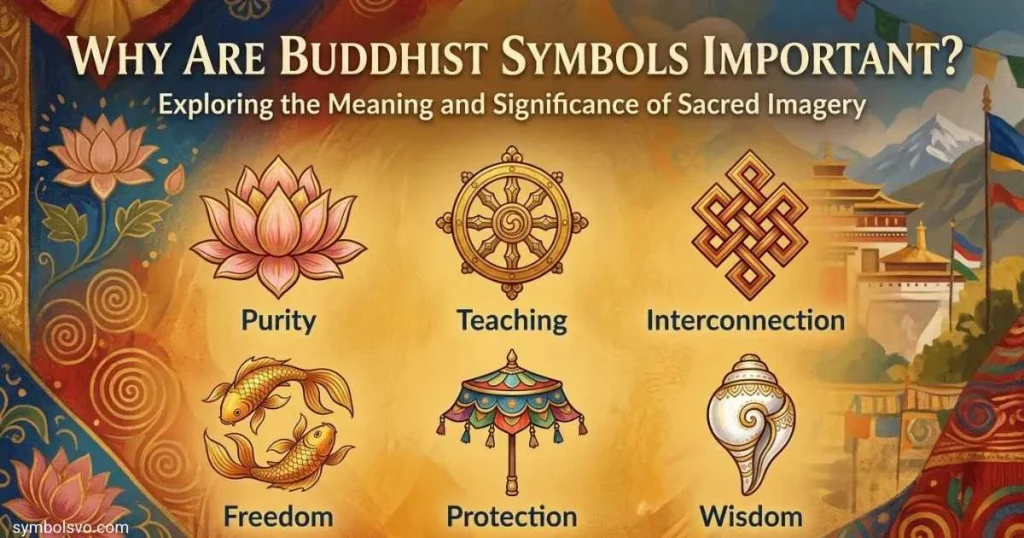
They communicate Buddhist teachings
Buddhist symbols help express ideas that are difficult to explain in a single sentence. The endless knot, for example, provides a visual starting point for thinking about interdependence. The Wheel of Life presents several connected teachings about suffering, rebirth, and the causes of continued existence.
For people who encounter Buddhist art in temples or museums, these images can offer an introduction to Buddhist philosophy without requiring extensive knowledge of religious texts.
They support devotion and contemplation
Many Buddhists use sacred images during prayer, offerings, meditation, and other devotional activities. A Buddha statue may serve as a reminder of the qualities associated with awakening. A Dharma wheel may encourage reflection on ethical conduct and the Noble Eightfold Path.
These practices vary across communities. Some focus on silent meditation, while others incorporate chanting, offerings, prostrations, or elaborate ceremonies.
They preserve cultural heritage
Buddhist art has developed across India, Sri Lanka, Nepal, Tibet, China, Japan, Korea, Southeast Asia, and many other regions. Each culture has contributed distinctive artistic styles and interpretations.
The eight auspicious symbols, for example, appear on ritual objects and shrine decorations in Tibetan Buddhist settings. The Smithsonian’s National Museum of Asian Art documents a set of eight auspicious emblems made in Tibet during the late nineteenth or early twentieth century.
These objects show how Buddhist symbolism connects religious teachings with craftsmanship, local history, and artistic traditions.
Buddhist Symbols in Different Traditions
Buddhism includes several major traditions. Although they share foundational teachings, their artwork, rituals, and symbolic systems differ.
Buddhist symbols in Tibetan Buddhism
Tibetan Buddhism is particularly well known for its rich visual traditions. The eight auspicious symbols appear in paintings, textiles, shrine decorations, and ceremonial objects.
Other familiar elements include:
- Vajras and bells used in Vajrayana rituals.
- Prayer wheels containing mantras.
- Prayer flags printed with prayers and auspicious imagery.
- Thangka paintings depicting Buddhas, bodhisattvas, mandalas, and the Wheel of Life.
These objects belong to a living religious tradition. Their significance often depends on teachings and practices passed down through Buddhist communities.
Buddhist symbols in Theravada Buddhism
Theravada Buddhism is practiced widely in countries including Sri Lanka, Thailand, Myanmar, Cambodia, and Laos.
Prominent imagery includes the Buddha, the Bodhi Tree, stupas, Dharma wheels, and Buddha footprints. Temples often contain Buddha statues and scenes from the Buddha’s life, while stupas may house or commemorate sacred relics.
Theravada communities also have distinctive regional artistic traditions. A Buddha image in Thailand may look quite different from one created in Sri Lanka, even when both express reverence for the same teacher.
Buddhist symbols in Mahayana Buddhism
Mahayana Buddhism includes diverse traditions across East Asia and other parts of the world. Its art frequently features Buddhas and bodhisattvas, including Avalokiteshvara and Manjushri.
The lotus is especially prominent in many Mahayana artworks, and sacred imagery often expresses compassion, wisdom, and the aspiration to attain awakening for the benefit of living beings.
Chinese, Japanese, Korean, and Vietnamese Buddhist art developed their own styles and symbolic conventions. As a result, Buddhist cultural symbols can look different even when they express related teachings.
How Are Buddhist Symbols Used Today?
Buddhist symbols remain part of religious life, artistic traditions, and personal reflection. Their modern uses range from traditional ceremonies to contemporary art.
In temples, monasteries, and shrines
Buddhist temples may feature Dharma wheels, lotus designs, Buddha statues, stupas, and other sacred imagery. These symbols help identify religious spaces and provide visual reminders of Buddhist teachings.
Some temples display the eight auspicious symbols together, especially in Tibetan Buddhist settings. Others emphasize particular Buddhas, bodhisattvas, or regional artistic traditions.
In meditation and contemplation
Certain practitioners use Buddhist images as focal points for contemplation or visualization. A lotus may prompt reflection on awakening, while a Buddha image can remind someone of qualities such as patience, wisdom, and compassion.
However, not every Buddhist meditation practice requires symbols or images. Some traditions emphasize attention to breathing, bodily sensations, mental states, or other aspects of experience.
In jewelry and everyday objects
The Dharma wheel, lotus, and endless knot appear on pendants, bracelets, clothing, and decorative items. Some people wear these designs because they practice Buddhism, while others appreciate their artistic or philosophical associations.
Context matters. A sacred emblem used during a ceremony may have a different role from the same design printed on a fashion accessory.
In homes and meditation spaces
People sometimes display Buddhist artwork in homes, reading areas, or meditation spaces. A small Buddha statue, lotus painting, or Dharma wheel may serve as a reminder of values they wish to cultivate.
When choosing Buddhist-inspired artwork, learn what the image represents and consider its cultural context. Sacred images aren’t interchangeable decorations, and different communities have different expectations for how religious objects should be treated.
How to Understand Buddhist Symbols Respectfully
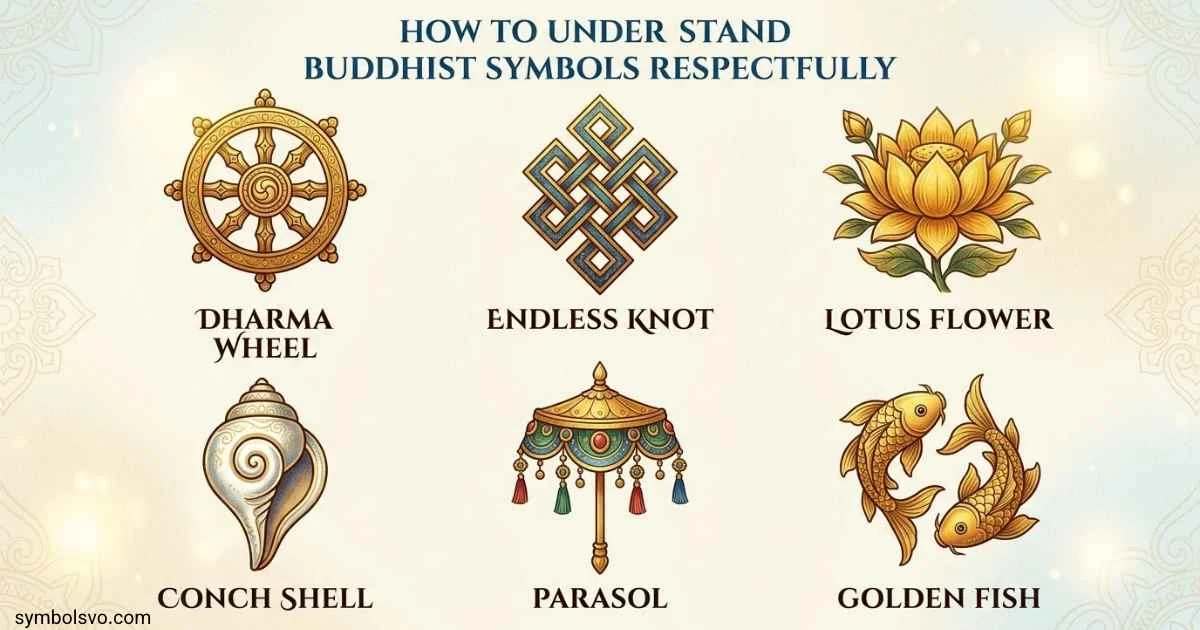
Learning about Buddhist symbolism involves more than memorizing a list of meanings. A little attention to history and tradition helps avoid common misunderstandings.
- Check the context. A lotus may have different associations depending on its color, accompanying figures, and artistic tradition.
- Distinguish tradition from modern interpretation. Claims that a symbol guarantees wealth, protection, or success may reflect commercial marketing rather than established Buddhist teachings.
- Recognize shared cultural history. Buddhism developed in societies where religious traditions influenced one another. Some symbols appear in Buddhism and Hinduism, but their meanings aren’t always identical.
- Respect sacred objects. Buddha images and ritual objects may hold deep religious significance for practitioners. Learn local customs when visiting temples or monasteries.
- Avoid treating every symbol as universal. Some symbols are especially important in particular Buddhist traditions, while others appear much more broadly.
Most importantly, Buddhist symbols make the most sense when connected to the teachings and communities that give them meaning.
Frequently Asked Questions About Buddhist Symbols
What are the eight Buddhist symbols?
The eight auspicious symbols are the Dharma wheel, conch shell, pair of golden fish, lotus flower, parasol, treasure vase, victory banner, and endless knot. They are especially prominent in Tibetan Buddhist art and represent qualities associated with the Dharma, spiritual development, auspiciousness, and awakening.
What is the most important symbol in Buddhism?
There isn’t one universally agreed-upon most important symbol across all Buddhist traditions. The Dharma wheel is among the most recognizable because it represents the Buddha’s teachings and the Noble Eightfold Path. The lotus, Bodhi Tree, Buddha images, and stupas also hold major significance.
What does the lotus flower mean in Buddhism?
The lotus commonly symbolizes purity, spiritual development, and enlightenment. Its growth from muddy water into a flower above the surface provides an image of awakening amid difficult conditions.
What does the endless knot symbolize?
The endless knot commonly represents interconnectedness and the relationship between causes and effects. It is also associated with Buddhist reflections on karma and dependent origination, particularly in Tibetan Buddhist traditions.
What does the golden fish symbolize in Buddhism?
The golden fish are commonly associated with freedom, fearlessness, and liberation. Their ability to move freely through water provides an image of release from the constraints of suffering.
Which Buddhist symbols represent wisdom and compassion?
The Dharma wheel is closely associated with the Buddha’s teachings and wisdom. Lotus imagery often connects with compassion and awakening, while bodhisattva images can express the commitment to help living beings. The precise meaning depends on the tradition and artistic context.
Are Buddhist symbols the same in every tradition?
No. Many symbols appear across multiple Buddhist traditions, but their prominence, design, and interpretation vary. Tibetan Buddhist art is especially known for the eight auspicious symbols, vajras, prayer wheels, and thangkas. Theravada traditions prominently feature Buddha images, stupas, and Bodhi Tree imagery, while Mahayana art often features a wide range of Buddhas and bodhisattvas.
How are Buddhist symbols used in meditation?
Some practitioners use Buddhist images as visual reminders or focal points for contemplation. Others practice meditation without religious imagery. The approach depends on the method, teacher, and tradition.
What is the difference between Buddhist symbols and Hindu symbols?
Buddhist and Hindu traditions share some historical and cultural imagery, including the lotus and conch shell. However, a symbol’s meaning depends on the religious context in which it appears. The Dharma wheel, for example, has a specific association with Buddhist teachings.
What does the Buddhist symbol of protection mean?
The parasol is a prominent auspicious symbol associated with protection from suffering and harmful influences. Other symbols may carry protective meanings in particular traditions. These are religious interpretations, not guarantees that an object will prevent harm.
Conclusion:
Buddhist symbols offer a window into the teachings, history, and artistic traditions of Buddhism. The eight auspicious symbols express ideas such as wisdom, purity, freedom, abundance, and spiritual progress. Other important images, including the Bodhi Tree, Buddha footprints, mudras, stupas, and Wheel of Life, connect visual art with the Buddha’s life and the path toward awakening.
Their meanings become clearer when viewed within the traditions that shaped them. A lotus isn’t simply a flower, and an endless knot isn’t merely an attractive pattern. Each can invite reflection on Buddhist teachings about suffering, wisdom, compassion, and the relationships that shape existence.
Whether you encounter these symbols in a monastery, a museum, a painting, or a meditation space, understanding their background helps you appreciate both their religious significance and their lasting influence on Asian art and culture.

I’m Nathan Holloway, a passionate researcher and writer with a deep interest in symbols, signs, and their hidden meanings. I enjoy exploring how symbols have influenced different civilizations, religions, and modern communication. Through my work, I aim to make complex historical and cultural concepts easy to understand for readers of all backgrounds. Every article I write is carefully researched to provide reliable and engaging information.
Books:
- Beyond the Symbol
- The Secret Meanings of Everyday Signs
Author 2: Grace Whitmore
Description:
My name is Grace Whitmore, and I love discovering the stories behind the world’s most fascinating symbols. I spend my time researching ancient civilizations, mythology, spiritual traditions, and modern iconography to uncover the meanings people often overlook. I believe that every symbol has a history worth telling, and I enjoy sharing that knowledge in a simple and reader-friendly way.
Books:
- Echoes of Ancient Symbols
- The Symbolic World
 Mason Ellington
 Daniel Brooks